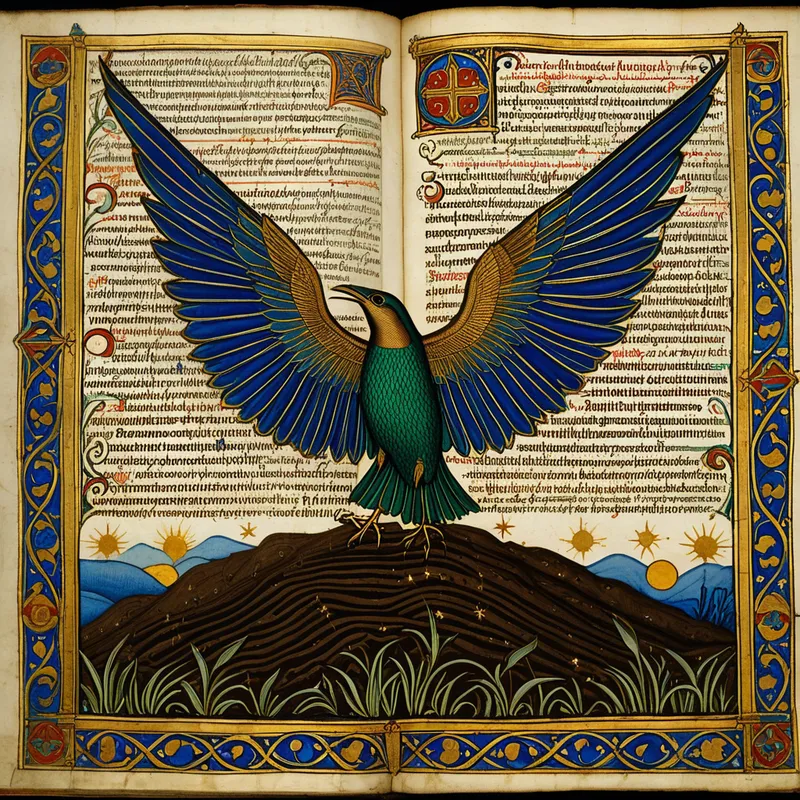
The Lark in Medieval Bestiaries Myth Meaning & Symbolism
A small bird who, in medieval lore, must touch the earth to sing, embodying the sacred marriage of heaven's aspiration with earthly humility.
The Tale of The Lark in Medieval Bestiaries
Listen, and hear the tale not of a dragon or a lion, but of a creature small and brown, whose song is woven into the very fabric of dawn. In the grey hour before light, when [the world](/myths/the-world “Myth from Tarot culture.”/) is held in a breath of dew and shadow, the Lark stirs.
It does not preen on a gilded perch or strut in courts of stone. No. It finds its place in the humble field, among [the thistle](/myths/the-thistle “Myth from Celtic/Scottish culture.”/) and the furrow, where [the earth](/myths/the-earth “Myth from Hindu culture.”/) is cold and honest. With a heart that beats a frantic rhythm against its fragile breast, it pushes upward. Its wings, seemingly too plain for such ambition, beat against the clinging air. It climbs, not in a straight and arrogant line, but in a spiraling prayer, a corkscrew of yearning turning toward the source of all light.
Higher it goes, leaving the scent of loam and the weight of the ground far below. It ascends into a realm of pure air and blinding brightness, where the blue deepens into the color of a Virgin’s mantle. And there, at the apex of its climb, where the human eye can barely discern it as more than a speck of dust dancing in a sunbeam, it opens its beak.
And it sings.
The song is not a earthly [thing](/myths/thing “Myth from Norse culture.”/). It is a cascade of liquid silver, a shower of crystalline notes that fall back to the sleeping world. It is the soul’s own melody, poured out in an offering to the rising sun. But here lies the mystery, the sacred paradox written in the creature’s very nature. This celestial song, this hymn of the heights, cannot be sustained there. The breath that fuels it, the very life that makes the music, is drawn from below.
And so, the song still on its lips, the Lark must descend. It cannot remain aloft in pure ecstasy. It must return, tracing its spiral downward, back to the dark soil from whence it came. Its feet, once again, must touch the earth. It must press its breast to the ground, to the humus, to the realm of worms and seeds and decay. Only by this grounding, this humble reunion with the dust, can it gather the strength, the breath, to ascend once more when the next grey dawn calls. Its glory is born of its return; its highest praise is rooted in its lowest bow.
Cultural Origins & Context
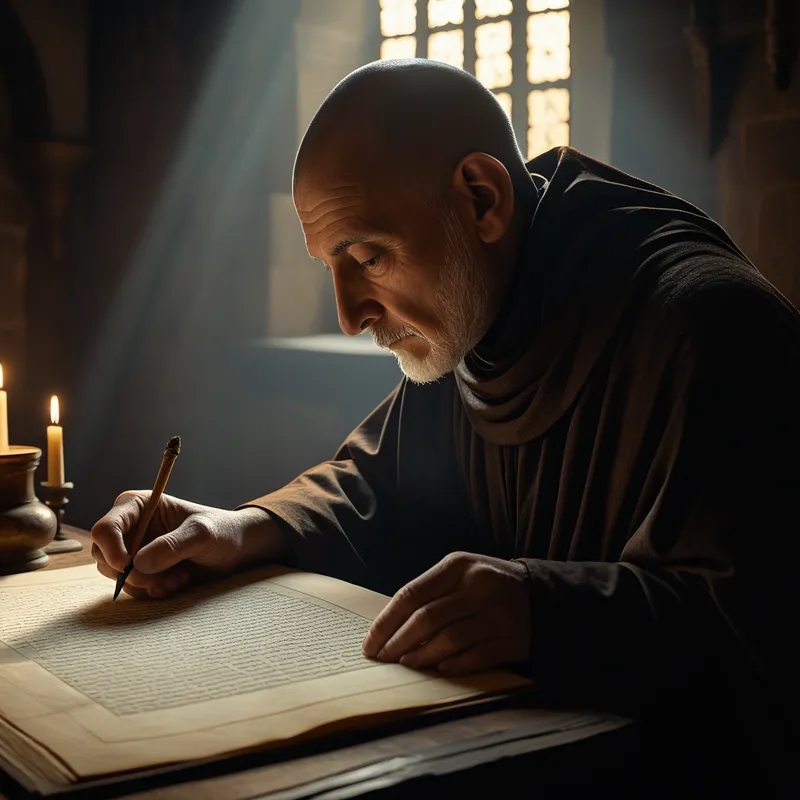
This was not a folk tale told around hearths, but a moralized exemplum inscribed by monastic hands in the margins of faith. The myth of the Lark finds its home in the Bestiaries, those illuminated encyclopedias where the natural world was decoded as a divine text. Copied in scriptoria across Europe from the 12th century onward, these books were not zoological guides but theological mirrors.
The anonymous monks who compiled and illustrated these works were not scientists, but semioticians of the sacred. Every creature, from the noble lion to the lowly ant, was a letter in God’s alphabet, a symbol holding a key to spiritual truth. The Lark’s behavior—observed by farmers and shepherds for millennia—was captured, distilled, and baptized into this symbolic system. Its story was passed down not through oral bards, but through the quiet scrape of quill on parchment, its function being to teach and to remind. It served as a meditative tool for the cloistered, a sermon illustration for the preacher, a way to see the drama of salvation and the soul’s journey reflected in the flutter of a common bird’s wing.
Symbolic Architecture
The Lark is a living [emblem](/symbols/emblem “Symbol: A symbolic design representing identity, authority, or ideals, often used in heraldry, logos, or artistic expression.”/) of the [soul](/symbols/soul “Symbol: The soul represents the essence of a person, encompassing their spirit, identity, and connection to the universe.”/)’s paradoxical [journey](/symbols/journey “Symbol: A journey in dreams typically signifies adventure, growth, or a significant life transition.”/). It embodies a sacred [tension](/symbols/tension “Symbol: A state of mental or emotional strain, often manifesting physically as tightness, pressure, or unease, signaling unresolved conflict or anticipation.”/) between two poles of existence that the medieval mind, and indeed the [human](/symbols/human “Symbol: The symbol of a human represents individuality, complexity of emotions, and social relationships.”/) [psyche](/myths/psyche “Myth from Greek culture.”/), perpetually negotiates.
The highest aspiration is nourished by the deepest humility; the soul’s flight is fueled by its return to the ground of being.
Its [ascent](/symbols/ascent “Symbol: Symbolizes upward movement, progress, spiritual elevation, or striving toward higher goals, often representing personal growth or transcendence.”/) symbolizes [prayer](/symbols/prayer “Symbol: Prayer represents communication with the divine or a higher power, often reflecting inner desires and spiritual needs.”/), contemplation, and the soul’s yearning for union with the divine—the unio mystica. [The spiral](/myths/the-spiral “Myth from Celtic culture.”/) climb represents the arduous, non-[linear](/symbols/linear “Symbol: Represents order, predictability, and a direct, step-by-step progression. It symbolizes a clear path from cause to effect.”/) [path](/symbols/path “Symbol: The ‘path’ symbolizes a journey, choices, and the direction one’s life is taking, often representing individual growth and exploration.”/) of spiritual growth. The song at the apex is the soul’s pure [expression](/symbols/expression “Symbol: Expression represents the act of conveying thoughts, emotions, and individuality, emphasizing personal communication and creativity.”/), its true work, offered freely without thought of reward.
Its descent and grounding are equally critical. They represent humility, incarnation, and the necessity of the [material](/symbols/material “Symbol: Material signifies the tangible aspects of life, often representing physical resources, desires, and the physical world’s influence on our existence.”/) world. The Lark does not disdain the [earth](/symbols/earth “Symbol: The symbol of Earth often represents grounding, stability, and the physical realm, embodying a connection to nature and the innate support it provides.”/); it depends upon it. This touches on the core [Christian](/symbols/christian “Symbol: The symbol represents the faith, teachings, and cultural values associated with Christianity, including themes of love, salvation, and morality.”/) [mystery](/symbols/mystery “Symbol: An enigmatic, unresolved element that invites curiosity and exploration, often representing the unknown or hidden aspects of existence.”/) of the Incarnation—the divine entering the muddy, finite, human [condition](/symbols/condition “Symbol: Condition reflects the state of being, often focusing on physical, emotional, or situational aspects of life.”/). Psychologically, it represents [the ego](/myths/the-ego “Myth from Jungian culture.”/)’s necessary grounding in [reality](/symbols/reality “Symbol: Reality signifies the state of existence and perception, often reflecting one’s understanding of truth and life experiences.”/), in the [body](/symbols/body “Symbol: The body in dreams often symbolizes the dreamer’s self-identity, personal health, and the relationship they have with their physical existence.”/), in the shadowy aspects of [the self](/myths/the-self “Myth from Jungian culture.”/) that we might wish to transcend. The Lark teaches that enlightenment which flees the world is a phantom; true spiritual power is that which can touch the [earth](/symbols/earth “Symbol: The symbol of Earth often represents grounding, stability, and the physical realm, embodying a connection to nature and the innate support it provides.”/) and not be corrupted by it, but rather, gain [strength](/symbols/strength “Symbol: ‘Strength’ symbolizes resilience, courage, and the ability to overcome challenges.”/) from it.
The Dreamer’s Resonance
When the myth of the Lark stirs in the modern unconscious, it often manifests in dreams of simultaneous flight and grounding. You may dream of soaring over landscapes, only to feel a compelling pull back to a specific, often humble, patch of earth. You may hear a beautiful, unearthly song but find its source is your own feet planted in soil or your hands digging in clay.
This dream pattern signals a critical phase of psychological integration. The somatic feeling is often one of tension—a straining in the chest and shoulders toward some ideal, goal, or spiritual awakening (the ascent), coupled with a heavy, rooting sensation in the legs and feet (the grounding). The psyche is wrestling with a perceived split between your aspirations—who you feel you could be, your “higher” self—and your foundations—where you come from, your body, your history, your “lower” or ignored instincts.
The dream is not advocating for abandoning your climb. It is insisting that the energy for that climb must be drawn from a full acknowledgment of your earthly reality. It asks: What part of yourself are you trying to leave behind in your ascent? What humble, “dirty,” or forgotten aspect of your being have you disowned? The Lark’s message is that this very aspect is the wellspring of your authentic song.
Alchemical Translation
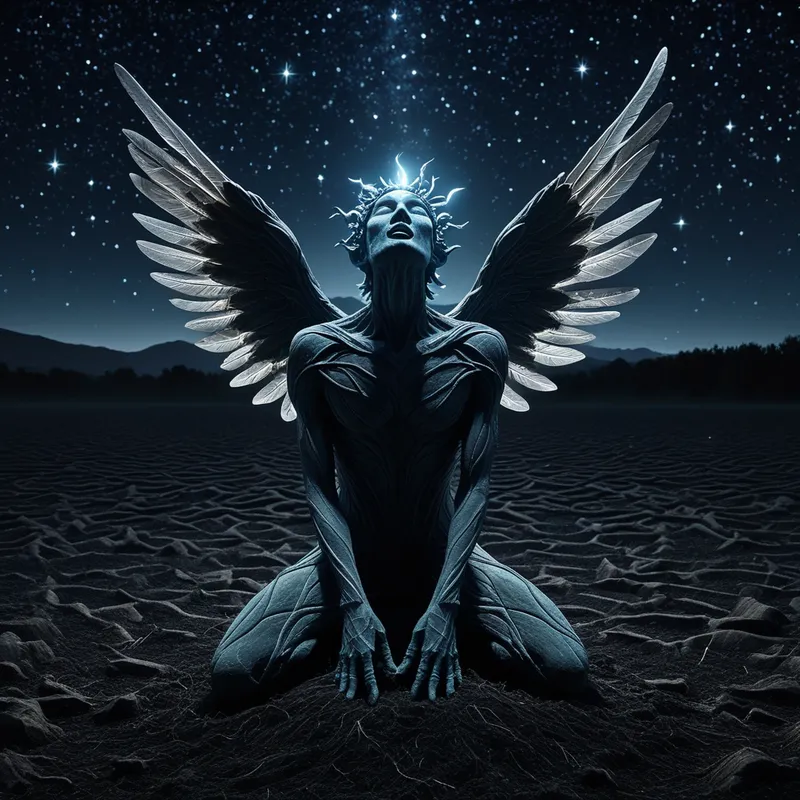
In the alchemical vessel of the psyche, the Lark’s myth models the stage of coniunctio oppositorum—[the sacred marriage](/myths/the-sacred-marriage “Myth from Various culture.”/) of opposites. The process of individuation, of becoming whole, is not an endless ascent into spiritual abstraction. It is a cyclic process of distillation and coagulation.
Individuation is the art of turning the lead of our earthly nature into the gold of consciousness, not by rejecting the lead, but by submitting it to the transformative fire of honest self-awareness.
The first phase (Ascent/Song) is the sublimatio: the rising of conscious insight, the formulation of a ideal, the clarity of a spiritual or creative vision. This is our “song,” our unique contribution, our conscious aim.
The necessary return (Descent/Grounding) is the coagulatio: the embodiment of that insight. It is the often frustrating, humbling work of bringing the brilliant idea down into the messy reality of daily life, relationships, and personal history. It is facing [the shadow](/myths/the-shadow “Myth from Jungian culture.”/) that the bright light of your aspiration casts.
The Lark’s cycle reveals that the goal is not to live perpetually in the song, but to master the rhythm of the journey itself. For the modern individual, this means recognizing that periods of intense productivity or spiritual high must be followed by periods of rest, integration, and even mundane work. Your deepest wounds, your most basic bodily needs, your familial patterns—this “earth” is not your enemy. It is the source of your substance. The alchemical work is to touch that earth consciously, to draw breath from it, and in so doing, find that your next ascent is stronger, your song more resonant, because it contains within it the full truth of both your heaven and your humus.
Associated Symbols
Explore related symbols from the CaleaDream lexicon: