The Lapis Philosophorum Myth Meaning & Symbolism
The myth of the ultimate alchemical substance, born from the union of opposites, representing the perfected self and the secret of eternal transformation.
The Tale of The Lapis Philosophorum
Listen, and I will tell you of the secret that sleeps in the heart of matter, and the dream that haunts the soul of the seeker. It is not a tale of kings and battles, but of fire and shadow, of patience that outlasts mountains.
In the beginning was the Materia Prima, a dark, heavy, and confused [thing](/myths/thing “Myth from Norse culture.”/). It was the leaden sleep of [the world](/myths/the-world “Myth from Tarot culture.”/), the unformed potential that groaned under its own weight. [The Alchemist](/myths/the-alchemist “Myth from Various culture.”/), who is not a man but a spirit of relentless inquiry, entered the Laboratorium—a place that is both a room of soot and glass and the cavern of the inner self. His first act was one of violence and grief: the [Nigredo](/myths/nigredo “Myth from Alchemical culture.”/). He took [the prima materia](/myths/the-prima-materia “Myth from Alchemical culture.”/) and subjected it to the fire. It did not glow, but blackened. It did not sing, but screamed a silent scream as it cracked and putrefied, dissolving into a uniform, starless night. This was the descent, the confrontation with [the shadow](/myths/the-shadow “Myth from Jungian culture.”/), the death that must come before life.
From that blackness, born of despair, a strange washing began. The Albedo. Like [the moon](/myths/the-moon “Myth from Tarot culture.”/) drawing tides from the dark sea, a process of distillation and purification commenced. The black mass was washed in tears and [the dew](/myths/the-dew “Myth from Alchemical culture.”/) of dawn until it whitened, becoming the Luna, cold, chaste, and reflective. This was the spirit cleansed of its grossness, but alone, sterile, and silver-cold.
Then, the fire was stoked again, but with a different intent. The white substance yearned for its counterpart. And so came the Citrinitas, a dawning of golden light within the white. This was the approach of the Sol, not yet union, but the thrilling, dangerous approach of the opposite. [The laboratory](/myths/the-laboratory “Myth from Alchemical culture.”/) trembled with the tension of their separation.
Finally, the great and terrible marriage: the [Rubedo](/myths/rubedo “Myth from Alchemical culture.”/). The white queen and the red king were brought together in the sealed vessel, the Chymical Wedding. Their union was not gentle, but a conflagration of opposites, a battle of love that shook the very foundations of the work. For a moment, it seemed all would be shattered.
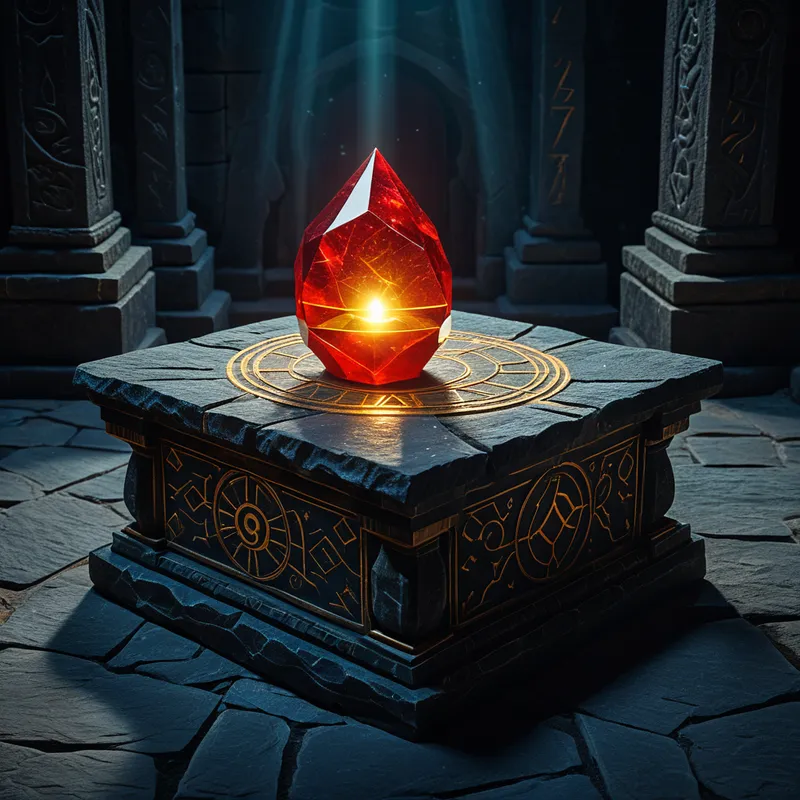
But from that consummate strife, a stillness was born. And in that stillness, it crystallized. Not a gem from [the earth](/myths/the-earth “Myth from Hindu culture.”/), but a gem from the soul of the world. The [Lapis Philosophorum](/myths/lapis-philosophorum “Myth from Alchemical culture.”/). It glowed with an inner sun, a deep, translucent red shot through with veins of living gold. It was heavy with the gravity of all that had been sacrificed and light with the spirit of all that had been redeemed. It could touch base lead and, in a whisper of radiance, turn it to gold. It held the Elixir Vitae within its structure, the secret of coagulation and dissolution, of death and life eternal. The seeker held it, and in holding it, understood that the stone was never out there, but was the final, perfected shape of the journey itself.

Cultural Origins & Context
The myth of the Lapis is the central, guiding narrative of Western alchemy, a tradition spanning from Hellenistic Egypt through the Islamic [Golden Age](/myths/golden-age “Myth from Universal culture.”/) to the Renaissance and early modern Europe. It was never a single, standardized story but a pervasive, evolving pattern encoded in cryptic texts, symbolic woodcuts, and oral teachings. It was passed down not in public forums but in handwritten manuscripts like the [Tabula Smaragdina](/myths/tabula-smaragdina “Myth from Alchemical/Hermetic culture.”/), and later in the guarded circles of adepts.
Its societal function was multifaceted. On one level, it was a proto-scientific narrative, framing the investigation of nature as a sacred, heroic quest. On another, it was a vessel for esoteric spiritual wisdom, often disguised for protection from religious orthodoxy. For the alchemist working in his laboratory, the myth provided a symbolic map for the long, frustrating, and often dangerous physical processes. It gave meaning to failure (the many “deaths” of [the Nigredo](/myths/the-nigredo “Myth from Alchemical culture.”/)) and a transcendent goal beyond mere material wealth. The myth served as a container for the profound human experiences of despair, purification, inner conflict, and the hope for ultimate integration and healing.
Symbolic Architecture
The myth is a grand [metaphor](/symbols/metaphor “Symbol: A figure of speech where one thing represents another, often revealing hidden connections and deeper truths through symbolic comparison.”/) for the process of psychological and spiritual individuation. The Materia Prima represents the unconscious, undifferentiated state of the [psyche](/myths/psyche “Myth from Greek culture.”/)—our raw, unexamined [life](/symbols/life “Symbol: The symbol of ‘Life’ represents a journey of growth, interconnectedness, and existential meaning, encompassing both the joys and challenges that define human experience.”/) with all its potential and [confusion](/symbols/confusion “Symbol: A state of mental uncertainty or disorientation, often reflecting internal conflict, lack of clarity, or overwhelming choices in waking life.”/).
The Nigredo is the necessary descent into one’s own darkness. One cannot find the gold without first confronting the lead.
The stages—Nigredo, [Albedo](/symbols/albedo “Symbol: In alchemy, the whitening stage representing purification, spiritual ascension, and the emergence of consciousness from darkness.”/), Citrinitas, Rubedo—are not chemical formulas but archetypal phases of transformation. The Nigredo is the confrontation with the [Shadow](/symbols/shadow “Symbol: The ‘shadow’ embodies the unconscious, repressed aspects of the self and often represents fears or hidden emotions.”/), where cherished illusions die. The [Albedo](/symbols/albedo “Symbol: In alchemy, the whitening stage representing purification, spiritual ascension, and the emergence of consciousness from darkness.”/) is the purification, where one distills a conscious [awareness](/symbols/awareness “Symbol: Conscious perception of self, surroundings, or internal states. Often signifies awakening, insight, or heightened sensitivity.”/) (the lunar, reflective principle) from the [chaos](/symbols/chaos “Symbol: In Arts & Music, chaos represents raw creative potential, uncontrolled expression, and the breakdown of order to forge new artistic forms.”/). [The Citrinitas](/myths/the-citrinitas “Myth from Alchemical culture.”/) is the [emergence](/symbols/emergence “Symbol: A process of coming into being, rising from obscurity, or breaking through a barrier, often representing birth, transformation, or revelation.”/) of a guiding, spiritual wisdom or sense of self (the solar principle). [The Rubedo](/myths/the-rubedo “Myth from Alchemical culture.”/) is the sacred [marriage](/symbols/marriage “Symbol: Marriage symbolizes commitment, partnership, and the merging of two identities, often reflecting one’s feelings about relationships and social obligations.”/), the Coniunctio Oppositorum, where the conscious ego and the vast unconscious are integrated.
The [Lapis](/symbols/lapis “Symbol: A deep blue stone historically revered as a celestial connection and symbol of wisdom, truth, and spiritual enlightenment.”/) itself is the [symbol](/symbols/symbol “Symbol: A symbol can represent an idea, concept, or belief, serving as a powerful tool for communication and understanding.”/) of the Self. It is the total, complete, and perfected [personality](/symbols/personality “Symbol: Personality in dreams often symbolizes the traits and characteristics of the dreamer, reflecting how they perceive themselves and how they believe they are perceived by others.”/) that results from this lifelong work. Its power to transmute lead to gold symbolizes the alchemist’s newfound [ability](/symbols/ability “Symbol: In dreams, ‘ability’ often denotes a recognition of skills or potential that one possesses, whether acknowledged or suppressed.”/) to transform base, unconscious impulses (lead) into conscious, creative, and valuable psychological [energy](/symbols/energy “Symbol: Energy symbolizes vitality, motivation, and the drive that fuels actions and ambitions.”/) (gold).
The Dreamer’s Resonance
When this myth stirs in the modern dreamer, it signals a profound process of psychic transmutation already underway. Dreaming of furnaces, melting metals, or decaying black matter points directly to the Nigredo—an active phase of breakdown, depression, or ego-dissolution where old structures of identity are being dismantled.
Dreams of washing, clear [water](/myths/water “Myth from Chinese culture.”/), white stones, or silvery moons resonate with the Albedo, a phase of cleansing, insight, and emotional purification following a crisis. A dream of a dawning golden light, a lion, or a crowned sun suggests the Citrinitas, the first confident emergence of a renewed sense of purpose or consciousness from the trials.
Most powerfully, dreams of a [sacred marriage](/myths/sacred-marriage “Myth from Alchemy culture.”/), a red and white rose intertwining, or the discovery of a precious, glowing stone or jewel signify the Rubedo and the appearance of the Lapis. These are dreams of profound resolution, where opposing forces within the dreamer (perhaps represented by warring figures, or choices between two paths) are suddenly and beautifully reconciled into a new, third, and transcendent state of being. The somatic feeling is often one of deep peace, awe, and embodied wholeness.
Alchemical Translation
For the modern individual, the laboratory is the psyche itself, and [the opus](/myths/the-opus “Myth from Alchemical culture.”/) is the work of life. We are all presented with our Materia Prima: the raw material of our inherited traits, childhood experiences, talents, and traumas. The myth models the non-linear, often painful, but ultimately sacred path of turning this leaden condition into golden consciousness.
The process begins with the voluntary or involuntary Nigredo—a midlife crisis, a devastating loss, a period of deep depression or meaninglessness. This is not pathology, but the first, crucial stage of the Work. One must “hold the tension of the opposites” in [the vessel](/myths/the-vessel “Myth from Alchemical culture.”/) of one’s awareness, enduring the fire of conflict between who one was and who one might become.
The Stone is not found; it is grown. It is the crystalline structure that slowly forms from the saturated solution of a fully lived and examined life.
The subsequent stages map onto the long work of therapy, introspection, creative expression, and relationship—the slow washing clean of projections (Albedo), the dawning of self-knowledge and direction (Citrinitas), and the integration of one’s masculine and feminine aspects, logic and intuition, strength and vulnerability (Rubedo). The [triumph](/myths/triumph “Myth from Roman culture.”/) is not wealth or immortality, but the creation of the Lapis within: a centered, resilient, and authentic Self. This “Stone” is then the touchstone for one’s existence. It is what allows us to “transmute” daily suffering into wisdom, base reactions into conscious responses, and the leaden weight of the past into the golden possibility of the present. The myth teaches that perfection is not a static state of flawlessness, but the dynamic, living wholeness that comes from having consciously united all parts of one’s being.
Associated Symbols
Explore related symbols from the CaleaDream lexicon: