The Land of Yomi Myth Meaning & Symbolism
The story of Izanami's death and Izanagi's forbidden journey to the underworld, defining the eternal separation of life and death in Shinto cosmology.
The Tale of The Land of Yomi
Listen, and hear the tale that carved the chasm between the living breath and the silent stone, between the warm sun and the cold clay. In the Age of the Gods, when the world was still soft and unformed, the divine pair, Izanagi and Izanagi, stood upon the Ame-no-ukihashi. With a jeweled spear, they churned the brine, and from its dripping tip, the first island coagulated—Onogorojima. There they descended, marrying and giving birth to the islands of Japan and to the myriad kami.
But creation is a fiery, dangerous act. When Izanami bore the fire god, Kagutsuchi, her womb was scorched. She writhed in agony, her life-force seeping into the earth, and she died. Izanagi’s grief was a tempest. He wept rivers that carved valleys, and in his rage, he slew the fire child, from whose blood and body new gods sprang. But his heart was a hollow cave echoing only her name.
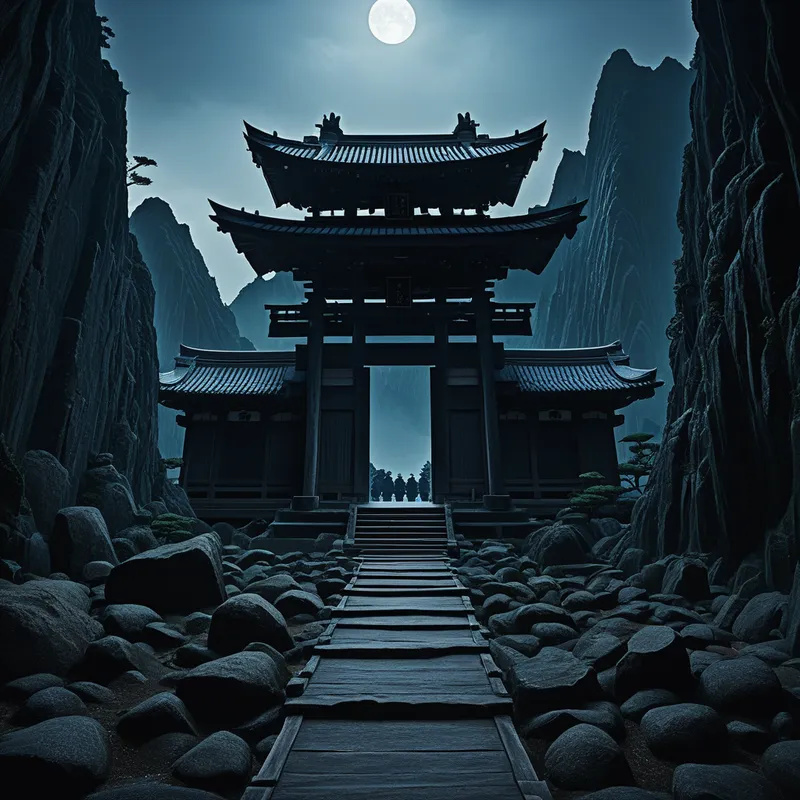
He could not bear the absence. He resolved a desperate thing: to descend to Yomi-no-kuni, the Land of Gloom, and bring his beloved back. His journey was a descent into increasing negation. The light faded, the air grew thick and still, and a profound cold, not of winter but of cessation, seeped into his divine bones. He found the entrance, a great cleft in the world, and passed into the eternal twilight.
In that silent realm, he called for her. A shape emerged from the shadows—it was Izanami! But she spoke from the darkness, her voice a memory of itself. “My lord, you have come too soon. I have eaten at the hearth of Yomi. I am bound. Wait, and do not look upon me.” But impatience and love are a torment. The silence stretched. Driven by fear and longing, Izanagi broke a tooth from his sacred comb, lit it as a torch, and lifted its flickering light.
The flame revealed not his beautiful bride, but a horror. Her body was swollen and rotting, host to the Eight Thunders, which writhed in her flesh. Maggots dropped from her form. She was death incarnate, the goddess transformed into a queen of decay. She shrieked in shame and fury, betrayed by his gaze. “You have seen me!” she cried, and her humiliation turned to wrath. She commanded the Yomotsu-shikome, the foul women of Yomi, to chase him.
What followed was a frantic flight from the underworld, a divine panic. Izanagi threw his headdress, which became grapes to delay the hags; he threw his comb, which became bamboo shoots. Finally, at the very border of Yomi, he reached the Yomotsu-hirasaka. He seized a massive boulder and thrust it into the pass, sealing it forever, a stone divider between life and death. From behind it, Izanami’s voice echoed, now filled with a terrible, final promise: “My former husband, if you do this, I will each day strangle one thousand of your people.” To which Izanagi, from the side of life, replied with weary defiance, “Then I shall each day build fifteen hundred birthing huts.”
Thus, death entered the world, not as a natural transition, but as a permanent, polluted separation. The boulder stands, and the chase ended not in reunion, but in a eternal, stalemated divorce.

Cultural Origins & Context
This foundational myth is recorded in Japan’s oldest chronicles, the Kojiki (712 CE) and the Nihon Shoki (720 CE). These texts were commissioned by the imperial court to establish a divine lineage and a unified cultural cosmology. The story of Yomi, however, feels older, rooted in primal anxieties about death, pollution (kegare), and the dangerous allure of the departed.
It was not a myth for proselytizing, but for explaining. It functioned as a cosmological anchor, defining the absolute, taboo boundary between the world of the living (utsushiyo) and the world of the dead (yūkai or takama-no-hara in other contexts). It established why the dead cannot return, why corpses are sources of profound kegare, and why rituals of separation and purification are paramount. The myth gave narrative form to the Shinto emphasis on purity, life, and the sacredness of the visible world, by so vividly depicting its terrifying opposite.
Symbolic Architecture
At its [heart](/symbols/heart “Symbol: The heart symbolizes love, emotion, and the core of one’s existence, representing deep connections with others and self.”/), the myth of Yomi is about the psychological impossibility of looking upon the face of a completed process and seeing it as it was in its becoming. Izanagi’s [journey](/symbols/journey “Symbol: A journey in dreams typically signifies adventure, growth, or a significant life transition.”/) is not just a [husband](/symbols/husband “Symbol: In dreams, the symbol of a husband often represents commitment, partnership, and the dynamics of intimate relationships.”/)‘s [quest](/symbols/quest “Symbol: A quest symbolizes a journey or search for purpose, fulfillment, or knowledge, often representing life’s challenges and adventures.”/), but the ego’s attempt to reclaim a lost part of the psyche—an [anima](/symbols/anima “Symbol: The feminine archetype within the male unconscious, representing soul, creativity, and connection to the inner world.”/) figure, a creative [partner](/symbols/partner “Symbol: In dreams, the symbol of a ‘partner’ often represents intimacy, connection, and the dynamics of personal relationships, reflecting one’s desires and fears surrounding companionship.”/), a state of [innocence](/symbols/innocence “Symbol: A state of purity, naivety, and freedom from guilt or corruption, often associated with childhood and moral simplicity.”/)—that has undergone a fundamental, irreversible change.
The torch in the darkness does not reveal truth; it reveals the present, horrific reality of what the past has become when viewed from a place of longing.
Yomi is the psychic [realm](/symbols/realm “Symbol: The symbol of ‘Realm’ often signifies the boundaries of one’s consciousness, experiences, or emotional states, suggesting aspects of reality that are either explored or ignored.”/) of the irreversible, the digested, the assimilated. To “eat of the hearth of Yomi” is to be fundamentally altered by an experience (here, [death](/symbols/death “Symbol: Symbolizes transformation, endings, and new beginnings; often associated with fear of the unknown.”/), but psychologically, any profound [trauma](/symbols/trauma “Symbol: A deeply distressing or disturbing experience that overwhelms the psyche, often manifesting in dreams as unresolved emotional wounds or psychological injury.”/), [loss](/symbols/loss “Symbol: Loss often symbolizes change, grief, and transformation in dreams, representing the emotional or psychological detachment from something or someone significant.”/), or [initiation](/symbols/initiation “Symbol: A symbolic beginning or transition into a new phase, status, or awareness, often involving tests, rituals, or profound personal change.”/)). The rotting form of Izanami is the shocking, often grotesque, [truth](/symbols/truth “Symbol: Truth represents authenticity, honesty, and the quest for knowledge beyond mere appearances.”/) of a [relationship](/symbols/relationship “Symbol: A representation of connections we have with others in our lives, often reflecting our emotional state.”/) or a part of the self that has been internalized by the [shadow](/symbols/shadow “Symbol: The ‘shadow’ embodies the unconscious, repressed aspects of the self and often represents fears or hidden emotions.”/). It is no longer the beautiful, external ideal we remember; it is a part of the internal [landscape](/symbols/landscape “Symbol: Landscapes in dreams are powerful symbols representing the dreamer’s emotional state, personal journey, and the broader context of life situations.”/) of decay and transformation. The [pursuit](/symbols/pursuit “Symbol: A chase or being chased in dreams often reflects unresolved anxieties, unfulfilled desires, or internal conflicts demanding attention.”/) by the Yomotsu-shikome represents the terrifying pull of this assimilated [material](/symbols/material “Symbol: Material signifies the tangible aspects of life, often representing physical resources, desires, and the physical world’s influence on our existence.”/)—the [guilt](/symbols/guilt “Symbol: A painful emotional state arising from a perceived violation of moral or social standards, often tied to actions or inactions.”/), [shame](/symbols/shame “Symbol: A painful emotion arising from perceived failure or violation of social norms, often involving exposure of vulnerability or wrongdoing.”/), and unresolved [grief](/symbols/grief “Symbol: A profound emotional response to loss, often manifesting as deep sorrow, yearning, and a sense of emptiness.”/)—that seeks to drag [consciousness](/symbols/consciousness “Symbol: Consciousness represents the state of awareness and perception, encompassing thoughts, feelings, and experiences.”/) back into identification with it.
The final act, the placing of the great [stone](/symbols/stone “Symbol: In dreams, a stone often symbolizes strength, stability, and permanence, but it may also represent emotional burdens or obstacles that need to be acknowledged and processed.”/), is not a failure, but the essential act of consciousness: the establishment of a [boundary](/symbols/boundary “Symbol: A conceptual or physical limit defining separation, protection, or identity between entities, spaces, or states of being.”/). It is the ego saying, “This, here, is me. That, there, is not-me.” It is the painful but necessary act of psychic [differentiation](/symbols/differentiation “Symbol: The process of distinguishing or separating parts of the self, emotions, or identity from a whole, often marking a developmental or psychological milestone.”/) that allows [life](/symbols/life “Symbol: The symbol of ‘Life’ represents a journey of growth, interconnectedness, and existential meaning, encompassing both the joys and challenges that define human experience.”/) to continue.
The Dreamer’s Resonance
When this myth stirs in the modern soul, it often manifests in dreams of forbidden looking, polluted spaces, and futile chases. To dream of pursuing a loved one into a decaying building, only to have them transform into something monstrous when you finally see their face, is to walk the Yomotsu-hirasaka. This is the psyche working through a process of disillusionment.
The somatic feeling is one of visceral revulsion and cold dread—the “kegare feeling.” It signals that the dreamer is confronting something that has been psychologically “digested” by the shadow: a finished relationship viewed with new, harsh clarity; a childhood ideal seen through adult eyes; a personal failure fully assimilated. The chase sequence in the dream mirrors the anxiety of being consumed by this reclaimed knowledge. The resolution, if the dream allows it, is not in reconciliation with the monstrous form, but in a frantic, instinctive flight toward a boundary—a door, a river, a light—and the profound relief of shutting it. This is the body-mind enacting the necessary separation from a toxic identification.

Alchemical Translation
The alchemical process mirrored here is the separatio—the crucial, often violent separation of elements that must precede any new synthesis. Izanagi begins in a state of unconscious coniunctio (divine marriage), which is shattered by the trauma of death (the nigredo, the blackening). His descent is a willed entry into the prima materia of the unconscious, driven by a desire to restore the old union. This is the classic heroic error: attempting to redeem the past on its own terms.
The true transmutation occurs not in the recovery of the lost object, but in the acceptance of its irreversible transformation and the conscious enactment of the boundary.
The lighting of the torch is the moment of brutal insight (illuminatio), where the nature of the shadow-content is fully seen, in all its horrifying reality. The flight and pursuit are the chaotic, purgative phase where the conscious mind struggles to integrate this shocking sight without being overwhelmed by it. The final act—the rolling of the stone—is the coagulatio, the “making solid.” It is the conscious, willed creation of a new structure: the ego boundary. From this act of separation, purification is born (Izanagi’s subsequent ritual ablutions that birth the sun goddess Amaterasu and other deities). The old coniunctio is dead, but from the acceptance of its death and the establishment of a clean boundary, a new, more conscious order of the psyche can emerge. The hero does not bring back the treasure in the form he expected; he brings back the knowledge of the stone, the wisdom of the limit, which is the foundation for all future life.
Associated Symbols
Explore related symbols from the CaleaDream lexicon:
- Door — The entrance to Yomi, representing the taboo threshold between consciousness and the unconscious, a point of no return once crossed and looked upon.
- Stone — The massive boulder Izanagi uses to seal Yomi, symbolizing the absolute, final boundary that must be erected to separate life from death, the conscious from the assimilated past.
- Fire — The torch of insight that reveals the horrific truth, and Kagutsuchi, the destructive element of creation whose birth catalyzes the entire descent into the underworld.
- Journey — Izanagi’s descent and flight, modeling the perilous psychic voyage into the shadowlands of the psyche to confront a lost or transformed complex.
- Death — The core event and the nature of Yomi itself, representing not just physical cessation but psychological finality, irreversible change, and the source of primal pollution (kegare).
- Shadow — The entire Land of Yomi and its inhabitants, embodying the repressed, transformed, and horrifying aspects of the self and one’s relationships that have been consigned to the unconscious.
- Ritual — Izanagi’s subsequent purification after escaping, reflecting the necessary acts of cleansing and re-ordering required after a traumatic confrontation with shadow material.
- Land — Yomi-no-kuni as a specific, polluted landscape of the soul, a foundational psychic territory defined by stagnation, decay, and eternal twilight.
- Wound — Izanami’s fatal burns, the original trauma that creates the separation and initiates the entire cycle of grief, quest, and horrifying revelation.
- Fear — The driving force of the flight from Yomi, representing the primal terror of being re-assimilated by the decaying contents of one’s own past or shadow.
- Grief — Izanagi’s initial tempest of sorrow, the powerful emotion that compels the ill-advised journey to reclaim what is irrevocably lost.
- Light — The singular, fragile torch in the overwhelming darkness of Yomi, symbolizing the piercing, often shocking, clarity of conscious insight into the unconscious.