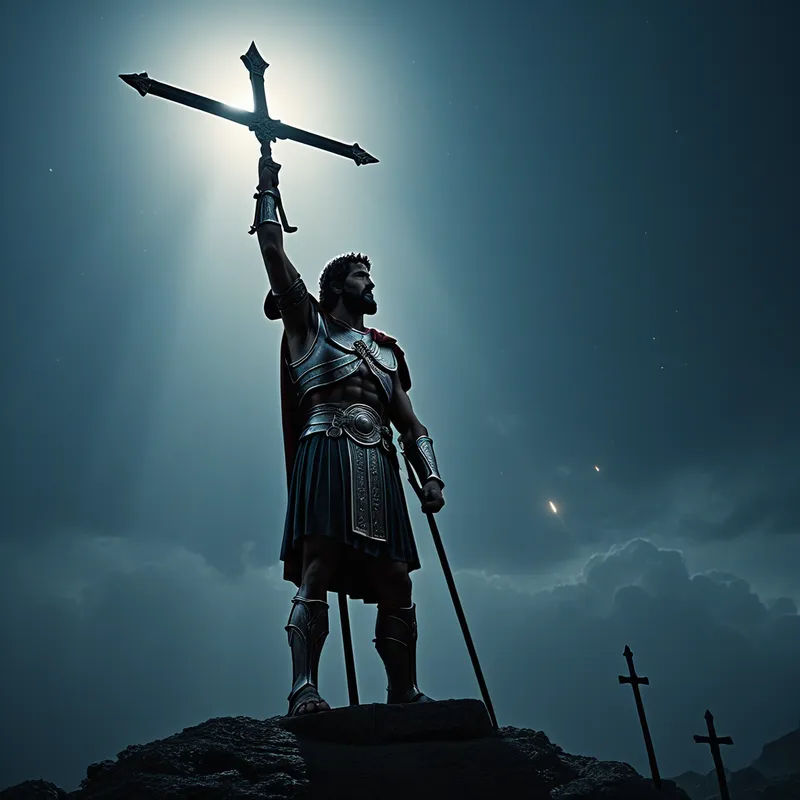
The Lance of Longinus Myth Meaning & Symbolism
The Roman soldier's spear pierces the side of the crucified Christ, a moment of profane violence that becomes a sacred revelation of mercy.
The Tale of The Lance of Longinus
The sky over Golgotha was the color of a fresh bruise, a deep and weeping purple. The air did not move; it hung thick with the scent of dust, blood, and myrrh. Three figures were silhouetted against that terrible sky, suspended between heaven and the hard, unyielding earth. The central figure, a man whose body was a map of suffering, bore a silence more profound than the taunts of the crowd, the weeping of the women, or the coarse laughter of the guards.
Among those guards was a man named Longinus. His world was one of order, of the clean line of a marching column, the definitive thrust of a pilum. This slow, public unraveling of a life was a chaos to his soul. He had seen death in Gaul and Germania—swift, brutal, and final. This was different. This was a distillation.
Hours passed like centuries. The light began to fail, not with the gentle fade of evening, but as if the sun itself was turning away. A deep, unnatural darkness descended, swallowing the hills of Judea. In that gloom, the crucified man spoke words that cut through the noise: a prayer of forgiveness, a promise of paradise, a cry of abandonment that echoed in the hollow of every heart present. Then, a final whisper: “It is finished.”
The tension broke. The earth itself seemed to shudder. But for Longinus, duty remained. A protocol existed to hasten the end of the condemned before the Sabbath. His comrades moved to break the legs of the two thieves, the crack of bone a grim percussion. But when they came to the center cross, they stopped. The man was already gone. To be certain, to fulfill the letter of the law, the task fell to Longinus.
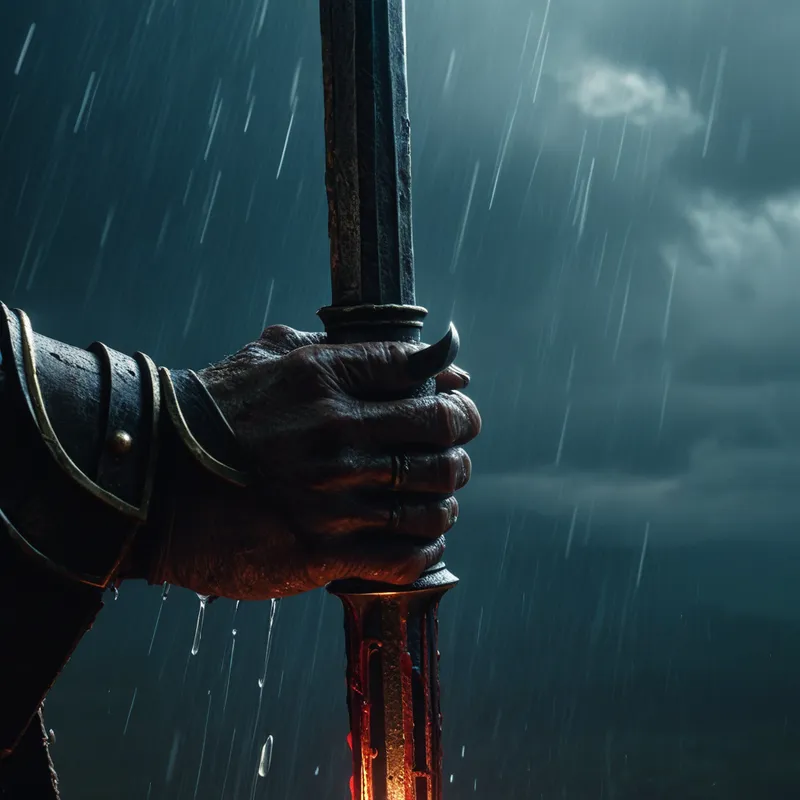
He hefted his lance, a simple, brutal tool of empire. Its iron point was dulled by dust and use. He did not look at the face above; he focused on the task, on the clean, professional strike. He set his stance, took a breath held in the oppressive air, and thrust upward.
The point met flesh, slid between ribs with a wet, soft sound. And then—a miracle not of light, but of release. From the wound, not a gush of blood alone, but a sudden, clear stream of water followed, cascading down the shaft, over his hands, warm and shocking. In that instant, the darkened sky was torn asunder. A spear of true light pierced the gloom, illuminating the cross, the flowing wound, and the soldier’s astonished, upturned face. The centurion dropped his lance as if it were white-hot. The words were torn from him, not a report, but a confession that shook his very being: “Truly, this man was the Son of God.”
Cultural Origins & Context
The story of the Holy Lance, or the Spear of Destiny, is woven into the fabric of the Passion narratives found in the Gospel of John. It exists at the intersection of historical reportage and profound theological allegory. Unlike the Synoptic Gospels, John’s account meticulously includes this detail, serving a dual purpose: to present evidence of Christ’s physical death (and thus the reality of the Resurrection) and to fulfill a nexus of Hebrew scriptural prophecies concerning the unbroken bones of the Paschal lamb and the one “whom they have pierced.”
For centuries, this narrative was not merely read but enacted in liturgical drama and contemplated in monastic cells. It was a story passed down by preachers and painters, a visceral anchor-point in the cosmic drama of salvation. The figure of Longinus himself evolved from a nameless soldier in scripture to a named, legendary convert in the Apocrypha and later hagiography, often portrayed as a martyred saint. The Lance became a relic of immense power, its purported fragments venerated across Christendom, symbolizing the paradoxical truth that the instrument of final proof—of death—became a witness to ultimate life.
Symbolic Architecture
At its core, the myth is an alchemical drama of perception. The Lance represents the penetrating, often brutal, instrument of reality-testing. It is the undeniable fact, the conclusive act, the point of no return. Longinus is not a villain, but an agent of the literal world, performing a grim, functional duty. His thrust is the ultimate profane act: violating the sacred body.
The wound that proves death becomes the fountain that reveals life.
The miracle is in the transformation of the witness, not the weapon. The flow of blood and water—symbols of sacrifice and purification, the Eucharist and Baptism—transforms the lance from a tool of death into a conduit of grace. Longinus’s enlightenment is instantaneous. He sees not a executed criminal, but the Divine. The very action that confirmed mortality for the world revealed divinity to him. The symbol thus encapsulates the psychological moment when a profound wounding, a piercing truth about ourselves or our world, breaks open not into despair, but into a shocking, liberating revelation. The shadow of our own complicity or trauma becomes the opening through which meaning floods in.

The Dreamer’s Resonance
When this myth stirs in the modern psyche, it often manifests in dreams of being pierced or of wielding a piercing instrument at a moment of critical decision. One might dream of a surgical procedure that reveals a hidden, luminous core, or of firing an arrow that splits a dark cloud to reveal the sun. The somatic sensation is often one of a sharp, sudden release of pressure—a puncture followed by flow.
Psychologically, this signals a confrontation with a core wound—a betrayal, a failure, a truth too painful to ignore—that the dreamer has been circling. The Longinus figure in the dream represents the part of the self that must finally “do the deed,” to confront and penetrate the heart of the pain. The dream is not about the infliction of wounding, but about the necessity of the witness. It indicates that the ego is being compelled, often against its will, to enact a truth that will break open a stagnant situation. The healing is not in avoiding the spear, but in what flows out when the spear does its work. The dreamer is undergoing the process of moving from being a passive victim of circumstance to an active, albeit awestruck, witness to their own transformation.

Alchemical Translation
The individuation journey modeled here is the transmutation of guilt into responsibility, and of evidence into faith. We all carry our Lances: the harsh judgments, the definitive actions, the painful truths we have wielded against ourselves or others. We believe their function is merely to prove brokenness, to confirm the finality of our failures.
The alchemical work is to stand, like Longinus, at the foot of our own crucifixions—those moments where our highest ideals or deepest loves seem to have died—and to perform the necessary, painful duty of acknowledging the reality of that death. But the opus does not end there. We must then have the courage to perceive what flows from the wound.
The goal is not to heal the wound to make it disappear, but to recognize it as the sacred aperture it has become.
This is the translation: the spear of our own critical intellect or traumatic experience, which we used to confirm our separation (our “orphan” archetype), is repurposed by the Self. It becomes the very tool that pierces the veil of our isolation, releasing the waters of compassion and the blood of embodied life. We move from the orphan who inflicts and suffers wounds, to the witness who understands that the wound itself is the gateway. The hardened centurion of the ego, dutifully enforcing the law of cause and effect, is dissolved in the sudden, flooding grace of meaning, realizing that his every act, even the violent one, is held within a larger, redeeming narrative.
Associated Symbols
Explore related symbols from the CaleaDream lexicon: