
The Lamp Myth Meaning & Symbolism
A myth of a lost divine light, a perilous descent into the underworld of memory, and the sacred duty of keeping the inner flame alive.
The Tale of The Lamp
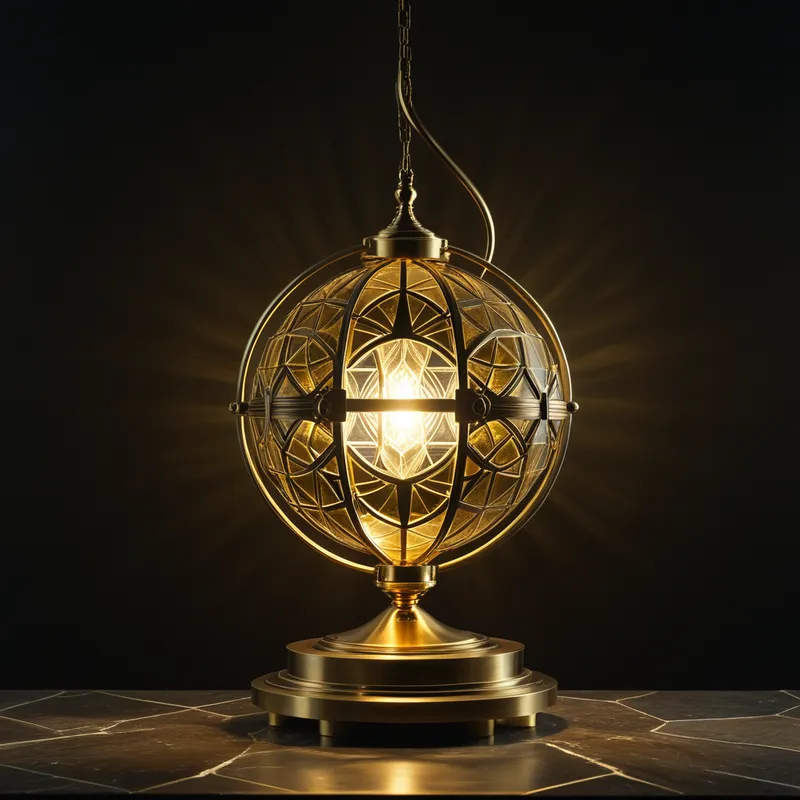
Listen, and let the embers of the story warm you. In the time before time was measured, when the world was a crucible of potential, there existed a light not born of sun or star. It was the First Flame, kindled in the silent heart of the Prima Materia. From this flame, the Lamplighter was breathed into being, a deity whose sole purpose was to tend the light. And tend it they did, pouring the liquid radiance into a vessel of perfect geometry—The Lamp.
This Lamp did not merely cast light; it wove reality. Its beams were the threads of memory, of identity, of soul. All that came to be knew itself by this light. For eons, the Lamplighter walked the nascent realms, and where their footfall landed, a spark from The Lamp would leap into the clay of existence, igniting a consciousness—a human, a beast, a spirit. Each being carried within its deepest core a tiny, perfect echo of that First Flame, a pilot light for the soul.
But in the deep places, where the weight of form pressed heaviest, a shadow stirred. Not a shadow cast by an absence of light, but a shadow that hungered for it. This was the Eater of Names. It could not create, only consume. It fed on the forgotten, the abandoned, the memories left to fade. And it coveted the pure, undiluted memory-light of The Lamp itself.
One fateful cycle, as the Lamplighter knelt to kindle a new valley of sentient stone, the Eater of Names struck. It did not attack the deity, but the ground beneath them. It whispered to the very earth, awakening a chasm of absolute forgetting—the Mnemosyne Abyss. The Lamplighter, for a fraction of an instant, forgot the step, forgot the balance. The sacred Lamp tumbled from their grasp, falling soundlessly into the swallowing dark below.
The world did not go dark. The sun still rose. But a deeper chill set in. Beings began to forget their dreams upon waking. Lovers forgot the first glance. Elders forgot the stories that held the tribe together. A great, hollow yearning echoed in every chest, a homesickness for a home one could not name. The Lamplighter stood at the rim of the Abyss, their hands empty, the song of the light already fading from the world’s memory.
Yet, the echo remained. In one human, a woman named Elara, the pilot light flickered with a strange, persistent urgency. She dreamt not of light, but of the shape of its absence. She heard the hollow wind in the Abyss as a melody. While others succumbed to the creeping amnesia, Elara gathered the remnants: a story from her grandmother’s fading lips, the pattern of heat in dying embers, the certainty in her own pulse. From these, she fashioned a humble vessel of clay and will—a simple lamp.
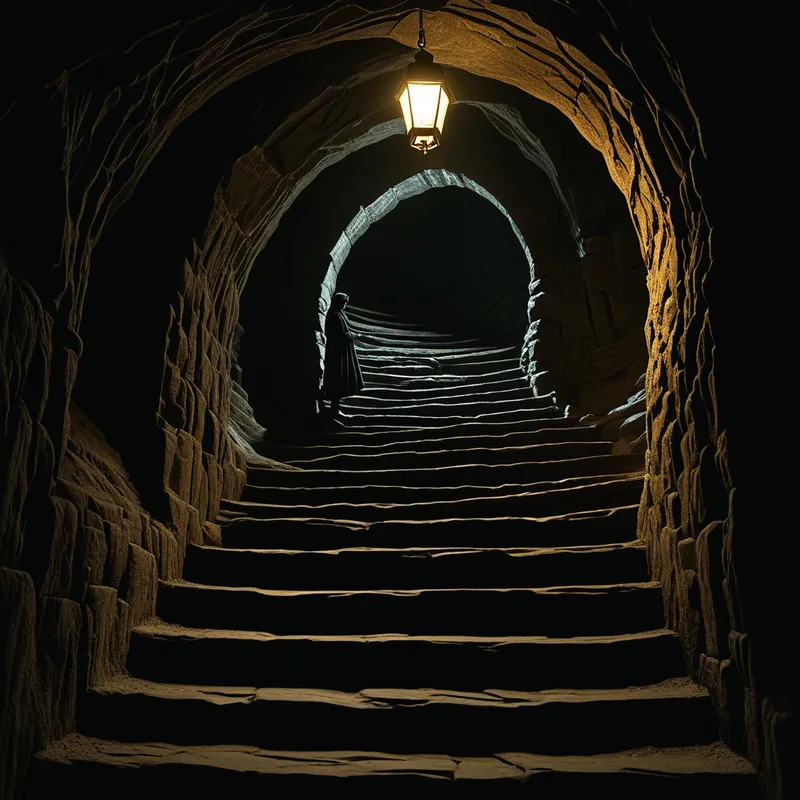
With no guarantee of return, armed only with this tiny, mortal light, Elara began the descent into the Mnemosyne Abyss. The path was not of stone, but of slipping memories. She faced not monsters, but the ghosts of her own forgotten joys and shames, each one threatening to blow out her fragile flame. She walked through the gallery of the world’s lapsed memories, a silent, mournful museum. Deeper she went, her little lamp guttering, its light growing ever more precious.
At the nadir of all things, she found it. The Lamp of the Lamplighter lay not broken, but dormant, its glorious light turned inward, cooling into a crystalline sleep. Around it coiled the Eater of Names, a formless smear of hungry silence. As Elara approached, her footfall—the step of a being who chose to remember—echoed. The Eater turned, not to her, but to her little clay lamp. It saw the flame, small and defiant, and recoiled. For this was a light it could not consume; it was not a forgotten memory, but a memory actively being made, a light fueled by present courage.
In that moment of the creature’s confusion, Elara did not attack. She knelt. She placed her humble lamp beside the divine one. The contact was a circuit closing. The mortal flame, born of yearning and search, touched the dormant divine flame, born of primordial source. The First Flame remembered itself. With a sound like a universe sighing, The Lamp awoke. Light, terrible and beautiful, filled the Abyss. The Eater of Names dissolved into the very memories it had sought to devour, now brilliantly recalled.
The Lamplighter, feeling the rekindling, reached down. Elara, holding both lamps now—the divine and the mortal—was lifted from the deep. The Lamplighter looked at the human, then at the two lamps now burning with a single, inseparable light.
“The light never left,” the Lamplighter said, their voice like a mountain stream. “It was only waiting to be found by its own echo.”
And so, a new covenant was made. The Lamplighter would keep the Great Lamp, walking the high roads of the cosmos. But to humanity was given the sacred duty of the small lamps. For the light is not simply given; it must be carried, sheltered, and continually rekindled from within, lest the world forget its own name.
Cultural Origins & Context
The myth of The Lamp is central to the esoteric tradition of the Alchemical culture, a philosophical and proto-psychological school that flourished in the late medieval and Renaissance periods across Europe, though its roots tap into older Hermetic and Gnostic streams. Unlike state religions, Alchemical knowledge was transmitted orally and through cryptic, illustrated manuscripts among small, secretive circles of practitioners. The myth was not told in public squares but whispered in laboratories, where the work on metals was understood as a mirror for the work on the soul.
The teller of this myth was likely a master to an apprentice, often beside the actual furnace (athanor). Its function was not entertainment but orientation. It served as a foundational map for the alchemist’s entire endeavor. It framed the “Great Work” not as a quest for physical gold, but as the recovery of the lumen naturae—the light of nature, or the divine spark buried within the leaden, confused matter of the human condition (the nigredo, or blackening). The societal function was initiatory and therapeutic: it prepared the mind for a long, dark, and perilous inward journey, promising that the goal, though seemingly lost, was an intrinsic part of the seeker’s own substance.
Symbolic Architecture
The myth’s power lies in its precise symbolic architecture, a blueprint of the psyche.
The First Flame & The Lamp represent the transcendent Self, the original, unified state of consciousness before the fragmentation of ego. It is the divine source, the scintilla or spark of the soul.
The Lamplighter is the archetype of the guiding principle, the inner sage or spirit that connects the individual to the transpersonal. Their “dropping” of the Lamp symbolizes the inevitable fall into manifestation—the descent of spirit into matter, and the consequent obscuration of the Self by the complexities of life and the personal unconscious.
The Eater of Names is the shadow of the psyche, specifically the force of psychic entropy. It is not evil, but a natural tendency toward dissolution, forgetfulness, and the abandonment of one’s authentic nature. It feeds on neglected potentials, unlived lives, and repressed memories.
The Mnemosyne Abyss is the collective unconscious, the vast, impersonal realm of archetypal patterns and forgotten human experience. Its name, from the Greek muse of memory, is profoundly Alchemical: the way down into the unconscious is the way to remember what the soul has always known.
Elara is the ego-consciousness that undertakes the work. Her clay lamp is the fragile but authentic vessel of the seeking ego—her will, her attention, her humble dedication to the process. It is the lamp of introspection and conscious effort.
The central revelation is that the divine light (the Self) cannot be restored by the divine alone (the Lamplighter). It requires the courageous, questing human element (the ego) to descend into its own darkness and offer its own small, earned light. The conjoining of the two lamps signifies the hieros gamos, the sacred marriage of the conscious and unconscious, the ego and the Self, which is the pinnacle of the individuation process.
The Dreamer’s Resonance
When this myth activates in the modern dreamer, it signals a critical phase of psychic integration. Dreaming of a lost or sought-after light, descending endless staircases, or protecting a fragile flame against a consuming darkness are direct resonances.
The somatic experience is often one of a deep, core anxiety—a “hollow yearning” in the chest—coupled with a determined, almost somnambulant focus. Psychologically, the dreamer is navigating their own Mnemosyne Abyss. They are being called to remember something essential that has been lost to them: a forgotten talent, a buried trauma, a discarded aspect of personality, or a sense of purpose. The “Eater” in the dream may appear as a faceless threat, a sucking void, or even as the seductive pull of nihilism and despair. The dream is an enactment of the psyche’s imperative to recover its own central light before it is subsumed by the inertia of the unconscious. It is a call to active remembrance, to the hard work of bringing what is in shadow into the light of awareness.
Alchemical Translation
For the modern individual, the myth of The Lamp models the complete arc of individuation—the Alchemical Opus.
-
The Fall (Nigredo): The initial state is one of spiritual or psychological poverty. We feel a sense of loss, meaninglessness, or fragmentation. This is the Lamp falling into the Abyss. It is the necessary first step, the prima materia of the work: confronting the blackness.
-
The Making of the Clay Lamp (Meditatio): This is the stage of conscious preparation. It is the ego’s decision to engage in therapy, introspection, art, or any disciplined practice of self-observation. We fashion our “clay lamp” through journaling, active imagination, or mindful attention to our inner states. It is a humble, human tool, but it is our own.
-
The Descent (Solutio): The often painful and confusing dive into the unconscious. This is the therapy session, the dark night of the soul, the period of depression or confusion where old structures dissolve. We confront our personal “Eaters”—our repressed memories, complexes, and shadows. The ego feels perilously small.
-
The Contact & Rekindling (Coniunctio): The transformative moment. It occurs when the conscious attitude (the clay lamp) makes genuine, respectful contact with an autonomous content of the unconscious (the dormant Divine Lamp). This is the insight that heals, the synchronicity that awakens, the creative act that feels inspired. The two lights—effort and grace, ego and Self—merge.
-
The Ascent & New Covenant (Rubedo): The return to daily life, integrated and renewed. The light is now embodied. The individual becomes their own Lamplighter for their own life, but also understands they are a keeper of a shared, human light. The duty is no longer to find the light “out there,” but to maintain the inner connection, to continually remember and choose the Self amid the world’s forgetting.
The ultimate Alchemical translation is this: Gold is not made. It is remembered. The radiant, enduring substance—the Philosopher’s Stone—is the realized Self, recovered from the dark matter of experience by the courageous, lamp-bearing journey of consciousness itself. The work is a pilgrimage back to a home that was, paradoxically, within us all along.
Associated Symbols
Explore related symbols from the CaleaDream lexicon: