The Lament for the Destruction of Sumer Myth Meaning & Symbolism
A sacred poem mourning the fall of Sumer, where gods unleash chaos, cities burn, and the land weeps, revealing the deep psyche's cycle of death and rebirth.
The Tale of The Lament for the Destruction of Sumer
Hear now the voice of the land that was. It does not sing of glory, but weeps. It is the sound of the Tigris choked with silt, of the Euphrates running black with ash. The great bellies of the granaries are hollow. The smoke of burnt cedar and tamarisk hangs heavy over Ur, and Nippur, and Uruk. The gods have turned their faces away.
It began not with a shout, but with a terrible silence in the council of the Anunnaki. The divine decrees, which once flowed like sweet water ensuring the Me of kingship and fertility, ceased. Enlil, in his cosmic rage, lifted his gaze from the plain of Shinar. His breath, which was the wind that filled sails and brought rain, became the searing Imhullu. He summoned the Udug-demon, a being of howling chaos.
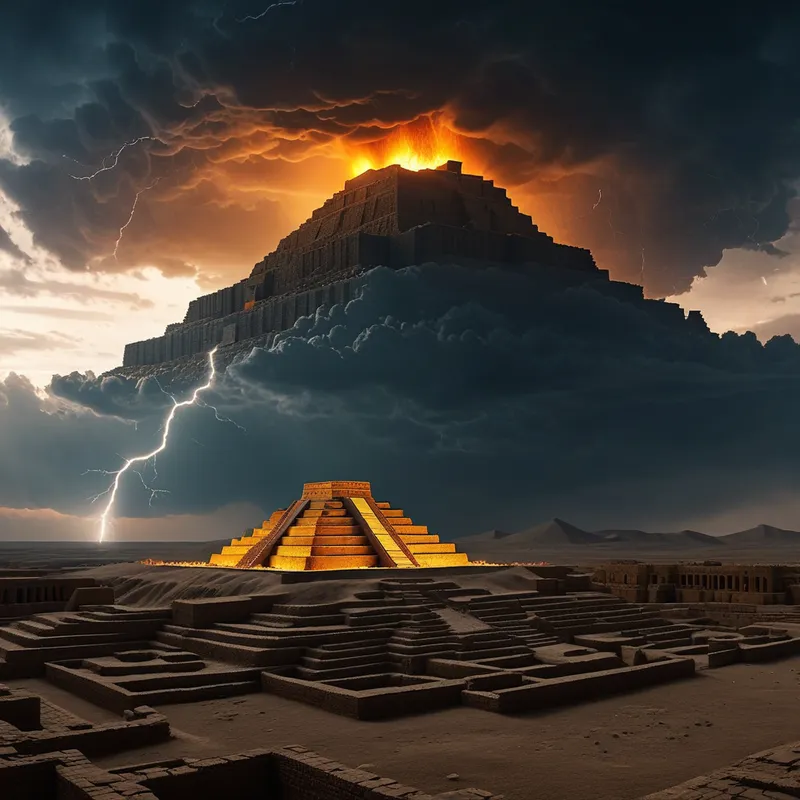
Then came the strangers. Not men, but a force as inevitable as decay. They poured down from the highlands like a flood of bronze and fire, a people whose gods were not our gods. They shattered the city walls that had stood since the days when kingship first descended from heaven. They drove their chariots through the holy precincts. The sacred Ziggurats, the bond between An and Ki, were defiled. The statues of the gods, their eyes of lapis lazuli, were blinded with dust.
The land itself recoiled. The rivers changed their courses, abandoning the fields. Salt invaded the soil, and the barley withered in the furrow. In the streets, the mother did not know her child, for hunger had sharpened all faces into the same mask of want. The lamentation priest, the Gala, tore his robes and scarred his cheeks, but his songs were drowned by the cries of the dying and the crackle of flame. The Lady Inanna watched from her desecrated temple, her lion dormant at her feet. Enki, in his watery abyss, heard the prayers but could not stem the tide of divine judgment.
This was the unraveling of order, the return of primeval Tiamat’s roar within the world. It ended not with a battle, but with an exhaustion so profound it was a kind of silence. The invaders, too, were eventually swallowed by the dust. And in that silence, only the wind remained, sweeping across the ruins, carrying the last whispered syllables of the lament—a plea cast into the future, that someone might remember the name of Sumer, and in remembering, begin the slow, impossible work of making the waters flow again.
Cultural Origins & Context
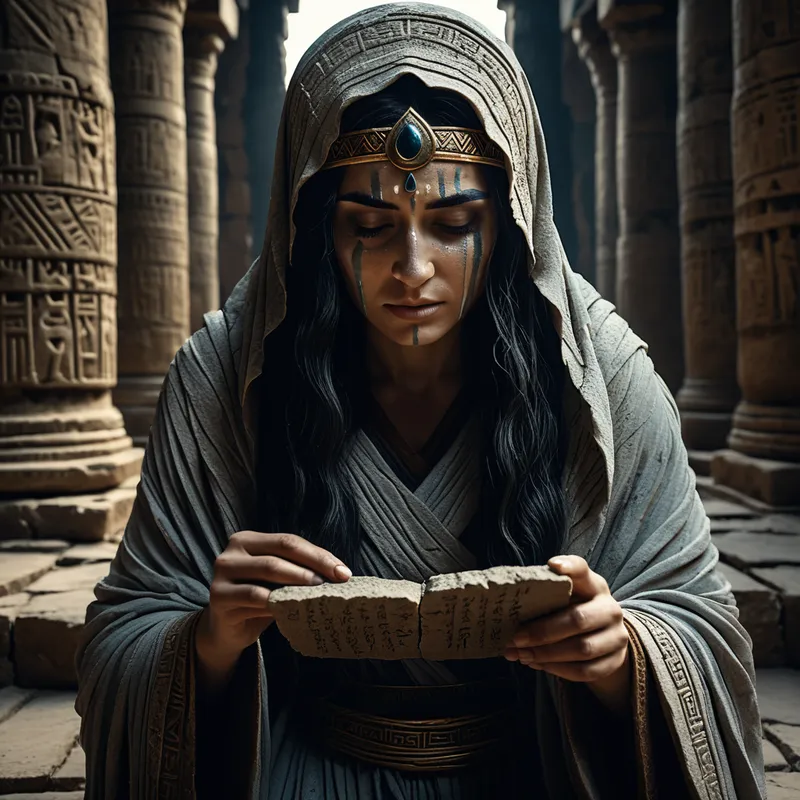
“The Lament for the Destruction of Sumer” is not a single myth but a genre of sacred literature, a collection of poetic compositions inscribed on clay tablets in the early second millennium BCE. They were likely composed by the priestly scribal schools of cities like Ur and Nippur, possibly following the catastrophic fall of the Third Dynasty of Ur around 2004 BCE to invading Elamites and Amorites. These were not mere historical records; they were ritual texts, performative magic.
The function was profound and twofold. Societally, they were a form of theological explanation and catharsis. The destruction was too vast to be mere human failure; it had to be a divine decree, a necessary, if terrible, rebalancing of the cosmic order. By lamenting correctly—detailing every fallen city, every desecrated temple—the community participated in a ritual of purification and acknowledgment of the gods’ supreme power. Psychologically, they were an act of preservation. To name the loss was to defy total annihilation. The very act of inscribing the lament on tablet after tablet was a stubborn assertion that memory, and thus identity, could survive even the physical destruction of its source. The Gala priests chanted these dirges to soothe the hearts of the gods and the people, weaving grief into a formal, beautiful pattern, making the chaos of suffering somehow containable.
Symbolic Architecture
At its core, the Lament maps the psyche’s confrontation with the obliteration of its own foundational structures. The ordered, irrigated, [temple](/symbols/temple “Symbol: A temple often symbolizes spirituality, sanctuary, and a deep connection to the sacred aspects of life.”/)-centered world of Sumer represents the constructed ego-complex. The invading storm of strangers and the withheld [favor](/symbols/favor “Symbol: ‘Favor’ represents the themes of acceptance, goodwill, and the desire for approval from others.”/) of the gods symbolize the irruption of the unconscious—a [tidal wave](/symbols/tidal-wave “Symbol: A tidal wave signifies overwhelming emotions or situations, often representing a sense of loss of control or an impending crisis.”/) of neglected [shadow](/symbols/shadow “Symbol: The ‘shadow’ embodies the unconscious, repressed aspects of the self and often represents fears or hidden emotions.”/), [fate](/symbols/fate “Symbol: Fate represents the belief in predetermined outcomes, suggesting that some aspects of life are beyond human control.”/), or [reality](/symbols/reality “Symbol: Reality signifies the state of existence and perception, often reflecting one’s understanding of truth and life experiences.”/) that can no longer be held back by the walls of old assumptions.
The city is the psyche, and its walls are the dogmas that keep chaos at bay. Their fall is not merely tragedy, but revelation.
The turning away of Enlil signifies the withdrawal of animating [spirit](/symbols/spirit “Symbol: Spirit symbolizes the essence of life, vitality, and the spiritual journey of the individual.”/), the divine pneuma that gives meaning and vitality to a [life](/symbols/life “Symbol: The symbol of ‘Life’ represents a journey of growth, interconnectedness, and existential meaning, encompassing both the joys and challenges that define human experience.”/)‘s work. The salinization of the [soil](/symbols/soil “Symbol: Soil symbolizes fertility, nourishment, and the foundation of life, serving as a metaphor for growth and stability.”/) is a potent [symbol](/symbols/symbol “Symbol: A symbol can represent an idea, concept, or belief, serving as a powerful tool for communication and understanding.”/) of psychic [sterility](/symbols/sterility “Symbol: Represents inability to create, grow, or produce, often linked to emotional barrenness, creative blocks, or existential emptiness.”/), where what once nurtured (ambition, tradition, [relationship](/symbols/relationship “Symbol: A representation of connections we have with others in our lives, often reflecting our emotional state.”/)) now poisons. The lament itself, however, is the crucial [symbol](/symbols/symbol “Symbol: A symbol can represent an idea, concept, or belief, serving as a powerful tool for communication and understanding.”/). It is the voice of the [orphan](/symbols/orphan “Symbol: Represents spiritual abandonment, primal vulnerability, and the quest for belonging beyond biological ties. Often signifies a soul’s journey toward self-reliance.”/) [archetype](/symbols/archetype “Symbol: A universal, primordial pattern or prototype in the collective unconscious that shapes human experience, behavior, and creative expression.”/), not in self-pity, but in profound witness. It does not seek to immediately rebuild, but to fully behold the scale of the ruin. This conscious, embodied [grief](/symbols/grief “Symbol: A profound emotional response to loss, often manifesting as deep sorrow, yearning, and a sense of emptiness.”/) is the first, essential nutrient in the salted [earth](/symbols/earth “Symbol: The symbol of Earth often represents grounding, stability, and the physical realm, embodying a connection to nature and the innate support it provides.”/).
The Dreamer’s Resonance
When this myth stirs in the modern dreamer, it often manifests not as a historical tableau, but as a profound somatic experience of collapse. One may dream of their childhood home dissolving into sand, of their university diploma burning to ash, or of a towering corporate office building quietly crumbling into a heap of clay bricks. The emotional tone is one of immense, quiet grief and awe, rather than panic.
Psychologically, this signals a necessary dissolution. The dream-ego is witnessing the end of a psychological “kingdom”—a long-held identity (the successful professional, the perfect caregiver, the eternal seeker), a foundational belief system, or a life structure that has, like the old Sumerian order, become rigid, isolated from its spiritual水源 (water source), and unable to adapt. The body may feel heavy, leaden, or hollow in the dream, mirroring the salted earth. This is the psyche’s ritual lament. It is performing the sacred duty the Gala priests performed: to fully register the loss, to feel the weight of every fallen stone of the old self, without rushing to rebuild on the same, now-cursed ground. The process is one of deep, non-verbal mourning, preparing the inner soil for a future it cannot yet imagine.
Alchemical Translation
The alchemical journey mirrored in the Lament is the Nigredo, the blackening, the descent into the massa confusa. For individuation to proceed, the obsolete structures of the personality must be dissolved. The myth models this not as a heroic battle one wins, but as a cataclysm one survives through sacred attention.
The work is not to avoid the flood, but to learn to inscribe your name on a tablet that can float upon it.
The first alchemical act is the lament itself—the recognition and naming of the ruin. This is the conscious assimilation of shadow material on a colossal scale. The ego does not fight the invading “strangers” (new, disruptive psychic contents); instead, it becomes the scribe of their passage. The second act is the implied, silent aftermath: the Albedo of waiting. Just as the land lies fallow, the psyche must endure a period of not-knowing, of emptiness where the old gods are silent. This is the incubation. The hope—and it is only a whisper in the text—lies in the very existence of the lament tablet. The recorded word outlasts the brick. The symbolic essence survives the material form. Thus, the modern individual undergoing this process is tasked with finding their own “tablet”—the journal, the art, the honest conversation—that can hold the truth of their dissolution. In doing so, they perform the ultimate alchemy: transmuting raw, annihilating experience into a durable witness, the first seed of a soul-structure that will be rooted not in brittle order, but in the resilient truth of having endured the flood.
Associated Symbols
Explore related symbols from the CaleaDream lexicon:
- River — The life-giving Tigris and Euphrates turning hostile or abandoning their courses symbolize the withdrawal of psychic energy and fertility, the drying up of one’s inner flow and sustenance.
- Temple — The desecrated ziggurat represents the collapse of one’s highest values, spiritual center, or connection to the divine, leaving the soul exposed and profaned.
- Fire — The all-consuming flames that ravage the cities embody the destructive, purgative force of divine wrath and the necessary, terrifying burn that clears the ground for something new.
- Earth — The salted, barren soil signifies psychic sterility and the poisoning of what was once fertile ground for growth, relationships, and creativity.
- Grief — The central action of the lament itself; it is the sacred, formalized process of mourning that acknowledges loss fully, preventing it from festering as unconscious poison.
- Rain — Its absence in the myth represents the withholding of grace, blessing, and emotional nourishment, creating a spiritual drought within the soul’s landscape.
- Stone — The shattered city walls and temple foundations are the broken structures of identity and defense, the rigid beliefs that could not withstand the pressure of reality.
- Tablet — The inscribed cuneiform lament is the symbol of memory, witness, and the enduring word that survives physical destruction, representing the core of consciousness that persists through change.
- Death — The wholesale demise of a civilization mirrors the necessary death of a psychological era, a comprehensive ending that makes true rebirth possible.
- Root — The salinization attacks the very root of life in the land, symbolizing an assault on the foundational, often unconscious, sources of one’s being and vitality.
- Shadow — The invading “stranger” hordes represent the eruption of the repressed, unknown, or feared aspects of the self that the ordered ego-complex could no longer keep at bay.
- Rebirth — Implicit in the act of lamentation is the seed of renewal; to mourn a world is to affirm that a world existed, planting the first fragile hope for a future one.