The Lady of Shalott Myth Meaning & Symbolism
A woman cursed to view the world only through a mirror weaves its reflections into a tapestry, until a glimpse of Lancelot shatters her life.
The Tale of The Lady of Shalott
Listen. There is a river that runs to Camelot. And on that river lies an island, and on that island stands a grey tower, silent as a tomb. Within that tower dwells a woman. No one knows her name. The reapers in the barley fields hear her song, a low, mournful sound that drifts across the water at twilight, and they whisper, “It is the fairy Lady of Shalott.”
She lives under a curse, a decree as old and cold as the stones of her prison. She may not look upon the world directly. She may not gaze from her window at the road that winds down to Camelot, nor at the knights who ride there, nor at the lovers who walk in the fields. Her world is a reflection, a second-hand truth. A great, round mirror of burnished silver hangs before her, and in its polished surface, the shadows of the world move. She sees the moving pictures of the road, the river, the market girls in red cloaks, the armored figures on horseback—all passing like phantoms, silent and colourless.
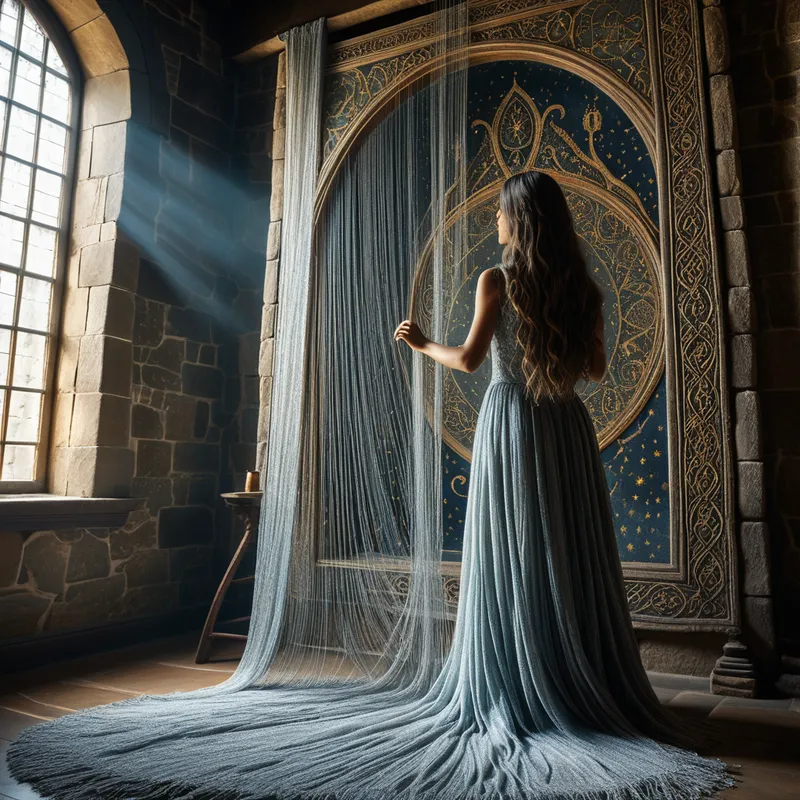
And this is her life, and this is her art. From the shadows in the mirror, she weaves. A mighty loom stands in her chamber, and upon it, day and night, she works the images she sees. She weaves the reflected reapers, the reflected pilgrims, the reflected funeral with its plumes. She weaves the web of the world’s shadow, and the tapestry grows, a vast and silent chronicle of a life she cannot touch. “I am half-sick of shadows,” she sighs to the empty air.
Then comes the sun. It is a morning in the harvest, and the mirror shimmers, and into its field rides a figure that burns. His armour is like a thousand suns, his helmet plume is a star, and on his shield, a red cross blazes. It is Sir Lancelot. He rides singing, a song of joy and prowess, and the sound, though faint, pierces the tower’s silence. The Lady stops. The shuttle falls from her hand. The song is a hook in her soul. For one fatal, irresistible moment, she turns from the mirror. She runs to the window. She looks down, directly, upon the sunlit hair and the flashing shield of Lancelot as he rides to Camelot.
The mirror cracks from side to side. A long, terrible shiver runs through the silver, and the world in it splinters into a thousand useless fragments. The curse is upon her. She knows it in her bones. The air grows cold. A wind, smelling of autumn and decay, whips through the tower. The tapestry, her life’s work, billows and tears free from the loom, swirling around her like a shroud.
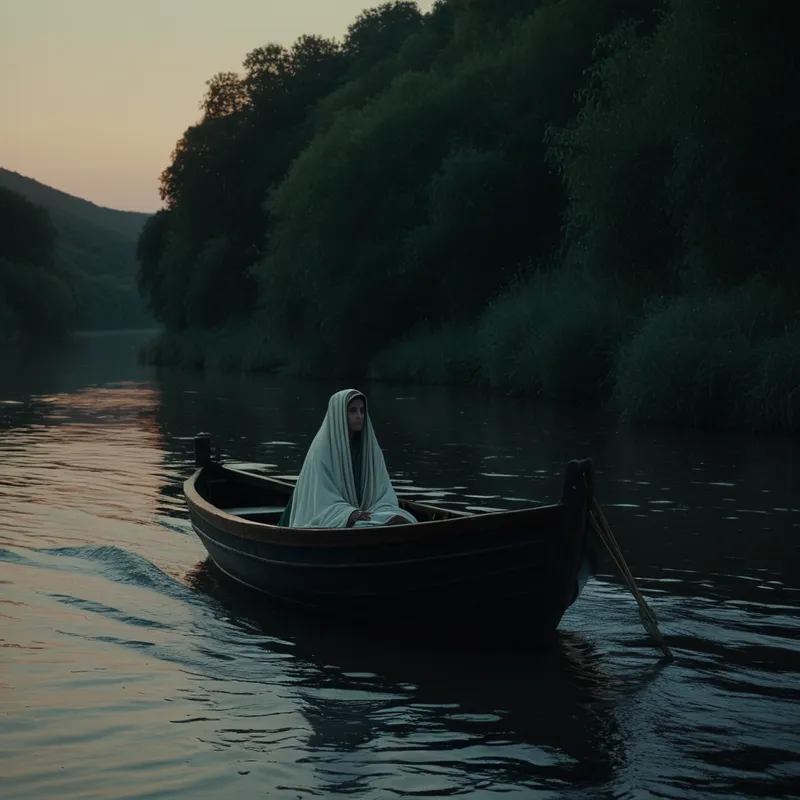
She descends the spiral stair, a place she has never trod. She finds a boat at the island’s edge, paints her name upon its prow—The Lady of Shalott—and lies down within it. She loosens the chain. The current takes her. Dressed in a snowy white robe, her face pale as moonstone, she drifts down the river, past the fields and the whispering reapers, past the water lilies, her dead eyes open to the sky she was forbidden to see. She sings a last, low, deathly song until her breath fails. And so the boat, a silent bier, carries her into the heart of Camelot, where knights and ladies crowd the banks in wonder and dread, and Lancelot, looking down, murmurs only, “She has a lovely face.”
Cultural Origins & Context
The tale of the Lady of Shalott is a Victorian-era crystallization of older Arthurian fragments, most famously rendered by the poet Alfred, Lord Tennyson in 1832 (and revised in 1842). While not from medieval Arthuriana proper, Tennyson drew upon the Italian Donna di Scalotta and likely wove in threads from other isolated, doomed maidens in Celtic and Arthurian lore. The myth, as we know it, is a Romantic creation, born in an age grappling with the artist’s role in an industrializing world, the tension between isolation and engagement, and the nature of perception itself.
Its societal function was multifaceted. For the Victorians, it was a poignant narrative about the dangers of stepping outside prescribed roles—particularly for women. It also served as a powerful allegory for the artist: one who observes life at a remove, translating it into art, yet is ultimately destroyed by a desire for direct, unmediated experience. Passed down not by bards in halls but by poets and painters in books and galleries, it became a cultural touchstone for the perils and poignancy of the creative life, a modern myth that felt ancient in its psychological truth.
Symbolic Architecture
The myth is a perfect symbolic chamber, each element a key to an inner state. The tower is not just a prison; it is the isolated psyche, the individuation not yet begun. The mirror is the veil of consciousness itself—how we perceive reality through the filters of memory, culture, and personal psychology. We do not see the world; we see our reflection of it.
The Lady’s tapestry is the art of the unlived life, a beautiful, intricate record of shadows. It is the ego’s construction, a meaningful pattern woven from secondary experience.
The curse is the core wound, the primordial fear that direct engagement with life will be annihilating. Lancelot is the animus, the soul-image, the brilliant, golden symbol of the outer world, of action, love, and connection that calls one out of isolation. To look upon him directly is to allow the archetypal energy of the Other to breach the defenses. The cracking mirror signifies the irreversible shattering of the old, reflective consciousness. The deathly voyage downstream is not merely an end, but a necessary dissolution; the old self, the isolated weaver of shadows, must die for any possibility of a new consciousness to emerge.
The Dreamer’s Resonance
When this myth stirs in the modern dreamer, it signals a profound crisis of perception and engagement. To dream of being in a high room, watching life through a screen or window, weaving complex stories or projects that feel disconnected from the body, is to feel the Lady’s curse somatically. There is often a feeling of chill, of stillness, of being “half-sick of shadows”—a deep, melancholic yearning for something real.
The dream may present a dazzling figure (a lover, a hero, a calling) that appears and compels a turning away from the reflective surface. The somatic response here is crucial: a lurch in the stomach, a quickening of the heart—the body’s intelligence demanding engagement. The subsequent dream imagery of breaking glass, unraveling threads, or a journey on dark water indicates the psyche is in the throes of this painful but necessary disintegration. The dreamer is not dreaming of death, but of the death of a way of being—the insulated, observing ego that must break to make contact with the living world.

Alchemical Translation
The myth models the alchemical nigredo, the blackening, the descent. The conscious personality, safely ensconced in its tower of intellectual or artistic abstraction, is called by the soul. Lancelot, as the golden animus, is the catalyst for the solutio—the cracking of the mirror is the flooding of the rigid ego with unconscious contents. The tapestry unraveling is the deconstruction of the persona, the identity built on reflected appraisals and indirect living.
Her voyage to Camelot is the coagulatio, the journey of the dissolved soul-matter toward a new center. She arrives dead to the old world, but her arrival is the birth of a new awareness in the collective.
For the modern individual, the process is one of moving from the creator archetype in isolation (weaving meaning from a safe distance) toward the lover archetype (risking direct connection, even if it leads to heartbreak). The triumph is not in survival, but in authenticity. The curse is not the isolation, but the belief that one can only live in reflection. The myth teaches that the psyche’s wholeness requires the shattering of the perfect mirror. We must risk the direct gaze, even if it means the beautiful, shadowy tapestry of our former self lies in ruins. Only then can the boat of the soul, bearing our true name, begin its inevitable journey to the crowded, messy, and glorious Camelot of the real.
Associated Symbols
Explore related symbols from the CaleaDream lexicon: