The Labyrinth & The World Myth Meaning & Symbolism
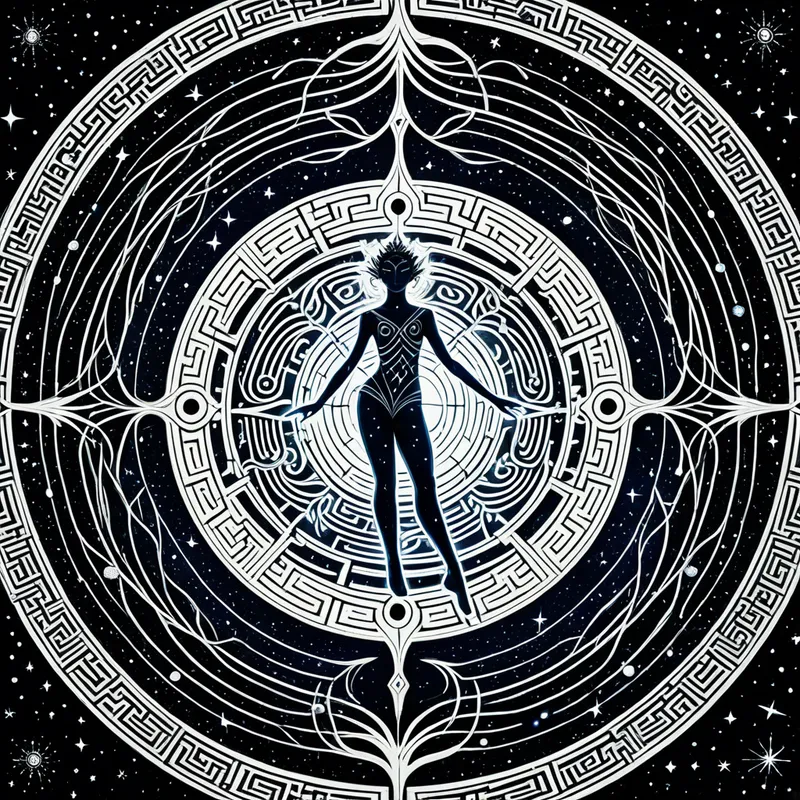
A cosmic entity dances within a living labyrinth, weaving all opposites into a unified whole, symbolizing the soul's journey to ultimate integration.
The Tale of The Labyrinth & The World
Listen, and let the old pattern be told anew. It begins not with a birth, but with a turning—a slow, inevitable spiral into being. In the time before time was measured, there existed only the Unfathomable Potential, a silent egg of pure possibility. From its stillness, a rhythm was born. A pulse. And with that pulse came a desire: the desire to know itself.
Thus, the World Dancer stirred within the shell. Not a god of thunder or a goddess of harvest, but an entity of pure synthesis, androgynous and complete. Their form was the first shape, and their movement was the first law. As they began to turn in a slow, cosmic waltz, their outstretched arms described a circle, and that circle became the first boundary—the outer wall of the Great Labyrinth.
But a circle alone is a prison. The Dancer’s joy, their contemplation, their very being, began to trace a path inward. With each step of their eternal dance, the path doubled back, folded upon itself, and carved deeper into the substance of potential. Walls of star-stuff and primordial matter rose not to confine, but to define. The Labyrinth was not built; it was danced into existence. Its corridors were the echoes of the Dancer’s footfalls; its dead ends, moments of profound pause; its turns, the shifts in understanding.
At the four corners of their created world, the Dancer placed watchers: the Four Keepers of the Corners—the Angel, the Eagle, the Lion, and the Bull. They were not guardians to keep things out, but witnesses to hold the space, to ensure the dance did not collapse into chaos or stagnate into perfect, motionless order. They represented the elemental forces—Air, Water, Fire, Earth—the raw materials of experience.
The central conflict of this cosmos was not a battle, but a tension: the tension between the Dancer’s perfect, unified consciousness at the center and the vast, complex, and often confusing path that led to them. The Labyrinth was the manifested universe, beautiful and terrifying in its complexity. Many souls, sparks of the Dancer’s own light, found themselves born onto its winding paths. They experienced separation, fear, longing, and the agony of choice at every fork. They heard the distant, enchanting music of the central dance but could not see the source, lost in the twists of their own experience.
The resolution is the journey itself. The myth tells that when a soul stops fighting the walls, stops cursing the turns, and instead begins to walk with sincere attention, the Labyrinth responds. The path itself becomes the teacher. The soul learns that every dead end held a forgotten truth; every long corridor, a lesson in patience; every seeming retreat, a necessary integration. Finally, worn not by fatigue but by fulfillment, the soul turns one last corner and there is no more path. Only a open space, and in its center, the World Dancer, turning eternally. The soul does not merge and vanish; it takes its place within the dance, adding its unique rhythm to the whole. The center was not a place of arrival, but a state of recognition. The seeker looks at the Dancer and sees their own face, serene and complete. The Labyrinth was never a prison, but the very shape of their own becoming.
Cultural Origins & Context
This myth does not belong to a single ancient tribe but to the secret, whispering tradition of the Alchemists and the keepers of the Tarot. It is the narrative hidden within the iconography of the final Major Arcana card, The World. Passed down not in epic poems but in illustrated cards, cryptic manuscripts, and oral teachings within European esoteric circles from the Renaissance onward, its function was initiatory.
It was a map for the psyche, told by masters to students on the path of the Great Work. In a society often rigid with dogma, this myth served as a counter-narrative. It said: your confusion has a pattern. Your life’s twists and turns are not meaningless. The goal is not to escape the world, but to understand it as the sacred, complex manifestation of a unified truth. The Labyrinth was the opus alchymicum—the laboratory of the soul—and The World Dancer was the perfected Philosopher’s Stone.
Symbolic Architecture
The myth is a master symbol of the psyche’s journey toward integration, or what Carl Jung termed Individuation.
The World Dancer is the Self, the archetype of wholeness that exists both as the core of our being and as the ultimate goal. Their androgyny signifies the reconciliation of masculine and feminine, conscious and unconscious, spirit and matter.
The Labyrinth is the structure of the phenomenal world and the personal psyche. Unlike a maze (designed to confuse), a labyrinth has a single, winding path to the center. It represents the necessary, non-linear journey of life and self-discovery.
The path to the center is a spiral; we circle the truth, drawing closer with each revolution of experience, each integration of a forgotten shadow.
The Four Keepers symbolize the four functions of consciousness (Thinking, Feeling, Sensation, Intuition) or the four elements that must be balanced and honored in the process of becoming whole. They hold the space, meaning no part of our experience is excluded from the journey.
The Center is not a static point but a dynamic state of being—the realization of one’s essential nature within and as part of the cosmic dance.
The Dreamer’s Resonance
When this myth stirs in the modern dreamer, it often manifests as dreams of intricate buildings, endless hallways, complex machinery, or natural formations like dense roots or river deltas. The dreamer may feel a potent mix of anxiety and curiosity—lost, yet compelled to find a way.
Psychologically, this signals a profound process of psychic reorganization. The ego feels lost in the complexity of its own inner world—unresolved traumas (dead ends), habitual patterns (circular paths), and emerging aspects of the personality (new corridors) all present themselves. The somatic experience can be one of tightness in the chest (constriction of the labyrinth) or a dizzy, disoriented feeling (the spiral). The dream is an invitation from the Self to stop trying to “think” your way out and to begin feeling your way through. The path is in the walking, not in the map.
Alchemical Translation
For the modern individual, this myth models the ultimate alchemical transmutation: turning the lead of a fragmented, ego-driven life into the gold of an integrated existence.
The first stage, Nigredo, is embodied by the soul’s initial experience of the Labyrinth—the feeling of being lost, of confronting shadow and chaos. This is the necessary dissolution of old, rigid identities.
The second stage, Albedo, occurs as one walks with attention. Insights gleaned, patterns recognized, and small integrations light the way, like moonlight on the path.
The final conjunction, Rubedo, is the arrival at the center. Here, the seeker performs their own inner “dance,” synthesizing all learned opposites. The personal ego does not die; it is recontextualized. It realizes it is not the master of the Labyrinth, but a conscious participant in the Dance.
The World is not a card you are dealt; it is the dance you learn to perform with the entirety of your being. The Labyrinth is the school, and your life is the curriculum.
Thus, the myth teaches that wholeness is not achieved by rejecting the complexity of the world or the self, but by embracing it as the sacred, intricate, and beautiful expression of a single, unifying truth that waits, dancing, at the heart of our own experience.
Associated Symbols
Explore related symbols from the CaleaDream lexicon: