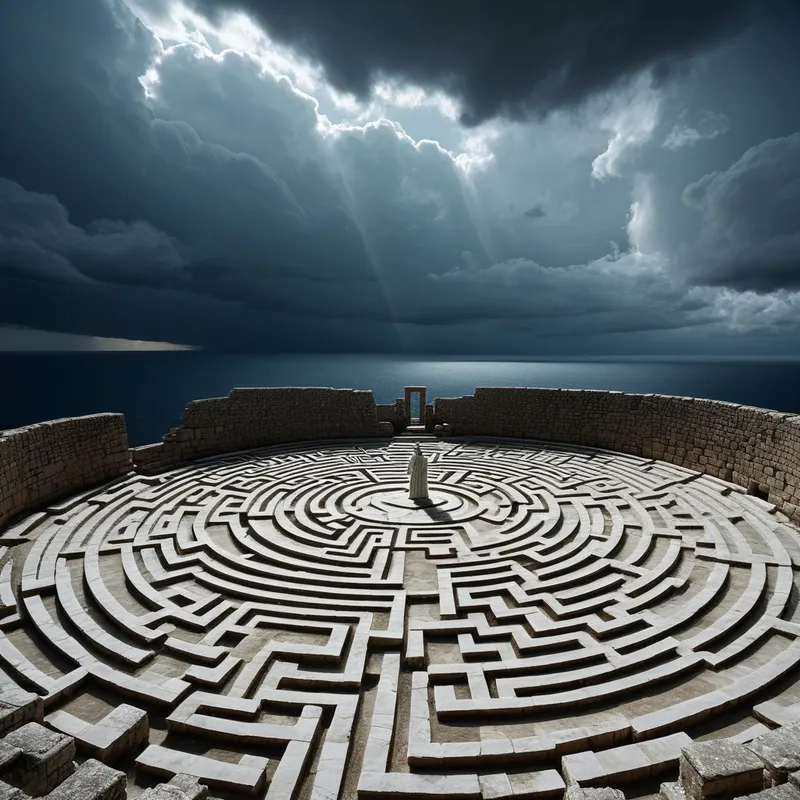
The Labyrinth of the Minotaur Myth Meaning & Symbolism
A hero descends into a monstrous maze to face a half-bull, half-man, navigating a dark architecture of shame to reclaim his lineage and his soul.
The Tale of The Labyrinth of the Minotaur
Hear now of a prison built for a monster, and a monster born of a king’s shame. On the isle of Crete, where the wine-dark sea kisses the shore, King [Minos](/myths/minos “Myth from Greek culture.”/) ruled. He prayed to [Poseidon](/myths/poseidon “Myth from Greek culture.”/) for a sign of favor, a bull from the waves to sacrifice. The god sent a bull, magnificent and white as sea-foam, its horns tipped with [pearl](/myths/pearl “Myth from Chinese culture.”/). But [Minos](/myths/minos “Myth from Greek culture.”/), coveting such splendor, kept it and sacrificed another. [The sea](/myths/the-sea “Myth from Greek culture.”/)-god’s wrath is a cold, patient [thing](/myths/thing “Myth from Norse culture.”/). He made Pasiphaë, the queen, burn with an unholy desire for the white bull.
From this cursed union, a child was born—not a babe, but a creature. He had the muscled torso of a man and the great, shaggy head and shoulders of a bull. They named him Asterion, but [the world](/myths/the-world “Myth from Tarot culture.”/) would know him as the [Minotaur](/myths/minotaur “Myth from Greek culture.”/). His bellow was not of a man, nor wholly of a beast, but a sound of profound loneliness. To hide his wife’s transgression and his own dishonor, Minos summoned the legendary artificer, Daedalus, and commanded him: “Build a holding place from which nothing that enters may ever leave.”
And so Daedalus, with a heavy heart, conceived the [Labyrinth](/myths/labyrinth “Myth from Various culture.”/). It was not merely a maze of high walls, but a place of the soul. Paths doubled back on themselves, corridors sloped imperceptibly, doorways led to blank walls. The very air within grew still and stale, thick with the scent of damp stone and despair. Here, in the sunless heart of this stone puzzle, [the Minotaur](/myths/the-minotaur “Myth from Greek culture.”/) was placed. And here, to sate its hunger and Minos’s vengeance, the king demanded a terrible tribute from Athens, which he had conquered: seven youths and seven maidens, sent every nine years, to be cast into [the Labyrinth](/myths/the-labyrinth “Myth from Greek culture.”/)’s maw.
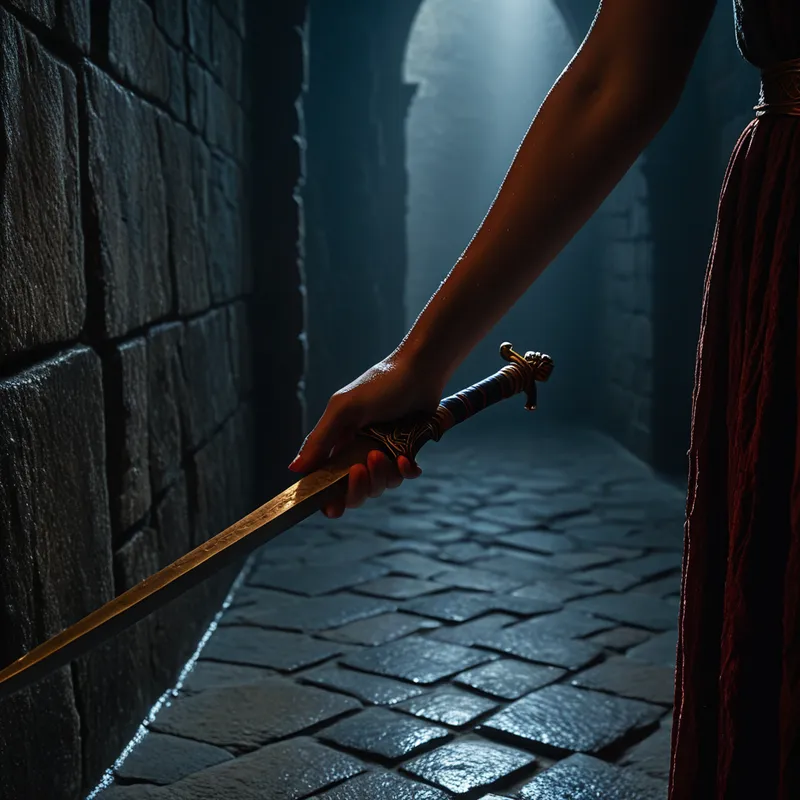
The third tribute brought a different offering: [Theseus](/myths/theseus “Myth from Greek culture.”/), prince of Athens, who volunteered to be among the sacrificial victims. As the black-sailed ship left for Crete, his father, King Aegeus, begged him: “If you live, change the sails to white.” On Crete, Ariadne, daughter of Minos, saw [Theseus](/myths/theseus “Myth from Greek culture.”/) and her heart, too, became a labyrinth of desire and defiance. She went to Daedalus, who gave her the answer to his own creation: a simple skein of thread. She found Theseus in the dark holding cell, pressed the thread and a sword into his hands, and whispered the plan.
At dawn, the gates groaned open. The fourteen Athenians were pushed into a twisting stone throat. Theseus tied the thread to the lintel, and they ventured into the whispering dark. The sounds were of dripping [water](/myths/water “Myth from Chinese culture.”/), of scuttling things, and of their own ragged breath. The path was a confusion, a geometry of madness. One by one, his companions were lost to the shadows, their cries echoing then fading. Deeper and deeper Theseus went, the thread his only tether to the world above, until he came to the center.
It was not a grand chamber, but a wide, dusty space. And there, in the gloom, stood the Minotaur. Its eyes held not mere animal rage, but a deep, cognizant agony. It charged, a force of primal fury. The fight was brutal, short, and profoundly sad. Theseus drove his sword home. The creature fell with a sigh that seemed to shake the very stones. Using the thread, Theseus led the surviving Athenians back to the light, to Ariadne, and to a ship waiting to carry them away from the nightmare. But in the [triumph](/myths/triumph “Myth from Roman culture.”/), he forgot his father’s plea. The sails remained black. Seeing them from the cliffs of Athens, Aegeus believed his son dead and cast himself into the sea that bears his name to this day.
Cultural Origins & Context
This is a core myth of the ancient Greek world, most comprehensively told in the works of later writers like Plutarch and woven into the epic cycles of Athenian foundation. It is not a single, frozen story but an oral tradition that evolved, reflecting the complex relationship between the powerful Minoan civilization of Crete (which the Greeks called “thalassocratic” or sea-ruling) and the rising mainland power of Mycenaean and later Classical Athens. The myth served multiple societal functions: as an etiological tale explaining Athenian subjugation and eventual supremacy, as a narrative reinforcing the heroic ideal of the city-savior, and as a profound cautionary tale about the consequences of broken oaths to the gods (hubris) and the perils of unnatural desire. It was performed, not read, a shared psychic inheritance that taught where monsters come from—not from the wilds, but from the corrupted heart of civilization itself.
Symbolic Architecture
The [Labyrinth](/symbols/labyrinth “Symbol: The labyrinth represents a complex journey, symbolizing the intricate path toward self-discovery and understanding one’s life’s direction.”/) is the ultimate [symbol](/symbols/symbol “Symbol: A symbol can represent an idea, concept, or belief, serving as a powerful tool for communication and understanding.”/) of the complex, winding, and often terrifying [structure](/symbols/structure “Symbol: Structure in dreams often symbolizes stability, organization, and the framework of one’s life, reflecting how one perceives their environment and personal life.”/) of the unconscious [psyche](/myths/psyche “Myth from Greek culture.”/). It is a constructed [confusion](/symbols/confusion “Symbol: A state of mental uncertainty or disorientation, often reflecting internal conflict, lack of clarity, or overwhelming choices in waking life.”/), a [prison](/symbols/prison “Symbol: Prison in dreams typically represents feelings of restriction, confinement, or a lack of freedom in one’s life or mind.”/) built by the rational, cunning mind (Daedalus) to contain what the conscious ego (Minos) cannot accept or integrate.
The monster in the maze is not what we fear we might meet, but what we fear we might be.
The [Minotaur](/symbols/minotaur “Symbol: The Minotaur, a creature from Greek mythology, is often interpreted as a symbol of inner turmoil and the struggle between human and beast.”/) is the [shadow](/symbols/shadow “Symbol: The ‘shadow’ embodies the unconscious, repressed aspects of the self and often represents fears or hidden emotions.”/) incarnate—the rejected, bestial, and passionate half born from a [king](/symbols/king “Symbol: A symbol of ultimate authority, leadership, and societal order, often representing the dreamer’s inner power or external control figures.”/)’s broken vow and a [queen](/symbols/queen “Symbol: A queen represents authority, power, nurturing, and femininity, often embodying leadership and responsibility.”/)’s transgressive desire. It represents the untamed libido, the raw instinctual [nature](/symbols/nature “Symbol: Nature symbolizes growth, connectivity, and the primal forces of existence.”/) that society and the conscious self deem monstrous and seek to bury. Yet, it is also profoundly tragic, a being of immense power condemned for the sin of its [origin](/symbols/origin “Symbol: The starting point of a journey, often representing one’s roots, source, or initial state before transformation.”/). Ariadne’s thread is the slender, vital [connection](/symbols/connection “Symbol: Connection symbolizes relationships, communication, and bonds among individuals.”/) to [consciousness](/symbols/consciousness “Symbol: Consciousness represents the state of awareness and perception, encompassing thoughts, feelings, and experiences.”/), to love, to [intuition](/symbols/intuition “Symbol: The immediate, non-rational understanding of truth or insight, often described as a ‘gut feeling’ or inner knowing that bypasses conscious reasoning.”/)—the “Aha!” [moment](/symbols/moment “Symbol: The symbol of a ‘moment’ embodies the significance of transient experiences that encapsulate emotional depth or pivotal transformations in life.”/) in therapy or [analysis](/symbols/analysis “Symbol: The process of examining something methodically to understand its components or meaning. In dreams, it represents the mind’s attempt to break down complex experiences.”/) that guides one back through the twists of a complex. Theseus’s [journey](/symbols/journey “Symbol: A journey in dreams typically signifies adventure, growth, or a significant life transition.”/) is [the ego](/myths/the-ego “Myth from Jungian culture.”/)’s necessary, perilous descent into the unconscious to confront and integrate the [shadow](/symbols/shadow “Symbol: The ‘shadow’ embodies the unconscious, repressed aspects of the self and often represents fears or hidden emotions.”/). His victory is not a [celebration](/symbols/celebration “Symbol: The symbol of ‘celebration’ represents joy, accomplishment, and community, often serving as a collective acknowledgment of achievements or significant life milestones.”/) of slaughter, but a somber [integration](/symbols/integration “Symbol: The process of unifying disparate parts of the self or experience into a cohesive whole, often representing psychological wholeness or resolution of internal conflict.”/); he does not become the [Minotaur](/symbols/minotaur “Symbol: The Minotaur, a creature from Greek mythology, is often interpreted as a symbol of inner turmoil and the struggle between human and beast.”/), but he must acknowledge and overcome the part of himself that is capable of being it.
The Dreamer’s Resonance
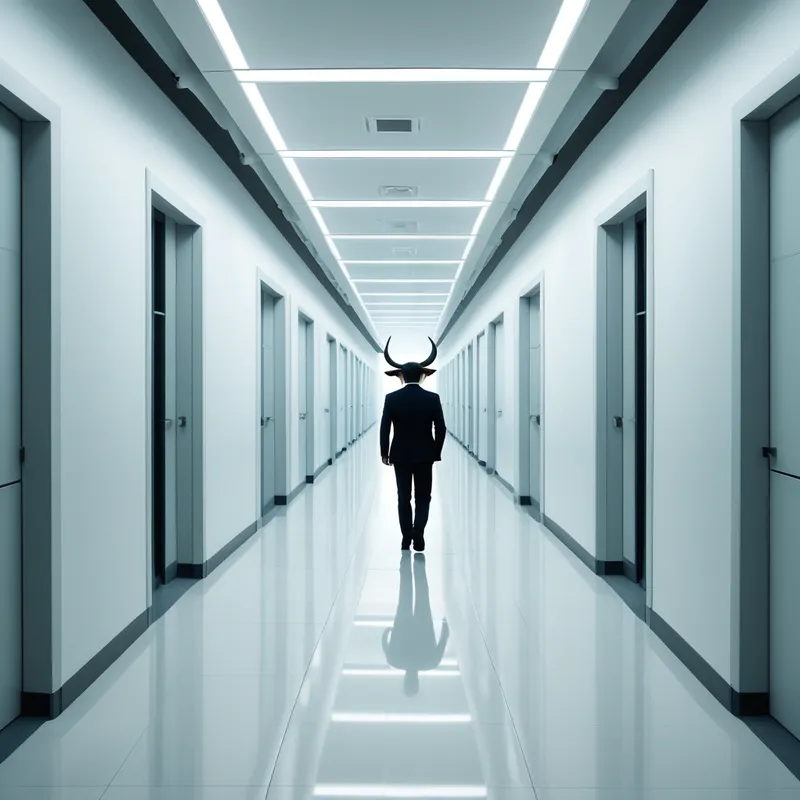
When this myth pattern stirs in modern dreams, the dreamer is navigating a psychological process of feeling trapped, lost, or pursued by an unrecognizable part of themselves. The labyrinth may appear as an endless bureaucracy, a repeating suburban street, or a vast, impersonal data network. The somatic feeling is one of constriction in the chest, a quickening pulse, the dread of the unseen turn. The Minotaur is rarely seen fully; it is a pressure, a sound of heavy breath in the next room, a looming presence in a corporate boardroom, or the face of a stranger that holds a terrifying familiarity. This dream signals that an aspect of [the self](/myths/the-self “Myth from Jungian culture.”/)—perhaps a buried anger, a stifled creativity, or a sexual shame—has grown powerful in the darkness and now demands recognition. The dream is the psyche’s way of initiating the confrontation the waking self has avoided, forcing the dreamer to become their own Theseus, seeking their own thread.
Alchemical Translation
The alchemical journey of the myth maps perfectly onto the process of individuation. The initial state is one of [nigredo](/myths/nigredo “Myth from Alchemical culture.”/), the blackening: the oppressive rule of King Minos (the rigid, prideful ego), the hidden shame (Pasiphaë’s desire), and the creation of the labyrinth (the complex).
The hero’s sword is not a weapon of destruction, but the discriminating light of consciousness that separates the useful from the monstrous within the primal unity.
The descent is the [solutio](/myths/solutio “Myth from Alchemical culture.”/), the dissolution of the ego’s certainty in the maze of the unconscious. Confronting the Minotaur is the fiery calcinatio—the burning encounter with [the shadow](/myths/the-shadow “Myth from Jungian culture.”/), where the raw material of the psyche is tested by extreme emotion. The slaying is not a killing but a [separatio](/myths/separatio “Myth from Alchemical culture.”/); the instinctual energy is separated from its monstrous, autonomous form. Using the thread to return is the coagulatio, the re-forming of the conscious self now enriched and altered by the encounter. The final stage, often overlooked, is the tragedy of the black sails—the mortificatio. Even in triumph, there is a cost. The old king (the former, naive ego) must die for the new, more conscious self to fully reign. The integrated individual carries the memory of the monster and the maze within, no longer as a prison, but as a charted territory of the soul.
Associated Symbols
Explore related symbols from the CaleaDream lexicon: