The Labyrinth Entrance Myth Meaning & Symbolism
The story of the hero Theseus entering the Labyrinth to face the Minotaur, a primal tale of confronting the monstrous self within a sacred maze.
The Tale of The Labyrinth Entrance
Hear now the tale of the threshold, the story of the door that is also a mouth. It begins not in sunlight, but in the shadow of a king’s shame and a monster’s hunger.
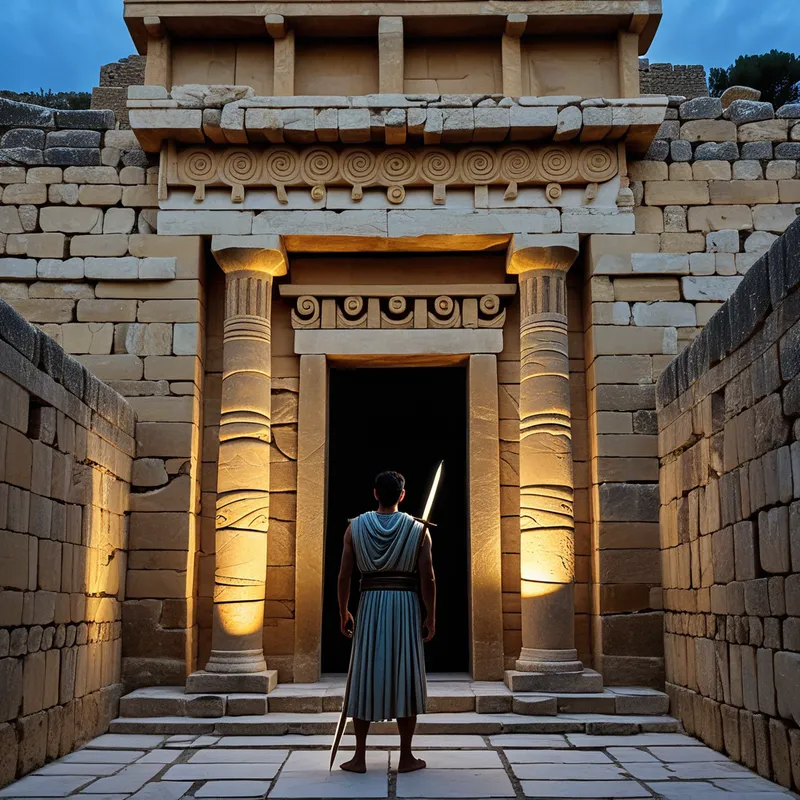
On the great island of Crete, beneath a palace that sprawled like a waking dream, there lay a wound in the earth. King Minos, his pride stung by the gods and his wife Pasiphaë cursed with a terrible desire, commanded the divine artifcer Daedalus to build a prison for the fruit of that curse: the Minotaur. But Daedalus did not build a cage of bars. He built a Labyrinth—a winding, turning, coiling thing of stone, a puzzle with a monster at its heart and a single, secret path through its belly. Its entrance was a gaping maw of polished stone, adorned with spirals that seemed to move in the flickering torchlight, a promise of confusion and a guarantee of death for any who entered without the key to its turns.
From across the wine-dark sea came the tribute: seven youths and seven maidens from Athens, bound for the Minotaur’s hunger. Among them walked Theseus, prince of Athens, his heart not bowed by fear but burning with a hero’s fire. He would enter the maze. He would slay the beast. But to do so, he needed to defy the Labyrinth’s first and greatest magic: it was made to make men forget. To lose their way. To become as lost as the monster they hunted.
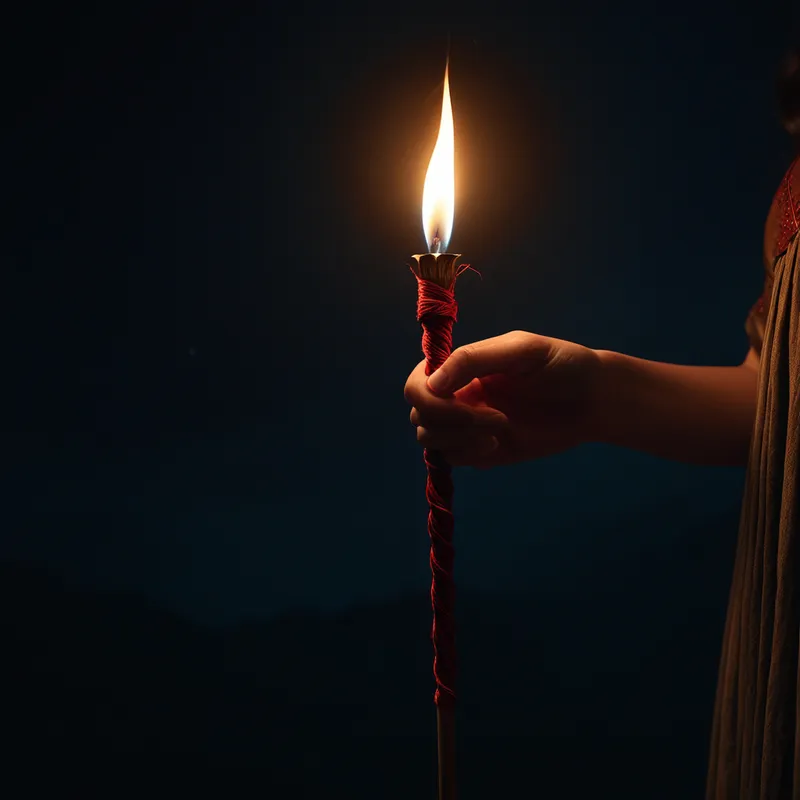
And here, at the threshold, appears not a warrior, but a weaver. Ariadne, daughter of Minos, saw the prince and her fate shifted. In the deep night, she came to him. Not with a sword, but with a spindle. In her hands was a simple skein of crimson thread. “Tie this to the stone at the entrance,” she whispered, her voice the only clear sound in that place of echoes. “Unwind it as you go. It will be your memory. It will be your way back to the light. It will be your connection to the world outside this stone gut.”
So Theseus stood at the entrance. He felt the cold breath of the maze on his face, smelling of damp earth and ancient fear. He placed his hand on the sun-warmed stone of the outer world, tied the thread fast, and stepped into the cool, consuming dark. The crimson line spilled from his hand, a fragile artery connecting his pounding heart to the realm of life. With each step, the light from behind faded, until there was only the sound of his breath, the scrape of his sandals, the whisper of the thread running through his fingers, and the distant, echoing bellow of the beast that waited in the absolute center.
Cultural Origins & Context
This is a core myth of the Minoan-Mycenaean transition, later crystallized by Athenian storytellers like the poet Bacchylides and, most famously, in the Bibliotheca of Pseudo-Apollodorus. For the emerging city-state of Athens, the myth served a potent political and social function. It transformed a likely historical tribute—a symbol of subjugation to the older Minoan thalassocracy—into a foundational hero narrative. Theseus’s journey became an allegory for Athenian courage and intellect overcoming brute, chaotic force.
The story was not merely recited; it was performed. It lived in the oral tradition of bards, in the rituals of coming-of-age, and in the visual culture painted on pottery and etched into stone. The Labyrinth itself was not just a storybook setting; its pattern—the classic seven-circuit design—has been found on coins and as a petroglyph across the Mediterranean, suggesting it functioned as a ritual symbol long before the Theseus myth was attached to it. It was a dance pattern, a meditation path, a representation of the difficult journey to the center of things, whether that center was the self, the divine, or the underworld.
Symbolic Architecture
The entrance to the Labyrinth is the most critical, and most overlooked, symbol in the entire myth. It is the liminal space, the point of no return. It represents the conscious decision to engage with the unconscious, with the complex, tangled, and monstrous aspects of the psyche.
The hero does not triumph by strength alone, but by accepting the humble thread offered at the threshold. The true weapon is the connection back to consciousness.
The Minotaur is the ultimate shadow: the bestial, shameful, and potent energy born of a king’s hubris and a queen’s transgressive desire. It is not “evil” in a simplistic sense; it is the unintegrated, ravenous part of the self that has been hidden away in a maze of denial and complexity. Ariadne represents the guiding function of the soul (psyche), the anima that offers the connective insight (the thread) necessary for the heroic ego (Theseus) to navigate the inner chaos without being consumed by it. The thread itself is the symbol of relatedness and memory—the thin, vital line of consciousness, intention, and love that must be maintained when one descends into the depths.
The Dreamer’s Resonance
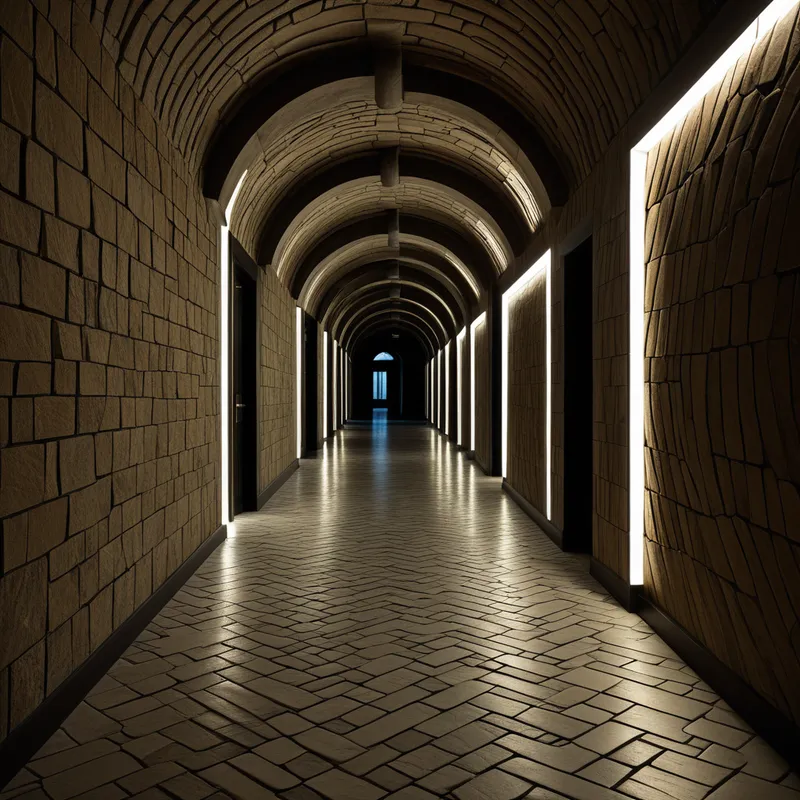
When the Labyrinth entrance appears in a modern dream, it is rarely a literal stone doorway. It manifests as the beginning of a confounding process: the start of a new job that feels overwhelmingly complex, the first therapy session, the moment a difficult conversation begins, or the first page of a creative project that intimidates. The somatic feeling is one of standing on a precipice, of chilled anticipation in the gut.
The dream is signaling an initiation. The dreamer is being presented with the necessity—and the terror—of entering their own inner maze to face something they have been feeding with their avoidance, their shame, or their unexamined passions. The critical question the dream poses is: What is your thread? What is the simple, practical, connective principle you will hold onto? Is it a daily journal entry? A commitment to truthful conversation with a partner? A creative practice? The dream of the entrance is a call to secure that thread before proceeding, for the maze is designed to make you forget why you entered in the first place.
Alchemical Translation
The journey of Theseus is a perfect map of the individuation process. The alchemical work begins not in the fight with the beast, but in the conscious, willing step across the threshold. This is the nigredo, the descent into the blackness, the confrontation with the prima materia of the soul—which is often experienced as confusion, depression, or chaos.
The maze is not a prison if you hold the end of the thread. It becomes a sacred path of return.
Ariadne’s thread is the symbol of the transforming function that makes the descent purposeful. It is the observing ego, the therapeutic alliance, the spiritual practice—the thing that allows for analysis and integration rather than possession by the shadow. Slaying the Minotaur is the integration of the shadow; it is not its destruction, but its acknowledgment and taming, bringing its potent, bull-like energy under the dominion of the human self. The triumphant return, following the thread back to the light, represents the emergence of the newly integrated personality, carrying the wisdom of the center back into the world. However, the myth in its fullness reminds us that this is not a one-time event. Theseus, in his later carelessness, forgets Ariadne—he neglects the very guiding principle that saved him. The Labyrinth, therefore, is not conquered once and for all. Its entrance remains, a permanent archetypal threshold in the psyche, waiting for the next time we must gather our courage, secure our thread, and descend to meet what we have hidden at our core.
Associated Symbols
Explore related symbols from the CaleaDream lexicon: