The Labyrinth & Ariadne's Thread Myth Meaning & Symbolism
A hero, a monster, a princess, and a thread. The ancient story of navigating the ultimate maze to confront the beast within and find the way out.
The Tale of The Labyrinth & Ariadne’s Thread
Hear now the tale of stone and shadow, of a beast born of shame and a king’s desperate pride. On the isle of Crete, where [the sea](/myths/the-sea “Myth from Greek culture.”/) whispers against sun-bleached rock, King [Minos](/myths/minos “Myth from Greek culture.”/) ruled. His power was absolute, a gift from the sea god [Poseidon](/myths/poseidon “Myth from Greek culture.”/) himself. Yet a gift from the gods is a coiled serpent; it may bless or bind. When [Minos](/myths/minos “Myth from Greek culture.”/) betrayed his vow, the god’s wrath took a terrible form. From the waves came a bull, pure and white as sea-foam, and from the queen’s unnatural passion for this beast was born a creature: half-man, half-bull, all fury. They named him the [Minotaur](/myths/minotaur “Myth from Greek culture.”/), the “Bull of [Minos](/myths/minos “Myth from Greek culture.”/).”
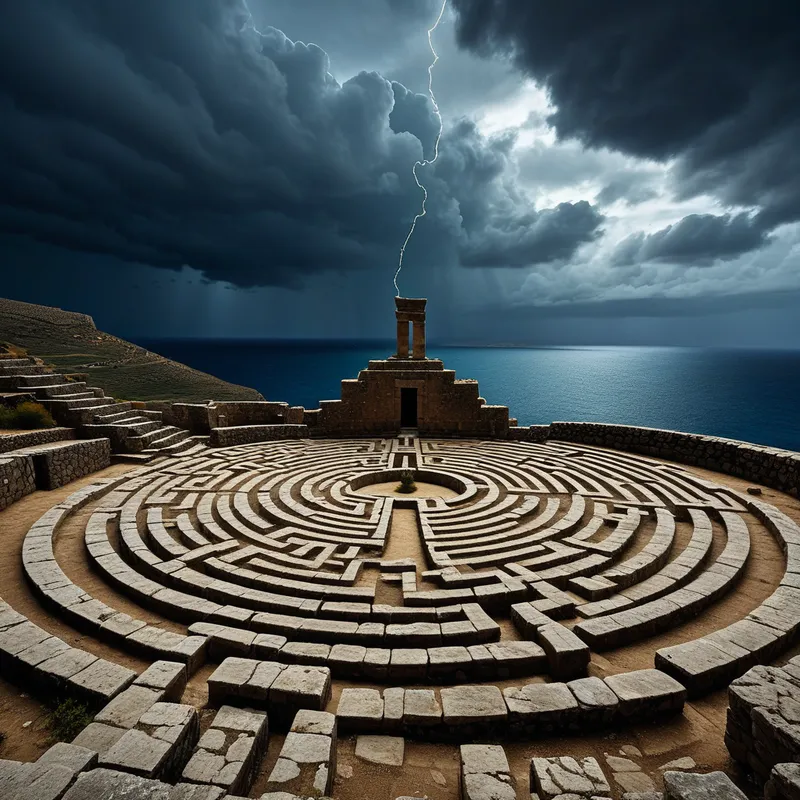
His roaring shook the palace foundations. His hunger was for human flesh. To hide his family’s disgrace and sate the monster’s endless appetite, Minos summoned the genius of Daedalus. “Build me a prison,” commanded the king, “from which nothing that enters may ever leave.” And so Daedalus, his mind a [labyrinth](/myths/labyrinth “Myth from Various culture.”/) itself, conceived a structure of such bewildering complexity it became a living riddle in stone: the [Labyrinth](/myths/labyrinth “Myth from Various culture.”/). Its passages doubled back on themselves, its corridors were identical and endless, a geometric madness where the very walls seemed to breathe and shift. Into its heart, [the Minotaur](/myths/the-minotaur “Myth from Greek culture.”/) was cast.
And the price for this hidden horror? Tribute. Every nine years, seven youths and seven maidens from vanquished Athens were sent into the winding stone gut of the maze, a sacrificial offering to the king’s secret shame. Their cries echoed, then faded, swallowed by the silent, waiting beast.
Then came a prince with the sea in his eyes: [Theseus](/myths/theseus “Myth from Greek culture.”/), son of Aegeus. He volunteered to be part of the tribute, not as victim, but as avenger. His ship, its sails black with mourning, arrived at Crete. In the court of Minos, a princess watched. Ariadne saw the Athenian’s resolve, his bearing unlike the doomed others, and Aphrodite pierced her heart with a desperate, treacherous love.
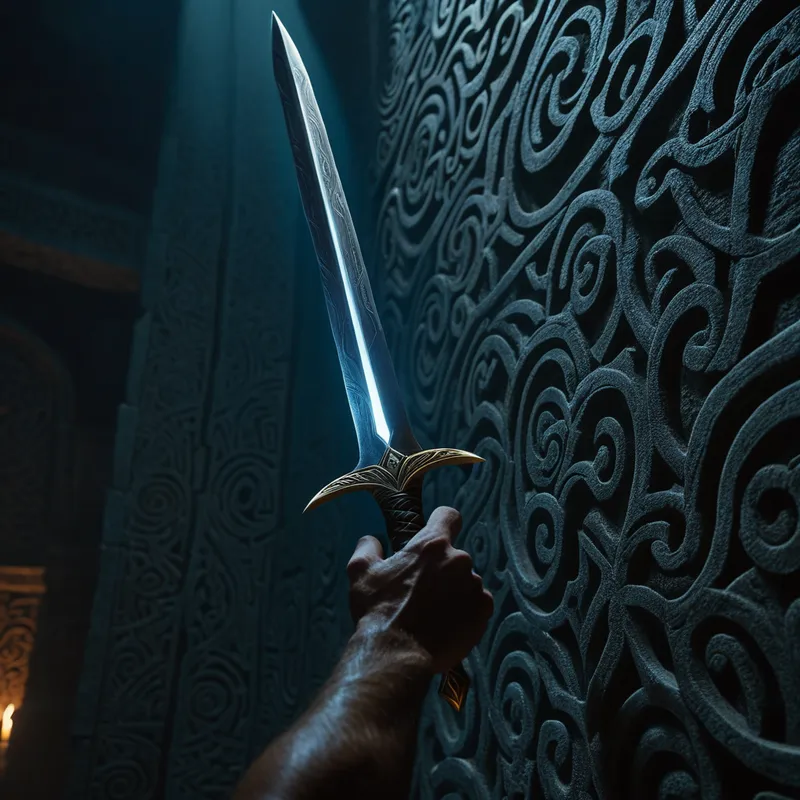
Before Theseus was forced into the maze’s gaping maw, Ariadne found him. In her hands was salvation: a simple ball of thread and a sword. “Tie this end to the stone at the entrance,” she whispered, her voice trembling with fear and hope. “Unwind it as you go. It will remember the path your mind cannot. It will lead you back from the darkness.” She also gave him the sword, its edge hungry for monstrous flesh.
Into [the Labyrinth](/myths/the-labyrinth “Myth from Greek culture.”/) Theseus descended. The air grew cold and still, thick with the smell of damp stone and old terror. The only sound was the scrape of his feet and the unspooling thread. Left, right, dead end, circle back—the thread, a crimson lifeline, was his sole tether to [the world](/myths/the-world “Myth from Tarot culture.”/) above. Deeper and deeper he went, into the epicenter of the myth, until he heard it: the wet, heavy breathing of the Minotaur.
The battle was not in a grand hall, but in a cramped, dark junction of passages. Beast and hero clashed, a chaos of muscle, horn, and gleaming bronze. With Ariadne’s gift, Theseus struck true. The Minotaur fell, its monstrous roar dying to a gurgle. The labyrinth, which had echoed with its rage for years, fell into a profound, listening silence.
Then, the crucial turn. Victorious, but in the absolute dark, Theseus did not celebrate. He sought the thread. His fingers found it, slick with condensation, lying on the cold floor. He followed it, hand over hand, the same path now leading outward, upward. The thread did not judge, did not forget. It led him past the bones of those less fortunate, through the identical arches, back to the blinding light of the entrance, to the waiting Ariadne and the promise of freedom.
Cultural Origins & Context
This myth, as we know it, was crystallized in the poetic works of authors like Hesiod and later in the vivid narratives of Ovid. It was not mere entertainment. It functioned as a foundational narrative for the Athenian city-state, explaining and justifying its historical rivalry and eventual dominance over Minoan Crete. Theseus’s [triumph](/myths/triumph “Myth from Roman culture.”/) symbolized Athenian heroism and political order conquering the older, more chaotic, and potentially tyrannical power represented by Minos and his monster.
The story was performed, painted on pottery, and sculpted into temples. It was a shared cultural code. The Labyrinth itself may echo the complex, multi-chambered palaces of historical Minoan Crete, which to later Greeks seemed like impenetrable mazes. The myth was a way to process the mystery and danger of a powerful, neighboring civilization, transforming it into a monster to be slain by a civilized hero. It was passed down as a lesson in cunning over brute strength, in the necessity of external aid (Ariadne’s thread), and in the Athenian ideal of the citizen-hero who ventures into chaos to secure his people’s safety.
Symbolic Architecture
The [Labyrinth](/symbols/labyrinth “Symbol: The labyrinth represents a complex journey, symbolizing the intricate path toward self-discovery and understanding one’s life’s direction.”/) is the ultimate [symbol](/symbols/symbol “Symbol: A symbol can represent an idea, concept, or belief, serving as a powerful tool for communication and understanding.”/) of the unconscious [psyche](/myths/psyche “Myth from Greek culture.”/). It is not a [dungeon](/symbols/dungeon “Symbol: A dark, confined underground prison or labyrinth, often representing subconscious fears, psychological constraints, or hidden aspects of the self.”/) with a single [door](/symbols/door “Symbol: A door symbolizes transition, opportunity, and choices, representing thresholds between different states of being or experiences.”/), but a confounding, [inward](/symbols/inward “Symbol: A journey toward self-awareness, introspection, and the exploration of one’s inner world, thoughts, and unconscious mind.”/)-turning [structure](/symbols/structure “Symbol: Structure in dreams often symbolizes stability, organization, and the framework of one’s life, reflecting how one perceives their environment and personal life.”/). It represents a state of [confusion](/symbols/confusion “Symbol: A state of mental uncertainty or disorientation, often reflecting internal conflict, lack of clarity, or overwhelming choices in waking life.”/), a [life](/symbols/life “Symbol: The symbol of ‘Life’ represents a journey of growth, interconnectedness, and existential meaning, encompassing both the joys and challenges that define human experience.”/) [crisis](/symbols/crisis “Symbol: A crisis symbolizes turmoil, urgent challenges, and the need for immediate resolution or change.”/), a neurotic [pattern](/symbols/pattern “Symbol: A ‘Pattern’ in dreams often signifies the underlying structure of experiences and thoughts, representing both order and the repetitiveness of life’s situations.”/), or the tangled [depths](/symbols/depths “Symbol: Represents the subconscious, hidden emotions, or foundational aspects of the self, often linked to primal fears or profound truths.”/) of one’s own mind where the [minotaur](/symbols/minotaur “Symbol: The Minotaur, a creature from Greek mythology, is often interpreted as a symbol of inner turmoil and the struggle between human and beast.”/) of our unresolved [trauma](/symbols/trauma “Symbol: A deeply distressing or disturbing experience that overwhelms the psyche, often manifesting in dreams as unresolved emotional wounds or psychological injury.”/) and instinctual [shadow](/symbols/shadow “Symbol: The ‘shadow’ embodies the unconscious, repressed aspects of the self and often represents fears or hidden emotions.”/) resides.
The Labyrinth is not a prison you are put in, but a psyche you are born with. The Minotaur is not a monster you meet, but one you must become conscious of.
The Minotaur is the embodied shadow—the bestial, untamed, and shameful [aspect](/symbols/aspect “Symbol: A distinct feature, quality, or perspective of something, often representing a partial view of a larger whole.”/) of [the self](/myths/the-self “Myth from Jungian culture.”/) that is hidden away at the center of our personal [maze](/symbols/maze “Symbol: A maze represents confusion, complexity, or a search for truth, often reflecting life’s challenges or inner turmoil.”/). Born of a transgression (Poseidon’s [bull](/symbols/bull “Symbol: The bull often symbolizes strength, power, and determination in many cultures.”/), Pasiphaë’s desire), it represents the primal, chaotic energies that culture and [consciousness](/symbols/consciousness “Symbol: Consciousness represents the state of awareness and perception, encompassing thoughts, feelings, and experiences.”/) seek to repress. Confronting it is not optional for wholeness.
Ariadne’s thread is the symbol of syntropy—the guiding principle, the connecting [insight](/symbols/insight “Symbol: A sudden, deep understanding of a complex situation or truth, often arriving unexpectedly and illuminating hidden connections.”/), the slender but unbreakable link to consciousness. It is not intelligence, but [connection](/symbols/connection “Symbol: Connection symbolizes relationships, communication, and bonds among individuals.”/). It represents the love (Ariadne), the therapy, the spiritual practice, the creative [impulse](/symbols/impulse “Symbol: A sudden, powerful urge or drive that arises without conscious deliberation, often linked to primal instincts or emotional surges.”/), or the remembered vow that allows one to [journey](/symbols/journey “Symbol: A journey in dreams typically signifies adventure, growth, or a significant life transition.”/) into [disintegration](/symbols/disintegration “Symbol: A symbol of breakdown, loss of form, or fragmentation, often reflecting anxiety about personal identity, control, or stability.”/) without becoming permanently lost.
Theseus is [the ego](/myths/the-ego “Myth from Jungian culture.”/)-consciousness that volunteers for the descent. He represents the part of us that must actively engage with the inner [chaos](/symbols/chaos “Symbol: In Arts & Music, chaos represents raw creative potential, uncontrolled expression, and the breakdown of order to forge new artistic forms.”/), armed with the sword of discrimination (the [ability](/symbols/ability “Symbol: In dreams, ‘ability’ often denotes a recognition of skills or potential that one possesses, whether acknowledged or suppressed.”/) to cut through illusion) and the thread of [guidance](/symbols/guidance “Symbol: The act of receiving or seeking direction, advice, or leadership in a dream, often representing a need for clarity, support, or a higher purpose on one’s life path.”/).
The Dreamer’s Resonance
When this myth appears in modern dreams, the dreamer is often at a critical juncture of inner searching or feeling profoundly stuck. Dreaming of being lost in a maze—be it a building, a forest, or an endless series of rooms—signals a state of psychological disorientation. The somatic feeling is one of tightening in the chest, shallow breath, and a desperate need to find an exit that remains elusive.
If the Minotaur appears, it often manifests not as a literal bull-man, but as a looming presence, a chasing figure, a terrifying animal, or even an overwhelming emotion like rage or shame that stalks the dreamer through the dream corridors. This indicates that a core shadow element is demanding attention. The act of finding or following a thread, a string of light, a voice, or a known path in the dream marks the moment the psyche provides its own “Ariadne’s thread”—an intuitive hint, a memory, or an emerging insight that promises a way through the confusion. The dream is the psyche’s nightly enactment of the heroic journey toward integration.
Alchemical Translation
The myth models the complete process of individuation. The first step is the voluntary descent (Theseus offering himself). One must consciously choose to engage with one’s inner complexity, not just be victimized by it.
The journey inward ([nigredo](/myths/nigredo “Myth from Alchemical culture.”/), the blackening) is the confusing, dark, and often despairing navigation of the labyrinth of one’s personal history and complexes. At the center lies the conjunction, the fierce engagement with [the shadow](/myths/the-shadow “Myth from Jungian culture.”/) (the battle). This is not about annihilation, but about recognition and integration. One must “slay” the monster’s autonomous, destructive power by bringing it into the light of consciousness.
The thread is the secret: the process is not about killing the Minotaur and leaving, but about using the encounter to find your way back to yourself, transformed.
Then comes the crucial, often overlooked, final alchemy: the return. Using the thread—the remembered connection to one’s purpose, relationships, and consciousness—to trace the path back out. The hero emerges not just with a victory, but with a map encoded in the thread itself. The maze is not destroyed; it is mastered. The integrated self now contains the labyrinth and its former monster, no longer as a terrifying secret, but as a source of deep, instinctual power. The thread becomes the newly spun integrity of the personality, the continuous line that connects the depths to the surface, the unconscious to the conscious, creating a coherent self that has looked into the heart of its own darkness and returned, guided by the slender, unwavering filament of love and insight.
Associated Symbols
Explore related symbols from the CaleaDream lexicon: