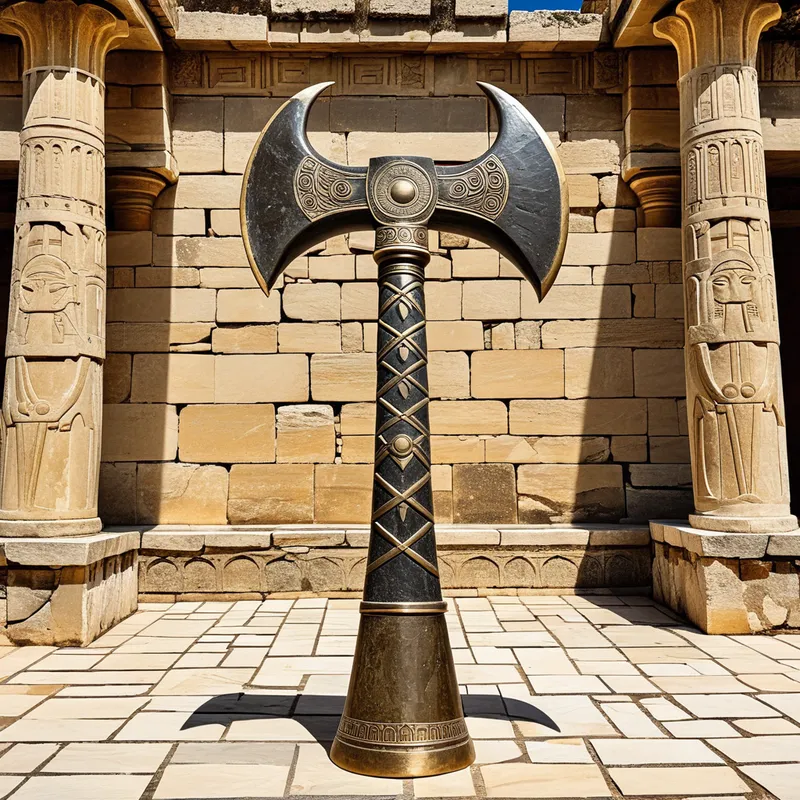
The Labrys Myth Meaning & Symbolism
The sacred double axe of Crete, a symbol of divine power, labyrinthine journeys, and the alchemical union of opposing forces within the soul.
The Tale of The Labrys
Hear now, a story not of a hero, but of a symbol. A story born in the heart of the wine-dark sea, on an island of stone and cypress: Crete. In the time when gods walked closer to the earth, and the breath of the bull was the wind of the world.
In the great house of Minos, a house so vast it was called the Labyrinth, a sound echoed. Not the roar of the beast in its dark heart, but the clear, ringing clang of bronze on bronze. It was the sound of the sacred smith, hammering form from fire. From the forge of the divine artisan, perhaps Hephaestus himself in older tales, or from the hands of the Daedalus, the cunning one, it emerged: the Labrys.
Its shape was a mystery made metal. Two great, crescent blades, mirror-images, born from a single, central haft. It was not a tool for war, though it held the promise of terrible division. It was an instrument of consecration. It was the scepter of the Goddess. In the central courts of Knossos, under the watchful eyes of the Snake Goddess, the Labrys stood. Priestesses in flounced skirts would raise it high in the ritual dance, its polished edges catching the sun, becoming twin arcs of captured light. It was the axis upon which the world turned, the cleaver that separated the sacred from the profane.
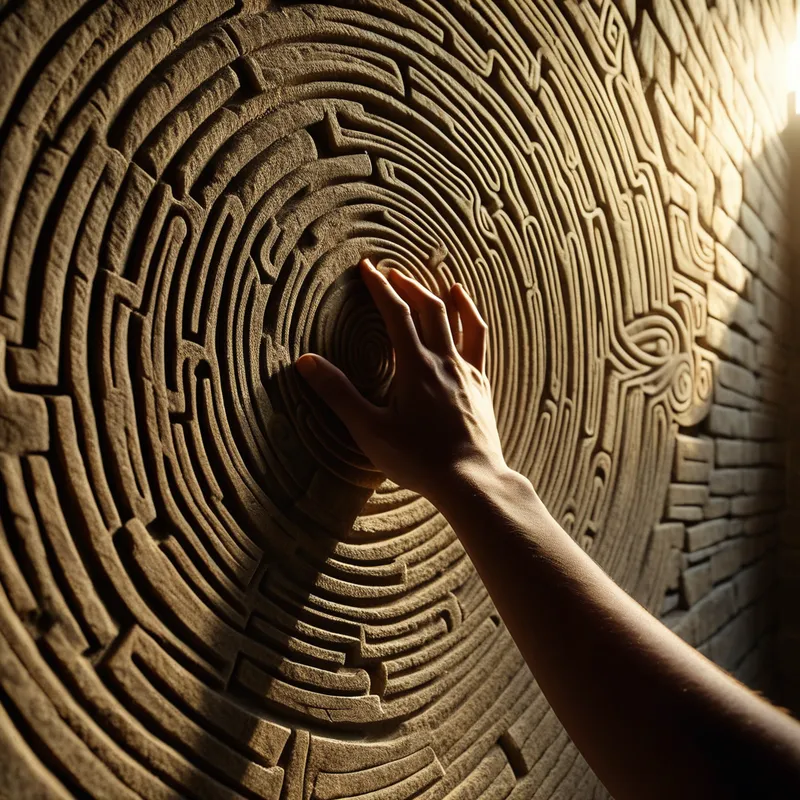
And in the deep places, in the winding paths where the stone walls whispered, the Labrys was the key and the guardian. The hero Theseus did not carry it, but its form was the map he followed. The labyrinth itself, they say, was the House of the Double Axe—Labryrinthos. To walk its coils was to pass between the blades, to be tested by duality itself: courage and fear, life and death, the human and the monstrous. The final confrontation in the dark was not just with the Minotaur, but with the raw, undivided power the Labrys represented. The triumph was not merely survival, but the reclaiming of the symbol—the threading of the duality back into a single, purposeful thread.
Cultural Origins & Context
The myth of the Labrys is uniquely rooted not in the later, Olympian-focused narratives of mainland Greece, but in the earlier, vibrant Minoan civilization. Here, it was less a “myth” told in epic verse and more a living, sacred reality embedded in art, architecture, and ritual. The Labrys appears incessantly in Minoan frescoes, on seals, and as a cult object, predating the familiar Greek pantheon’s full dominance.
It was a symbol of supreme, likely feminine, divine authority. The great palaces like Knossos, with their complex, non-defensive layouts centered around large courtyards, were perhaps less royal seats and more communal ritual centers—the literal “House of the Labrys.” The symbol functioned as a societal anchor, representing the generative and destructive power of nature (embodied by the Goddess), the authority of the priestly class, and the sophisticated craftsmanship of the culture. Its story was passed down not by bards, but by artisans, priests, and through the very walls of the labyrinthine palaces. After the decline of the Minoans, the symbol was absorbed and reinterpreted by the incoming Mycenaean and later classical Greek cultures, transforming from a central cult object into a legendary artifact within the myths of Theseus and Minos, thus preserving its awe in a new narrative language.
Symbolic Architecture
The Labrys is a master symbol of psychic architecture. Its primary meaning is not destruction, but sovereign division.
The Labrys does not merely cut; it delineates. It creates the sacred space by separating it from the chaotic whole. It is the act of conscious distinction.
Psychologically, it represents the essential human capacity for discernment—the ability to split complex, overwhelming wholes into manageable, conscious opposites: good and bad, conscious and unconscious, self and other. The central haft is the ego, the point of consciousness that must grip and wield these powerful opposites. The twin blades are the archetypal polarities that define our inner world.
Furthermore, it is a symbol of dynamic balance. Unlike a single-bladed axe, which implies a simple direction of force, the Labrys is symmetrical. It suggests that true power lies not in choosing one side, but in holding the tension of both. It models the coniunctio oppositorum—the alchemical marriage of opposites. The labyrinth it names is the journey of the soul through these paired opposites, where the monster at the center is the undifferentiated, unconscious self that must be faced and integrated.
The Dreamer’s Resonance
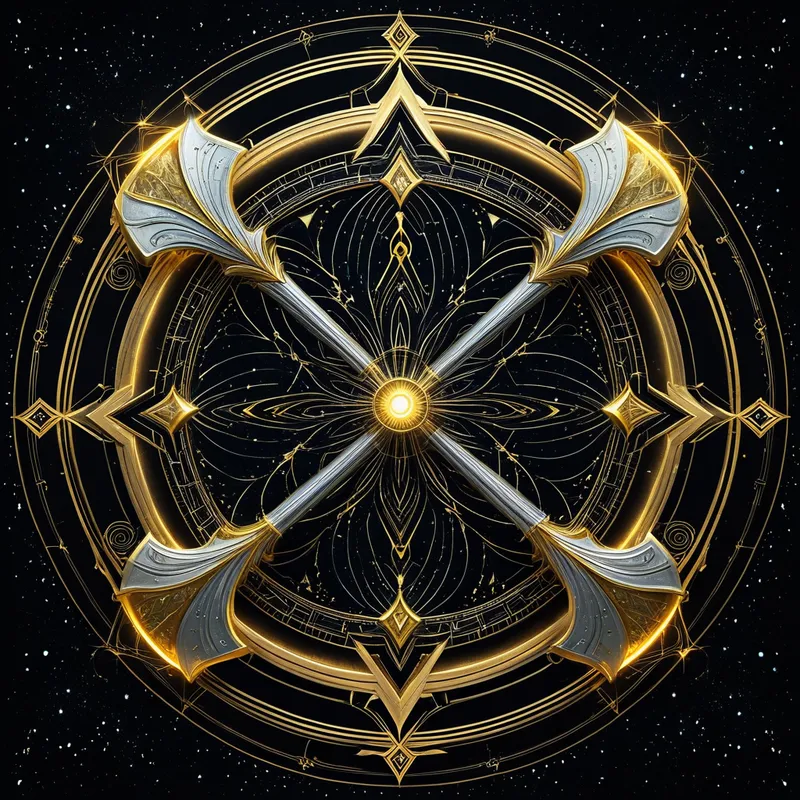
When the Labrys appears in a modern dream, it signals a profound moment of psychic initiation. It is not a call to action, but a call to discernment.
The dreamer may find themselves in a complex, confusing building or situation (the modern labyrinth). The appearance of the double axe—whether as a tool, a symbol on a wall, or a weapon—indicates that the psyche is activating its innate capacity for critical division. Somatically, this can feel like a tightening in the gut or chest, a pressure to choose or to define. The dreamer is being asked to consciously separate two fused elements in their life: perhaps duty from desire, a professional identity from a personal one, or a past trauma from present reality.
If the dreamer is wielding the Labrys, it suggests an active, if anxious, engagement with this process of differentiation. If it is looming over them or being wielded by another, it may represent an external authority or an internal archetypal force (the Self) demanding that they make necessary, perhaps painful, distinctions. The dream is an expression of the psyche’s own “smithing” process, forging the tool of consciousness needed to navigate an inner complexity.
Alchemical Translation
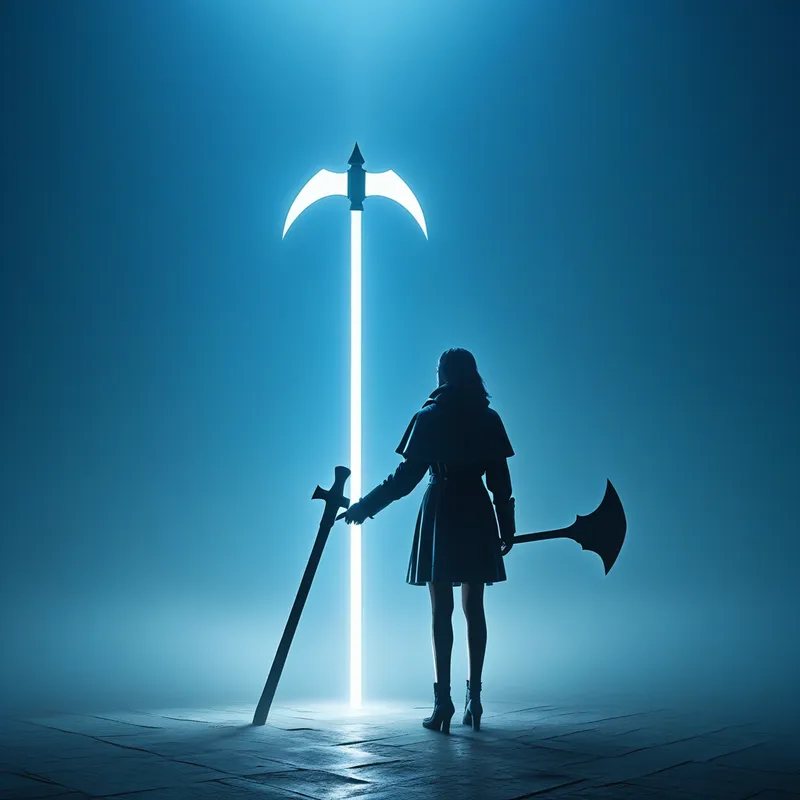
The alchemical journey modeled by the Labrys is the core of individuation. It maps the transformation from unconscious fusion to conscious, integrated duality.
The first stage (Nigredo) is the labyrinth itself: the confused, dark, and chaotic state of being lost in one’s own undifferentiated problems and potentials. The Minotaur is the shadow, the brute, unconscious complex that devours energy.
The Labrys is the tool of the Separatio, the crucial alchemical operation where the pure is parted from the impure, the essential from the superfluous.
Wielding the Labrys is the conscious work of analysis, introspection, and difficult choice (Albedo). It is using the blade of discrimination to cut away false identities, outdated loyalties, and compulsive behaviors. This is not a battle to kill a part of oneself, but a ritual sacrifice of unconsciousness. Each cut creates clarity.
The final stage (Rubedo) is symbolized by the Labrys’s symmetrical form. After the necessary divisions have been made, the task is not to live with one blade but to reunite the now-conscious opposites at a higher level. The haft—the integrated ego in service to the Self—becomes the axis for a new, revolving power. The once-threatening duality becomes a balanced, generative force. The individual emerges from their personal labyrinth not having destroyed their inner “monster,” but having harnessed its power, holding the double axe not as a weapon, but as a scepter of their own hard-won, sovereign wholeness.
Associated Symbols
Explore related symbols from the CaleaDream lexicon: