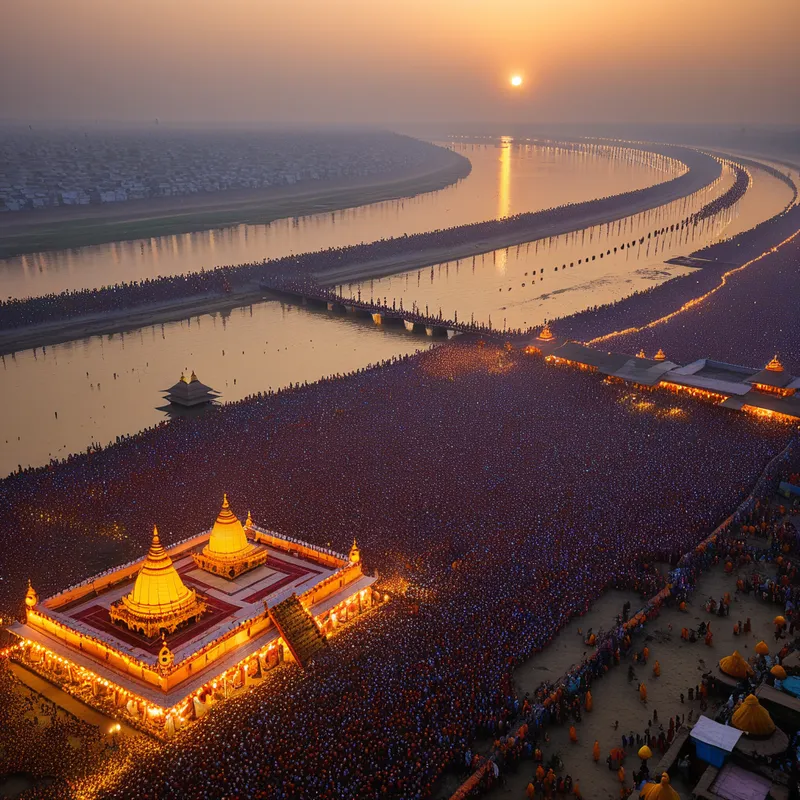
The Kumbh Mela Festival Grounds Myth Meaning & Symbolism
A celestial struggle for the nectar of immortality spills onto Earth, creating sacred sites where humanity gathers to bathe in time and remember its divine origin.
The Tale of The Kumbh Mela Festival Grounds
Listen. Before the world knew the names of its rivers, when the cosmos was still churning with possibility, the gods and the demons made a pact. They were weary of their endless war, their strength sapped, their immortality a fading memory. They agreed to work together, for once, to dredge the primordial ocean of milk, the Kshirasagara, for the nectar of immortality—the Amrita.
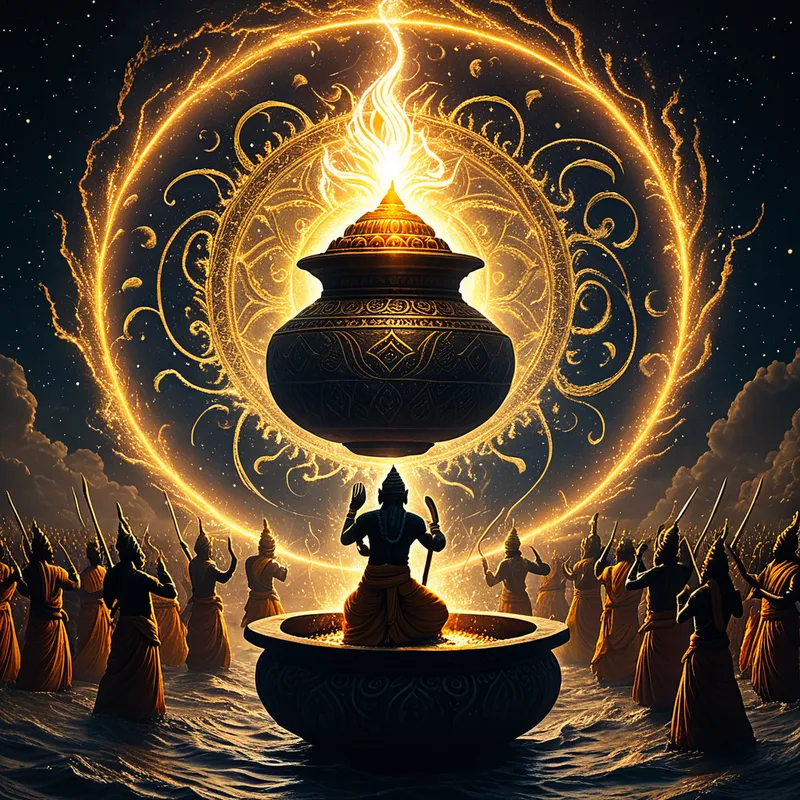
They uprooted the great mountain Mandara and set it upon the back of the great turtle-king, Kurma, who steadied it in the depths. The king of serpents, Vasuki, coiled himself around the mountain. The gods took hold of his tail; the demons, his fearsome head. With a great heave, they began to churn. The mountain spun, groaning, and the ocean frothed and boiled.
From its tortured depths emerged wonders and terrors: the deadly poison Halahala, swallowed by Shiva to save creation; the goddess of fortune, Lakshmi; the divine white elephant, Airavata. And finally, from the heart of the foam, emerged the radiant physician of the gods, Dhanvantari, holding aloft the gleaming pot, the Kumbh, brimming with the luminous Amrita.
The truce shattered. A desperate, cataclysmic struggle erupted across the heavens for possession of the Kumbh. For twelve days and twelve nights—a blink for the gods, an acon for mortals—the pot passed from hand to hand, a prize fought over with thunderbolts and maces. Drops of the precious nectar fell from the vessel, spilled in the fury of battle, and landed upon the earth below.
They fell at four places: at Prayagraj, where three rivers meet as one; at Haridwar, where the Ganges descends from the locks of Shiva; at Nashik, on the banks of the Godavari; and at Ujjain, on the banks of the Shipra. Where each drop touched the soil, the earth itself became sanctified, a permanent tirtha—a crossing place between the human and the divine.
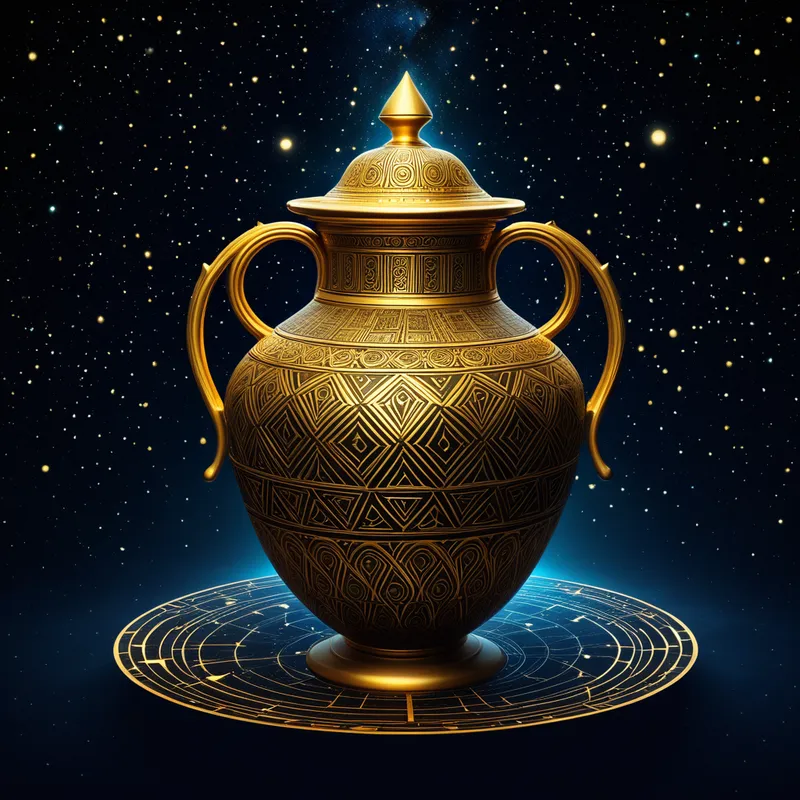
And it is said that the battle’s rhythm echoes through time. The pot’s journey across the constellations dictates the sacred calendar. Every twelve years, when the stars realign as they did during that primordial struggle, the memory of the nectar awakens in those hallowed grounds. The rivers remember. The land remembers. And humanity is called, in a vast and silent pilgrimage, to bathe in that memory, to touch the place where eternity once brushed against the dust.
Cultural Origins & Context
The myth of the Kumbh Mela is not a single, frozen text but a living, breathing tradition woven from the strands of Vedic cosmology, Puranic lore, and astrological observation. Its earliest seeds are found in the epic tale of the Samudra Manthan, the Churning of the Ocean, detailed in texts like the Mahabharata and several Puranas. The specific connection of this celestial event to the four earthly sites and the timing of the Mela is a later, brilliant synthesis by medieval Hindu astrologers and theologians.
The story was passed down not just by priests, but by the sadhus, the ascetics who consider themselves the direct inheritors of the gods’ struggle for enlightenment. During the festival, these akharas—monastic orders—reenact the procession of the gods and demons, carrying their insignia with martial pride, embodying the myth in flesh and bone. The Kumbh Mela itself became the primary vehicle for the myth’s transmission, a grand oral and experiential tradition where tens of millions gather not merely to hear the story, but to step into it. Its societal function is profound: it periodically reconsecrates the social and cosmic order, offers a mass mechanism for spiritual purification (sangam, or confluence, of people and divinity), and reaffirms the Hindu conception of time as cyclical, where sacred history is not past but perpetually accessible.
Symbolic Architecture
At its core, the myth is a grand allegory for the struggle to distill immortality from the chaotic soup of existence. The Kshirasagara represents the undifferentiated unconscious, the pleroma containing all potential—both luminous treasures and deadly poisons. The churning is the arduous process of consciousness itself, the necessary friction required to bring latent psychic contents to the surface.
The nectar is never found in stillness, but only in the great, painful churning of opposites.
The gods and demons are not mere external beings but internal archetypal forces. The gods (devas) represent the ordering, integrative tendencies of the psyche—light, structure, consciousness. The demons (asuras) represent the potent, chaotic, and often disruptive energies of desire, power, and the shadow. The myth wisely states that both are needed to turn the mountain; spiritual wholeness cannot be achieved by repressing one’s “demonic” vitality, but only by engaging with it, harnessing its power for the transformative work. The spilled drops signify that enlightenment (Amrita) is not a distant, purely celestial prize. It is immanent. It has touched the earth—the realm of the body, of time, of human community. The sacred site (tirtha) is thus a psychological coordinate: a point within the self where the eternal has intersected with the temporal, where one can cross over from identification with the mortal ego to a connection with the timeless Self.
The Dreamer’s Resonance
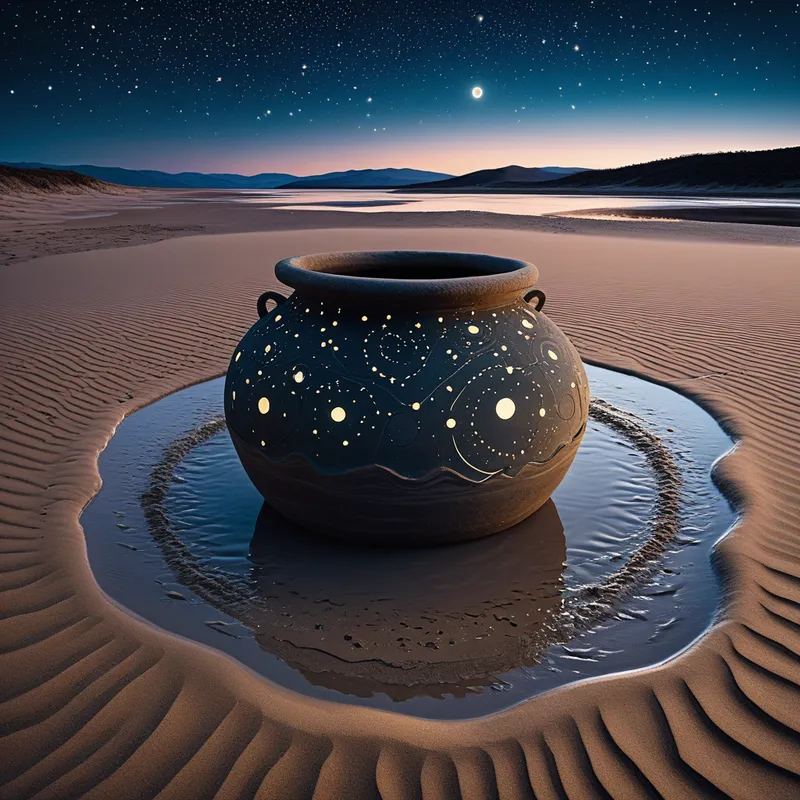
To dream of the Kumbh Mela grounds is to dream of the Self organizing a massive, internal pilgrimage. The dreamer may find themselves on the outskirts of an immense, crowded festival they did not consciously plan to attend. This is the psyche announcing a necessary convergence. The somatic feeling is often one of being swept along by a current larger than oneself—a mix of awe, anxiety, and profound belonging.
The dream may highlight specific elements: struggling to reach the water’s edge through the press of countless unknown faces (the ego navigating the collective unconscious); seeing a radiant, serene sadhu who makes direct eye contact (an encounter with the inner sage or guru); or being immersed in the cold, rushing river (a baptism into a new psychic state, a dissolution of old structures). This dream pattern emerges during life transitions, when the individual is being called to purify outdated identities and integrate disparate parts of their personality. It signifies a process where the personal psyche aligns itself with a transpersonal, archetypal rhythm. The “crowd” is not just other people, but the multitude of sub-personalities, memories, and potentials within, all moving toward a central, transformative purpose.
Alchemical Translation
The individuation process, the journey toward psychic wholeness, is perfectly modeled by the Kumbh myth. The first stage is the pact: the ego (perhaps identifying with the “godly” persona) must acknowledge its need for the shadow’s power (the demonic) to begin the work. One cannot churn the ocean of the unconscious alone.
The churning itself is the analytic and transformative work—therapy, creative struggle, moral conflict—where both beautiful and terrifying aspects of the self emerge. The poison, Halahala, must be confronted and contained (by the Shiva function, the transcendent consciousness that can hold contradiction). The emergence of the Kumbh is the birth of the transcendent function, the symbol that reconciles opposites. The fight for it is the inevitable resistance, the old patterns struggling to claim and distort this new, integrative potential.
The festival is the psyche’s celebration of its own cyclical renewal, a ritual where the personal ego bathes in the waters of the collective and ancestral soul.
Finally, the establishment of the festival grounds is the lasting internalization of this process. It is not enough to have a fleeting moment of insight (grabbing the pot). One must establish permanent “tirthas” within—enduring attitudes, practices, or realizations—where one can return, cyclically, to reconnect with that sacred center. The calendar of the Mela, based on Jupiter’s journey, mirrors the slow, orbital pace of deep psychological change. The modern individual’s “Kumbh Mela” is thus the deliberate, periodic return to one’s core values, one’s spiritual practice, or one’s authentic community, to bathe in the meaning that was wrested from life’s great churning, and to remember one’s place in a story far older than the self.
Associated Symbols
Explore related symbols from the CaleaDream lexicon: