The Knights of the Round Table Myth Meaning & Symbolism
A fellowship of flawed heroes bound by a sacred code, seeking a divine vessel, their quest a mirror for the soul's struggle for unity and purpose.
The Tale of The Knights of the Round Table
Listen, and let the mists of Avalon gather. In a land fractured by petty kings and the cold memory of Rome’s retreat, a sword was drawn from a stone. Not by brute force, but by a destined hand. Thus was Arthur Pendragon crowned, a king forged not in lineage alone, but in miracle. Yet a crown is a lonely weight. A kingdom of law and light requires more than one man’s dream.
From the forges of a dying age and the deep greenwoods of the ancient isle, they came. Not gods, but men—flawed, fierce, and yearning. Lancelot of the Lake, whose sword-skill was a psalm and whose heart was a secret wound. Gawain, the sun-bright nephew, bound by a code of courtesy that was both his armor and his cage. Percival, the innocent raised in wilderness, whose purity was his only guide. And others, a constellation of strength: Bedivere, Kay, Tristan, and many whose names are whispered with the wind in the oaks.
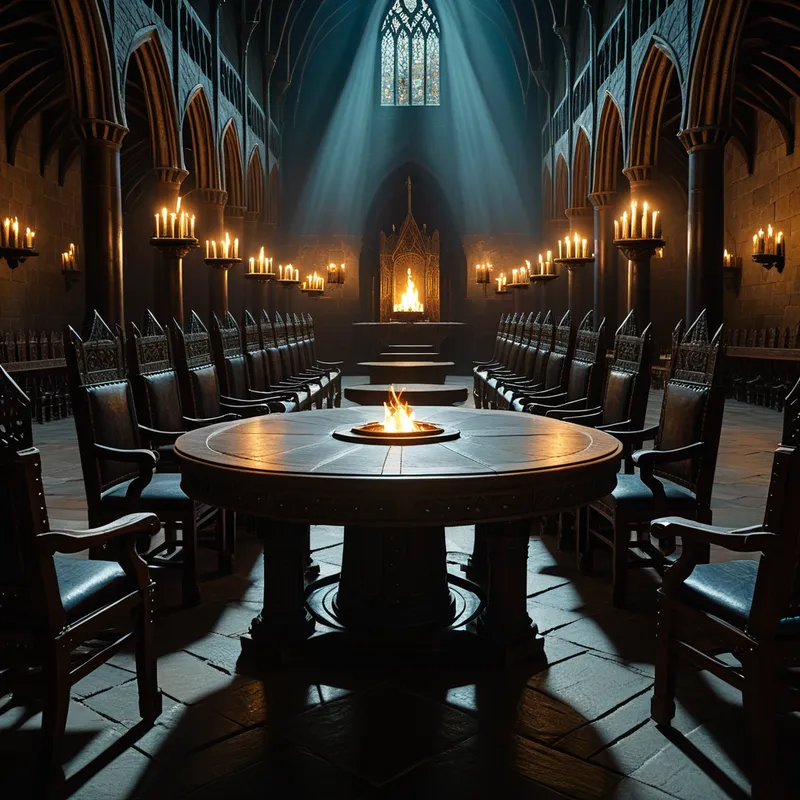
Their gathering place was not a throne room, but a hall centered around a wonder: the Round Table. A vast circle of dark, polished oak, crafted by the enchanter Merlin himself. Here, no head, no foot. Here, every knight who sat was equal in voice and honor, bound to a sacred oath: to protect the weak, to right wrongs, to live for justice, not glory. Camelot’s light was not its white towers, but the fellowship reflected in that wooden ring.
But a circle can also be a wheel, and it must turn. A quest was given, a divine hunger planted in their hearts. The Holy Grail—the vessel of the Last Supper, a beacon of divine grace—had manifested in the land, visible only to the purest soul. The fellowship shattered into individual paths. Each knight rode alone into the tangled, whispering forest of the world, a place of physical peril and spiritual trial.
They faced not just dragons and rogue kings, but the specters within. Lancelot, for all his valor, was barred from the Grail’s fullness by his forbidden love for Queen Guinevere. Gawain’s charm met the grim test of the Green Knight’s axe, a lesson in the integrity of one’s word. For most, the quest ended in failure, in a return to Camelot humbled and empty-handed. But for one—the spotless knight Galahad—the forest parted into a blinding chapel. He beheld the Grail, his soul united with the divine, and in that ecstatic moment, his earthly journey was complete. He did not return.
The Table endured, but its perfect circle was cracked by human frailty. Betrayal, passion, and destiny conspired. The final battle came on the fog-cloaked field of Camlann. The fellowship was broken, knight against knight, ideal shattered by reality. Arthur, mortally wounded, was borne away across the water to Avalon, where he sleeps. The Table was empty, its story passing into legend, a promise that one day, the king and his fellowship would be needed again.

Cultural Origins & Context
The myth of the Round Table is not a single, frozen story but a living tapestry woven over centuries. Its threads are Celtic, drawing from Welsh legends of heroic warbands and magical cauldrons (a precursor to the Grail). These stories were carried by bards and storytellers, finding new form in the courts of Norman and Plantagenet England, where writers like Geoffrey of Monmouth and later, the French poet Chrétien de Troyes, codified the narrative.
The Table itself is a potent political symbol emerging in the High Middle Ages. It served as a fantastical mirror for the feudal aristocracy, transforming the reality of violent, land-hungry barons into an idealized vision of chivalric order, courtesy, and service. The code of the knights—the Chivalric Code—was both a societal manual and a spiritual aspiration, blending martial duty with Christian piety. The Grail Quest, heavily developed by Cistercian monks, turned the narrative inward, making the knight’s primary adversary his own sin and imperfection. The myth was told in grand halls to inspire nobility, and in simpler forms, to give the common folk a story of a just king and a lost golden age.
Symbolic Architecture
At its heart, the Round Table is a symbol of psychic wholeness. It represents the ego’s attempt to create order—a mandala of consciousness—from the chaos of the inner and outer worlds. Each knight is not merely a character, but an archetype, a facet of the complete human psyche: the Lover, the Warrior, the Innocent, the King.
The Round Table is the soul’s council chamber, where every aspect of the self has a seat, but none may claim dominion.
The quest for the Holy Grail symbolizes the ultimate human yearning for transcendence, for direct experience of the divine or the deepest Self. It is an inner calling that disrupts the comfortable order of the ego (Camelot) and forces a journey into the unconscious (the Perilous Forest). Success is rare and demands not strength alone, but integration—the reconciliation of one’s highest aspiration with one’s shadowy failings. Galahad’s achievement and departure signify that attaining such wholeness often means transcending the worldly system entirely. The fall of Camelot, then, is the inevitable dissolution of any conscious structure that cannot accommodate the full weight of human complexity, passion, and fate.
The Dreamer’s Resonance
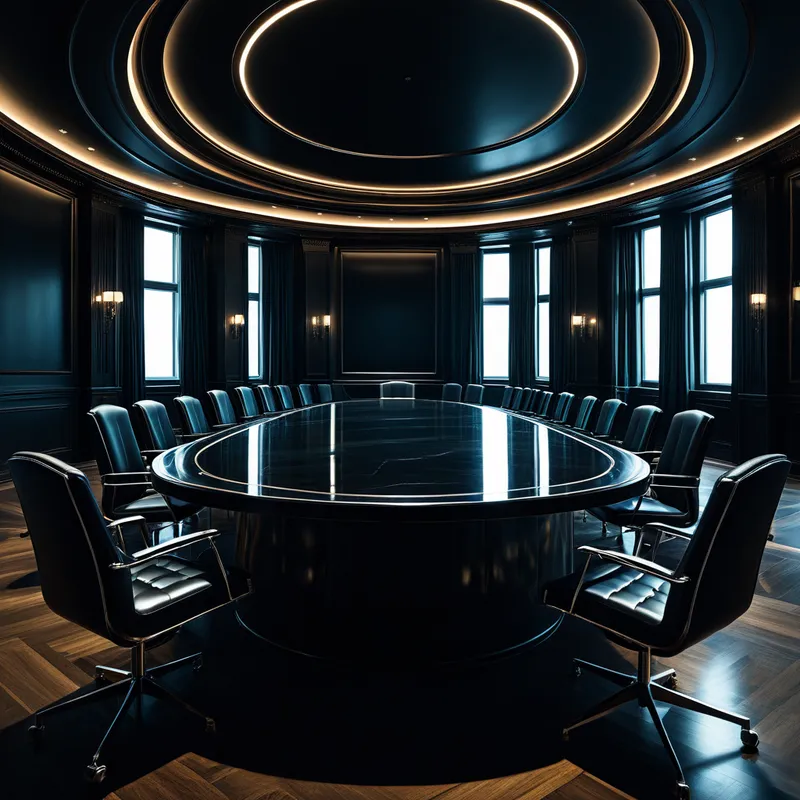
When this myth stirs in the modern dreamer, it often manifests as dreams of councils, teams, or round meeting tables where a crucial decision is pending. The dreamer may find themselves at such a table, either as a silent observer or a participant with no voice. Alternatively, they may dream of a sacred, elusive object—a glowing cup, a lost document, a source of light—that they must find, often while navigating a confusing urban landscape or an endless office complex.
Somatically, this can feel like a pressure in the chest—the weight of a quest or a duty not yet defined. Psychologically, it signals a stage where the conscious mind is assembling its resources. The dream-ego is calling its inner “knights” to the table: the disciplined part (the warrior), the compassionate part (the lover), the ethical part (the ruler). The conflict arises when one of these aspects is missing, overly dominant (a “Lancelot” complex of brilliant but destructive passion), or barred from the table by shame. The dream is an indicator of the psyche preparing for a significant life transition—a career change, a relational commitment, a spiritual search—requiring the mobilization of the entire self.
Alchemical Translation
The alchemical process mirrored in this myth is the opus circulatorium—the circular work. It begins with the nigredo, the blackening: the fractured, post-Roman world into which Arthur is born, analogous to the chaos and suffering that initiates the individuation journey. The creation of the Round Table is the albedo, the whitening: an attempt to create a pure, ordered system of consciousness (Camelot), a necessary but intermediate stage.
The Grail Quest is the pivotal citrinitas, the yellowing or solar awakening. It is the call from the Self that shatters the ego’s comfortable order. Each knight’s solitary journey into the forest is a confrontation with the shadow—the personal unconscious where dragons (repressed anger), temptresses (unintegrated anima/animus), and tricksters dwell.
The true Grail is not found in a distant castle, but in the crucible of one’s own failures and returned glances at what was left behind.
Galahad’s achievement represents the rubedo, the reddening or culmination: the synthesis of opposites, where the divine and the human, the conscious and the unconscious, momentarily unite. His subsequent passing from the world signifies that this level of integration often means a death of the old personal identity. The return of the failed knights and the fall of Camelot is not a tragedy, but a necessary dissolution. The work is never permanently finished. The Table is a process, not a possession. For the modern individual, the alchemy lies not in building a perfect, static life (Camelot), but in having the courage to heed the quest that disrupts it, to sit at one’s own inner round table continually renegotiating the fellowship of the self, and to understand that wholeness is found in the seeking, not merely in the finding. The king is wounded, the fellowship scattered, but the promise of return is the promise of the psyche’s endless capacity for renewal.
Associated Symbols
Explore related symbols from the CaleaDream lexicon: