
The Knight-Errant Myth Meaning & Symbolism
A lone knight rides into the wilds of Logres, seeking a quest to prove his worth and heal a wounded world, guided by fate and inner virtue.
The Tale of The Knight-Errant
Listen, and hear the tale of the road. It begins not in a hall of feasting, but in the silence after the feast, when the torches gutter low and the heart grows restless. In the days when Logres was a land half-wild and half-holy, a young man would rise from his seat. His armor was not yet scarred by dragon-fire, his shield bore no device of renown, only the blank, yearning field of potential. He was a knight-errant.
He would kiss the hand of his king or his lady, a gesture more of farewell than of fealty, for his true lord was the road itself. He would pass under the portcullis, the shadow of the castle gate falling across him like a baptism, and enter the whispering green chaos of the Forest of Adventure. Here, the world spoke in symbols. A white stag, fleeting as a moonbeam, demanded pursuit. A weeping maiden by a fountain held a grief that was a key. A dwarf, ugly and rude, would utter a riddle that festered in the soul until solved.
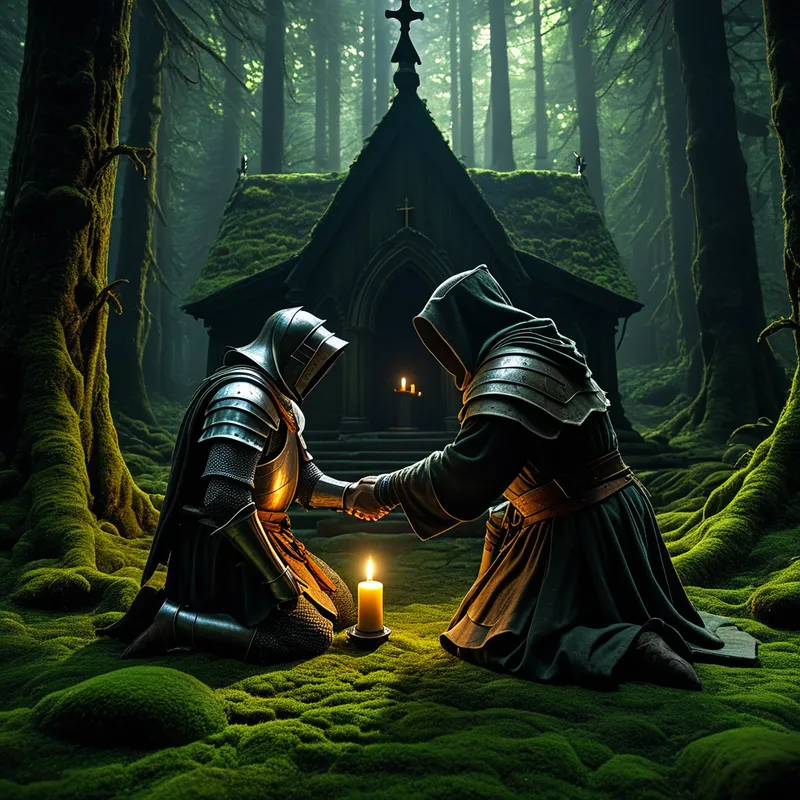
His quest was never the one he first imagined. He might ride out seeking a rogue giant, only to find the true monster was the despair in a nearby village. He would joust with a mysterious Black Knight at a ford, their lances shattering not just wood but illusions, revealing a lost brother or a wronged friend beneath the grim helm. He would spend a night in a Chapel Perilous, where the dead whispered and the altar candle was blown out by a breath from nowhere, forcing him to keep vigil in pure, faith-filled darkness until dawn.
The climax was not always a battle. Sometimes, it was the act of lowering his sword. To heal the Fisher King, the knight had to ask a simple, compassionate question: “What ails you?” The act of seeing the wound, of acknowledging the pain, was the lance that pierced the enchantment. The grail, if it appeared, was a moment of blinding, wordless grace—a scent of impossible flowers, a light that washed the world clean—before it vanished, leaving him forever changed.
He would return, if he returned at all, not to fanfare, but to quiet testimony. He would lay the recovered token—a sword, a hawk, a stolen child returned—at the feet of the court. His armor bore new dents, his eyes held shadows of the otherworld. He had answered the call of the wild Questing Beast and had learned that the chase itself was the meaning. Then, after a season of rest, the road would whisper again. For the knight-errant’s home was never a place of stone, but the endless, sacred journey between who he was and who he must become.
Cultural Origins & Context
The figure of the knight-errant is the narrative engine of the later Arthurian romance tradition, flourishing in the 12th to 15th centuries. While the core of the Arthurian cycle deals with kinghood, community, and the rise and fall of Camelot, the knight-errant tales are intensely personal. They emerged from the pens of poets like Chrétien de Troyes, who translated the older Welsh and Breton warrior ideals into the language of courtly love and individual spiritual quest.
These stories were not history, but soul-history. Told in royal courts and noble houses, they served multiple functions. They were entertainment, certainly—thrilling adventures of love and combat. But they were also didactic, modeling the complex, often contradictory ideals of chivalry: prowess tempered by mercy, loyalty to one’s lord balanced by the higher call of God or a righteous cause. The knight-errant existed in the tension between the structured order of Camelot and the chaotic, symbolic realm of the forest. His journeys mapped the outer edges of the known world, but more importantly, they charted the inner landscape of the developing Christian soul, grappling with temptation, doubt, and the longing for divine grace.
Symbolic Architecture
The knight-errant is not merely a man on a horse; he is a psyche in motion. His blank shield represents the unformed Self, the tabula rasa upon which experience and virtue must inscribe their marks. The road is the path of individuation, fraught with projections and unconscious contents that appear as fantastical beings.
The forest is not outside the knight; it is the untamed, instinctual wilderness of his own unconscious. Every creature he meets is a fragment of his soul waiting to be recognized.
The obligatory joust with the unnamed knight at the ford is a classic confrontation with the Shadow. One cannot proceed on the quest without first facing and integrating this dark double. The recurring damsels in distress are not mere plot devices but representations of the Anima, the soul-guide who leads him deeper into emotional and relational complexity. Her rescue is the rescue of his own capacity for relatedness, feeling, and eros. The ultimate goal—the Holy Grail—is the symbol of the transcendent function, the impossible wholeness that pulls the personality toward its complete realization.

The Dreamer’s Resonance
When the archetype of the knight-errant stirs in modern dreams, the dreamer is at a crossroads of purpose. The somatic feeling is often one of restless energy—a need to move, to depart from a stagnant life situation. You may dream of packing for a journey you don’t understand, of finding a mysterious map, or of standing before a vehicle (the modern steed) that is both enticing and intimidating.
Psychologically, this marks the onset of a questing phase. The conscious ego has outgrown its old castle—its familiar identity, job, or relationship—and the unconscious is issuing a call. The “giants” and “black knights” in these dreams will be modernized: a tyrannical boss, a labyrinthine bureaucracy, a personal addiction, or a profound sense of meaninglessness. The dream is presenting these not as mere problems to solve, but as ordeals that, if faced, will bestow a “boon”—a new skill, insight, or depth of character. The dreamer is being invited to pick up their own blank shield and declare, through action, who they intend to become.

Alchemical Translation
The knight-errant’s journey is a perfect allegory for the alchemical process of psychic transmutation, or individuation. The initial stage, nigredo (the blackening), is his departure into the forest—the dissolution of his old, comfortable identity. The confrontations and failures along the way are the mortificatio, the necessary humiliations and “deaths” of the ego.
The moment at the ford, where he is unhorsed by his shadow, is the crucial separatio—distinguishing what is truly “him” from what he has merely been conditioned to be.
His service to others—righting wrongs not for glory but because it is right—is the albedo (whitening), the purification of motive. The guidance he receives from hermits and wise women represents the coniunctio, the marriage of his masculine, striving consciousness with the feminine, intuitive wisdom of the unconscious. The fleeting vision of the Grail is the rubedo (reddening), the glimpse of the philosopher’s stone—the realized, integrated Self. He does not possess it; he is transformed by its witness. He returns not with a trophy, but with a story, which is the multiplicatio—the wisdom now available to enrich the entire psychic kingdom. For the modern individual, the myth teaches that wholeness is not a destination to be reached, but a quality of being forged on the endless, faithful road of engaging one’s own deepest calling.
Associated Symbols
Explore related symbols from the CaleaDream lexicon: