The Klezmer Myth Meaning & Symbolism
A wandering musician's soulful melodies bridge the worlds of joy and sorrow, mending broken spirits and awakening the divine spark hidden within the mundane.
The Tale of The Klezmer
Listen. In the spaces between the notes, in the silence that follows a sigh, there is a story. It is not written in books of stone or sung in royal courts. It is carried on [the wind](/myths/the-wind “Myth from Various culture.”/) that rattles the shutters of a shtetl, in the creak of a wagon wheel on a muddy road, and in the trembling breath before a song begins.
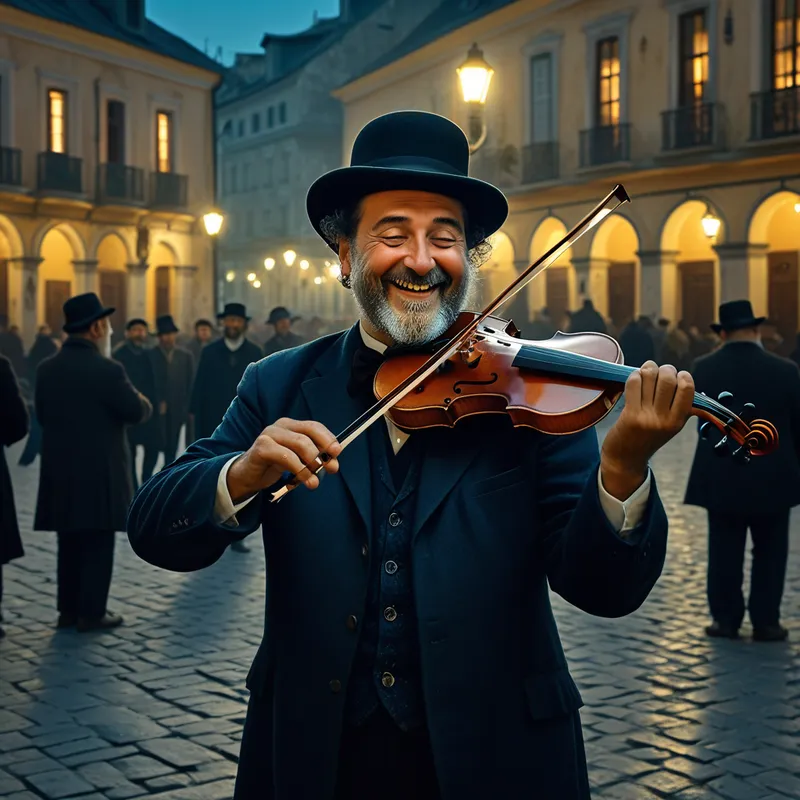
His name was forgotten, as all true names are, so they called him simply The Klezmer. He was born not of a mother, but of a need—the need of a people whose joy was a fortress and whose sorrow was a deep, private river. He had no home but the road, and his possessions were three: a coat patched with the fabric of a hundred towns, boots caked with the dust of exile, and a violin that was not an instrument, but a companion. Some said its wood was carved from the Etz Chaim itself, its strings spun from the tears of Rachel and the laughter of [Sarah](/myths/sarah “Myth from Biblical/Apocryphal culture.”/).
One winter, a silence fell upon the land. It was a cold so profound it froze not just the rivers, but the very souls of the people. Laughter died in throats. Prayers stuck like ice in the heart. [The Sabbath](/myths/the-sabbath “Myth from Abrahamic culture.”/) candles guttered without warmth. The people were not sick, but they were dying—dying of a stillness, a forgetting of the melody that connects earth to heaven.
The Klezmer walked into this frozen silence. He entered the village square, a lone, dark figure against the white. He did not speak. He lifted his violin to his chin, closed his eyes, and drew the bow.
The first note was a crack in the ice of [the world](/myths/the-world “Myth from Tarot culture.”/). It was a krekhts—a sob, a groan from the depths of [the earth](/myths/the-earth “Myth from Hindu culture.”/). It was the sound of the Churban, of lost homes and broken promises. People wept from windows, their tears melting the frost on the panes.
But he did not stop. The melody twisted, turned. The sob became a sigh, the sigh became a whisper, and the whisper became a mischievous, dancing phrase—a freylekhs. It was the sound of a wedding, of stomping feet, of wine spilled in celebration. Against their will, a foot began to tap. A hand began to clap. A spark, long buried, flickered in a weary eye.
He played through the night. He played the lullaby of a thousand mothers, the defiant tune of scholars, the wild, wordless song of the shepherd. He played until the music was no longer about something, but was something—a living bridge. And on that bridge, the people saw them: the shimmering forms of those who were gone, dancing with those who remained. The past and the present, joy and grief, held in a single, endless, heartbreakingly beautiful chord.
As dawn broke, the final note hung in the air, not fading, but dissolving into the morning light. The Klezmer was gone. But the silence was gone with him. In its place was a memory of the bridge, and the knowledge that the melody was not in his violin, but in their own listening hearts.
Cultural Origins & Context
The figure of the Klezmer is not a single myth from a sacred text, but a living archetype woven from the fabric of Ashkenazi life in Eastern Europe. The term itself derives from the Hebrew kley zemer, “vessels of song.” These musicians were not mere entertainers; they were itinerant ritual specialists, the sonic architects of communal emotion. They were present at every liminal point in life: the uncontrollable joy of the wedding (simcha), the profound grief of mourning, the weekly transcendence of the [Sabbath](/myths/sabbath “Myth from Judeo-Christian culture.”/).
Their myths were oral, passed down in anecdotes, in the exaggerated tales of their prowess, and in the very music they played—a music that was said to be half-learned and half-received from dreams, from spirits, or from eavesdropping on the angels. They occupied a sacred yet marginal space. They were essential yet rootless, pious yet worldly (often playing for Gentile courts), embodying the tension between the holy and the everyday. Their folklore grew in the space between the official, textual religion of the rabbis and the earthy, experiential life of the people. They were the keepers of the niggun—the wordless melody that bypasses intellect to touch the soul, a direct line to the [Shekhinah](/myths/shekhinah “Myth from Jewish Mysticism culture.”/).
Symbolic Architecture
The Klezmer is the ultimate liminal entity. He does not reside in the house of joy or the house of sorrow; he is the [doorway](/symbols/doorway “Symbol: A doorway signifies transition, opportunities for new beginnings, and the choice to walk through into the unknown.”/) between them, [the threshold](/myths/the-threshold “Myth from Folklore culture.”/) where transformation occurs.
The true magic is not in banishing the dark note, but in weaving it into the scale until it reveals its secret, essential light.
His [violin](/symbols/violin “Symbol: The violin is a symbol of elegance, emotional expression, and artistry, representing the complexities of human emotions and relationships.”/) is the Kli, the [vessel](/symbols/vessel “Symbol: A container or structure that holds, transports, or protects something essential, representing the self, emotions, or life journey.”/). It is the [human](/symbols/human “Symbol: The symbol of a human represents individuality, complexity of emotions, and social relationships.”/) [heart](/symbols/heart “Symbol: The heart symbolizes love, emotion, and the core of one’s existence, representing deep connections with others and self.”/), capable of resonating with every [frequency](/symbols/frequency “Symbol: In dreams, frequency often represents rhythm, cycles, patterns, or the rate of occurrence of events, thoughts, or emotions.”/) of experience. The bow is the will, the conscious [breath](/symbols/breath “Symbol: Breath symbolizes life, vitality, and the connection between the physical and spiritual realms.”/) that draws the raw [material](/symbols/material “Symbol: Material signifies the tangible aspects of life, often representing physical resources, desires, and the physical world’s influence on our existence.”/) of [emotion](/symbols/emotion “Symbol: Emotion symbolizes our inner feelings and responses to experiences, often guiding our actions and choices.”/)—the chaotic tohu va-vohu of the [soul](/symbols/soul “Symbol: The soul represents the essence of a person, encompassing their spirit, identity, and connection to the universe.”/)—into coherent, meaningful form. The Klezmer’s [journey](/symbols/journey “Symbol: A journey in dreams typically signifies adventure, growth, or a significant life transition.”/) is the journey of the [psyche](/myths/psyche “Myth from Greek culture.”/) gathering its fragments. His [music](/symbols/music “Symbol: Music in dreams often symbolizes the harmony between the conscious and unconscious mind, illustrating emotional expression and communication.”/) does not describe healing; it performs it. By giving sound to the unspeakable—the krekhts (sob), the tshok (laughing cry)—he legitimizes the full [spectrum](/symbols/spectrum “Symbol: A continuum of possibilities, representing diversity, transition, and the full range of existence from one extreme to another.”/) of [human](/symbols/human “Symbol: The symbol of a human represents individuality, complexity of emotions, and social relationships.”/) feeling, granting it a place in the cosmic order.
Psychologically, he represents the transcendent function, the [capacity](/symbols/capacity “Symbol: A measure of one’s potential, limits, or ability to contain, process, or achieve something, often reflecting self-assessment or external demands.”/) of the psyche to create a third, reconciling element from the [tension](/symbols/tension “Symbol: A state of mental or emotional strain, often manifesting physically as tightness, pressure, or unease, signaling unresolved conflict or anticipation.”/) of opposites. He is the inner [musician](/symbols/musician “Symbol: A musician symbolizes creativity, expression, and the ability to communicate emotions through art.”/) who can hold our [grief](/symbols/grief “Symbol: A profound emotional response to loss, often manifesting as deep sorrow, yearning, and a sense of emptiness.”/) and our joy simultaneously, not as a contradiction, but as a complex, richer [harmony](/symbols/harmony “Symbol: A state of balance, agreement, and pleasing combination of elements, often associated with musical consonance and visual or social unity.”/).
The Dreamer’s Resonance
To dream of the Klezmer, or of his music, is to be at a critical point of emotional integration. The dreamer is often in a state of numbness, a “frozen silence,” where feeling has been suspended for survival. The appearance of this figure signals that the unconscious is preparing to thaw a frozen complex.
Somatically, one might feel a vibration, a humming in the chest, or a sense of being “played upon.” The music in the dream is key: dissonant, screeching notes point to a painful affect demanding expression. A sudden, joyful dance tune emerging from sorrow indicates the psyche working to transmute that pain. The dream is an invitation to pick up one’s own “instrument”—be it voice, pen, or movement—and give form to the formless inner cry. It is a call to stop analyzing the pain and to sound it, to let the body’s wisdom find its melody.
Alchemical Translation
The alchemy of the Klezmer myth is the opus contra naturam—the work against the natural inclination to split joy from sorrow. The modern individual is tasked with this same work: to become [the vessel](/myths/the-vessel “Myth from Alchemical culture.”/) and the musician of their own soul.
[The first stage](/myths/the-first-stage “Myth from Alchemical culture.”/), [nigredo](/myths/nigredo “Myth from Alchemical culture.”/), is the frozen village, the collective depression, the personal numbness. It is the unplayed note, the stifled feeling. The klezmer archetype awakens as the inner impulse to make sound anyway, to scrape the bow across the string even if the first noise is ugly, a primal scream.
Individuation is not the composition of a perfect, happy melody. It is the courageous inclusion of every discord, until the discords themselves become the signature of one’s unique and holy scale.
The albedo is the listening, the moment the community hears its own sorrow reflected and thus validated. The citrinitas is the turning, the dance that emerges from the tears—the recognition of the golden thread connecting all opposites. Finally, the [rubedo](/myths/rubedo “Myth from Alchemical culture.”/) is not a finale, but the sustained state of the bridge. It is the achieved capacity to hold one’s history, one’s trauma, and one’s joy in a dynamic, vibrating tension that is itself the highest state of being. One becomes a living niggun, a wordless testament to the fact that the soul is not a problem to be solved, but a song to be played, in all its heartbreaking, glorious complexity. [The wanderer](/myths/the-wanderer “Myth from Taoist culture.”/) finds his home in the wandering, and the seeker discovers that the music he has been seeking is the sound of his own authentic life, played upon the instrument of his existence.
Associated Symbols
Explore related symbols from the CaleaDream lexicon: