
The Kawaii Aesthetic in Japan Myth Meaning & Symbolism
The myth of a world-weary spirit who discovers a forgotten, potent magic in vulnerability, sweetness, and smallness, transforming a hardened reality.
The Tale of The Kawaii Aesthetic in Japan
Listen. There was a world that had forgotten how to bend. Its spine was steel, its heart a ticking clock, its breath the exhaust of relentless progress. The people moved through canyons of glass and concrete, their faces mirrors of efficiency, their spirits weighed down by the immense gravity of being serious, of being adult. The old gods of forest and stream had receded into whispers, and in their place reigned the stern deities of Output and Conformity.
But in the shadow of a towering, humming spire, in a forgotten corner where the city’s light grew dim, there lived a spirit known as Mono no Aware. She was the feeling of the falling cherry blossom, the sigh for things that pass. She drifted, a ghost of melancholy, through the bustling crowds who had no time for sighs. One day, drawn by a sound softer than a mouse’s breath, she slipped into a small, cluttered room. A young human, face pale with exhaustion from the world’s demands, was not studying ledgers or crafting proposals. Instead, they were drawing. And what they drew was not grand or fearsome. It was a creature with a head too large for its body, eyes like vast, starry pools, and a mouth—a simple, shy curve of a line.
As the pencil touched the paper, something shimmered in the air. Mono no Aware felt a warmth she had not known for centuries. The drawing was… defenseless. It was openly, brazenly weak. It asked for nothing but a moment of regard. It was kawaii.
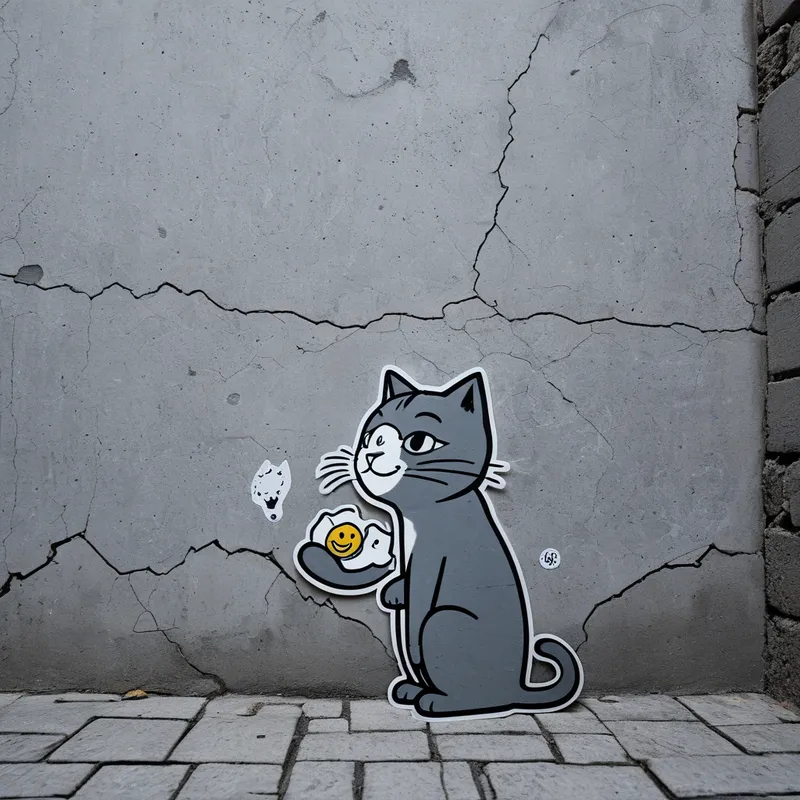
The spirit watched, entranced, as the human surrounded themselves with these creations: round, smiling animals; objects with blushing cheeks; letters that curled like sleeping kittens. They sewed small, soft plush beings and placed them on bags that carried the weight of books. They adorned rigid technology with dangling charms of pastel fruit. It was a silent, meticulous rebellion. A spell was being cast, not with incantations, but with rounded corners and wide, trusting eyes.
Mono no Aware leaned close and breathed upon the drawings. Her breath, once only a sigh of transience, now carried the essence of this newfound magic—the power of vulnerability as a shield, of sweetness as a sanctuary. The drawings seemed to glow from within. The spirit then wandered back into the steel world, and wherever she passed, she left a faint trace of this magic. A salaryman, gripping his briefcase, would catch a glimpse of a child’s kawaii mascot on a train ad and feel his jaw unclench, just for a second. A student, bowed under expectation, would doodle a tiny heart in the margin and feel a spark of something that was hers alone.
The stern deities of the city took notice. This was not productive. This was not efficient. It was frivolous, infantile—a weakening of the societal spine. They sent waves of derision, labeling it a regression, a commercialized emptiness. But the magic of Kawaii did not fight. It did not harden. It simply… persisted. It bent. It adorned. It softened the edges. It created pockets of psychic safety in plain sight, a hidden world of emotional reprieve within the overwhelming whole. The conflict was not a battle, but a permeation. The resolution was not a victory, but a transformation. The world did not shatter; it was gently, insistently, made habitable again for the heart.
Cultural Origins & Context
This is not a myth inscribed on ancient scrolls, but one written in the marginalia of modern life. Its origins are post-war 20th century Japan, a society undergoing rapid, intense industrialization and Westernization—a collective experience of what sociologists call “compressed modernity.” The primary “storytellers” were not bards, but often young people, particularly schoolgirls in the 1970s, who developed a rounded, childlike handwriting style (marui ji) as a subtle form of personal expression and resistance against rigid, formalized adult society.
The myth was passed down and amplified through consumer culture—stationery, kyara, fashion, and later, digital avatars and emoji. Its societal function is profound and dualistic. On one level, it serves as a social lubricant and a culturally sanctioned mode of emotional expression in a society that values harmony and restraint (wa). On another, deeper level, it acts as a psychological pressure valve, a sanctioned space for amae (the indulgence of dependent love) and the expression of vulnerability that is otherwise suppressed in public, professional life. It is a folk religion of the everyday, with its own icons, rituals, and sacred consumer goods.
Symbolic Architecture
At its core, the Kawaii myth symbolizes the reclamation and sanctification of vulnerability. In a world that equates power with invulnerability, aggression, and size, Kawaii proposes a radical alternative: power through openness, through the deliberate cultivation of traits deemed “weak”—softness, need, playfulness, and a wide-eyed wonder.
The mightiest fortress is sometimes a plush toy held by a weary soul; the most potent rebellion, a refusal to harden.
The large head and eyes of the kawaii character symbolize a state of perpetual childhood perception, where the world is still new and the emotional self is disproportionately large and central. The small mouth, often silent or speaking minimally, represents a communication that is non-confrontational, feeling-based rather than logic-based. The act of adorning a functional object (a phone, a pen) with a non-functional, cute charm is a symbolic act of ensoulment. It injects the personal, the idiosyncratic, and the emotional into the impersonal, mass-produced, and utilitarian.
Psychologically, Kawaii represents the Innocent archetype, but one that has consciously chosen its innocence as a strategy for survival in a corrupt or demanding world. It is not naivete, but a sophisticated, often melancholic (mono no aware) embrace of simplicity and sweetness as an antidote to complexity and bitterness.
The Dreamer’s Resonance
When this myth pattern arises in modern dreams, it signals a psyche grappling with the pressures of adaptation and the fear of losing its soft, core self. To dream of being surrounded by overwhelming, giant kawaii objects may point to a feeling of being infantilized or a longing to retreat into a safer, simpler state. Conversely, to dream of fiercely protecting a small, cute creature in a hostile environment speaks to the dreamer’s own need to protect their vulnerability, their creativity, or their capacity for joy.
Somatically, this process might feel like a tightness in the chest or jaw (the armoring of the adult) beginning to soften. It is the psychological process of re-childing—not regressing, but reintegrating the perceptive freshness, curiosity, and emotional honesty of the child-self into the adult personality. The dream is the psyche’s workshop where it practices bending instead of breaking, where it explores the strength found in admitting need.
Alchemical Translation
The alchemical journey modeled by the Kawaii myth is one of transmutation through tenderness. The prima materia, the leaden state, is the hardened, over-adapted persona—the efficient worker, the serious adult, the individual who has sacrificed play and vulnerability at the altar of productivity. The conflict is the friction between this hardened shell and the soft, living spirit within.
The nigredo is the feeling of spiritual weariness, the mono no aware of the myth’s spirit. The albedo is the discovery of the first drawing, the first conscious act of creating or embracing something cute—it is a purification through simplification, a return to an elemental emotional color (pink, pastel, soft). The citrinitas is the realization that this practice has power, that it creates a psychic buffer, a personal sanctuary.
The final rubedo, the red gold of the completed Self, is not a warrior clad in armor, but an individual who has integrated their vulnerability into their strength, who can navigate a harsh world while carrying an inviolable inner sanctuary of softness.
The triumph is individuation as the cultivation of a permeable resilience. The Self that emerges is not impervious, but selectively permeable—able to withstand pressure not by rigid resistance, but by absorbing and transforming it through an inner core of acknowledged tenderness, play, and self-compassion. It is the alchemy of turning the base metal of societal pressure into the gold of a personally meaningful, emotionally authentic life. The myth teaches that wholeness includes the parts of us we are told to leave behind.
Associated Symbols
Explore related symbols from the CaleaDream lexicon: