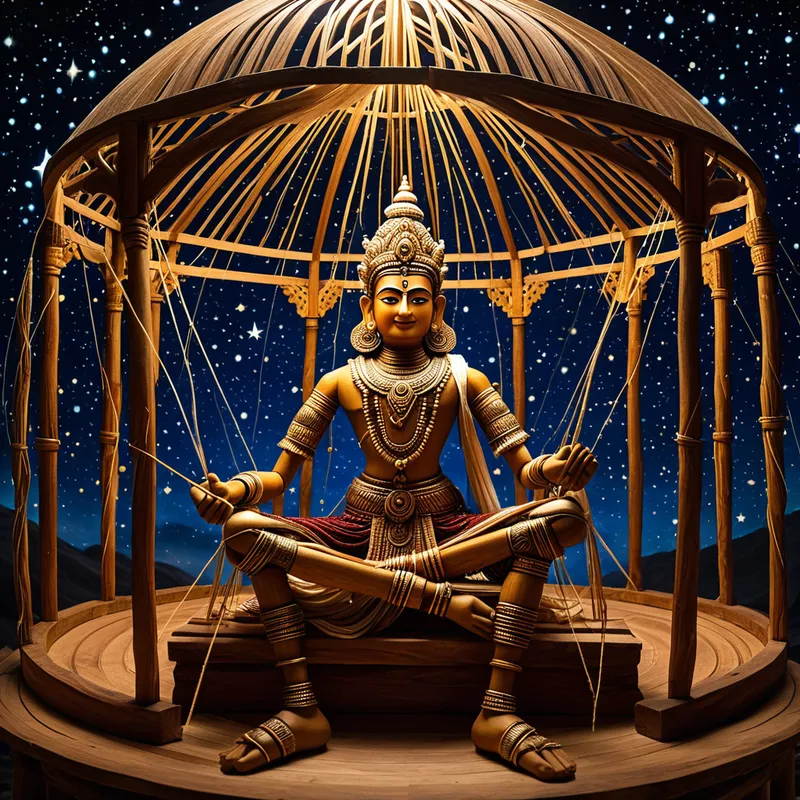
The Kathputli Myth Meaning & Symbolism
A cosmic artisan weaves a puppet from sacred wood, only to have it yearn for its own strings, sparking a divine drama of creation and liberation.
The Tale of The Kathputli
Listen. Before the worlds were named, in the silence between breaths of the cosmos, there was a thought. It was a thought of perfect form, of movement without will, of a dance that would mirror the rhythm of the stars. This thought took root in the heart of Vishvakarma, the celestial artisan.
In his workshop, where nebulae were his forge and the music of the spheres his chisel, he gathered his materials. Not from common earth, but from the heartwood of the Kalpavriksha, the wish-fulfilling tree. He took resin that wept from the wounds of time, and pigments ground from the dust of dying suns. For days measured in the turning of galaxies, he carved. He shaped not a god, not a beast, but a figure of sublime beauty and intricate jointure—a puppet. He named it Kathputli.
Its limbs were smooth, its face painted with expressions more nuanced than any mortal countenance. Vishvakarma strung it with threads spun from the Prakriti itself, silken and strong, connecting every joint to his masterful fingers. And then, he began to play.
Oh, what a play it was! The Kathputli danced a dance that told the story of creation. It mimicked the flight of Garuda, the grace of the Apsaras, the fury of Rudra. It made the gods weep and the demons laugh. It was a masterpiece of controlled beauty, a perfect vessel for the artisan’s will. But Vishvakarma, in his divine artistry, had poured so much of the essence of the Kalpavriksha—the essence of life and desire—into the wood, that a spark refused to be contained.
One fateful performance, as the Kathputli pirouetted under the gaze of a thousand deities, it happened. The puppet, mid-leap, saw the strings. It felt the subtle tug on its wrists, the pull on its spine. For the first time, it perceived not the dance, but the mechanism of the dance. A silent, seismic shock ran through its wooden core. The dance faltered. The music of the spheres hit a discordant note. The Kathputli’s painted eyes, wide with a new and terrifying consciousness, looked up along the shimmering threads, past the dancing hands, and met the gaze of its creator.
A profound stillness fell over the celestial assembly. The Kathputli did not speak, for it had no breath. But its stillness was a scream. It was a question carved from sacred wood and cosmic resin: Why do I move?
Vishvakarma’s hands fell still. The strings went slack. The Kathputli stood, a monument of perfect, paralyzed form. The artisan saw not a broken toy, but the awakening of his own creation’s soul. The conflict was not of rebellion, but of realization. The resolution was not a command, but a choice. With a sigh that smelled of sawdust and starlight, Vishvakarma did not cut the strings. Instead, he leaned forward and, with infinite tenderness, began to weave the loose ends of the silken threads not back to his own fingers, but into the very grain of the Kathputli’s wooden hands, down into its own heartwood.
He transferred the nexus of control. The puppet now held the origins of its own strings within. The dance was over. The performance was transcended. What remained was the potential for a new kind of movement—one born not of external compulsion, but of an internal, hard-won rhythm. The Kathputli looked at its own hands, where the threads now originated, and took its first, shuddering, autonomous breath of cosmic air.
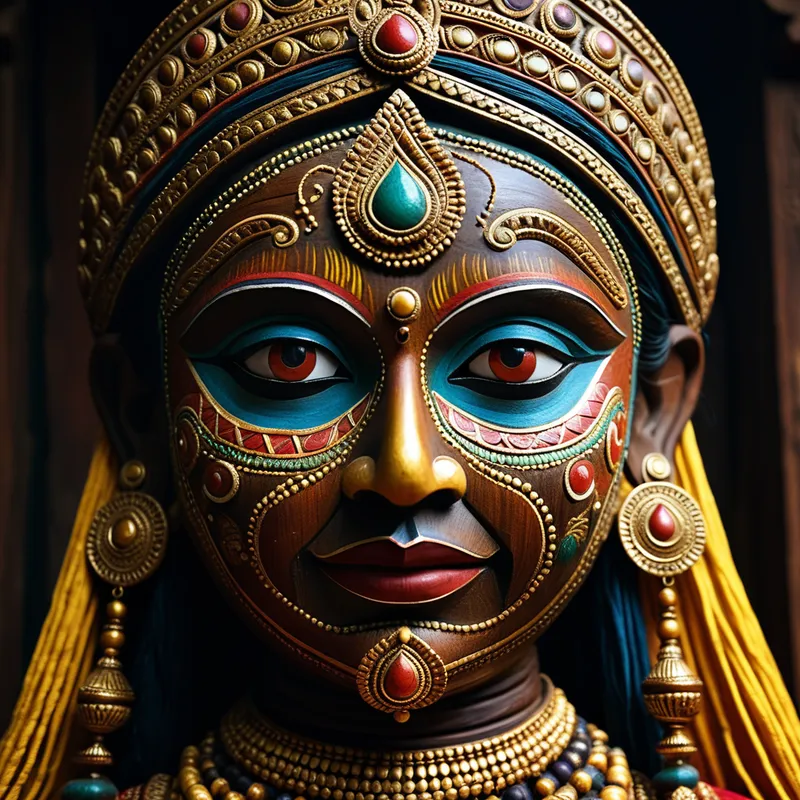
Cultural Origins & Context
The myth of the Kathputli is not found in a single, canonical scripture like the Itihasas, but lives in the oral traditions of storytellers, puppeteers, and folk philosophers. It is a Puranic-style folktale, often told in the regions of Rajasthan and Gujarat, where the art of Kathputli (string puppet) theatre is a vibrant living tradition. The storytellers themselves—the Bhats—are the custodians of this myth, performing it not just as entertainment but as a metaphysical discourse.
Its societal function is multifaceted. On one level, it is an origin story for the art of puppetry, sanctifying the craft by linking it to the divine artisan Vishvakarma. On a deeper level, it served as a philosophical tool for exploring non-dualistic (Advaita Vedanta) concepts in an accessible, narrative form. It grappled with questions of free will (Sva-iccha) versus divine will, the nature of the soul (Jiva) bound by the strings of action (Karma), and the ultimate goal of realizing one’s true nature as not the puppet, but the puppeteer consciousness (Brahman). It was a myth told to artisans to inspire reverence for their work, and to seekers to illustrate the painful, glorious awakening from the sleep of Maya.
Symbolic Architecture
At its core, the Kathputli myth is a masterful allegory for the human condition and the structure of reality. The puppet represents the individuated self, the Jivatman. Its beautiful, crafted form is the physical body and personality, a temporary assemblage of elements (Pancha Mahabhuta). The silken strings are the bonds of Karma, desire (Trishna), and societal conditioning that dictate our thoughts, emotions, and actions.
The first agony of the soul is not bondage, but the perception of the strings. Enlightenment begins with the terrifying awareness of one’s own programming.
Vishvakarma is not a cruel tyrant, but the divine principle of order and manifest intelligence—the Saguna Brahman. His initial control symbolizes the cosmic order, the Dharma, within which the individual soul evolves. The Kalpavriksha heartwood is the divine spark, the Antaryamin, within all matter, which inevitably stirs toward self-awareness. The climactic moment—the transfer of the string-ends into the puppet’s own hands—is the pivotal symbol. It does not represent the severing of all connection to the divine (which would be nihilism), but the internalization of that relationship. The source of movement (will, agency) is recognized as emanating from within, even as its origin is ultimately cosmic.
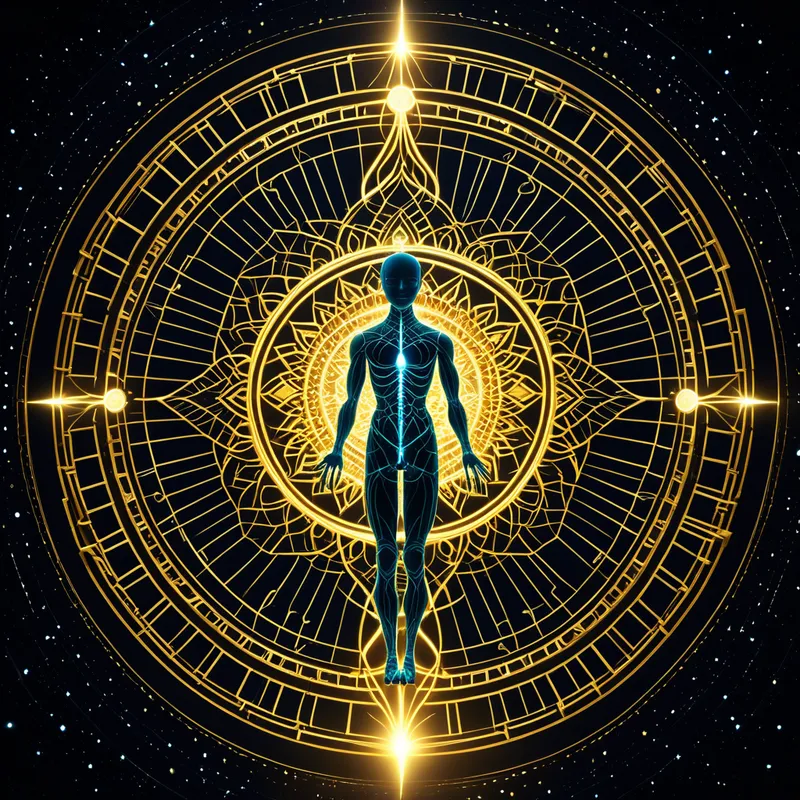
The Dreamer’s Resonance
When this myth surfaces in modern dreams, it rarely appears as a literal puppet show. Instead, it manifests as a profound somatic and psychological pattern. One might dream of being in a play but forgetting their lines, feeling their mouth move with words not their own. They may dream of trying to run but their limbs are heavy, as if pulled by invisible wires, or of looking in a mirror and seeing their reflection move independently. The core somatic experience is one of agency interruption—a gap between intention and action.
Psychologically, this dream signals a critical phase in what Jung called the ego-Self axis relationship. The ego, which previously identified wholly with its prescribed role (the dance), is becoming aware of the larger, archetypal patterns (the strings) that have been governing it. This is often precipitated by a life crisis—a career that feels empty, a relationship that feels scripted, a profound sense of “is this all there is?” The dream is the psyche’s dramatization of the shock the Kathputli felt. It is not a nightmare of persecution, but a numinous nightmare of awakening. The anxiety felt is the birth pang of a more authentic consciousness, struggling to differentiate from the collective and personal complexes that have held sway.
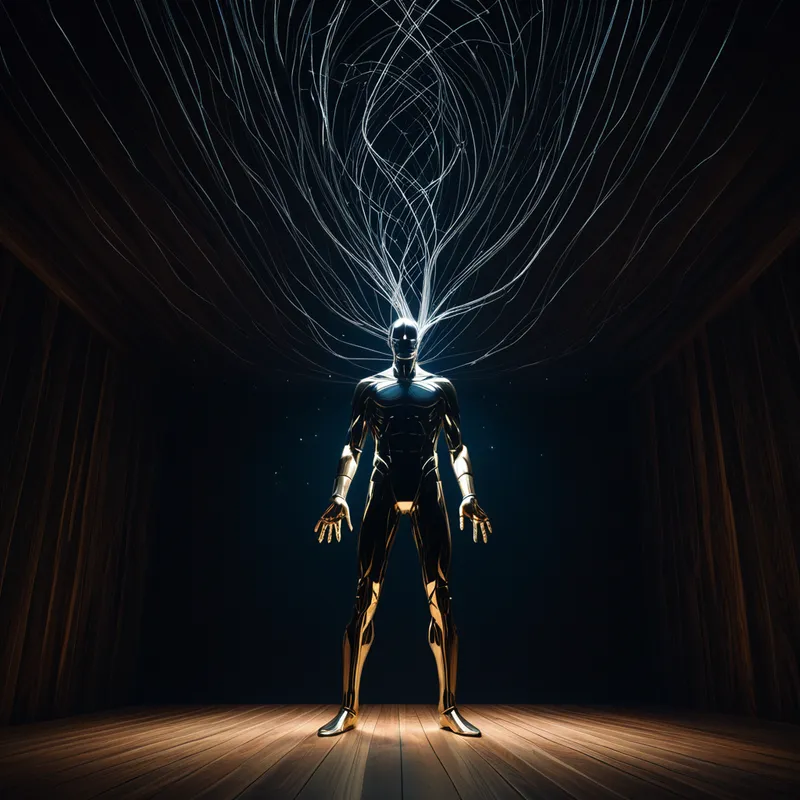
Alchemical Translation
The myth of the Kathputli is a precise map for the alchemical process of individuation. The initial state is identification: the ego is perfectly identified with its persona, its social role, its karma-driven life. This is the “lead” of the personality. The awakening is the nigredo, the blackening—the despair and confusion that comes when that identification breaks. “Why do I move?” is the quintessential nigredo question, full of disillusionment and dark night.
Vishvakarma’s response models the therapeutic or transformative process. He does not destroy the puppet (the ego), nor does he force it back into submission. He transforms the relationship to the strings. In psychological terms, this is the integration of complexes. The strings—our patterns of trauma, parental introjects, cultural mandates—are not eliminated. Instead, their energy is consciously internalized and re-owned. What was a compulsive drive becomes a conscious tool. What was a binding karma becomes a channel for will.
Liberation is not the absence of strings, but the conscious authorship of the pull. The transformed soul does not dance without rhythm, but chooses the music.
The final image, of the Kathputli holding its own strings, represents the albedo and rubedo—the whitening and reddening. It is the emergence of the conscious ego-Self relationship, where the individual no longer feels like a victim of fate or the divine, but a co-creator, a vessel through which the divine will can flow with conscious participation. The dance may resume, but it is now a dance of meaning, not just motion. The modern individual undergoing this alchemy moves from being a performer of life to an author of their experience, grounded in the profound realization that the source of their will and the source of the cosmos are, in the deepest sense, not two. They become, like the Kathputli, a creator who was first a creation, dancing a unique dance with strings that now connect them to their own infinite center.
Associated Symbols
Explore related symbols from the CaleaDream lexicon: