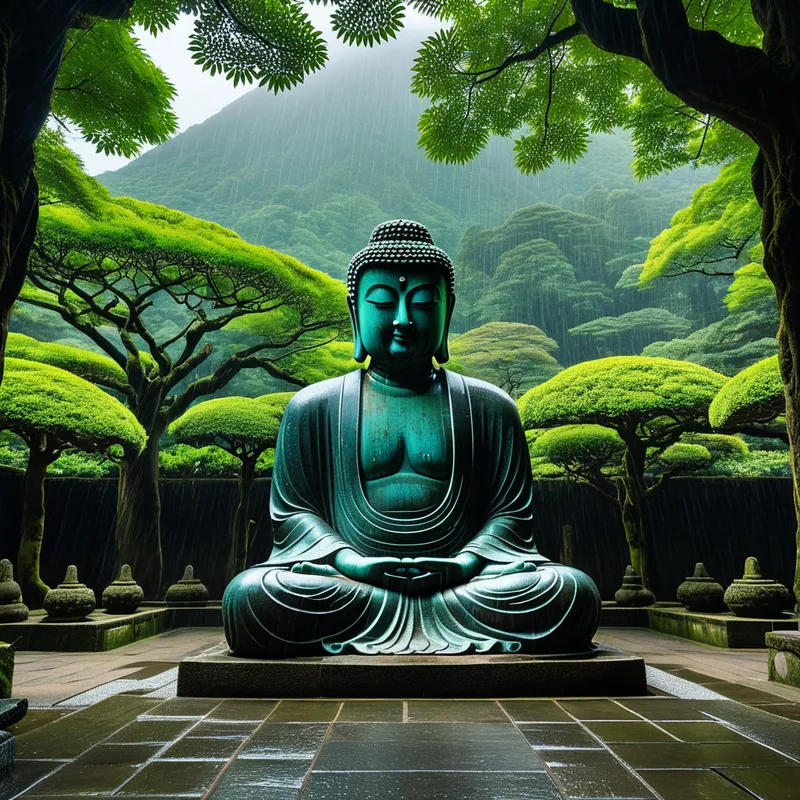
The Kamakura Daibutsu Myth Meaning & Symbolism
A colossal bronze Buddha, born from fire and flood, stands serene in an open field, teaching the alchemy of loss into unshakeable presence.
The Tale of The Kamakura Daibutsu
Listen. This is not a story of a god descending from a mountain. It is a story of a mountain learning to sit.
In the Kamakura period, when [the world](/myths/the-world “Myth from Tarot culture.”/) was drawn in the stark ink of sword and prayer, the people sought a harbor for their awe. They built a temple of wood, a cavernous hall to house a dream made solid. For decades, artisans poured not just bronze, but the collective yearning of an age into a single form: the Daibutsu of Kotoku-in. When the final mold was broken, there He sat—Amida Nyorai—in the posture of deep meditation, hands forming the Dhyana Mudra. His eyes, half-closed, saw not the walls around Him, but the endless vista of compassion. The hall echoed with chants, smoke, and the sighs of pilgrims who came to stand in [the shadow](/myths/the-shadow “Myth from Jungian culture.”/) of the eternal.
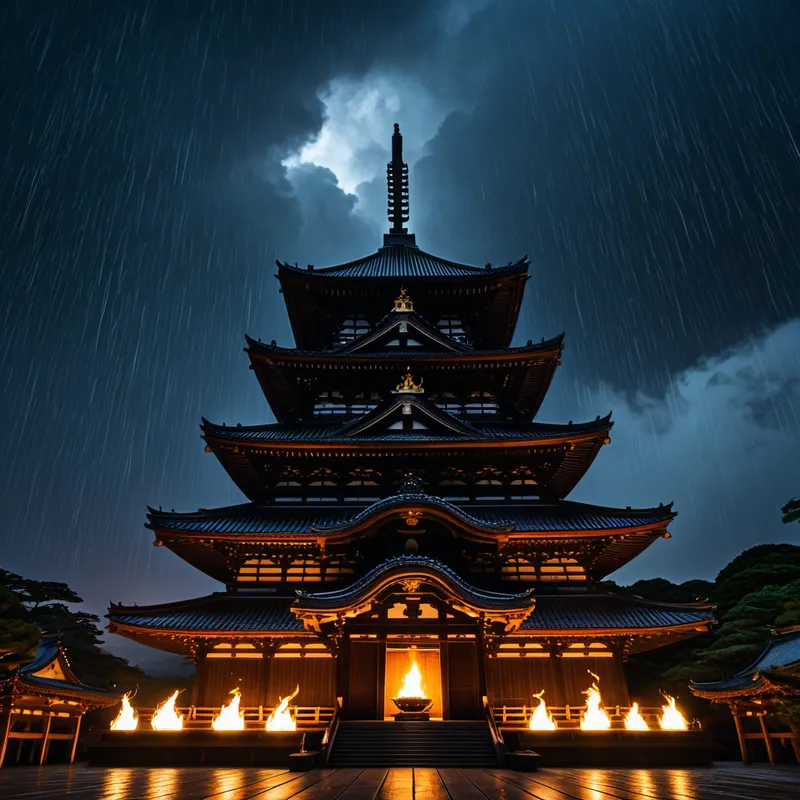
Then came [the wind](/myths/the-wind “Myth from Various culture.”/). It was not an ordinary wind, but the breath of change itself, howling down from the Mt. Kinubari. It carried embers from a world on fire—the strife of clans, the [impermanence](/myths/impermanence “Myth from Buddhist culture.”/) of all things built. The great wooden hall, which had dared to shelter infinity, embraced the spark. Flames, orange and hungry, licked the ancient timbers. The roar was not just of fire, but of a world-view burning. Beams that had held up heaven for generations groaned, cracked, and fell like slain giants. The people of Kamakura watched from a distance, their faces painted in the tragic glow, believing they were witnessing the end of a vision.
But when the dawn came, grey with ash and a quiet, drizzling rain, they saw. Where the grand hall had been, there was a smoldering plain. And at its center, untouched, sat the Daibutsu. Bronze, darkened by soot and now being washed clean by the rain, He sat. The roof that had defined His sacred space was gone. The walls that had framed Him had vanished. Now, His sanctuary was [the sky](/myths/the-sky “Myth from Persian culture.”/) itself. Clouds became His canopy; the flight of birds, His moving frescoes.
Years later, [the sea](/myths/the-sea “Myth from Greek culture.”/), in a tantrum of earth and wave, sent a great tsunami to reclaim the land. The waters rushed in, a salty, churning chaos, swallowing the grounds of Kotoku-in. Yet when they receded, the Great Buddha remained, seated now in a shallow pool, reflecting the vastness He had always embodied. [The temple](/myths/the-temple “Myth from Jewish culture.”/) was not rebuilt around Him. The people understood. The final, most profound temple had been revealed by disaster: the open air, the turning seasons, the direct face of sun and storm.
Now, He sits. Not in a story of resilience, but as resilience itself. The wind speaks through the hollows of His cast form. The moonlight silvers His brow. He is the story that continues when the book burns, the meaning that persists when the definition crumbles.
Cultural Origins & Context
The Kamakura Daibutsu is a historical artifact that transcends history, becoming myth through its biography of survival. Created in 1252, it exists at a pivotal crossroads in Japanese spirituality. The Kamakura period was an era of political upheaval and a shift from the aristocratic Heian aesthetics to a more austere, warrior-centric ethos. It was also a time of profound religious [ferment](/myths/ferment “Myth from Alchemical culture.”/), with the rise of Jodo Shu and other “easy path” schools of Buddhism, which offered the promise of [Sukhavati](/myths/sukhavati “Myth from Buddhist culture.”/) to all people, not just monastics.
The statue is not merely a representation of Amida Buddha; it is a yorishiro, a vessel intended to attract and house the spiritual presence of the deity. Its initial enshrinement within a great hall followed the orthodox model of containing the sacred. However, the successive calamities of 1369 (the storm/fire that destroyed the hall) and 1495 (the tsunami) performed a kind of involuntary cultural [wabi-sabi](/myths/wabi-sabi “Myth from Japanese culture.”/). They stripped away the ornate container, leaving the essential core exposed. This transition from a protected, interior icon to an open-air, weather-beaten presence mirrored a deeper cultural and psychological movement from formalized, institutional spirituality to a more direct, experiential, and rugged encounter with the sacred. The myth—for it became one—was not authored by a single bard, but written by typhoon and tide, and then read aloud by every pilgrim who stood before the silent, exposed colossus.
Symbolic Architecture
The Daibutsu is a complex [symbol](/symbols/symbol “Symbol: A symbol can represent an idea, concept, or belief, serving as a powerful tool for communication and understanding.”/) of [the Self](/myths/the-self “Myth from Jungian culture.”/), in the Jungian sense, encountering and integrating the [reality](/symbols/reality “Symbol: Reality signifies the state of existence and perception, often reflecting one’s understanding of truth and life experiences.”/) of impermanence (anicca).
The Bronze [Body](/symbols/body “Symbol: The body in dreams often symbolizes the dreamer’s self-identity, personal health, and the relationship they have with their physical existence.”/) represents the synthesized, enduring essence of the [psyche](/myths/psyche “Myth from Greek culture.”/)—the core [identity](/symbols/identity “Symbol: Identity represents the sense of self, encompassing personal beliefs, cultural background, and social roles.”/) forged under great pressure and heat. It is [consciousness](/symbols/consciousness “Symbol: Consciousness represents the state of awareness and perception, encompassing thoughts, feelings, and experiences.”/) made durable, yet not rigid. The Hollow [Interior](/symbols/interior “Symbol: The interior symbolizes one’s inner self, thoughts, and emotions, often reflecting personal growth, vulnerabilities, and secrets.”/) is crucial. It is not a solid idol. Visitors can enter it. This symbolizes the paradoxical [nature](/symbols/nature “Symbol: Nature symbolizes growth, connectivity, and the primal forces of existence.”/) of the mature Self: outwardly imposing and defined, yet inwardly empty, a [vessel](/symbols/vessel “Symbol: A container or structure that holds, transports, or protects something essential, representing the self, emotions, or life journey.”/) for something greater than the personal ego. It is a sacred void.
The Destroyed Hall represents the [persona](/symbols/persona “Symbol: The social mask or outward identity one presents to the world, often concealing the true self.”/), the protective structures of identity, belief systems, and cultural conditioning we build around our core. These are necessary for a time, but they are flammable, susceptible to the storms of [life](/symbols/life “Symbol: The symbol of ‘Life’ represents a journey of growth, interconnectedness, and existential meaning, encompassing both the joys and challenges that define human experience.”/)—[loss](/symbols/loss “Symbol: Loss often symbolizes change, grief, and transformation in dreams, representing the emotional or psychological detachment from something or someone significant.”/), failure, tragedy, [paradigm](/symbols/paradigm “Symbol: A fundamental model or framework in arts and music that shapes creative expression, perception, and cultural understanding.”/) shifts.
The most profound sanctuary is not built to keep the world out, but revealed when all the walls fall down.
The Open Sky that becomes the new [temple](/symbols/temple “Symbol: A temple often symbolizes spirituality, sanctuary, and a deep connection to the sacred aspects of life.”/) is the boundless [space](/symbols/space “Symbol: Dreaming of ‘Space’ often symbolizes the vastness of potential, personal freedom, or feelings of isolation and exploration in one’s life.”/) of [awareness](/symbols/awareness “Symbol: Conscious perception of self, surroundings, or internal states. Often signifies awakening, insight, or heightened sensitivity.”/) that exists when [the ego](/myths/the-ego “Myth from Jungian culture.”/)‘s defenses are incinerated. It is the direct experience of being, unmediated by dogma or [architecture](/symbols/architecture “Symbol: Architecture in dreams often signifies structure, stability, and the framing of personal identity or life’s journey.”/). The [Buddha](/symbols/buddha “Symbol: The image of Buddha embodies spiritual enlightenment, peace, and a quest for inner truth.”/)’s serene [expression](/symbols/expression “Symbol: Expression represents the act of conveying thoughts, emotions, and individuality, emphasizing personal communication and creativity.”/), unchanged by fire or flood, symbolizes the attainment of a [perspective](/symbols/perspective “Symbol: Perspective in dreams reflects one’s viewpoints, attitudes, and how one interprets experiences.”/) that can witness the cycling of creation and destruction without being annihilated by it. He does not resist the [disaster](/symbols/disaster “Symbol: A disaster can symbolize chaos, disruption, and fear surrounding life changes or unresolved conflicts.”/); he sits through it, and in doing so, transforms the meaning of the disaster from annihilation to [revelation](/symbols/revelation “Symbol: A sudden, profound disclosure of truth or insight, often through artistic or musical means, that transforms understanding.”/).
The Dreamer’s Resonance
When this myth stirs in the modern dreamer, it often manifests not as a literal giant Buddha, but as a pattern of imagery centered on exposed core resilience. One might dream of their childhood home burned to its foundation, yet the family hearthstone is intact and warm. Or of a fierce storm stripping all the leaves from a great tree, revealing a stunning, intricate architecture of branches against a lightning-lit sky. The somatic sensation is often one of initial terror (the fire, the wave) giving way to a shocking, deep calm and a feeling of expanded space.
Psychologically, this dream pattern signals a process of de-structuring. The psyche is undergoing a necessary dissolution of outmoded containers—a career identity that no longer fits, a relationship that served its purpose, a cherished self-narrative that has become a prison. The ego experiences this as a catastrophic loss (the burning hall). But the dreaming Self is orchestrating this to expose a more durable, authentic core that was always present but over-protected. The dream is an assurance: the center will hold, but only if the walls are allowed to fall. The feeling of the open sky is the relief of no longer having to maintain a facade that was doomed to burn.

Alchemical Translation
The alchemical process modeled here is the [nigredo](/myths/nigredo “Myth from Alchemical culture.”/) leading directly to the albedo, bypassing the ego’s desperate attempts at repair. In personal individuation, we spend years building a competent personality (the wooden hall). It is functional, often beautiful, and it houses our developing spirit. Then life delivers its inevitable fires: a failure that humiliates us, a betrayal that shatters trust, an illness that alters everything, the simple passage of time rendering our old self obsolete.
The instinct is to fight the fire, to mourn the hall, to vow to rebuild it exactly as it was. This is the ego’s resistance to the alchemical nigredo. The Daibutsu myth instructs a different path: let it burn. Do not abandon the center, but cease protecting it with what is already doomed. The fire is not an enemy; it is the agent of revelation.
The alchemical gold is not found by building a stronger furnace, but by realizing the base metal was always gold, and the furnace was only hiding it.
The work then becomes the courage to sit, exposed, in the center of the ruin. To feel the rain on your skin where a roof once was. To allow your identity to be defined not by its walls, but by its unshakeable posture. This is the albedo—the whitening, the illumination. The serene face of [the Buddha](/myths/the-buddha “Myth from Buddhist culture.”/) is the countenance of one who has stopped identifying with the temple and has become identical with the ground upon which all temples are built and fall. For the modern individual, this translates to finding one’s authenticity not in titles, roles, or possessions (the hall), but in a steadfast, compassionate presence that can endure life’s tsunamis. The goal is not to become a statue, but to cultivate that inner bronze—forged in experience, hollow enough to hold mystery, and serene enough to meet the open sky.
Associated Symbols
Explore related symbols from the CaleaDream lexicon: