The Isthmus of Corinth Myth Meaning & Symbolism
A myth of divine ambition where the hero Sisyphus attempts to sever the Isthmus of Corinth, a doomed act of hubris against the natural order.
The Tale of The Isthmus of Corinth
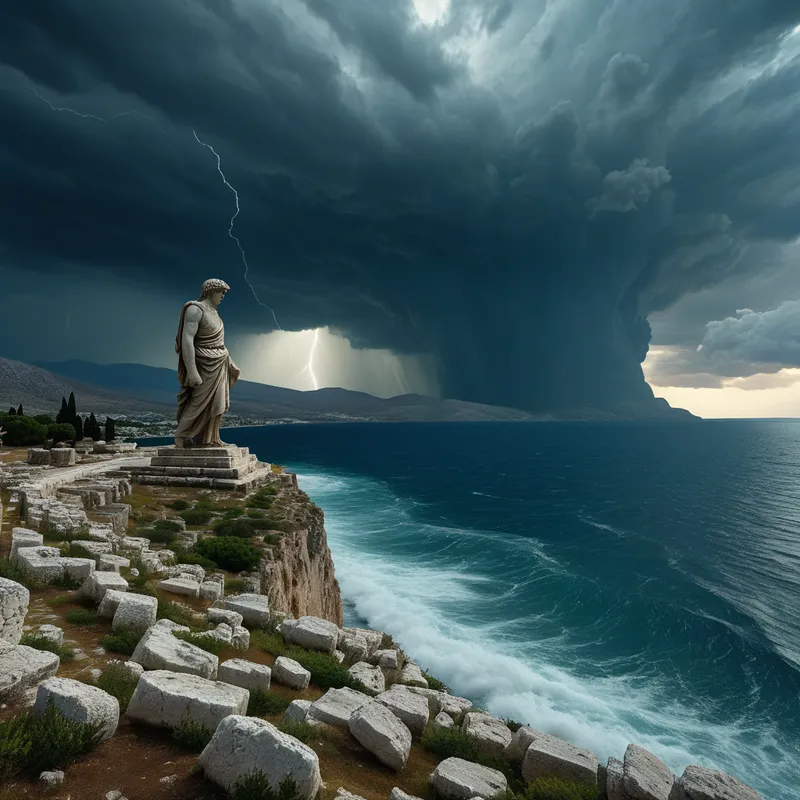
Hear now a tale not of a hero’s triumph, but of a king’s defiance, etched into the very bones of the land. In the time when gods walked with men in sunlight and shadow, there lay a place of profound contradiction—the Isthmus of Corinth. It was a stubborn bridge of earth, a clenched fist of soil and rock holding apart two raging seas: the Krisaean Gulf, with its wine-dark, whispering depths, and the Saronic, bright and treacherous. To stand upon it was to feel the tension of the world, the pull of two vast, yearning bodies of water forever kept from union by this slender, terrestrial wall.
And upon this wall ruled a man whose cunning was a match for the gods themselves: Sisyphus. He looked upon his kingdom, this bottleneck of all trade and travel, and saw not a blessing, but a barrier. He heard the lament of sailors who, to pass from sea to sea, must drag their ships across the rocky neck, their backs breaking, their time wasting. He dreamed of a canal—a clean, swift cut that would let the waters mingle and make Corinth the mistress of all navigation.
But this was no work for mortal hands alone. It was an act of geography, a reshaping of the Gaia-given world. It required a will to rival the earthquakes of Poseidon. Undaunted, Sisyphus, the trickster-king, sought aid. Some whispers say he petitioned the gods; others that he, in his boundless audacity, began the work himself, his laborers’ picks striking the earth like declarations of war. The vision was titanic: to sever the land, to undo a knot tied by the Fates themselves.
The work commenced. The air filled with the grit of shattered stone and the salt-sweat of men. A trench, deep and purposeful, began to scar the isthmus. For a moment, it seemed the impossible might yield. The seas themselves seemed to lean in, their waves lapping closer at the growing divide, scenting their imminent union.
But the order of the cosmos is not so easily undone. The gods, the true architects of the world’s form, looked down. To cut the isthmus was to violate a fundamental design, to impose a mortal’s will upon a divine blueprint. It was hubris of the highest order—not just to steal from the gods, as Prometheus had, but to correct their very handiwork.
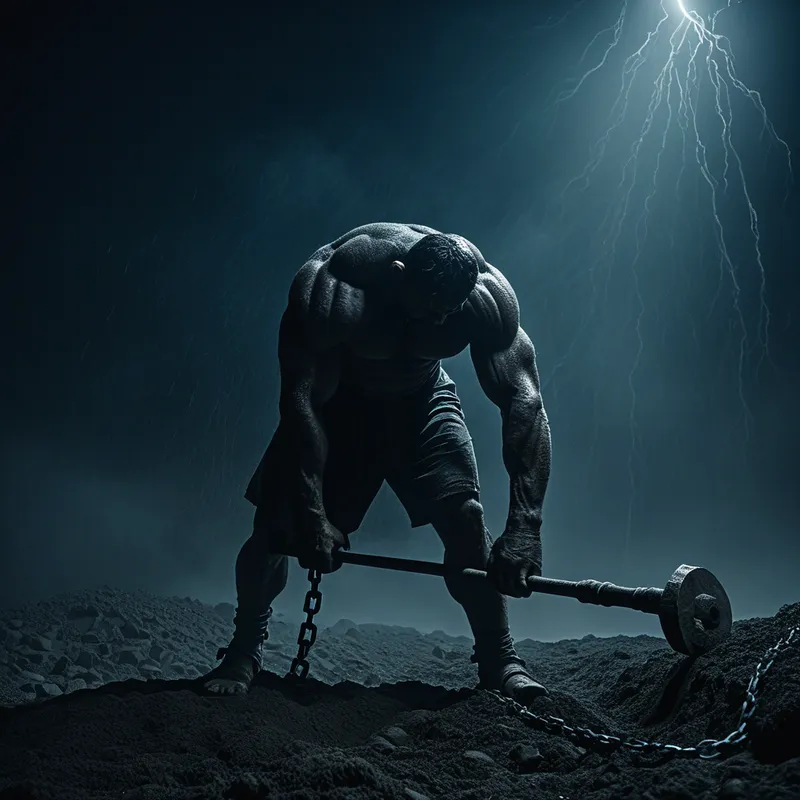
A profound resistance solidified. The earth, once yielding, became obdurate. Rocks re-fused as quickly as they were split. The trench filled with dust as if with the ghosts of the endeavor. The project, a monument to human ambition, ground to a halt, forever incomplete. The isthmus remained, unbroken. And for his transgression—for daring to redraw the lines laid down at creation—Sisyphus earned a punishment that would become the very emblem of futile labor: to push a boulder up a hill in the underworld for all eternity, only to watch it roll down again. The man who would cut the land was condemned to a task that could never cut to completion.
Cultural Origins & Context
This myth, less a single Homeric epic than a persistent strand of local lore and later scholarly commentary, is deeply rooted in the historical and geographical reality of Corinth. Corinth’s power and wealth were directly tied to its control of the isthmus, the Diolkos (a paved track for dragging ships) being a key economic and military asset. The idea of cutting a canal was not mere fantasy; it was a recurring engineering dream, attributed historically to figures like the tyrant Periander and later, Julius Caesar.
The myth of Sisyphus’s attempt served multiple societal functions. Primarily, it was an aetiological myth, explaining why the obvious geographical “solution” of a canal did not exist. It answered the persistent question of every traveler and merchant: “Why must we drag our ships?” with a profound, theological answer: because the gods decreed it so. It transformed a geographical fact into a divine ordinance, reinforcing the sacredness of the natural order. The story was likely propagated by Corinthian priests and storytellers to underscore the special, god-willed status of their city’s unique topography, making a necessity—the difficult portage—into a virtue and a sign of divine favor (or at least, divine intention).
Symbolic Architecture
At its core, the myth of the Isthmus of Corinth is a supreme metaphor for the liminal condition and the tragedy of seeking to resolve it through sheer force of will.
The isthmus itself is the ultimate symbol of the liminal. It is neither mainland nor island, but the tense, narrow between. It is a place of passage, but also of obstruction. Psychologically, it represents the threshold state in any profound transformation—the anxious, fraught space between an old identity and a new one, between a problem and its solution, between the conscious ego and the unconscious sea.
The isthmus is the soul’s own narrows, where two vast and opposing seas of possibility are held in precarious, creative tension.
Sisyphus represents the heroic, rebellious ego. His desire to “cut the knot” is the psyche’s drive for clarity, for decisive action, for a clean break that would end ambiguity and grant total control. He is the part of us that wants to solve the problem of being human, to engineer a straightforward channel through the complex, muddy terrain of the soul. His failure is not a failure of effort, but a failure of recognition. He mistakes a sacred, necessary tension for a mere technical obstacle.
The gods’ intervention symbolizes the autonomous, structuring forces of the psyche—the Self, or the natural laws of psychic growth. They enforce the necessity of the liminal space. The message is that some bridges must be crossed, not destroyed; some tensions must be endured, not severed. The punishment of Sisyphus eternally re-enacts the very essence of his crime: an endless, repetitive engagement with an unresolvable task, which is the fate of an ego that insists on absolute sovereignty over the soul’s geography.
The Dreamer’s Resonance
When this myth stirs in the modern unconscious, it often manifests in dreams of impossible, urgent tasks at a threshold. A dreamer may find themselves trying to dig a trench as tides rise, build a dam against an overwhelming flood, or separate two merging bodies of liquid or light with their bare hands. The somatic feeling is one of immense, futile strain—muscles burning, breath short, progress infinitesimal against an inevitable convergence.
Psychologically, this signals a critical point of transition where the ego is fighting the process. The dreamer is likely in a life situation that feels “stuck” yet is inherently transitional: a career change, the end of a relationship, a spiritual crisis. The Sisyphus-complex takes hold, pushing for a definitive, will-powered “cut” to escape the anxiety of the in-between. The dream is a reflection of the psyche’s exhaustion from this resistance. It shows the ego the nature of its labor: not progressive, but cyclical and draining, because it is working against the deeper currents of necessary change. The dream invites surrender to the process, to stop digging and instead learn to navigate the isthmus.

Alchemical Translation
The alchemical journey is never about destroying one element to achieve another, but about their sacred marriage, the coniunctio oppositorum. The Isthmus of Corinth myth models a failed, premature attempt at this operation.
In the alchemy of the soul, the two seas represent profound opposites: consciousness and unconsciousness, spirit and matter, masculine and feminine principles. The isthmus is the vas, the sealed container where their tension is held, allowing for the slow, fermentive work of transformation. Sisyphus, the rebellious ego, mistakes the vessel for the obstacle. He tries to break the vessel open, to force a conjunction through an act of violence, which would only result in a catastrophic flood—a psychic breakdown, not an integration.
True psychic transmutation occurs not by severing the tension, but by consciously standing within it, allowing the opposing waters to communicate through the porous earth of the soul.
The individuation process requires the courage to dwell on the isthmus, to endure its storms and its narrow confines. The “canal” is not forged by the pickaxe of will, but emerges slowly, as the ego aligns with the Self. It is a path of acceptance, not conquest. The eternal labor of Sisyphus is transformed only when one stops pushing the boulder up the hill of resolution and instead learns to sit with the stone, to understand its weight and substance. The triumph is not in cutting the land, but in becoming the wise ferryman who understands the sacred necessity of both the journey across and the land that makes the journey meaningful. The completed canal, when it finally appears in the soul, is not a scar of separation, but a graceful, integrated channel that honors the integrity of both shores.
Associated Symbols
Explore related symbols from the CaleaDream lexicon: