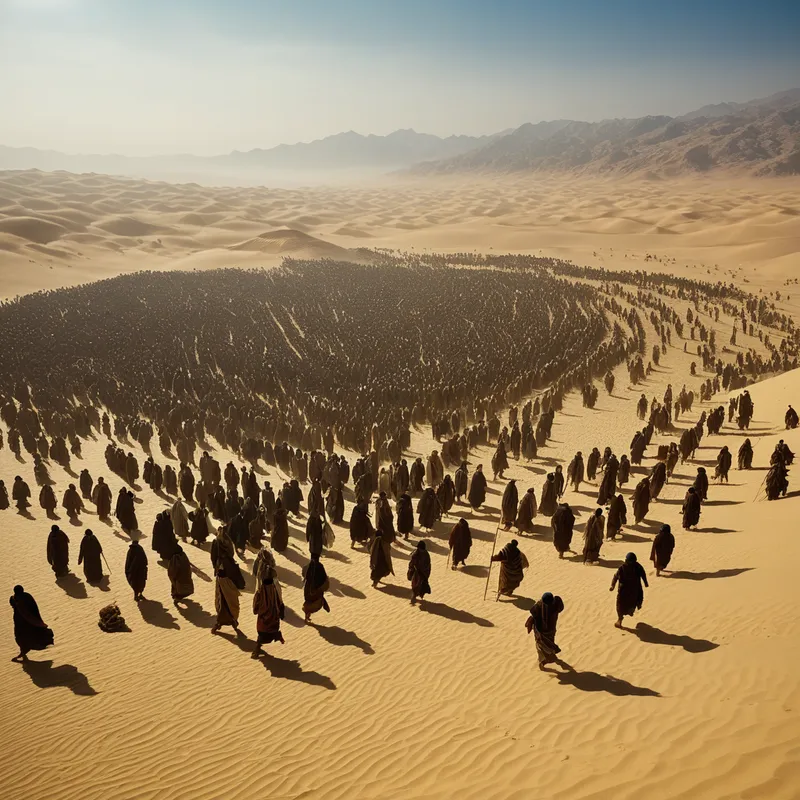
The Israelites in the Wilderness Myth Meaning & Symbolism
A people liberated from slavery wander a vast desert for a generation, forging a covenant with their God and shedding an old identity.
The Tale of The Israelites in the Wilderness
Hear now the tale of a people born in the crucible of sand and sky, a story written not on papyrus but on the human heart across forty burning years.
They emerged from the womb of bondage, a great and ragged multitude, their backs still feeling the phantom lash, their lungs filled not with the dust of bricks but with the free, sharp air of terror and promise. Before them lay the Sea of Reeds, a wall of water held back by a breath not their own. Behind them, the chariots of Pharaoh thundered, the last echo of a life known. They passed through on dry ground, and the waters returned, swallowing the old world whole. They were free. And they were utterly lost.
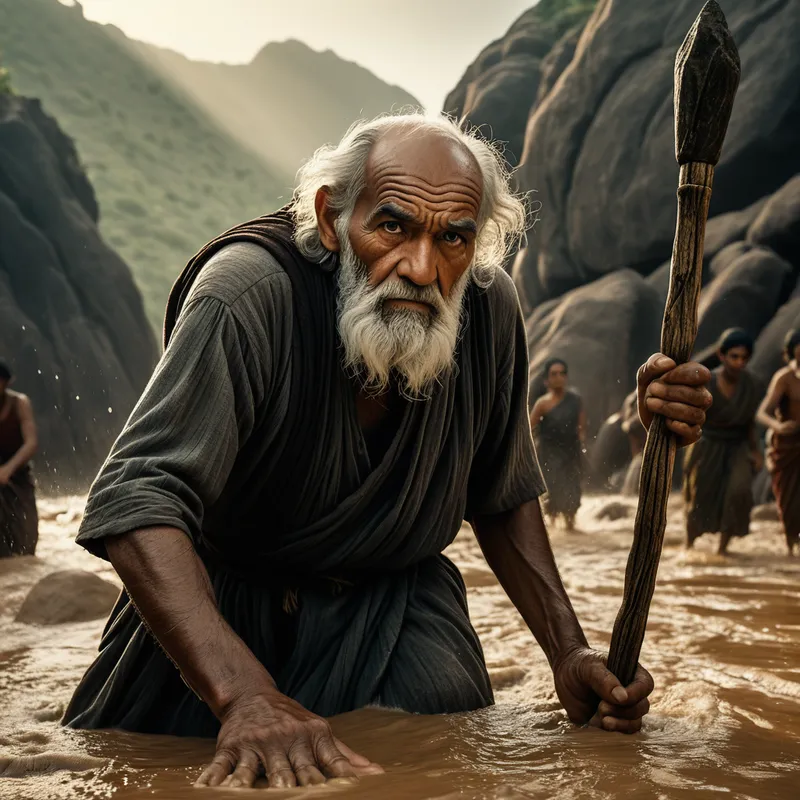
Their guide was Moses, a man who spoke with the mountain’s fire and carried a burden heavier than stone. Their compass was a pillar—by day, a column of cloud that cast a precious, moving shadow on the blistering ground; by night, a pillar of fire that turned the desert darkness into a furnace of guidance. They followed it into the barren embrace of Zin.
The wilderness was a teeth-bared truth. Thirst found them first, their tongues swelling, children crying for a drop that was not there. At Marah, Moses cast a tree into the bitter springs, and the water sweetened on their lips. Hunger came next, a gnawing ghost that whispered of the fleshpots of Egypt. Then, with the morning dew, came manna—fine, flaky, tasting of honey and wonder, a daily measure of grace that melted in the sun, teaching them to gather only for the day.
At the foot of Mount Sinai, the world shook. Thunder was a voice. Lightning was a script. The mountain smoked like a furnace, and the people trembled at the boundary, receiving the shape of their new soul: the Ten Words carved by divine finger on tablets of stone. Yet, in Moses’ absence, fear forged a golden calf, a god they could see, a echo of the familiar chains. Wrath and reconciliation flowed like bitter medicine.
The journey was a circle of complaint and miracle. Water burst from rock at Meribah. When venomous serpents besieged the camp, Moses lifted a serpent of bronze on a pole, and to look upon it was to live. They fought battles, wore their sandals thin, watched their children grow under the wandering shadow of the cloud.
And a promise lingered, a land of milk and honey, just beyond the next range of hills. Spies returned with a cluster of grapes so large it took two men to carry it, but their hearts were filled with the giants they saw. “We are as grasshoppers in their sight,” they cried. For this failure of nerve, for choosing the known slavery over the unknown promise, the sentence was passed: a generation must die in the wilderness. The circle of wandering became a spiral of purification.
For forty years, the manna fell. For forty years, their clothes did not wear out. For forty years, the old self, the slave-mind, was scoured away by the wind until nothing remained but the covenant and the waiting. Moses himself, the lawgiver, would only see the promised land from a distant peak. He laid his hands upon Joshua, and his breath left him on the plains of Moab. A people, tempered and hollowed out, stood on the bank of the Jordan, no longer refugees, but a nation born from the dust.
Cultural Origins & Context
This narrative forms the spine of the Torah—the books of Exodus, Leviticus, Numbers, and Deuteronomy. It is the foundational national epic of ancient Israel, likely compiled and refined during the monarchy or the Babylonian exile, a period of profound national crisis where the themes of displacement, covenant, and identity resonated with desperate power. It was not a single author’s tale but a collective memory, woven from oral traditions, liturgical recitations, and legal codes, told and retold at Passover to answer the child’s question: “What does this mean to you?” The answer was always: “We were slaves, and now we are free.” The wilderness was the necessary, terrifying space between those two states. Its function was etiological—it explained why Israel was a people bound by law rather than a king, why they observed certain rituals, and, most importantly, it established the template of the Mosaic Covenant: a relationship based on fidelity, tested in the desert, and remembered as the core of their identity.
Symbolic Architecture
The wilderness is not merely a location; it is the primary symbol—the tabula rasa, the liminal space where the old identity is annihilated so a new one can be inscribed. It represents the necessary void between stages of being.
The promised land cannot be entered by those who still dream of Egypt. The wilderness is the place where those dreams die of thirst.
Egypt symbolizes the complex, the entrenched pattern—the “fleshpots” of comfortable bondage, where sustenance comes at the cost of soul. The forty years is the time required for a complete psychic turnover, the death of the “slave generation” (the old ego-structure) so the “free generation” (the nascent Self) can emerge. The manna is the paradoxical sustenance of the transition—grace that cannot be hoarded, demanding daily trust and killing the anxiety of the ego that seeks to control tomorrow. The Nehushtan is a profound symbol of healing through confronting the shadow: the very image of the poison becomes the cure when viewed with conscious attention. The circling wanderings map the frustrating, non-linear path of deep psychological change, where progress is often invisible, and the terrain looks hauntingly familiar.

The Dreamer’s Resonance
When this myth stirs in the modern psyche, it often manifests in dreams of vast, empty landscapes—endless highways, featureless plains, or labyrinthine corridors. The dreamer feels profoundly lost, yet compelled to keep moving. There may be a sensed presence (the guiding pillar) or a distant, unreachable goal (the promised land). Somatic sensations are key: intense thirst, fatigue, or the feeling of carrying a heavy burden (the Ark of the Covenant). Psychologically, this indicates a state of ego dissolution following a major life transition—a liberation from a job, relationship, or belief system that was, in truth, a form of bondage. The dreamer is in the “wilderness,” where the old identity has collapsed, but the new one has not yet cohered. The complaints and fears in the biblical narrative mirror the dreamer’s own internal murmuring—the longing to return to the familiar misery, the terror of the unknown. The dream is the psyche’s confirmation: you are in the process. There is no going back. The only way is through the barrenness.
Alchemical Translation
The alchemy of the wilderness is the transformation of the massa confusa of a liberated crowd into a individuated people, a conscious community. For the individual, this is the journey from being a product of one’s history (Egypt) to becoming an author of one’s destiny (Canaan), mediated by the desert of the soul.
Individuation is not a conquest of a land, but a forty-year unlearning in the desert. The law received at Sinai is not an external rule, but the internal structure of the newly forming Self.
The process begins with the nigredo: the shocking, often painful liberation that plunges one into the void. The subsequent years of wandering are the albedo, the scorching purification by sun and doubt, where every non-essential aspect of the personality is burned away. The receiving of the law at Sinai is the citrinitas, the illumination of a new ethical and psychic structure from within. The final approach to the Jordan is the rubedo, the integration. Moses, who cannot enter, represents the necessary sacrifice of the old leader-ego that initiated the journey but is itself a product of the past. It must die for the Joshua-Self (a name meaning “Yahweh is salvation”) to lead the whole personality into its fullness. The promised land, therefore, is not a state of perpetual bliss, but the hard-won capacity to live from one’s deepest, covenant-bound truth, a land that must still be inhabited, fought for, and cultivated. The wilderness never fully leaves you; it becomes the sacred ground where your soul was forged.
Associated Symbols
Explore related symbols from the CaleaDream lexicon: