The Israelites in the Desert Myth Meaning & Symbolism
A people liberated from bondage wander a vast desert for a generation, tested by hunger, doubt, and a demanding covenant, forging a new identity.
The Tale of The Israelites in the Desert
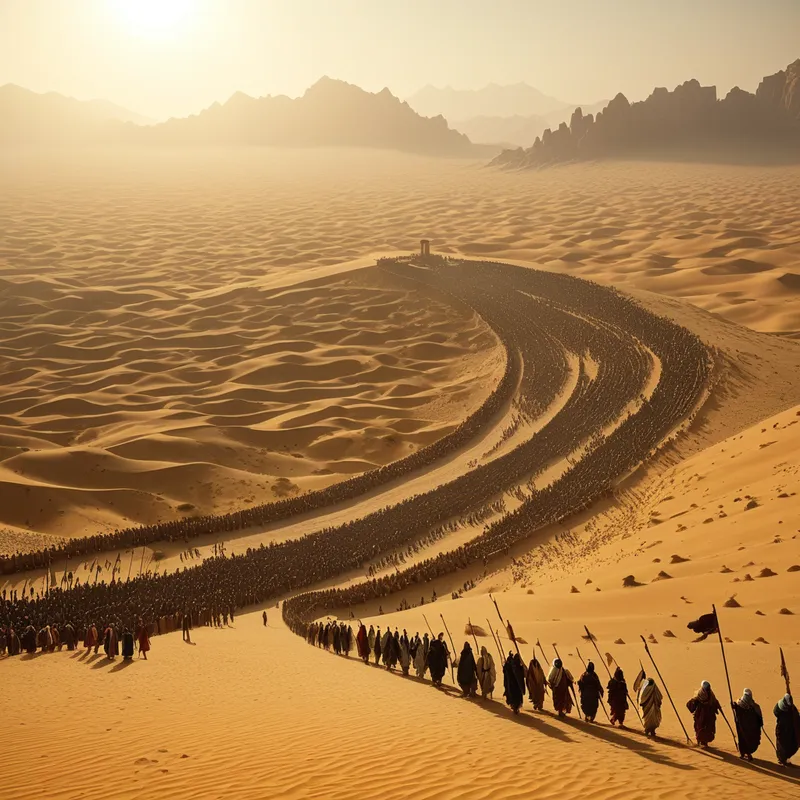
Hear now the tale of the great unraveling and the long becoming. It begins not with a birth, but with an unbinding. From the brick-kilns of Mitzrayim, from under [the shadow](/myths/the-shadow “Myth from Jungian culture.”/) of the crocodile-god and the lash of the taskmaster, a people stumbled forth. They were not an army, but a ragged multitude—men, women, children, herds, and the dust of generations. Before them walked a man named Moshe, his staff not a weapon but a sign, and his face turned away from the palaces of reeds towards the barren, singing emptiness.
[The sea](/myths/the-sea “Myth from Greek culture.”/) itself tore open a path of damp earth and towering walls of [water](/myths/water “Myth from Chinese culture.”/), and they crossed on trembling legs. When they turned, the waters crashed back into their bed, swallowing the chariots of their past. Then, silence. The vast, unblinking eye of [the desert](/myths/the-desert “Myth from Biblical culture.”/) opened before them. It was a place of bones and burning sky, of scorpions and thirst. The sweetness of freedom soured in their mouths, which tasted only of grit and fear. “Were there no graves in Egypt,” they cried, their voices a dry wind, “that you have brought us to die in this wilderness?”
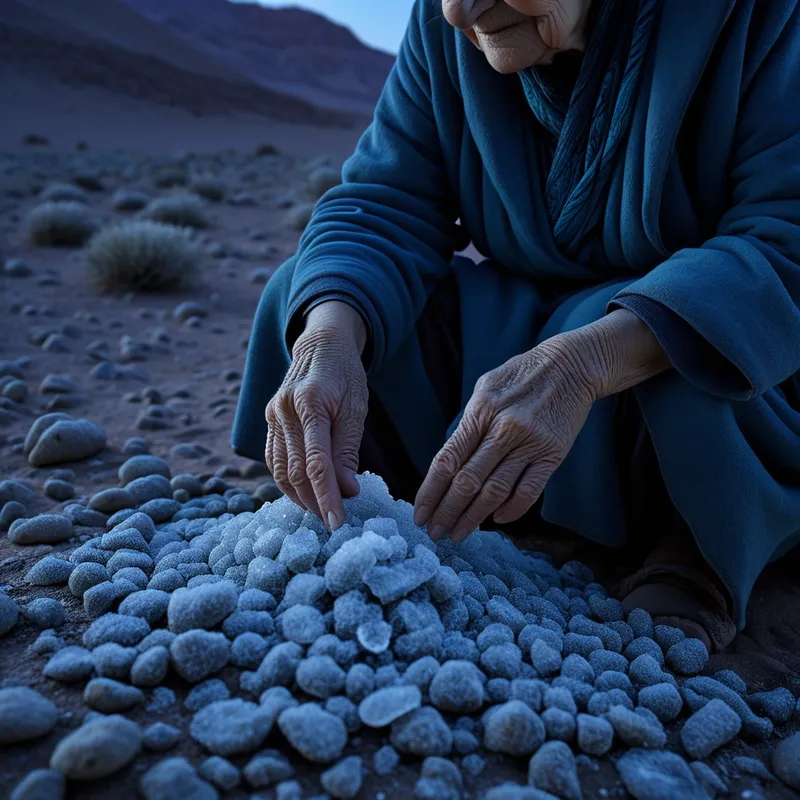
But from the starkness came provision. In the morning, the ground was covered with a fine, flaky substance, like frost on the desert floor—[manna](/myths/manna “Myth from Biblical culture.”/). It tasted of honey and memory. At evening, quails fell like a feathered blessing upon the camp. When their throats cracked with thirst, Moshe struck a rock at Horeb, and water, cold and shocking, gushed forth. Their journey was marked by a moving mystery: by day, a [pillar of cloud](/myths/pillar-of-cloud “Myth from Biblical culture.”/) to lead them through the furnace; by night, a pillar of fire to hold the terrifying emptiness at bay.
They came to the mountain, Sinai, and it trembled. Smoke wrapped its peak, and the sound of a shofar grew louder until the people shook in their tents. From that thunderous intimacy, a covenant was forged—not of stone and jewel, but of law and heart. They received the Aseret HaDibrot, the Ten Utterances, and swore, “We will do and we will hear.” Yet, in the terrifying absence of their leader, their faith melted and was recast as a [golden calf](/myths/golden-calf “Myth from Biblical culture.”/), a god they could see, a echo of the familiar idols left behind. Wrath followed, and a painful purification.
For forty years—a full generation—they wandered. The sand measured their days. Their clothes did not wear out; their feet did not swell. But their spirits were tested, grumbling against [the manna](/myths/the-manna “Myth from Biblical culture.”/), longing for the leeks and onions of their slavery. The old generation, whose souls were still shaped by the house of bondage, slowly faded into the dunes. Their children, who knew only [the wind](/myths/the-wind “Myth from Various culture.”/) and the covenant, grew strong in [the wilderness](/myths/the-wilderness “Myth from Biblical culture.”/). They were tempered by conflict with other nations, by internal rebellion, and by the constant, demanding presence of the Divine Name that dwelt among them in the Mishkan, a tent of meeting.
Finally, they stood on the eastern banks of the Jordan. Moshe, who had borne their complaints and their destiny, climbed the heights of Nebo. He looked across to the land flowing with milk and honey, a land he would not enter. His work was complete. He had led a slave-people out, and left a nation, forged in the desert furnace, ready to cross over.
Cultural Origins & Context
This narrative forms the spine of the biblical books of Exodus, Leviticus, Numbers, and Deuteronomy. It is the foundational national epic of ancient Israel, a story told and retold for millennia during Passover (Pesach), in weekly Torah readings, and in daily prayers. Its function was not merely historical but identity-forming. For a people often under foreign domination—in Babylon, Persia, Greece, and Rome—the desert story served as a powerful myth of origin that explained their unique relationship with the divine, their distinct laws (Torah), and their right to the land. It transformed a likely complex history of semi-nomadic groups and social upheaval into a sacred, teleological journey from chaos (slavery) to order (covenant), from a mixed multitude to a holy nation. It was a story told by priests to sanctify law, by prophets to chastise backsliding, and by parents to children to answer the question, “Who are we?”
Symbolic Architecture
The desert is the central [symbol](/symbols/symbol “Symbol: A symbol can represent an idea, concept, or belief, serving as a powerful tool for communication and understanding.”/)—the [temenos](/myths/temenos “Myth from Greek culture.”/) or sacred container for transformation. It is not a place of [death](/symbols/death “Symbol: Symbolizes transformation, endings, and new beginnings; often associated with fear of the unknown.”/), but of the death of the old self. It represents the necessary, barren, in-between state where the familiar structures of [identity](/symbols/identity “Symbol: Identity represents the sense of self, encompassing personal beliefs, cultural background, and social roles.”/) (even oppressive ones) have been left behind, and new ones are not yet formed.
The wilderness is the psyche’s crucible, where the glittering but false idols of the borrowed personality must be exposed and shattered against the stone of a deeper, more demanding truth.
Manna symbolizes grace that cannot be hoarded. It must be gathered daily, teaching dependence on something beyond [the ego](/myths/the-ego “Myth from Jungian culture.”/)‘s control and planning. The Mishkan represents the divine [presence](/symbols/presence “Symbol: Presence in dreams often signifies awareness or acknowledgment of something significant in one’s life.”/) not in a fixed [temple](/symbols/temple “Symbol: A temple often symbolizes spirituality, sanctuary, and a deep connection to the sacred aspects of life.”/), but in the [midst](/symbols/midst “Symbol: Midst often signifies being in the center of an experience, representing a state of engagement or confrontation with pressing life situations.”/) of the [journey](/symbols/journey “Symbol: A journey in dreams typically signifies adventure, growth, or a significant life transition.”/) itself—the sacred center is mobile, internalizable. The forty years signify the time required for a complete psychic cycle, the death of one mode of [consciousness](/symbols/consciousness “Symbol: Consciousness represents the state of awareness and perception, encompassing thoughts, feelings, and experiences.”/) (the “slave mentality”) and the [birth](/symbols/birth “Symbol: Birth symbolizes new beginnings, transformation, and the potential for growth and development.”/) of another (the “[covenant](/symbols/covenant “Symbol: A binding agreement or sacred promise between parties, often carrying deep moral, spiritual, or social obligations and consequences.”/) self”). [The golden calf](/myths/the-golden-calf “Myth from Biblical culture.”/) is the [shadow](/symbols/shadow “Symbol: The ‘shadow’ embodies the unconscious, repressed aspects of the self and often represents fears or hidden emotions.”/) of the [journey](/symbols/journey “Symbol: A journey in dreams typically signifies adventure, growth, or a significant life transition.”/): the desperate urge to re-materialize the transcendent, to craft a manageable god when the [mystery](/symbols/mystery “Symbol: An enigmatic, unresolved element that invites curiosity and exploration, often representing the unknown or hidden aspects of existence.”/) becomes too vast and silent.

The Dreamer’s Resonance
To dream of wandering in a vast, featureless desert often signals a profound life transition where old roles, relationships, or self-concepts have dissolved, but a new direction has not yet crystallized. The somatic feeling is one of existential thirst and disorientation. Dreaming of receiving mysterious, sustenance (like manna) suggests the dreamer is learning to rely on unexpected, perhaps subtle, inner resources or synchronicities. A dream of a guiding pillar of cloud or fire points to an emerging, intuitive sense of direction from the unconscious Self, cutting through the ego’s confusion. Conversely, dreaming of forging an idol or losing the path reflects anxiety about the process, a “regressive restoration of the [persona](/myths/persona “Myth from Greek culture.”/)” where the dreamer is tempted to revert to an older, more confined identity out of fear of the unknown. These dreams map the [psyche](/myths/psyche “Myth from Greek culture.”/)‘s own exodus from bondage to a promised, but not yet realized, wholeness.
Alchemical Translation
The alchemical process mirrored here is the [nigredo](/myths/nigredo “Myth from Alchemical culture.”/) and albedo—the blackening and whitening. The blackening is the descent into the chaos of the desert, the confrontation with hunger, doubt, and the shadow (the golden calf). It is the dissolution of the “Egyptian” complex, the patterned behaviors and beliefs formed in the “fleshpots” of our personal history—be they addiction, codependency, or a rigid self-image.
The covenant at Sinai is the albedo, the whitening: the reception of a new, non-negotiable inner law. This is not a harsh super-ego, but the lapis, the philosophical stone of the individuated Self—a core set of principles (truth, integrity, compassion) that structures the liberated psyche.
The forty-year wandering is the slow, meticulous circulatio, the circular distillation where these principles are integrated through daily practice and inevitable failure. One does not simply hear [the law](/myths/the-law “Myth from Biblical culture.”/) and become whole; one must live it in the barren places of life, where it is tested. [The promised land](/myths/the-promised-land “Myth from Biblical culture.”/), which Moshe sees but does not enter, represents the ultimate goal of individuation—a state of being that the current conscious ego (Moshe) has made possible but cannot fully inhabit. That task is for the next generation of the psyche, [the Self](/myths/the-self “Myth from Jungian culture.”/) that has been fully forged in the wilderness. Thus, the myth models the ultimate psychic journey: liberation is only the beginning; the long, purifying walk through the desert of the soul is where identity is truly born.
Associated Symbols
Explore related symbols from the CaleaDream lexicon: