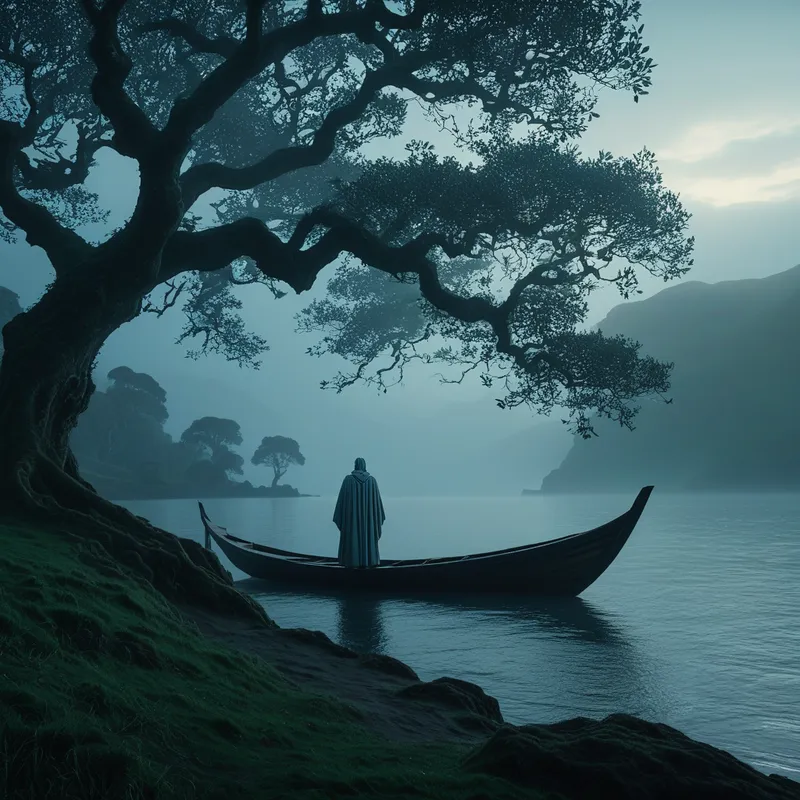
The Isle of Avalon from Arthur Myth Meaning & Symbolism
A wounded King Arthur is taken to the mist-shrouded Isle of Avalon, a realm beyond time, to be healed and to await the call to return.
The Tale of The Isle of Avalon from Arthur
Listen. The tale is not of an ending, but of a great turning. The last battle was fought, the field of Camlann soaked in blood and betrayal. There, the great king Arthur fell, not by a stranger’s hand, but by the poisoned strike of one he held dear. His body was broken, his kingdom shattered like glass upon stone.
A dread stillness fell. Then, from the weeping mists that clung to the marshes, a barge appeared. It moved without oar or sail, a vessel of dark, polished wood. Within it stood three figures, crowned not with gold but with sorrow: [Morgan le Fay](/myths/morgan-le-fay “Myth from Celtic culture.”/), the Queen of Orkney, and [the Lady of the Lake](/myths/the-lady-of-the-lake “Myth from Arthurian culture.”/), her face a mask of still [water](/myths/water “Myth from Chinese culture.”/). They lifted the king, his armor rent and stained, and laid him upon the barge’s deck. The waters parted silently before them, and the craft slid into the heart of [the mist](/myths/the-mist “Myth from Celtic culture.”/), a shroud that thickened until [the world](/myths/the-world “Myth from Tarot culture.”/) of men was lost.
For three days and three nights they traveled a river that was no river, under a sky that showed neither sun nor stars. The air grew thick with the scent of damp earth and blooming apple blossom. Then, the mists tore like a veil.
Before them rose the Isle. Avalon. A place of soft, perpetual twilight, where the grass was emerald and the trees bore fruit of gold and silver. Nine priestesses, sisters to those on the barge, waited on the shore, their robes the color of moonlight on water. They bore the king from the barge, their steps silent on the mossy path, to a chamber open to [the sky](/myths/the-sky “Myth from Persian culture.”/), where a bed of fragrant herbs awaited.
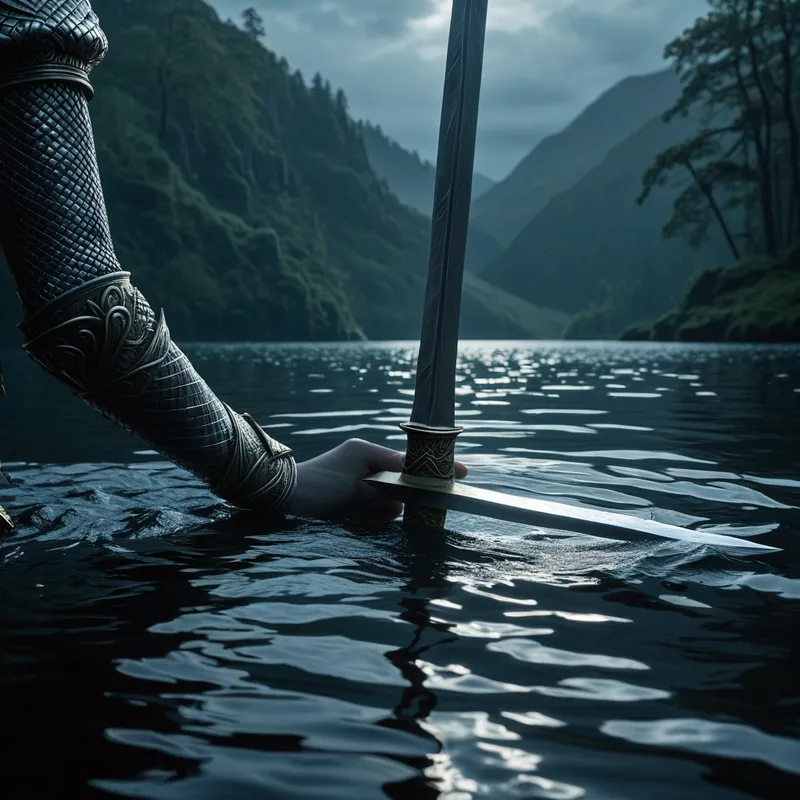
Here, the work began. Not with poultice and bandage, but with song and silence. Morgan le Fay, mistress of healing arts, tended the wound that would not close. The [Lady of the Lake](/myths/lady-of-the-lake “Myth from Celtic culture.”/) took from Arthur’s failing grasp the sword Excalibur. She walked to the edge of a still, black mere, and as she held it aloft, a hand clad in samite rose from the depths, took the hilt, brandished the blade three times, and drew it down beneath the water, leaving only ripples.
On the isle, time unspooled like thread. The king slept a sleep that was neither life nor death. The apples ripened and fell, seasons turning in a single breath. And it is said, in the deepest watch of the night, that the wound began to knit, not by mortal means, but by the slow, patient magic of the land itself. He rests there still, it is told. Not dead, but sleeping. Waiting for the trumpet call, for the hour of Britain’s greatest need, when he will rise again, whole and mighty, from the apple-scented mists of Avalon.
Cultural Origins & Context
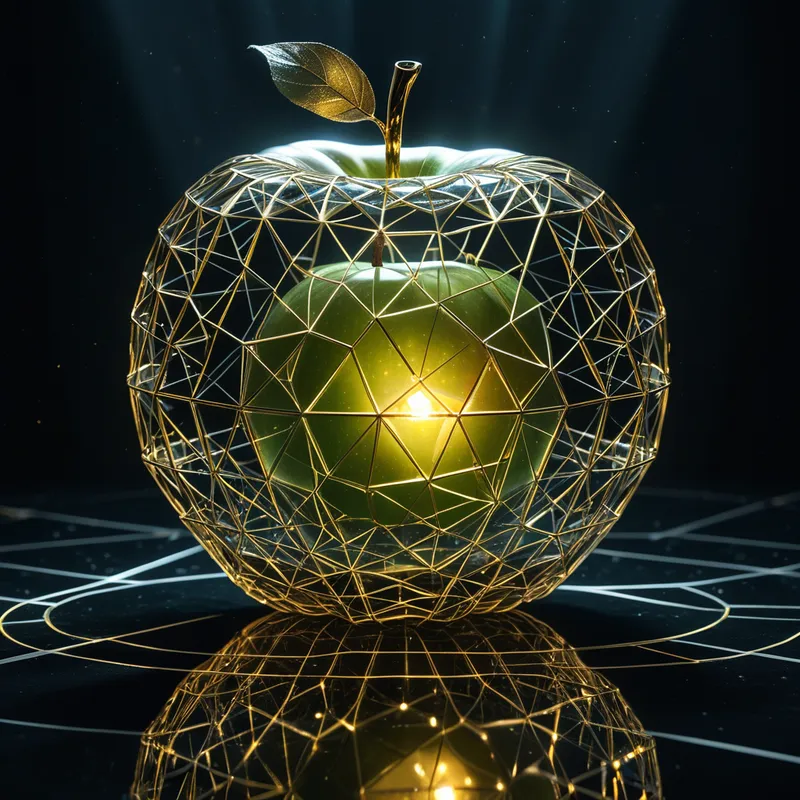
The myth of Avalon is a powerful confluence of Celtic [otherworld](/myths/otherworld “Myth from Celtic culture.”/) beliefs, medieval romance, and national legend. Its roots are deeply Celtic, drawing from the widespread concept of [Tír na nÓg](/myths/tr-na-ng “Myth from Celtic culture.”/) or Annwn—an island paradise of everlasting youth, healing, and abundance, often located over or under the western sea. The name “Avalon” itself derives from the Welsh Ynys Afallon, the “Isle of Apples,” fruit sacred in Celtic lore for its associations with immortality and wisdom.
The story crystallized in the 12th century, primarily through the work of Geoffrey of Monmouth in his Historia Regum Britanniae. Here, Avalon is specifically named as the place where Arthur’s sword was forged and where he is taken to heal his mortal wounds. Later French romancers, like Chrétien de Troyes, and most definitively Sir [Thomas](/myths/thomas “Myth from Christian culture.”/) Malory in Le Morte d’Arthur, wove the isle into the fabric of the Arthurian cycle. It functioned as a necessary mythic resolution, transforming a historical (or pseudo-historical) military defeat into a symbol of eternal hope and national destiny. It was a tale told in halls to inspire resilience and in monasteries to contemplate mysteries, a bridge between a lost [golden age](/myths/golden-age “Myth from Universal culture.”/) and a promised future return.
Symbolic Architecture
[Avalon](/symbols/avalon “Symbol: A mythical island from Arthurian legend, often representing a spiritual paradise, eternal rest, or a place of healing and transformation.”/) is not merely a [location](/symbols/location “Symbol: The symbol of ‘Location’ signifies a sense of place, context, and the environment in which experiences unfold.”/); it is a state of being. It represents the liminal threshold between [life](/symbols/life “Symbol: The symbol of ‘Life’ represents a journey of growth, interconnectedness, and existential meaning, encompassing both the joys and challenges that define human experience.”/) and [death](/symbols/death “Symbol: Symbolizes transformation, endings, and new beginnings; often associated with fear of the unknown.”/), [action](/symbols/action “Symbol: Action in dreams represents the drive for agency, motivation, and the ability to take control of situations in waking life.”/) and rest, [history](/symbols/history “Symbol: History in dreams often represents the dreamer’s past experiences, lessons learned, or unresolved issues that continue to influence their present.”/) and myth. It is the psychic container where what is broken is made whole, not by force, but by the profound, patient intelligence of [nature](/symbols/nature “Symbol: Nature symbolizes growth, connectivity, and the primal forces of existence.”/) and the unconscious.
The wound that will not heal in the world of men must be taken to the world of myth.
Arthur, the Wounded [King](/symbols/king “Symbol: A symbol of ultimate authority, leadership, and societal order, often representing the dreamer’s inner power or external control figures.”/), symbolizes the conscious ego and its worldly project—the establishment of order (Camelot) and the [pursuit](/symbols/pursuit “Symbol: A chase or being chased in dreams often reflects unresolved anxieties, unfulfilled desires, or internal conflicts demanding attention.”/) of a grand ideal ([the Grail](/myths/the-grail “Myth from Arthurian culture.”/)). His wound at Camlann represents the inevitable failure of the purely conscious project, betrayed by [shadow](/symbols/shadow “Symbol: The ‘shadow’ embodies the unconscious, repressed aspects of the self and often represents fears or hidden emotions.”/) elements ([Mordred](/myths/mordred “Myth from Arthurian culture.”/)) it could not integrate. Avalon, then, is the deep unconscious itself. The nine priestesses, often linked to the Gallizenae of Celtic tradition, personify the nurturing, regenerative, and magical aspects of the [psyche](/myths/psyche “Myth from Greek culture.”/) that exist beyond the [king](/symbols/king “Symbol: A symbol of ultimate authority, leadership, and societal order, often representing the dreamer’s inner power or external control figures.”/)’s rational, chivalric code.
The return of Excalibur to the [Lake](/symbols/lake “Symbol: A lake often symbolizes a place of reflection, emotional depth, and the subconscious mind, representing both tranquility and potential turmoil.”/) is a pivotal act of relinquishment. The [symbol](/symbols/symbol “Symbol: A symbol can represent an idea, concept, or belief, serving as a powerful tool for communication and understanding.”/) of temporal power and differentiated [consciousness](/symbols/consciousness “Symbol: Consciousness represents the state of awareness and perception, encompassing thoughts, feelings, and experiences.”/) is surrendered back to the primal, feminine waters of the unconscious from which it sprang. This is not a [loss](/symbols/loss “Symbol: Loss often symbolizes change, grief, and transformation in dreams, representing the emotional or psychological detachment from something or someone significant.”/), but a necessary [dissolution](/symbols/dissolution “Symbol: The process of breaking down, dispersing, or losing form, often representing transformation, release, or the end of a state of being.”/) so that a new, more integrated form of potency may one day emerge.
The Dreamer’s Resonance
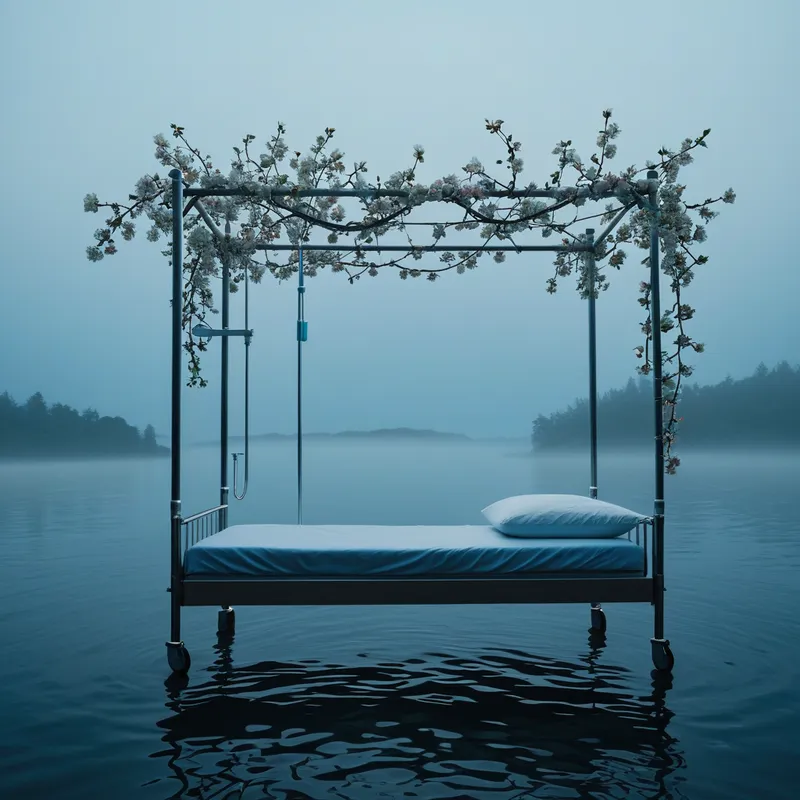
When [the Isle of Avalon](/myths/the-isle-of-avalon “Myth from Celtic culture.”/) rises from the mists of a modern dream, it signals a profound somatic and psychological process of withdrawal and incubation. The dreamer may be experiencing burnout, a deep illness (physical or emotional), or a sense that their life’s structure has collapsed. The dream landscape often features isolated, beautiful, yet eerily quiet places—a hidden garden, a secluded hospital, a silent island.
This is the psyche’s imperative for healing beyond the reach of daily consciousness. The dream-Avalon is a sanctuary where the frantic “doing” of [the ego](/myths/the-ego “Myth from Jungian culture.”/) is forced to cease, and the slower, wiser processes of the body and the deep unconscious can begin their work. To dream of being ferried to such a place, or of waiting within it, speaks to a necessary descent. It is a call to honor convalescence, depression, or creative fallow periods not as failures, but as sacred transitions orchestrated by the soul itself. The feeling is often one of profound melancholy mixed with peace—the sorrow of what was lost, and the quiet acceptance of a healing that operates on a different timeline.
Alchemical Translation
The journey to Avalon models the alchemical stage of [solutio](/myths/solutio “Myth from Alchemical culture.”/), followed by a long fermentatio. In the work of individuation, there comes a point where the conscious attitude—no matter how heroic or well-intentioned—reaches its limit and breaks down. The Arthurian project of the ego is complete, and its end is catastrophic.
The true alchemy begins not in the fire of ambition, but in the waters of surrender.
The alchemical translation requires the individual to consciously participate in their own “ferrying to the isle.” This means voluntarily stepping back from identified roles, surrendering outdated symbols of power and identity (the Excalibur of one’s career, [persona](/myths/persona “Myth from Greek culture.”/), or old self-image), and entering a period of purposeful incubation. It is an active passivity, a allowing of the psychic priestesses—the intuitive, nutritive, and restorative functions—to take the lead.
This process transmutes the lead of defeat and despair into the gold of wisdom and latent potential. The “sleep” of Arthur is not oblivion, but a profound restructuring of the personality around a deeper, more authentic center. One becomes, like the sleeping king, a latent force. The promise of return is the knowledge that from this deep rest, a new form of consciousness will eventually emerge, not to rebuild the old kingdom, but to serve a purpose born from the integration of both the light of Camelot and the healing mists of Avalon. The individual is no longer just a ruler of an external realm, but a sage who has touched the timeless isle within.
Associated Symbols
Explore related symbols from the CaleaDream lexicon: