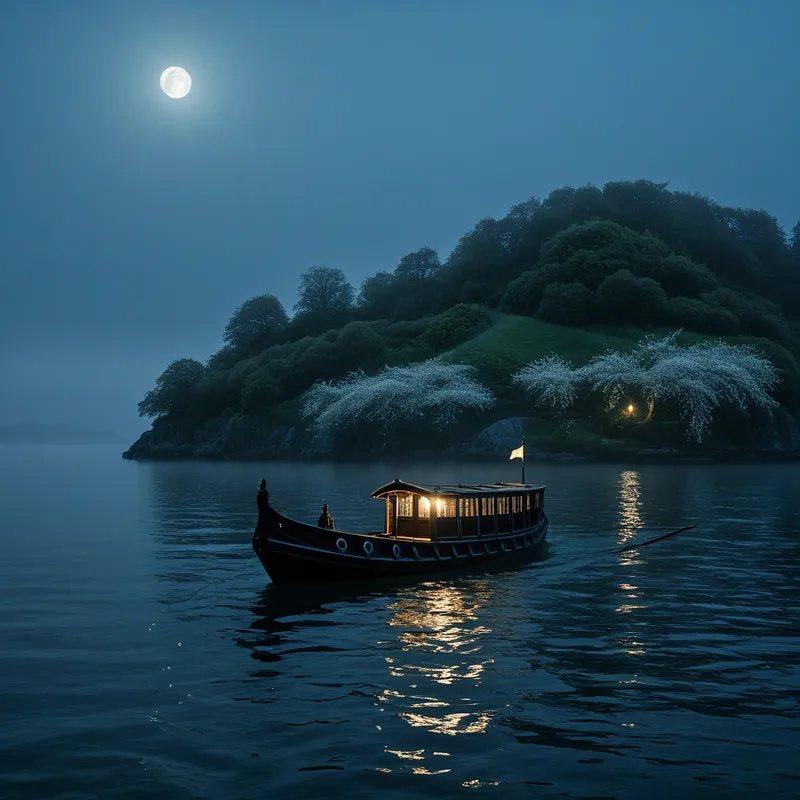
The Island of Avalon (Arthuria Myth Meaning & Symbolism
The mythic isle where the wounded King Arthur is taken to heal, a liminal realm of mist, magic, and the promise of a return.
The Tale of The Island of Avalon
Listen, and hear the tale of the last voyage, the journey taken when all other journeys seem done.
The field was a wasteland of mud and sorrow, the air thick with the iron scent of blood and the keening of crows. Here, upon the ravaged earth of Camlann, the great king lay broken. Arthur Pendragon was a man carved from the stone of Britain itself, but now that stone was shattered. His life, like the light of the day, bled out into the churned soil. The dream of the Round Table was a scattered ruin, its justice and fellowship drowned in the treachery of kin.
All seemed lost, the final note of a tragic song. But the world holds other melodies, sung in keys beyond mortal hearing. From the mist that clung to the fens and the meres, a shape emerged. Not a warship, but a barge, black as a raven’s wing and silent as a shadow. In it stood three figures, women whose faces were like the moon behind a veil of cloud. They were the Queens of Avalon. Their presence did not dispel the grief; they were its deeper, wiser aspect.
Without a word, they gathered the king—his armor rent, his body a testament to betrayal—and laid him upon the barge. The waters of the mortal realm seemed to part for them, not in a wave, but in a sigh. The mists on the lake deepened, becoming a wall of luminous grey. The world of men—the cries, the blood, the stark reality of failure—faded into a muffled silence.
Then, through the veil, it appeared: Avalon. An island that was less land and more idea, rising from the silvered water. The air was sweet with the perfume of apple blossoms, though no season seemed to rule here. The light was soft, eternal, caught between sunset and dawn. Here, time was not a river but a deep, still pool.
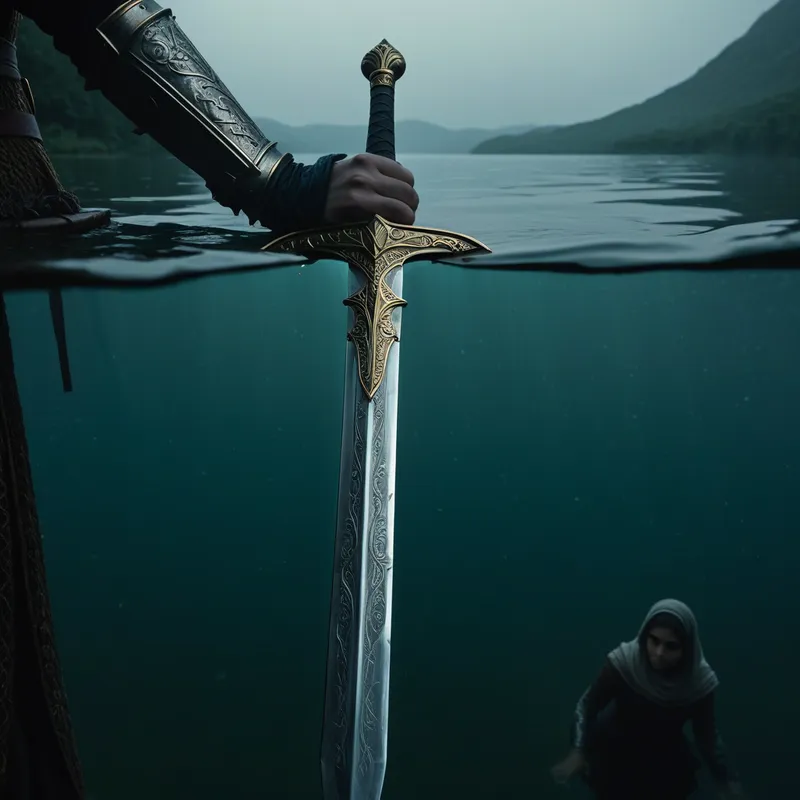
The barge grounded on a shore of pale sand. The Queens bore Arthur to a place of quiet green, where the grass was tender and the only sound was the gentle lap of water. His great sword, Excalibur, was taken. In one of the myth’s most poignant moments, the loyal knight Bedivere, after much struggle, fulfilled his king’s last command. He cast the brilliant blade into the lake. From the depths, a hand clad in white samite rose, caught the hilt, brandished it three times, and drew it down, reclaiming the symbol of divine right and sovereign power into the realm of mystery from whence it came.
On Avalon, Arthur’s wounds were tended not with simple poultices, but with the essence of the isle itself—with songs older than Britain, with sleep that was a forgetting and a remembering, with the cool touch of hands that knew the secrets of life and death. He did not die. He passed into a state of profound healing, a restorative slumber within the womb of the world. The myth ends not with an end, but with a promise, whispered on the wind: that the king is not gone, but sleeping, and will return when the world has need of him again.
Cultural Origins & Context
The Avalon myth is a late flowering of the vast Arthurian cycle, crystallizing in the High Middle Ages through the work of chroniclers like Geoffrey of Monmouth and poet Chrétien de Troyes. Its roots, however, sink deep into the pre-Christian soil of Celtic Britain. The name “Avalon” derives from the Welsh Ynys Afallon, “Isle of Apples,” linking it to the Celtic Otherworld—a paradisiacal realm of eternal youth and abundance, often located over the western sea or within hollow hills.
This myth was not a state chronicle but a soul chronicle, passed down by bards and shaped by monastic scribes. Its societal function was multifaceted: it provided a heroic, yet tragic, national origin story for a post-Roman Britain; it grappled with the trauma of invasion and societal collapse; and, most importantly, it offered a mythic container for the profound human experiences of failure, wounding, and the hope for restoration beyond the visible world. It transformed a military defeat into a spiritual passage.
Symbolic Architecture
Avalon is the ultimate symbol of the liminal zone. It is not heaven, nor is it the earthly realm. It is the temenos, the sacred precinct where the impossible work of soul-repair occurs.
The wounded king is the conscious ego, shattered by its own ambitions, betrayals, and the unbearable weight of its projected ideals.
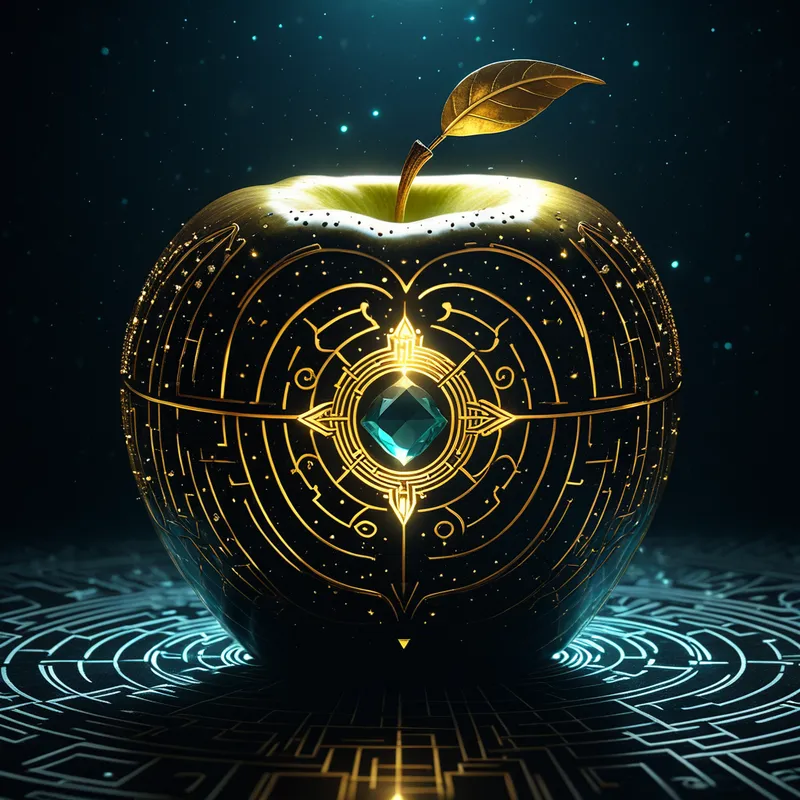
The island itself, shrouded in mist and accessible only by a silent barge, represents the unconscious psyche. We cannot march to it; we must be ferried, surrendering our will and our waking orientation. The apple, a fruit of immortality in many traditions, symbolizes the nourishing, regenerative substance of the unconscious, the psychic nourishment needed to heal a life lived too intensely in the outer world.
The casting away of Excalibur is a critical act of kenosis—an emptying. It represents the relinquishment of the persona, the heroic identity, the sword of will and control that both defined and ultimately broke the king. The hand from the lake—the hand of the Lady of the Lake—signifies the unconscious itself reclaiming its power, integrating the conscious projection back into the whole.
The Dreamer’s Resonance
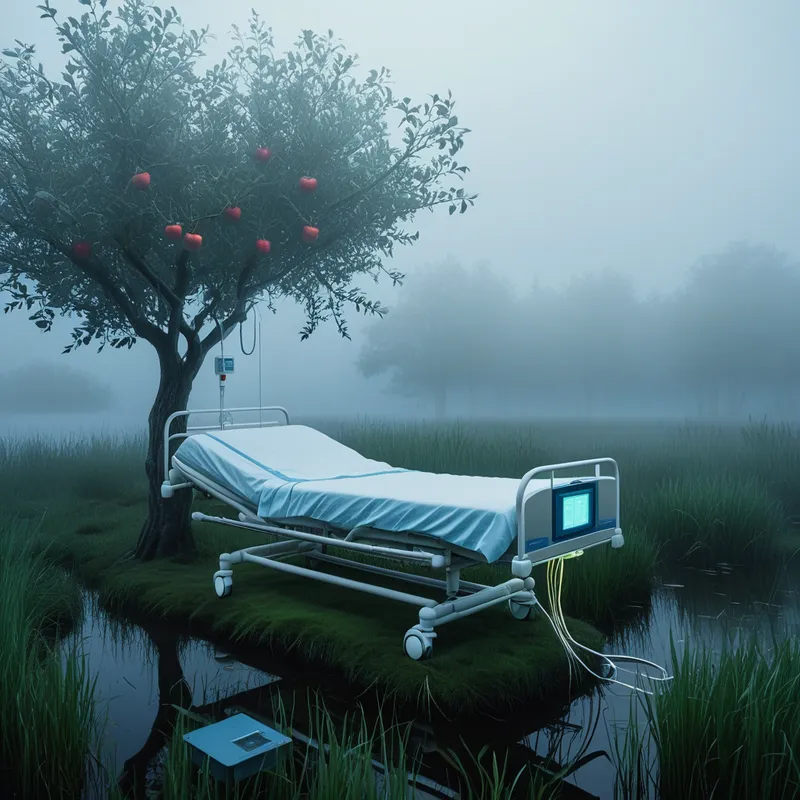
When Avalon appears in modern dreams, it rarely manifests as a literal medieval island. Instead, the dreamer may find themselves in a secluded, inexplicably peaceful sanatorium after a great ordeal; a hidden room in a familiar house that offers perfect quiet; or a misty landscape where time feels suspended. The somatic sense is one of profound relief, deep fatigue, and a release of tension held for too long.
This dream motif signals that the psyche has initiated a necessary withdrawal. The individual may be psychologically or physically “wounded”—burned out, depressed, recovering from trauma, or simply exhausted by the demands of their “kingdom” (career, family, identity). The dream is not an escape, but an instinctual prescription for a healing crisis. It marks the point where the ego’s resources are spent, and the deeper, slower, restorative processes of the Self must take over. The dreamer is being ferried to their own inner Avalon.
Alchemical Translation
The Avalon myth is a perfect map for the alchemical stage of solutio—dissolution. The rigid, crystalline structure of the conscious personality (the king in his armor) is dissolved in the waters of the unconscious (the misty lake) so that a new, more flexible form can coalesce.
The promise of return is not about a literal second coming, but the emergence of a renewed consciousness, tempered by its sojourn in the depths.
For the modern individual, the “alchemical translation” involves several steps. First, one must acknowledge the “Camlann”—the inner or outer battle that has left them wounded and defeated. This requires brutal honesty about failure and limitation. Second, one must allow the “barge” to come—to cease struggling and surrender to a period of introspection, rest, or therapy. This is the journey into the mist, away from the collective’s gaze.
The crucial, active step is the sacrifice of the sword: voluntarily setting aside the tools of one’s old identity—the career, the role, the compulsive productivity—that can no longer be wielded. This creates the vacuum into which new insight can flow. The healing sleep on Avalon is the period of incubation, where the work happens beneath awareness. The final stage is the integration of this healed, more humble self back into the world, not as a messianic hero, but as one who has seen the misty isle and carries its quiet wisdom within. The king is healed not to rule again as before, but to embody the sage who knows the value of both the sword and the scabbard, the battle and the restorative sleep.
Associated Symbols
Explore related symbols from the CaleaDream lexicon: