The Inuit Sky World Myth Meaning & Symbolism
A myth of a celestial hunter's fall to Earth, creating land, sea, and the delicate balance between the human and spirit worlds.
The Tale of The Inuit Sky World
Listen, and hear the story of the time before time, when the world above was the only world.
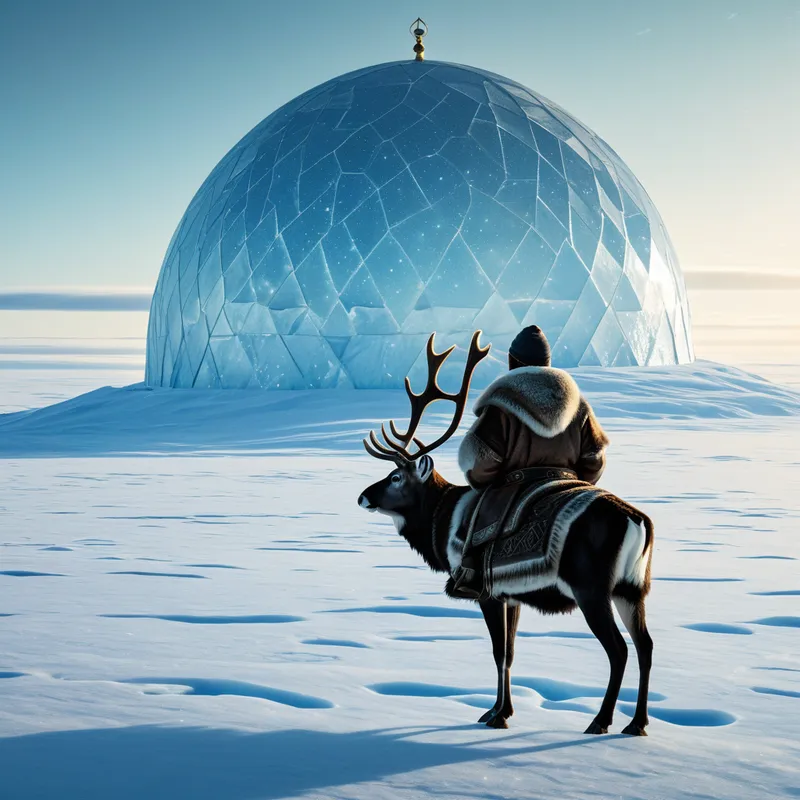
In the beginning, there was only the Sky World. A vast, luminous plain of eternal day, its ground was smooth, polished ice, and its sky a glowing, seamless dome. There were no mountains, no seas, no valleys—only light and flatness stretching forever. Here lived the first people, spirits in the form of humans, who knew neither cold nor hunger. They hunted great, ethereal caribou that drifted like clouds, and their lives were a quiet, unchanging rhythm beneath the constant sun.
Among them was a hunter, skilled and curious. His eyes were always drawn to the dome above, wondering what lay beyond its luminous shell. One day, while stalking a magnificent caribou, the chase grew fierce. The hunter, driven by a force he did not understand, pursued the beast further than any had before. The caribou, in its terror, leaped—and its hoof struck the very fabric of the sky-dome.
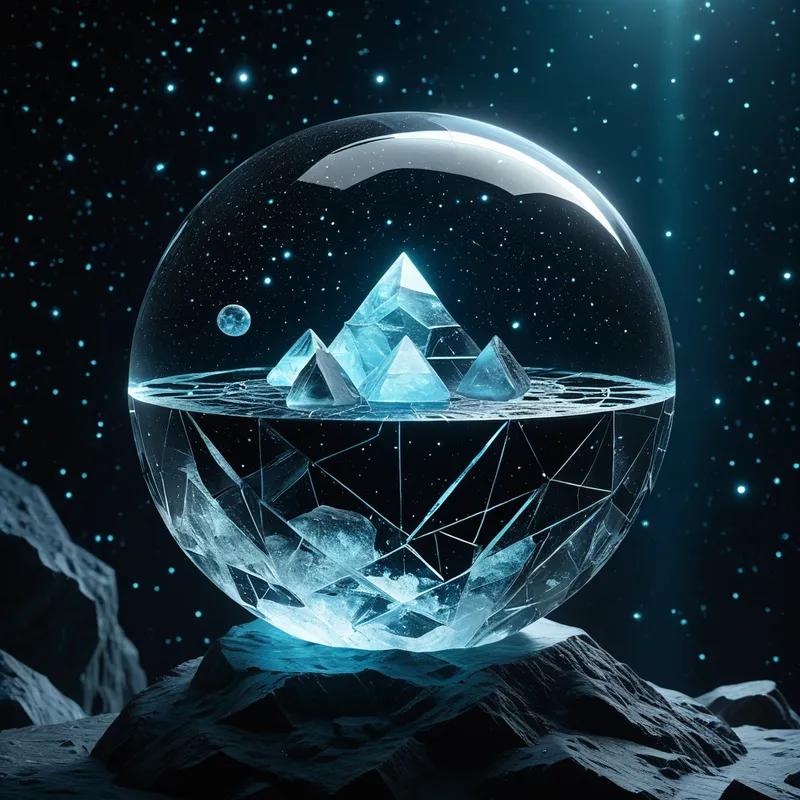
A crack appeared, a spider-web of darkness in the light. A single, perfect piece of the sky broke loose and fell away, revealing a terrifying, beautiful void. Through this hole, the hunter saw… nothing. A deep, formless black, punctuated by tiny, cold points of light. A great wind, a wind that was the very breath of chaos, rushed up through the opening. It caught the hunter, the caribou, and all the people who had gathered to see the wonder.
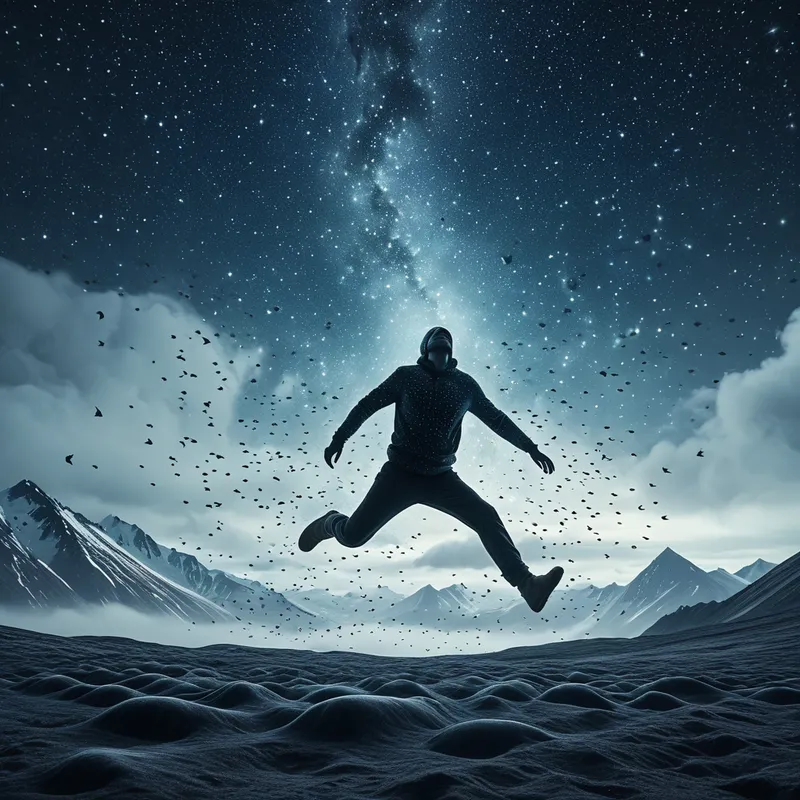
They were pulled, tumbling and crying out, through the hole in the world. Down they fell, through the endless dark, past the cold stars, for a time beyond counting. The hunter felt the warmth of the Sky World vanish, replaced by a biting, unknown cold. He saw his people scatter into the darkness like dust.
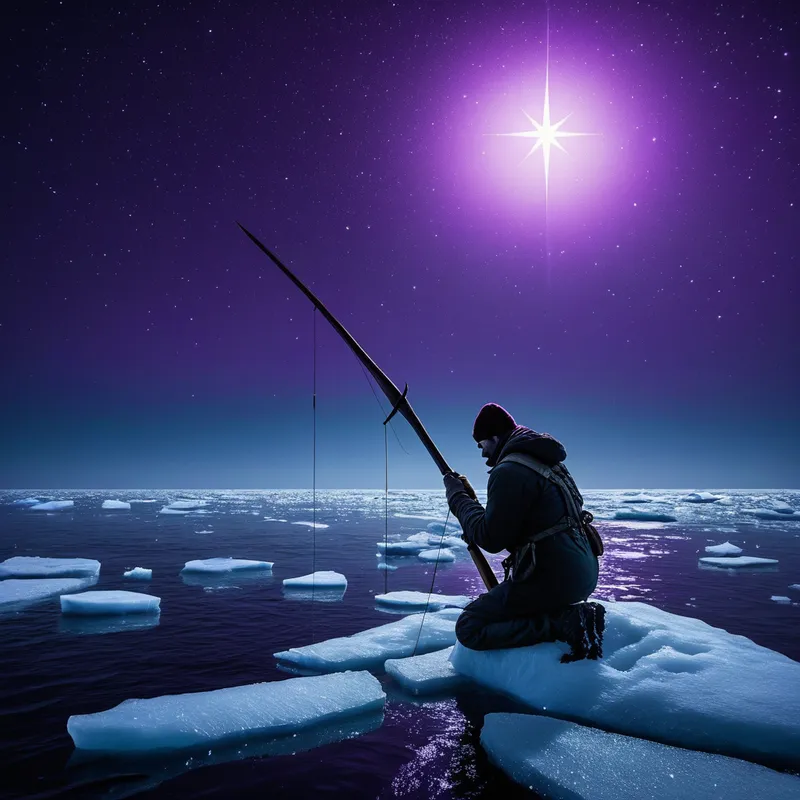
He landed not with a crash, but with a slow, sinking emergence onto something new. He found himself on a fragment of the very ice that had been his world, now adrift on a vast, black, heaving Ocean. There was land, but it was jagged and raw—great mountains thrusting from the water, born from the rubble of the fallen sky. The smooth ice was gone, replaced by a world of terrifying and magnificent contrasts: towering peaks and deep fjords, blinding snow and long, dark winters.
The hunter was alone. The eternal day was shattered into a cycle of light and dark. The familiar spirits were gone, replaced by new ones in the wind, the sea, and the ice. He was the first orphan of the universe, cast out of paradise, and in his fall, he had become the first human. From his loneliness and his need, he learned to truly see this new world—to watch the seal rise for breath, to follow the caribou over the rocky land, to understand that life here was a fragile bargain struck with a world that could give sustenance or death with equal indifference. He did not create the world; he discovered it through his fall, and in doing so, he gave it its meaning.
Cultural Origins & Context
This myth, in its many regional variations, is a cornerstone of Inuit cosmology, passed down through millennia by elders and storytellers, the isumataq. It was not merely entertainment but a vital framework for understanding humanity's place in the cosmos. Told during the long winter nights in the qarmaq or iglu, the story served multiple profound functions.
It explained the origin of the harsh, beautiful Arctic landscape—the mountains, the seasons, the sea—as the direct result of a primordial event. More importantly, it established the fundamental existential condition of Inuit life: humans are not the masters of creation, but beings who arrived in a world already full of powerful, sentient forces. The myth codifies the concept of inua. The fall from the Sky World represents the moment of separation from a unified spirit existence into a reality where humans must constantly negotiate with the inua of the seal, the weather, the moon.
The story functioned as a moral and practical guide. It taught respect, humility, and keen observation. The hunter’s fate was a reminder that curiosity and necessity can disrupt order, but also that survival depends on adapting to the new reality one has helped create. It framed life not as a struggle against nature, but as a precarious and sacred relationship born from a shared cosmic trauma.
Symbolic Architecture
The myth’s power lies in its stark, elemental symbolism. The Sky World represents the unconscious unity of infancy or a pre-conscious state—a world of undifferentiated light where all needs are met without effort. It is the psychic "paradise" that lacks individuation.
The fall is not a punishment, but the necessary rupture that creates consciousness. One cannot know the self until one is cast out of the whole.
The hunter’s curiosity is the first stirring of the ego, the part of the psyche that asks "what lies beyond?" This questing impulse inevitably breaches the protective dome of the known. The resulting fall is the traumatic, lonely birth of the individual into the "real world"—a world of duality (light/dark, land/sea, life/death), suffering, and responsibility.
The Ocean upon which he lands is the vast, unknown, and fertile realm of the unconscious itself, now below him instead of above. The jagged Mountains that arise are the first structures of the conscious mind, born from the shattered pieces of the old, simplistic reality. The hunter becomes the Orphan, the archetype who must build a soul from the ground up, through observation, relationship, and ritual.
The Dreamer's Resonance
When this myth pattern activates in the modern dreamer, it often manifests as dreams of catastrophic falls, finding oneself in utterly alien yet strangely familiar landscapes, or a profound sense of being an orphan or castaway in one’s own life. The somatic experience can be one of free-fall anxiety in the chest, or the deep chill of isolation.
Psychologically, this signals a pivotal dismantling. The dreamer is undergoing a "fall from grace"—the end of a naive worldview, the collapse of an old identity (the smooth, predictable Sky World), and the terrifying, lonely entry into a new phase of life. This could be the loss of a job that defined the self, the end of a relationship that provided a shared reality, or the shattering of a long-held belief. The dream confirms the trauma but also points to the nascent opportunity: you are landing on your own ice floe in a vast new psychic ocean. The task is not to claw your way back up, but to learn the laws of this new, more complex world you have fallen into.
Alchemical Translation
The alchemical process modeled here is the nigredo—the blackening, the descent into the chaotic prima materia. The myth provides a map for psychic transmutation that begins with a sacred rupture.
First, there is the Unconscious Unity (Sky World): A state of embeddedness, whether in family, ideology, or a comfortable persona. It feels like "home," but it is a home without true self-knowledge.
Then, the Catalytic Curiosity (The Hunter's Gaze): An inner impulse, perhaps a question, a creative urge, or a deep dissatisfaction, turns upward and outward, seeking something more. This is the ego’s necessary rebellion against the confines of the perfect dome.
Next, the Primordial Shattering (The Fall): The old container breaks. This is the painful, involuntary phase—depression, life crisis, profound loss. The dreamer plummets into the Chaos of the personal unconscious, feeling scattered and lost.
The alchemical vessel is not the safe dome of the sky, but the fragile ice floe on the dark sea—the conscious awareness that remains amidst the turmoil.
Finally, the Discovery of the Real (The New World): One lands. This is the beginning of the albedo, the whitening. The dreamer, like the hunter, must now practice radical observation. What are the true shapes of this inner landscape? What "seals" (instincts) and "caribou" (drives) sustain life here? This is the slow, meticulous work of building a conscious relationship with the powerful, often dangerous, but ultimately sacred forces of one’s own psyche—the inua of one’s emotions, talents, and wounds.
The goal is not to rebuild the Sky World on earth, but to become a skilled inhabitant of the broken, beautiful, and authentic world one has fallen into. The individuated self is the hunter who has learned the language of the new land, who has made a soul from the sacrifice of paradise.
Associated Symbols
Explore related symbols from the CaleaDream lexicon:
- Sky — The original, unified state of consciousness and spirit from which the individual falls, representing both paradise and the limitation of pre-individuated existence.
- Ocean — The vast, primordial, and unconscious realm upon which the new self is set adrift, symbolizing the unknown depths of the psyche and the source of all potential life.
- Mountain — The raw, jagged structures of the new world, born from the shattered sky, representing the challenges and the enduring formations of the emerging conscious ego.
- Journey — The core narrative of the myth is not a chosen quest but an involuntary, transformative passage from one state of being to another, mirroring the psychic process of individuation.
- Orphan — The central archetype embodied by the hunter, representing the state of being cast out from a containing order and forced to build identity and belonging from the ground up.
- Spirit World — The Sky World itself, and by extension, the perceived realm of unified meaning and connection from which the fall creates a painful but necessary separation.
- Fall — The pivotal, catastrophic event that ruptures unity and initiates creation, symbolizing the traumatic yet essential breakdown that precedes psychological growth and differentiation.
- Hunter — The active principle of curiosity and pursuit that catalyzes the fall, who then becomes the archetype of the conscious ego learning to navigate and negotiate with a sentient world.
- Ice — The substance of the old world that becomes the fragile foundation in the new, representing both the pristine, static state of the unconscious and the precarious platform of initial consciousness.
- Chaos — The formless void revealed by the broken dome and experienced in the fall, representing the fertile, terrifying state of unformed potential that exists between psychic orders.
- Sacrifice — The implicit offering of eternal unity and ease for the hard-won knowledge, relationship, and authentic existence of the human condition in the created world.
- Dream — The myth itself functions as a collective dream, explaining origins, while the fall mirrors the dreamer's own experience of being thrust into new, unfamiliar psychic landscapes.