The inn where Jesus was born i Myth Meaning & Symbolism
A myth of sacred arrival where the divine is born not in a palace, but in the humble, overlooked refuge of a stable, signifying the incarnation of the holy in the mundane.
The Tale of The inn where Jesus was born i
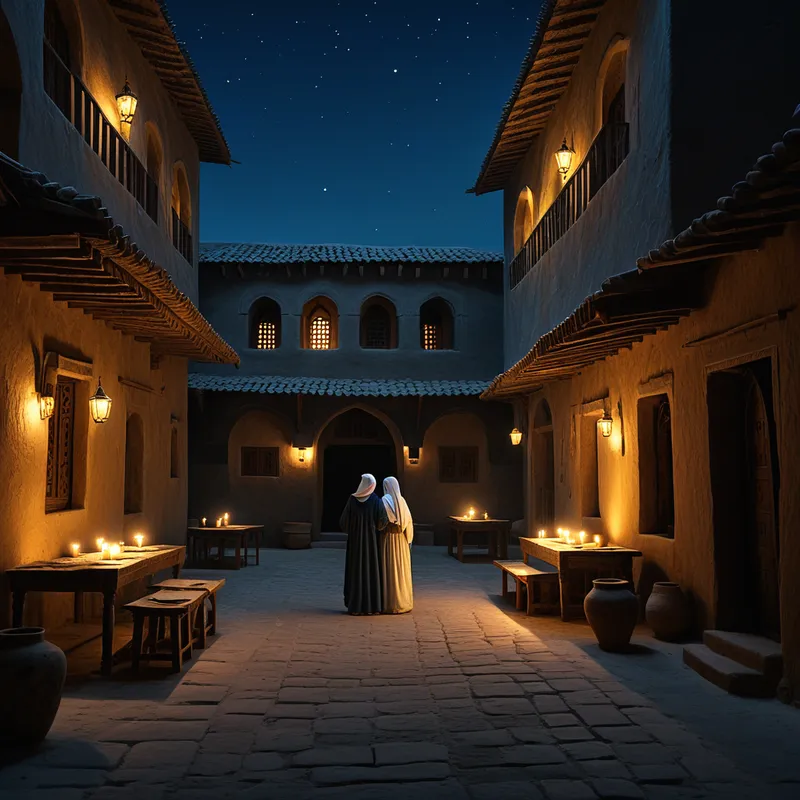
The world was heavy, a sigh held too long in the chest of empire. Dust rose from the road to Bethlehem, stirred by the feet of a thousand souls answering the call of a distant throne. Among them walked a man, his face etched with the miles, and beside him, a woman riding a donkey, her hands cradling the great curve of her womb. The night was a deep indigo cloak, pricked with cold, watchful stars.
They came to the inn. It was not a grand place, but a haven of noise and warmth against the pressing dark. Firelight spilled from its windows, and the air was thick with the smell of bread, animals, and the sweat of crowded humanity. The man, Joseph, pushed through the press of bodies to the keeper, whose brow was slick with the labor of managing the flood. “A room,” Joseph pleaded, his voice a dry leaf in the tumult. “My wife… her time is near.”
The innkeeper’s eyes, weary but not unkind, swept over the throng. Every corner was claimed, every mat occupied by a body bound for the census. Regret touched his features, a genuine sorrow. He had no space in the house of men. His gaze then drifted past Joseph, through the open door, to the quiet yard where the beasts of burden were kept. There stood a stable, a humble structure of stone and timber, smelling of hay and animal breath. It was a place of necessity, not hospitality. A refuge of last resort.
“No room,” the innkeeper said, the words final as a closed door. But then he gestured, not with dismissal, but with offering. “There… in the manger. It is shelter. It is quiet.”
And so, they turned from the house full of light and noise and went into the house of quiet and earth. The stable was a cave of shadows, its air still and cool. Gentle animals—an ox, perhaps a donkey—shifted in their stalls, their warm breath creating clouds in the air. With tender hands, Joseph made a nest in the hay of a feeding trough, the manger. And there, under the patient gaze of creatures, far from the halls of power that had summoned them, the woman, Mary, brought forth her child.
The first cry was not a shout to shake palaces, but a small, vital sound that hung in the sweet-scented air. She wrapped him in simple cloths and laid him in the trough, on a bed of hay meant for beasts. In that moment, the stable was transfigured. It was no longer the overlooked annex of the inn; it became the center. The divine had arrived, not by storming the gates of the crowded house, but by entering through the back door of the world, in the one place where there was, paradoxically, space to receive it.
Cultural Origins & Context
This narrative, central to the Christian nativity, originates from the Gospel of Luke in the New Testament. Its cultural setting is the Pax Romana, a time of enforced order, imperial decrees, and mass movements of people for administrative purposes. The story was passed down orally within early Christian communities before being codified in scripture, functioning as a foundational etiological myth for the nature of the Christian deity.
Its societal function was profoundly counter-cultural. In an era where divinity was associated with power, grandeur, and cosmic remoteness (in Roman Imperial cults or distant philosophical gods), this myth located the sacred in vulnerability, poverty, and obscurity. It was told not to glorify earthly rulers but to subvert their authority, suggesting that true kingship emerges from humility and that the cosmos pivots on events unnoticed by the powerful. It served as an identity-forming story for a marginalized community, affirming that God was with them precisely in their state of being overlooked and displaced.
Symbolic Architecture
The myth is a masterclass in symbolic inversion. The inn represents the crowded, conscious world—the ego’s domain of business, social obligation, and noise. It is full, complete, with no room for anything new or disruptive. The stable, by contrast, is the unconscious, the humble, animal, and earthy part of the self that is often ignored or deemed unworthy.
The divine does not compete for space in the crowded inn of the ego; it is born in the stable of the neglected soul.
The manger is a potent symbol of nourishment. The child, representing the nascent Self or a new consciousness, is placed where food for beasts is given. This signifies that the deepest spiritual nourishment often comes in forms the rational, “civilized” mind (the inn) considers crude or beneath it. The animals symbolize the instinctual, somatic wisdom that witnesses and accepts this birth without question, in contrast to the busy, distracted human world.
The “no room” is not merely a logistical fact but a profound psychological state. It represents a psyche too occupied with its own agendas, defenses, and identities to accommodate a transformative, vulnerable new content.
The Dreamer’s Resonance
When this mythic pattern appears in modern dreams, it often manifests as a search for shelter or a place to give birth amidst overwhelming circumstances. The dreamer may be frantically seeking a hotel room, an office, or a house that is perpetually full, locked, or unsuitable. The somatic feeling is one of profound weariness, displacement, and urgent need.
The psychological process is one of making space. The ego is overwhelmed; the conscious mind is “booked solid” with anxieties, duties, and old narratives. The dream points toward the necessity of retreating to a humbler, more instinctual, and perhaps “messier” part of the self (the stable) to allow something new to emerge. The birth in the dream is rarely literal; it is the emergence of a new feeling, a creative idea, a fragile insight, or a deeper connection to the body that requires a quiet, protected, and non-judgmental space to come to life. The dream is an instruction from the unconscious to stop seeking validation in the crowded marketplace of the ego and to tend to the sacred process occurring in the overlooked interior.
Alchemical Translation
The alchemical process modeled here is the incarnation of the spirit in matter, or the coniunctio of the divine and the humble. For the modern individual undergoing individuation, the “inn” is the persona—the adapted, social self that is full of roles and performances. The journey to Bethlehem is the call to one’s essential destiny (the census of the soul), which forces a confrontation with the fact that the persona has no room for the authentic Self.
The triumph is not in forcing entry into the inn, but in accepting the refuge of the stable. This is the act of humility, of turning inward to the earthy, instinctual, and often undervalued aspects of one’s being—the body, the shadow, the raw emotional life. The manger is the vessel of transformation, where the base material (hay, animal feed) becomes the cradle for the gold (the divine child).
The alchemical work is to recognize that the stable, with all its apparent poverty, is the only vessel capable of holding the new birth.
The process concludes not with the child being moved to a palace, but with it being recognized and honored in its humble surroundings by shepherds (those connected to nature) and wise men from afar (the integrated intellect). This signifies that once the new consciousness is born in the right interior space, the outer world—in its instinctual and wise forms—will align to acknowledge it. The myth teaches that psychic wholeness begins not with grandiosity, but with finding the sacred space for arrival within one’s own overlooked depths.
Associated Symbols
Explore related symbols from the CaleaDream lexicon: