The Immortal Myth Meaning & Symbolism
A seeker transcends mortal limits through inner alchemy, merging with the eternal Tao to become a free-roaming sage of the cosmos.
The Tale of The Immortal
Listen, and let the mists of Mount Kunlun part.
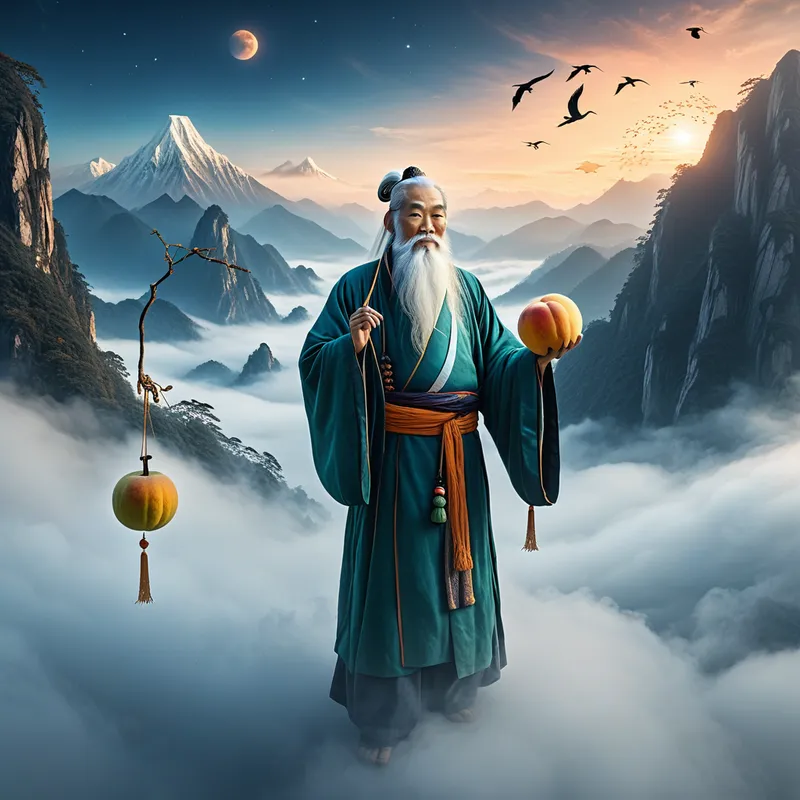
There was a seeker, once. Not a king, not a warrior, but a soul who felt the ache of time in their bones, who saw the seasons turn and asked, “Is this all?” They turned their back on the clamor of [the world](/myths/the-world “Myth from Tarot culture.”/)—the clinking of coins, the rustle of official silks, the endless cycle of desire and loss. With a heart both heavy and light, they ascended into the deep mountains where the pines whisper ancient secrets and the waterfalls sing the songs of [the Tao](/myths/the-tao “Myth from Taoist culture.”/).
Their journey was not one of conquest, but of shedding. In a cave or a humble thatched hut, they sat. They learned to still the xin, that chattering monkey of the mind. They practiced neidan, not with grand furnaces, but within [the crucible](/myths/the-crucible “Myth from Alchemical culture.”/) of their own body. They breathed with the rhythm of the tides, circulating the qi, gathering the luminous jing, refining it into pure shen.
Decades passed like clouds. Their hair whitened, yet their eyes grew clearer, seeing the li in a falling leaf. They consumed not rich foods, but the subtle vapors of dawn and the essence of pine needles. They sought the Lingzhi on cliff faces and learned the language of cranes. [The great work](/myths/the-great-work “Myth from Alchemical culture.”/) was an internal marriage—the union of Yin and Yang within their own dantian.
Then came the trial. Not a dragon, but a profound inner stillness so vast it felt like death. The final letting go. In that absolute emptiness, the elixir coalesced. A golden light bloomed in the lower abdomen, rising up the spine, washing through every channel, until the mortal frame itself became translucent, a vessel no longer needed.
The resolution was not an explosion, but a gentle unfurling. One morning, the seeker simply stepped out of their hut and did not return. Their body, it is said, vanished—“ascended in broad daylight.” They became a Xian, a free and wandering sage. Now they ride clouds over the sacred peaks, play weiqi with fellow Immortals in celestial grottoes, and occasionally descend, disguised as a beggar or an old farmer, to guide another aching heart onto the path. They are not a god to be worshipped, but a promise whispered on [the wind](/myths/the-wind “Myth from Various culture.”/): harmony with the Tao is possible.
Cultural Origins & Context
The myth of The Immortal is not a single, codified story but a pervasive archetype woven into the fabric of Taoist culture, emerging from the philosophical soil of the Daodejing and the [Zhuangzi](/myths/zhuangzi “Myth from Chinese culture.”/). Historically, it flourished during the Han dynasty and beyond, as Taoism evolved from a philosophy into a religion with practices aimed at literal physical longevity and spiritual transcendence.
These tales were passed down through oral tradition, in temple teachings, and in the rich genre of “Zhiguai” and “Liexian Zhuan.” They were told not just as entertainment, but as pedagogical tools and social commentary. The Immortal was often an ordinary person—a butcher, a woodcutter, a minor official—who achieved the extraordinary through dedication and alignment with the Tao. This democratized spiritual potential, offering an alternative to the rigid hierarchies of Confucian society. The myth functioned as a beacon of hope and a manual for liberation, providing a symbolic roadmap for the internal alchemical processes of neidan and qigong that were central to Taoist practice.
Symbolic Architecture
At its core, the myth of The Immortal is a grand [allegory](/symbols/allegory “Symbol: A narrative device where characters, events, or settings represent abstract ideas or moral qualities, conveying deeper meanings through symbolic storytelling.”/) for the process of psychological and spiritual [integration](/symbols/integration “Symbol: The process of unifying disparate parts of the self or experience into a cohesive whole, often representing psychological wholeness or resolution of internal conflict.”/). The [mountain](/symbols/mountain “Symbol: Mountains often symbolize challenges, aspirations, and the journey toward self-discovery and enlightenment.”/) [ascent](/symbols/ascent “Symbol: Symbolizes upward movement, progress, spiritual elevation, or striving toward higher goals, often representing personal growth or transcendence.”/) symbolizes the turn [inward](/symbols/inward “Symbol: A journey toward self-awareness, introspection, and the exploration of one’s inner world, thoughts, and unconscious mind.”/), away from [the ego](/myths/the-ego “Myth from Jungian culture.”/)‘s projections (the “red [dust](/symbols/dust “Symbol: Dust often symbolizes neglect, forgotten memories, or the passage of time and life’s impermanence.”/)” of the world). The long, solitary cultivation represents the arduous work of confronting and reconciling the contents of the personal and [collective unconscious](/symbols/collective-unconscious “Symbol: The Collective Unconscious refers to the part of the unconscious mind shared among beings of the same species, embodying universal experiences and archetypes.”/).
The Immortal does not fight the dragon; they learn the dragon’s true name, which is their own coiled potential.
The [alchemical process](/symbols/alchemical-process “Symbol: A symbolic transformation of base materials into spiritual gold, representing inner purification, integration, and the journey toward wholeness.”/) is key. The raw, instinctual jing (often symbolized by lead or [mercury](/symbols/mercury “Symbol: Mercury symbolizes communication, intellect, and swift movement, often representing the messenger between realms in spiritual and mythological contexts.”/)) is the unrefined [life](/symbols/life “Symbol: The symbol of ‘Life’ represents a journey of growth, interconnectedness, and existential meaning, encompassing both the joys and challenges that define human experience.”/) force, our primal energies and desires. Through disciplined practice (zhou tian), it is transformed into the conscious, directed [energy](/symbols/energy “Symbol: Energy symbolizes vitality, motivation, and the drive that fuels actions and ambitions.”/) of qi (silver), and finally sublimated into the luminous, transcendent [awareness](/symbols/awareness “Symbol: Conscious perception of self, surroundings, or internal states. Often signifies awakening, insight, or heightened sensitivity.”/) of shen (gold). This is the creation of the “shengtai” or sacred [embryo](/symbols/embryo “Symbol: Represents the earliest stage of development, potential, and the beginning of a profound journey toward becoming.”/)—a new, integrated psychic [structure](/symbols/structure “Symbol: Structure in dreams often symbolizes stability, organization, and the framework of one’s life, reflecting how one perceives their environment and personal life.”/).
The final “[ascension](/symbols/ascension “Symbol: A profound sense of rising upward, often representing spiritual enlightenment, personal growth, or transcendence beyond physical limitations.”/)” symbolizes the [death](/symbols/death “Symbol: Symbolizes transformation, endings, and new beginnings; often associated with fear of the unknown.”/) of the identification with the mortal, separate self (the ego) and the [birth](/symbols/birth “Symbol: Birth symbolizes new beginnings, transformation, and the potential for growth and development.”/) of a [consciousness](/symbols/consciousness “Symbol: Consciousness represents the state of awareness and perception, encompassing thoughts, feelings, and experiences.”/) that identifies with [the Self](/myths/the-self “Myth from Jungian culture.”/), the totality of the [psyche](/myths/psyche “Myth from Greek culture.”/) in [harmony](/symbols/harmony “Symbol: A state of balance, agreement, and pleasing combination of elements, often associated with musical consonance and visual or social unity.”/) with the Tao. The Immortal, now a Xian, represents this achieved state of wholeness: autonomous, fluid, and in effortless accord with the patterns of [nature](/symbols/nature “Symbol: Nature symbolizes growth, connectivity, and the primal forces of existence.”/) and [cosmos](/symbols/cosmos “Symbol: The entire universe as an ordered, harmonious system, often representing the totality of existence, spiritual connection, and the unknown.”/).
The Dreamer’s Resonance
When this myth stirs in the modern dreamer, it often signals a profound crisis or calling related to meaning, time, and authenticity. To dream of an ancient sage on a mountain, a glowing pill or elixir, or of one’s own body becoming light or translucent, is to encounter the archetype of the Self beckoning from the depths.
Somatically, this may coincide with a feeling of being “stuck” in life, a deep fatigue with worldly pursuits, or a mysterious pull toward simplicity and nature. Psychologically, it is the process of “descending into the mountain”—entering a necessary period of introspection, often forced by illness, loss, or burnout. The dreamer is being asked to engage in their own inner alchemy: to stop projecting their vitality outward (dissipating jing) and to begin the difficult work of circulation and refinement. The dream-Immortal is both a guide and a reflection of the potential wholeness awaiting on the other side of this conscious engagement with [the shadow](/myths/the-shadow “Myth from Jungian culture.”/) and the unlived life.
Alchemical Translation
For the modern individual, the myth of The Immortal provides a timeless model for the Jungian process of individuation—the journey toward becoming an integrated, unique self. Our “worldly mountain” is the complex of social identities, career pressures, and consumerist desires. The first step is the “retreat,” a conscious dis-identification from these outer dictates to ask the fundamental question: “What is true for my essential being?”
The crucible is not a cave of stone, but the vessel of attentive consciousness held steady in the fires of daily life.
The alchemical work translates into active imagination, mindfulness, therapy, creative expression, or any practice that serves to “circulate the qi”—that is, to make conscious the unconscious complexes and energies that govern us. Transforming “lead” into “gold” is the work of taking raw, often difficult emotions, memories, and instincts (the shadow) and, through the light of awareness, integrating them into the personality, thereby gaining their power and insight.
The “ascension” is not a literal departure from the world, but the achievement of a liberated perspective within it. It is the state where one acts from a center of gravity in the Self, not the ego. One becomes “immortal” in the sense that one’s actions are no longer solely for personal gain or fear, but are spontaneous expressions of one’s deep nature in harmony with the larger pattern. The modern Immortal walks the city streets or tends a garden, but they do so with the freedom of the cloud-rider, unattached to outcomes, fully present, and utterly real. They have found the elixir not in a pill, but in the quality of their own awakened attention.
Associated Symbols
Explore related symbols from the CaleaDream lexicon: