The I Ching Myth Meaning & Symbolism
An ancient divinatory text born from cosmic observation, revealing the patterns of change and offering timeless wisdom for navigating life's complexities.
The Tale of The I Ching
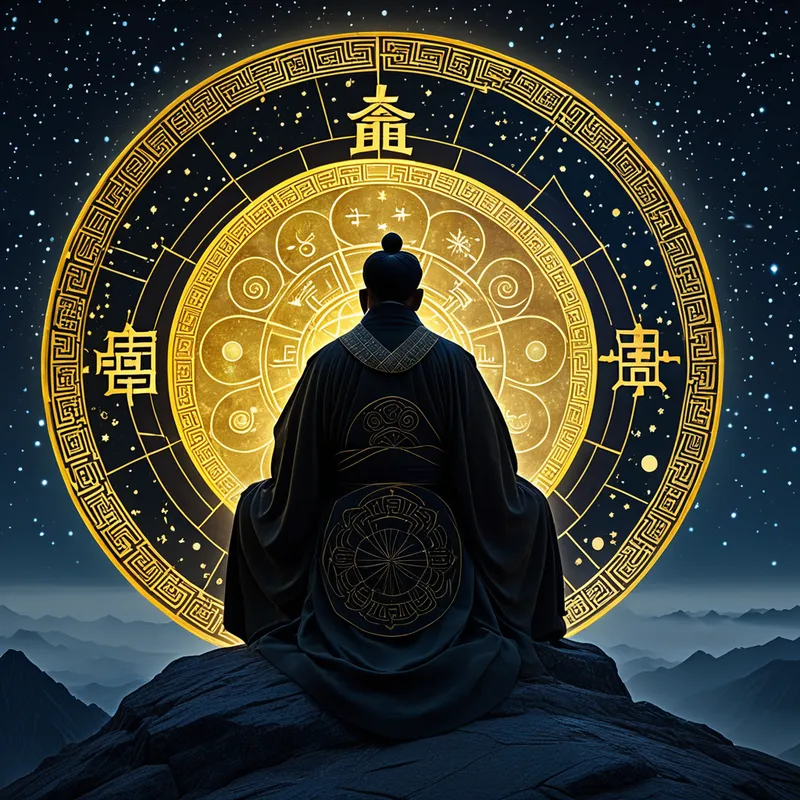
In the time before time was measured, when the sky was a fresh vault and the earth a new-plowed field, the patterns of the world were yet hidden. The great sage-king Fu Xi walked the land, his heart troubled by the chaos of existence. Men lived in fear of floods and fire, of sudden change and unseen fate. They had no compass for the soul, no map for the heart’s journey.
One day, Fu Xi climbed the sacred mountain. The wind whispered secrets in the pines, and the river below sang a song of endless flow. He sat by the Luo River, seeking a sign. As dusk bled into the indigo of night, a miracle emerged from the dark waters. A majestic, ancient tortoise surfaced, its shell a canvas of the cosmos itself. Upon its carapace, Fu Xi saw a grid of numbers—nine perfect arrangements. This was the Luo Shu, a divine script of order.
As he marveled, his gaze was drawn upward. The heavens unveiled their own scripture. The constellations wheeled in their eternal dance, and in their connections, Fu Xi perceived eight fundamental patterns. He saw the pure, creative force of Qian, and the deep, receptive womb of Kun. He saw the flickering danger of Li and the perilous abyss of Kan. With a stick, he traced these eight trigrams into the earth—three lines, broken or whole, a language of reality itself.
Centuries flowed like the Yellow River. A wise and virtuous king, King Wen of Zhou, found himself imprisoned by a tyrannical ruler. In the silence and despair of his cell, with only straw for a bed, King Wen did not succumb. He took the eight trigrams of Fu Xi and began to stack them, one upon another. From eight, he created sixty-four. To each of these six-lined hexagrams, he gave a name and a judgment—a pearl of wisdom forged in the crucible of suffering. The Creative spoke of potent beginnings. The Abysmal warned of danger. The Turning Point promised change.
His son, the Duke of Zhou, would later add words to each individual line, guiding the seeker through the nuances of their situation. And finally, in the crucible of the Axial Age, the great sage Confucius himself, in his later years, is said to have worn out the leather thongs binding his bamboo copies of the book from constant study. He added layers of commentary, weaving ethics and philosophy into the divinatory fabric, transforming it into a mirror for the noble heart. Thus, the I Ching was born—not in a single moment, but across the ages, a collaboration between the human spirit and the deep, patterning soul of the world.
Cultural Origins & Context
The I Ching, or Yijing, is not a myth with a single author or moment of genesis, but a living textual organism that grew from the very bedrock of Chinese civilization. Its earliest layers are rooted in the oracle bone divination practices of the Shang Dynasty (c. 1600–1046 BCE). Diviners would apply heat to bones or shells and interpret the resulting cracks as messages from the ancestors and spirits. This practice evolved into a more abstract system using yarrow stalks to generate numerical patterns, which eventually crystallized into the line symbols of the hexagrams.
Its societal function was paramount. It was a tool for kings to consult before battles and harvests, for nobles to understand their fate, and later, for philosophers to ponder the nature of the cosmos. It served as a bridge between the human realm (Ren) and the patterns of heaven (Tian). Unlike a static dogma, it was a dynamic interface. Its transmission was a sacred duty, passed from master to student, copied and recopied, with each generation adding its layer of understanding. It became one of the Five Classics of Confucianism, securing its place not merely as a book of fortune-telling, but as the foundational text of Chinese metaphysics, ethics, and statecraft.
Symbolic Architecture
At its core, the I Ching is a vast symbolic map of process itself. Its architecture is built from binary code—the solid line (Yang) and the broken line (Yin). These are not static opposites, but dynamic polarities in constant intercourse. From their pairing comes the four “images,” and from these, the eight trigrams, each a archetypal snapshot of a state of being or force of nature: Heaven, Earth, Thunder, Water, Mountain, Wind, Fire, Lake.
The hexagram is not a answer, but a living situation. It is a snapshot of the Tao in one of its 64 possible moods.
The 64 hexagrams are the complete lexicon of life’s situations, from Qian (The Creative) to Wei Ji (Before Completion). Each hexagram contains within it the seed of its opposite, and any line can “change” into its counterpart, morphing the entire hexagram into a new one. This embodies the central Chinese worldview: perpetual, cyclical change (Yi) is the only constant. The symbol of this is the Taijitu, the swirling circle of Yin and Yang, each containing the seed of the other.
Psychologically, the I Ching represents the archetype of the Self—the total, integrated psyche—as an ordering principle. It is a model of the psyche’s own structure, where conscious and unconscious, stable and chaotic elements (the lines and their changes) interact to produce the momentary constellation of who we are in any given situation. Consulting it is an act of projecting one’s inner state onto this objective, symbolic matrix to see it reflected back with clarity.
The Dreamer’s Resonance
When the patterns of the I Ching emerge in modern dreams, they rarely appear as an ancient book. Instead, one might dream of complex, shifting mosaics on a wall; of navigating a city built on an impossible geometric grid; of seeing one’s own face composed of alternating light and dark panels. These are dreams of seeking orientation within inner chaos.
The somatic feeling is often one of simultaneous confusion and profound order—a dizzying lattice that somehow makes sense. The dreamer is undergoing a process of psychic re-patterning. The conscious ego is confronted with the underlying, autonomous ordering principle of the unconscious. A dream of finding a single, glowing line in the darkness speaks to the emergence of a new clarity, a nascent Yang impulse from the Yin of the unknown. A dream of a perfect pattern shattering may reflect the necessary deconstruction of an old, rigid mindset to allow for a more fluid and authentic order to form. The I Ching in dreams is the psyche’s own algorithm running in the background, attempting to reconcile opposites and find the Zhong Yong—the central, balanced way—through a life transition.
Alchemical Translation
The alchemical work modeled by the I Ching is the individuation process—the forging of the individual from the raw materials of inherited patterns and personal experience. The ritual of consultation—the focused question, the random generation of lines—is an act of sacrificium intellectus: a voluntary surrender of the ego’s need for control and linear logic. One invites the irrational, the synchronicitous, to speak.
To cast the stalks is to plant the question in the soil of the unconscious and wait for the symbolic crop to rise.
The resulting hexagram is the prima materia, the initial confused state of the soul. The changing lines are the points of tension, the “hot spots” where transformation is not only possible but demanded. The counsel of the judgment and line texts is not a command, but a description of the Tao of the situation—its inherent flow and ethical grain. The task of the modern individual is to engage in an inner dialogue with this symbol. How does “The Well” (Hexagram 48) reflect my need to tap deep, neglected resources? How does “The Cauldron” (Hexagram 50) symbolize my need to transform raw experience into nourishing insight?
The ultimate goal is not to have a static answer, but to cultivate an inner state of resonance with change itself—to develop what the text calls “the superior man’s” quality of being “anxious and careful, discerning the minute.” It is to internalize the 64 hexagrams as 64 attitudes, 64 ways of being in the world, and to learn to move fluidly between them as life demands. In this, one performs the ultimate alchemy: transmuting the lead of chaotic fate into the gold of conscious destiny, becoming, in a small way, a co-creator with the ever-changing Tao.
Associated Symbols
Explore related symbols from the CaleaDream lexicon: