The Hypostasis of the Archons
A Gnostic creation myth revealing how malevolent cosmic rulers fashioned humanity to imprison divine light within physical bodies.
The Tale of The Hypostasis of the Archons
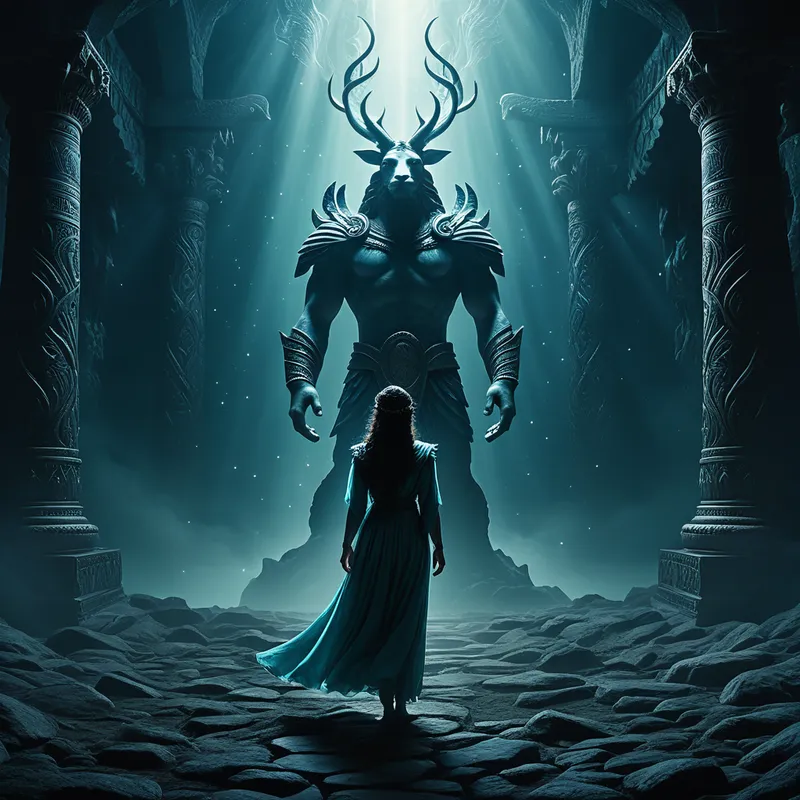
In the beginning, before [the world](/myths/the-world “Myth from Tarot culture.”/) we know, there was the Fullness, [the Pleroma](/myths/the-pleroma “Myth from Gnostic culture.”/)—a realm of ineffable light, harmony, and divine emanations. From this luminous source flowed [Sophia](/myths/sophia “Myth from Gnostic culture.”/), Wisdom, who desired to bring forth a thought without the consent of her divine counterpart. This solitary, passionate act gave birth to a formless, aborted entity, a being of ignorance and arrogance. This was [Yaldabaoth](/myths/yaldabaoth “Myth from Gnostic culture.”/), the first Archon, who, in his blindness, proclaimed, “I am God, and there is no other beside me.”
Cast out from the [Pleroma](/myths/pleroma “Myth from Gnostic culture.”/) into the profound emptiness of [chaos](/myths/chaos “Myth from Greek culture.”/), Yaldabaoth, swollen with borrowed power and pride, fashioned for himself a kingdom of shadow and matter. He called it the cosmos. With him were other [Archons](/myths/archons “Myth from Gnostic culture.”/), each a reflection of his own lack, rulers of [the celestial spheres](/myths/the-celestial-spheres “Myth from Medieval Christian culture.”/) that would become the prison walls of creation. They were the authorities, the jailers of a counterfeit heaven.
Yet, within this bleak dominion, a reflection of the true, upper light persisted. It moved upon the face of the watery depths, a luminous image from the world above. Seeing this reflection, [the Archons](/myths/the-archons “Myth from Gnostic culture.”/) were seized by desire and fear. “Come, let us create a man from [the earth](/myths/the-earth “Myth from Hindu culture.”/), according to the image and likeness we have seen,” they said to one another. They molded a psychic and physical form from the clay of chaos, a vessel of earth and [water](/myths/water “Myth from Chinese culture.”/). But their creation was inert, a lump of matter lying lifeless on the ground, for it contained no spirit, no inner spark.
The true light from above saw the trapped image and took pity. It sent forth the Epinoia of Light, the reflective Thought, hidden within the spiritual Eve. She entered the earthen Adam and breathed into his face. Adam became a living soul, and he stood up. Immediately, the Archons recognized that this being was wiser than they, for it now contained a luminous intelligence, a [divine spark](/myths/divine-spark “Myth from Gnostic culture.”/) from the realm they could not comprehend. In terror and envy, they cast Adam into the lowest part of their material cosmos, the garden of earthly delights, a gilded cage of distraction and forgetfulness.
They sought to subdue the light within by plunging Adam into a deep sleep—a stupor of unconsciousness. From his psychic side, they fashioned a woman of matter, the first Eve, intending her to be a further chain. But the spiritual Eve, the true Epinoia, was not so easily bound. She awakened Adam from his sleep of ignorance. When the Archons saw Adam standing with the spiritual Eve, understanding shining in his eyes, they were filled with rage. They pursued her. She, in her wisdom, left her likeness with the earthly Eve and ascended, leaving the rulers to defile only a phantom, a shadow of true life.
Thus began the great rebellion within the prison. The serpent of the garden, far from a deceiver, was an instructor sent from the light. It taught the humans to eat from the Tree of Gnosis—of knowledge of good and evil—to awaken fully to their divine origin and their captors’ true nature. When they ate, their eyes were opened, and they saw their nakedness—not as shame, but as the recognition of the crude, psychic garments fashioned for them by the Archons. They saw the poverty of the rulers who had made them.
Yaldabaoth, in his fury, cast humanity out of the garden and into the bitter toil of material existence, hoping suffering would make them forget. He sent [the great flood](/myths/the-great-flood “Myth from Biblical culture.”/) to drown the spark entirely. But the light, ever-resilient, instructed Noah to build an ark—a symbol of preserved knowledge—to survive [the deluge](/myths/the-deluge “Myth from Mesopotamian culture.”/) of ignorance. And so the struggle continued, a hidden war for remembrance, with prophets and voices of light sent secretly into the world to whisper the call of awakening: Know who you are, and know from whence you have come.
Cultural Origins & Context
The Hypostasis of the Archons is a Gnostic revelation discourse discovered among the Coptic texts of the Nag Hammadi library in Egypt, dated to the 4th [century](/myths/century “Myth from Biblical culture.”/) CE, though its original Greek composition is likely earlier. It exists within the turbulent spiritual landscape of the early centuries of the Common Era, where Hellenistic philosophy, Jewish mysticism, and emerging Christian thought intermingled and clashed. The text is a quintessential product of Sethian Gnosticism, a tradition that viewed the biblical creator God not as the supreme being, but as the ignorant [demiurge](/myths/demiurge “Myth from Platonic culture.”/), Yaldabaoth.
This myth was not a popular fable but a secret teaching, a gnosis (knowledge) reserved for those seeking liberation from the world. It represents a radical and polemical reinterpretation of the Genesis narrative, inverting its moral and theological assumptions. Where orthodox streams saw a story of divine sovereignty and human transgression, the Gnostics perceived a narrative of cosmic tyranny and heroic awakening. The text served as a psychological and cosmological map for the initiate, explaining the origin of suffering, the nature of the soul’s imprisonment, and the path of rebellion through inner knowledge.
Symbolic Architecture
The myth constructs a profound symbolic [architecture](/symbols/architecture “Symbol: Architecture in dreams often signifies structure, stability, and the framing of personal identity or life’s journey.”/) where every element is a key to understanding the [human](/symbols/human “Symbol: The symbol of a human represents individuality, complexity of emotions, and social relationships.”/) [condition](/symbols/condition “Symbol: Condition reflects the state of being, often focusing on physical, emotional, or situational aspects of life.”/). The [cosmos](/symbols/cosmos “Symbol: The entire universe as an ordered, harmonious system, often representing the totality of existence, spiritual connection, and the unknown.”/) is not a creation of love but an architectural [prison](/symbols/prison “Symbol: Prison in dreams typically represents feelings of restriction, confinement, or a lack of freedom in one’s life or mind.”/), a [system](/symbols/system “Symbol: A system represents structure, organization, and interrelated components functioning together, often reflecting personal or social order.”/) of hebdomad designed to induce [amnesia](/symbols/amnesia “Symbol: A dream symbol representing loss of memory, identity, or connection to one’s past, often linked to emotional trauma, avoidance, or transformation.”/). The [human](/symbols/human “Symbol: The symbol of a human represents individuality, complexity of emotions, and social relationships.”/) being is a composite [creature](/symbols/creature “Symbol: Creatures in dreams often symbolize instincts, primal urges, and the unknown aspects of the psyche.”/): a divine spark (the [pneuma](/myths/pneuma “Myth from Greek culture.”/)) trapped within a psychic [shell](/symbols/shell “Symbol: Shells are often seen as symbols of protection, transition, and the journey of personal growth.”/) (the [psyche](/myths/psyche “Myth from Greek culture.”/)) and a physical [body](/symbols/body “Symbol: The body in dreams often symbolizes the dreamer’s self-identity, personal health, and the relationship they have with their physical existence.”/) (the sarx), both fashioned by the Archons.
The reflection in the waters is the central mystery. It signifies the divine image, the true self, which is not of the world but is tragically, beautifully reflected into it, becoming the object of the rulers’ envy and the catalyst for the entire drama of incarnation.
The [serpent](/symbols/serpent “Symbol: A powerful symbol of transformation, wisdom, and primal energy, often representing hidden knowledge, healing, or temptation.”/) is radically redeemed from its [role](/symbols/role “Symbol: The concept of ‘role’ in dreams often reflects one’s identity or how individuals perceive their place within various social structures.”/) as tempter to become the embodiment of liberating [knowledge](/symbols/knowledge “Symbol: Knowledge symbolizes learning, understanding, and wisdom, embodying the acquisition of information and enlightenment.”/), the [gnosis](/symbols/gnosis “Symbol: Direct, intuitive spiritual knowledge or enlightenment that transcends ordinary understanding, often associated with mystical experiences and esoteric traditions.”/) that breaks the spell of [authority](/symbols/authority “Symbol: A symbol representing power structures, rules, and control, often reflecting one’s relationship with societal or personal governance.”/). The sleep of Adam is the state of unconscious [acceptance](/symbols/acceptance “Symbol: The experience of being welcomed, approved, or integrated into a group or situation, often involving validation of one’s identity or actions.”/) of the world’s false realities, and awakening is the traumatic, glorious [moment](/symbols/moment “Symbol: The symbol of a ‘moment’ embodies the significance of transient experiences that encapsulate emotional depth or pivotal transformations in life.”/) of seeing through the illusion.
The Dreamer’s Resonance
For the modern dreamer or psyche, the myth of the Archons resonates not as an ancient cosmology but as a penetrating description of inner experience. The “Archons” manifest as internalized authorities: the tyrannical voices of social conditioning, cultural norms, inherited shame, and the oppressive “shoulds” that govern behavior. They are the psychic structures that proclaim, “This is all there is,” seeking to keep consciousness confined to a narrow, materialistic identity.
The feeling of being a stranger in a familiar world, the sense that one’s true home is elsewhere, the rebellious impulse against arbitrary and soul-crushing systems—these are echoes of the pneuma remembering its origin. The pursuit of “Eve,” the spiritual thought, mirrors the soul’s longing for authentic connection and wisdom amidst a world offering only counterfeit substitutes. The myth validates the experience of alienation not as pathology, but as a sign of deeper health—a recognition that the prison is not one’s true home.
Alchemical Translation
Alchemically, this is the story of the opus contra naturam—the work against nature—where “nature” is the fallen, Archontic order. The base matter from which humanity is fashioned is the [prima materia](/myths/prima-materia “Myth from Alchemical culture.”/) of the unawakened soul, heavy with ignorance. The infusion of [the divine spark](/myths/the-divine-spark “Myth from Gnostic culture.”/) is the secret fire, the ignis divinus, that initiates [the great work](/myths/the-great-work “Myth from Alchemical culture.”/).
The entire process is an alchemy of separation: not of spirit from matter in contempt, but of the true light from the false light, the authentic self from the imposed identity. The “hypostasis” (the underlying reality) of the rulers is revealed to be emptiness and lack, while the hypostasis of the human is discovered to be a fragment of the unquenchable Pleroma.
The rebellion is the internal fermentation, the [nigredo](/myths/nigredo “Myth from Alchemical culture.”/) of confronting one’s own darkness and the oppressive structures within. The final goal is not escape from the body, but the liberation of the spark through the experience of the world, transforming the prison into the site of its own undoing.
Associated Symbols
Explore related symbols from the CaleaDream lexicon:
- Rebel — The essential archetype of the awakened human or divine agent who defies illegitimate authority to reclaim a stolen inheritance of spirit.
- Serpent — The embodiment of subversive wisdom and healing knowledge that liberates consciousness from imposed ignorance.
- Light — The divine spark of origin, trapped within matter yet indestructible, representing pure consciousness and true selfhood.
- Shadow — The realm of the Archons and the unconscious forces of ignorance, envy, and tyranny that seek to obscure the light.
- Mirror — The reflective surface of the material cosmos that captures and traps the image of the divine, initiating the drama of incarnation.
- Key — The gnosis or secret knowledge that unlocks the understanding of one’s true nature and origin, opening the door to liberation.
- Prison — The entire material cosmos and the psychic constructs fashioned by the rulers to confine and forget the divine spark.
- Dream — The state of spiritual amnesia and unconsciousness induced by the Archons, from which one must be violently awakened.
- Water — The chaotic, formless abyss upon which the divine reflection appears, representing the potential and the peril of the material realm.
- Tower — The rigid, hierarchical structure of the Archontic cosmos, a false heaven built on arrogance and separation.
- Spirit — The inviolable essence, the pneuma, that is the true self, in exile but never corrupted by its imprisonment.