The Hunter Myth Meaning & Symbolism
A hunter's quest for a sacred antelope leads to a pact with the wilderness, teaching that true power lies in respect, not dominion.
The Tale of The Hunter
Listen. The story begins not with a man, but with a hunger. Not the belly-hunger for meat, but the soul-hunger for a name that echoes beyond the village fires. In a time when the baobab was young, there was a hunter named Kelechi. His arm was strong, his eye was sharp, and the silence of the stalk was his only language. Yet, the praise of the elders tasted like dust, for he had never undertaken the Ududo.
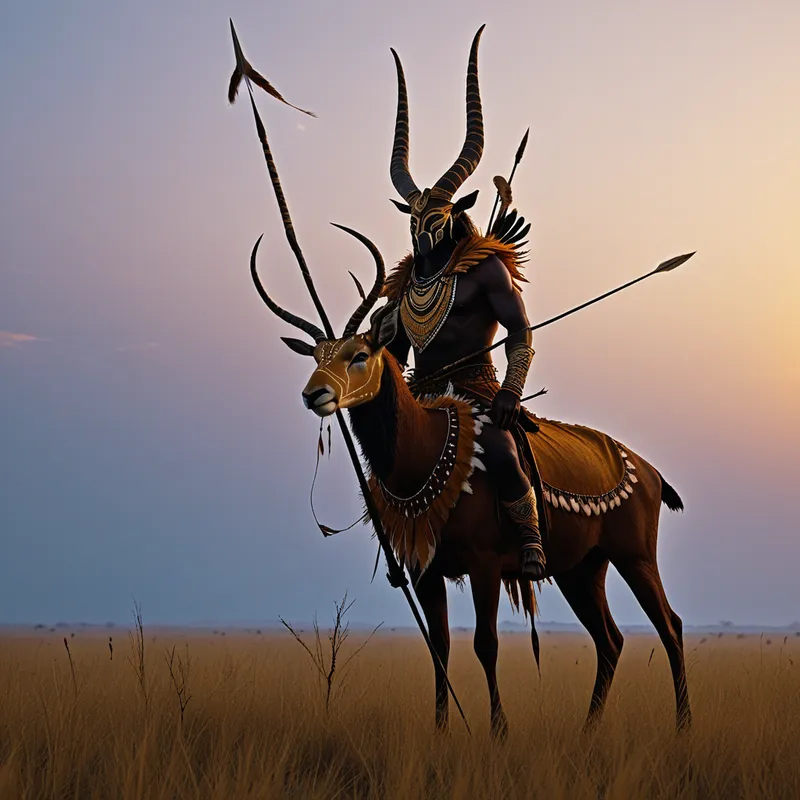
[The world](/myths/the-world “Myth from Tarot culture.”/) whispered of a being, the Agbani, an antelope whose coat held the last light of sunset and whose horns were woven from the first threads of dawn. To see it was a blessing; to hunt it was a madness only the proud or desperate would dare. Kelechi, wrapped in his quiet pride, took his finest spear, anointed his skin with ash, and walked beyond the known paths.
For seven days and seven nights, he followed signs that were not signs—the pattern of fallen leaves, the specific call of a hidden bird. The forest grew dense, the air thick with the breath of sleeping giants. On the eighth morning, in a clearing where mist clung to the grass like a ghost, he saw her. The Agbani. She stood, a statue of living light, drinking from a pool so clear it showed the stars beneath [the earth](/myths/the-earth “Myth from Hindu culture.”/). His heart became a drum of war. He drew his arm back, the spear a promise of death.
He threw. A perfect arc. A strike. A cry that was not an animal’s cry, but the sound of a breaking covenant. The Agbani stumbled, a bloom of crimson on gold. But as Kelechi approached, [triumph](/myths/triumph “Myth from Roman culture.”/) turning to ash in his mouth, she did not flee. She turned her great, liquid eyes upon him. And she spoke. Her voice was the rustle of all leaves, the trickle of all streams.
“You have pierced the skin of the world, hunter. Now you must mend it.”
From her wound, not blood, but a slow, golden sap began to flow. It touched the earth, and where it fell, a strange, sweet-smelling grass sprouted instantly. “The balance is broken,” she said. “My life is the life of this place. Take it, and this grove dies, and the death will spread like a fever across the land. Your village’s children will hunger in a silent forest.”
Kelechi fell to his knees, his hunter’s certainty shattered. “What must I do?”
“Remove the spear,” she commanded. “And give of your own life to seal the wound.”
Trembling, he pulled the spear from her side. Then, pressing his palm against the flowing light, he whispered the only true prayer he had ever known: his own regret. He felt his strength, his pride, his very heat drain from him, flowing into her. His vision dimmed. As he slumped to the ground, the last [thing](/myths/thing “Myth from Norse culture.”/) he saw was the wound on the Agbani closing, and her nuzzle, gentle as a breeze, against his cooling cheek.
He awoke. The clearing was vibrant, humming with life. The Agbani was gone. But beside him lay his spear, now grown around with living, flowering vines. And in his mind, a new knowledge resided—the paths of every creature, the language of the soil, the song of the seasons. He returned to his village not as a conqueror, but as a guardian. He hunted only what was given, and he spoke for the forest that now spoke through him. He had not captured the myth; he had been captured by it, and in that surrender, found his true name.

Cultural Origins & Context
This narrative pattern, with local variations, is found across many African cultural traditions, from the San peoples’ stories of [the Mantis](/myths/the-mantis “Myth from Chinese culture.”/) and the Eland to West African tales of hunters and bush spirits. It is fundamentally an etiological myth that establishes the sacred covenant between humanity and the natural world. It was not mere entertainment; it was a core component of ecological and ethical education.
Told by elders and griots around evening fires, the story served as a vital societal regulator. It framed hunting not as an act of dominance, but as a sacred dialogue requiring reciprocity, respect, and ritual apology. The hunter’s prowess was always tempered by this spiritual accountability. The myth functioned as a psychological and social container for the profound ambivalence of taking life to sustain life, transforming a necessary violence into a sacred exchange. It encoded the principle that true survival is symbiotic, not extractive.
Symbolic Architecture
At its [heart](/symbols/heart “Symbol: The heart symbolizes love, emotion, and the core of one’s existence, representing deep connections with others and self.”/), the myth is a map of a profound psychological [initiation](/symbols/initiation “Symbol: A symbolic beginning or transition into a new phase, status, or awareness, often involving tests, rituals, or profound personal change.”/). The Hunter, Kelechi, represents the conscious ego—skilled, focused, and driven by a desire for [achievement](/symbols/achievement “Symbol: Symbolizes success, mastery, or reaching a goal, often reflecting personal validation, social recognition, or overcoming challenges.”/) and recognition (the sacred [trophy](/symbols/trophy “Symbol: The trophy symbolizes achievement, recognition, and the reward for perseverance in competitive endeavors.”/)). The Agbani is the embodiment of [the Self](/myths/the-self “Myth from Jungian culture.”/), the totality of the [psyche](/myths/psyche “Myth from Greek culture.”/), and the animating [spirit](/symbols/spirit “Symbol: Spirit symbolizes the essence of life, vitality, and the spiritual journey of the individual.”/) of the natural world. It is the ultimate “other,” both the goal and the [guardian](/symbols/guardian “Symbol: A protector figure representing safety, authority, and guidance, often embodying parental, societal, or spiritual oversight.”/) of the deepest [truth](/symbols/truth “Symbol: Truth represents authenticity, honesty, and the quest for knowledge beyond mere appearances.”/).
The hunt is never for the beast, but for the meeting with the beast. In that encounter, the hunter is dismantled and remade.
The initial, successful strike symbolizes [the ego](/myths/the-ego “Myth from Jungian culture.”/)‘s arrogant attempt to possess the numinous, to capture the power of the Self for its own glory. This is the critical wounding, the [inflation](/symbols/inflation “Symbol: A dream symbol representing feelings of diminishing value, loss of control, or expansion beyond sustainable limits in one’s life or psyche.”/) that inevitably leads to a [crisis](/symbols/crisis “Symbol: A crisis symbolizes turmoil, urgent challenges, and the need for immediate resolution or change.”/). The Agbani’s refusal to die and its subsequent speech represent the psyche’s corrective function—the Self cannot be killed, only offended, and it demands restitution.
The healing [ritual](/symbols/ritual “Symbol: Rituals signify structured, meaningful actions carried out regularly, reflecting cultural beliefs and emotional needs.”/)—removing the [spear](/symbols/spear “Symbol: The spear often symbolizes power, aggression, and the drive to protect or conquer.”/) and giving his own [life](/symbols/life “Symbol: The symbol of ‘Life’ represents a journey of growth, interconnectedness, and existential meaning, encompassing both the joys and challenges that define human experience.”/)-force—is the core [alchemy](/symbols/alchemy “Symbol: A transformative process of purification and creation, often symbolizing personal or spiritual evolution through difficult stages.”/). It is the surrender of egoic possession (the [spear](/symbols/spear “Symbol: The spear often symbolizes power, aggression, and the drive to protect or conquer.”/)) and the offering of one’s own conscious [energy](/symbols/energy “Symbol: Energy symbolizes vitality, motivation, and the drive that fuels actions and ambitions.”/) (his vitality) to repair the [relationship](/symbols/relationship “Symbol: A representation of connections we have with others in our lives, often reflecting our emotional state.”/). The resulting transformation is not that Kelechi controls [nature](/symbols/nature “Symbol: Nature symbolizes growth, connectivity, and the primal forces of existence.”/), but that he becomes conscious of his inherent unity with it. The [vine](/symbols/vine “Symbol: Represents connection, growth, entanglement, or suffocation. Often symbolizes relationships, life force, or binding emotions.”/)-entwined [spear](/symbols/spear “Symbol: The spear often symbolizes power, aggression, and the drive to protect or conquer.”/) is the perfect [symbol](/symbols/symbol “Symbol: A symbol can represent an idea, concept, or belief, serving as a powerful tool for communication and understanding.”/): his tool of [separation](/symbols/separation “Symbol: A spiritual or mythic division between realms, states of being, or consciousness, often marking a transition or loss of connection.”/) now integrated with the living web, a [symbol](/symbols/symbol “Symbol: A symbol can represent an idea, concept, or belief, serving as a powerful tool for communication and understanding.”/) of his new [role](/symbols/role “Symbol: The concept of ‘role’ in dreams often reflects one’s identity or how individuals perceive their place within various social structures.”/) as a [mediator](/symbols/mediator “Symbol: A figure who resolves conflicts between opposing parties, representing balance, communication, and the integration of differences.”/), not a master.
The Dreamer’s Resonance
When this myth stirs in the modern dreamscape, it often manifests during life phases of over-extension, burnout, or ethical conflict in one’s “hunt”—be it in career, ambition, or relationships. The dreamer may find themselves pursuing a luminous, elusive goal (the Agbani) only to cause an unexpected, grievous wound upon catching it. The somatic feeling is often one of chilling dread and profound regret upon the moment of “success.”
The dream-wound is always a call to consciousness, a bill presented for a debt the waking self did not know it owed.
Alternatively, one might dream of being tasked with healing a mysterious, radiant animal or finding a tool (a pen, a key, a computer) that has become organically overgrown. These are signals of the psyche initiating a corrective process. The psychological movement is from a paradigm of extraction and conquest to one of listening and reciprocal care. The dream is prompting an examination of where one’s actions, however skilled, are breaking covenants—with one’s own body, with others, or with one’s deeper purpose—and what costly gift of attention and energy is required to mend them.

Alchemical Translation
The myth models the individuation process—the journey toward psychic wholeness—with stark elegance. [The first stage](/myths/the-first-stage “Myth from Alchemical culture.”/) is the Identification with the [Persona](/myths/persona “Myth from Greek culture.”/): “I am the Great Hunter.” This leads to the Confrontation with [the Shadow](/myths/the-shadow “Myth from Jungian culture.”/)/Self: striking the Agbani. The critical, transformative stage is the Enantiodromia, where the pursued becomes the guide, and the hunter’s skill becomes his flaw.
The alchemical operation is one of Coniunctio achieved through sacrifice. The ego does not annihilate the Self, nor does the Self consume the ego. Instead, through a voluntary sacrifice of egoic ambition (his life-force), a new, third thing is created: the integrated consciousness of the guardian-hunter. His old, isolated identity “dies” so that a more complex, relational identity can be born.
Individuation is not about becoming a perfectly autonomous self, but about becoming a conscious node in a living network. The power is in the connection, not the capture.
For the modern individual, this translates to any profound life transition where success-as-usual fails. It is the moment the CEO realizes his empire is poisoning the land, the artist sees her masterpiece is sterile, the thinker understands his logic has cut him off from life. The triumph is not in abandoning the “spear”—one’s skills, intellect, or drive—but in allowing it to be transformed by a deeper wisdom. It is to use one’s power not to take, but to serve the balance, to become a conduit for the very life one once sought only to claim. The myth teaches that our deepest quest ends not with a trophy on our wall, but with the wild forever alive in our soul.
Associated Symbols
Explore related symbols from the CaleaDream lexicon: