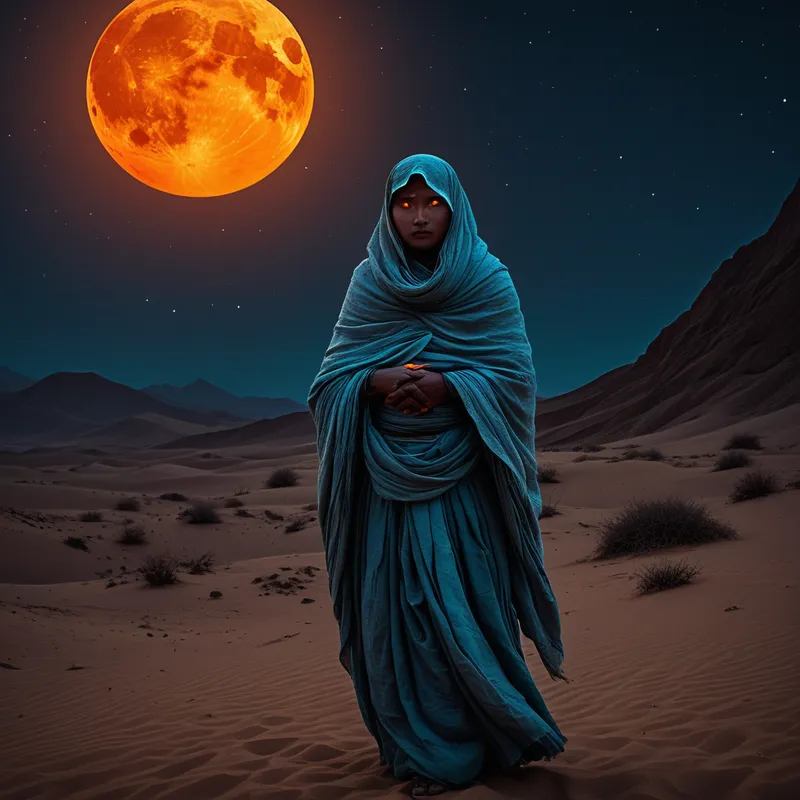
The Hungry Ghosts Myth Meaning & Symbolism
A haunting myth of beings with insatiable appetites and constricted throats, embodying the torment of unfulfilled desire and the possibility of release.
The Tale of The Hungry Ghosts
Listen, and let the twilight veil between worlds grow thin. There is a realm that is not a place, but a state of being, a landscape carved from the very substance of longing. Here, the sun is a dull coin and the wind carries the scent of spoiled nectar. These are the wandering grounds of the Pretas.
They are not born of blood, but of karma, taking shape from the smoke of unchecked greed, the residue of malice, and the cold ash of selfishness. Their forms are a cruel joke of the cosmos. See them now, moving through the grey wastes. Their bellies are vast, swollen caverns of emptiness, capable of containing oceans yet never knowing fullness. Their necks are slender as reeds, their throats constricted to the width of a needle’s eye. Some have mouths that spew fire, consuming whatever morsel they find. Others find that food turns to pus or molten iron upon their tongues.
One such ghost, a being whose past life was a tapestry of hoarding and envy, stumbles upon a clear pool. Its thirst is a roaring furnace within. It kneels, its skeletal fingers breaking the surface, and brings the water to its lips. But the moment the liquid touches its tongue, it transforms into a stream of hot, choking sand. The ghost wails, a sound like tearing silk, and the pool itself shrivels into cracked mud. In the distance, it spies a tree heavy with ripe, luscious fruit. It runs, a frantic, shuffling gait, but as it reaches the tree, the branches recoil, the fruit withering into hard, black stones before its eyes. This is its eternity: a feast laid out in a world of famine, forever just beyond the reach of its agonizing need.
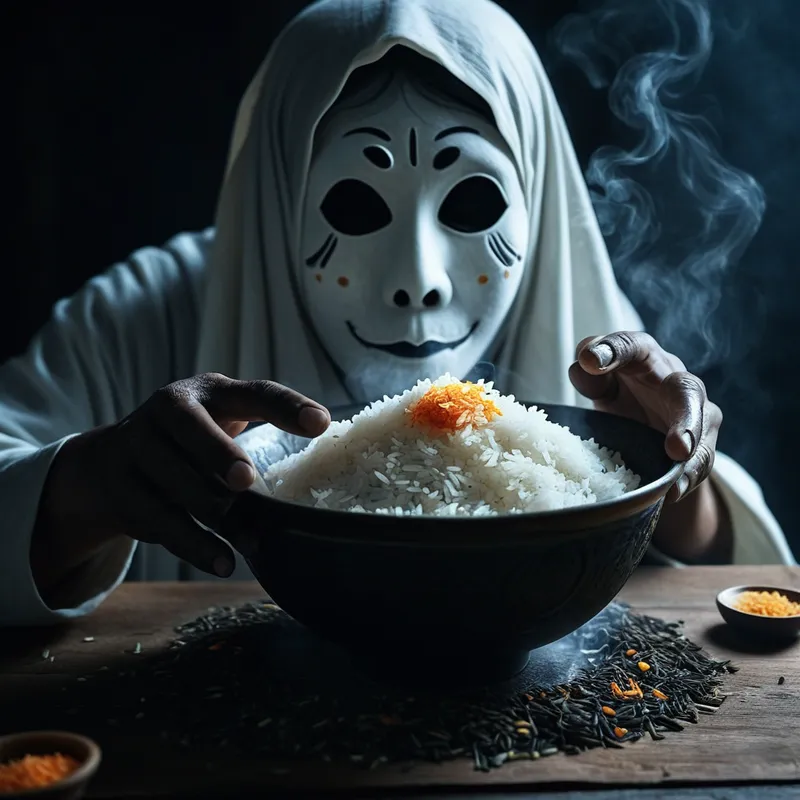
But the story does not end in this desolate loop. For the compassion of the Bodhisattva extends even here, into this realm of self-made torment. It is said that the Bodhisattva Avalokiteshvara, whose tears of pity for suffering beings formed a great lake, hears their silent screams. And the Buddha himself, in his boundless wisdom, provided a key. During the festival of Ullambana, the gates between realms soften. Through rituals, offerings, and the dedicated merit transferred by the living—especially by monks and one’s own descendants—a thread of grace is spun. A bowl of clean water, properly dedicated, may finally pass through the needle-throat. A morsel of food, given with pure intention, may nourish instead of burn. For a moment, the agony ceases. The ghost remembers, not its hunger, but the act of receiving. In that memory of connection, a crack appears in the shell of its isolation. It is the first, fragile step out of the desert of its own making.
Cultural Origins & Context
The myth of the Hungry Ghosts is not a singular tale but a pervasive archetype woven into the fabric of Buddhist cosmology across Asia. Its roots intertwine with ancient Indian concepts of Samsara and pre-Buddhist ancestor veneration. The Preta is one of the six possible realms of rebirth, a vivid teaching on the direct psychological consequences of one’s actions, or karma.
The myth was passed down through monastic teachings, Jataka tales, and vivid visual depictions in temple art and thangkas. Its primary societal function was twofold: ethical instruction and ritual practice. For the layperson, it served as a powerful, visceral deterrent against greed, jealousy, and selfish attachment, illustrating that such states of mind could forge an entire reality of torment. For the community, it established the crucial practice of parinamana, especially during the Ullambana festival. This created a sacred economy of compassion, binding the living to their ancestors and emphasizing that liberation is not a solitary pursuit but an interconnected responsibility.
Symbolic Architecture
The Hungry Ghost is not merely a supernatural being; it is a perfect, horrifying symbol of a specific structure of human consciousness. Its distorted body maps a distorted psyche.
The vast, empty belly represents the bottomless pit of craving—for material goods, for validation, for experiences, for anything that promises to fill an inner void it can never actually fill. The needle-throat symbolizes the constriction of the heart and mind that accompanies such craving: an inability to truly receive, digest, or be satisfied by what is given. The throat is the passage of transformation, where the outer world becomes the inner self. When that passage is shut, the world turns to poison. The ghost’s perception is itself a curse; it sees a mirage of fulfillment that constantly dissolves, reflecting a mind trapped in delusion (avidya).
The Hungry Ghost is the archetypal shape of addiction, where the object of desire is both the promised cure and the perpetual cause of the disease.
Psychologically, it represents the orphan archetype in its most exiled state—a consciousness that feels perpetually deprived, disconnected from the nourishing source (whether that be love, meaning, or self-worth), and condemned to scavenge for scraps that never satisfy. It is the shadow of consumption, a living emblem of the statement: “I want, therefore I am suffering.”
The Dreamer’s Resonance
When this myth stirs in the modern dreamer, it rarely appears as a traditional Preta. Instead, it manifests as the sensation of the myth. You dream of wandering through endless shopping malls where items lose their value as you touch them. You dream of preparing a lavish feast that turns to dust as guests arrive, or of trying to drink from a cup with a hole in the bottom. The somatic feeling is key: a tightness in the throat, a gnawing emptiness in the gut, a frantic, restless energy.
These dreams signal that a part of the psyche is trapped in a cycle of psychic consumption without assimilation. The dreamer may be “eating” experiences, information, relationships, or achievements without truly digesting their meaning or allowing them to nourish the soul. It points to an area of life governed by an insatiable “more,” where desire has detached from genuine need and become a self-perpetuating ghost. The psychological process is one of recognition—seeing the ghostly, unsatisfying pattern in one’s own waking life. The dream is the first gift of awareness, the first drop of clean water offered to the parched spirit within.

Alchemical Translation
The alchemical work modeled by this myth is not about slaying the ghost, but about transmuting its substance. The ghost is made of craving; the goal is to transform craving into conscious need, and ultimately, into compassionate connection.
The first stage is Confrontation: seeing the ghost in oneself. This is the harsh light of the desert sun, where one must acknowledge the ways they are perpetually thirsty, the ways their throat is constricted against receiving true nourishment. The second is Offering: this is the interior Ullambana. One must learn to make ritual offerings to one’s own inner orphan—not by feeding its cravings with more distraction, but by offering the pure water of mindful attention and the genuine food of self-compassion. This is the practice of sitting with the emptiness without rushing to fill it.
The alchemy occurs in the constricted throat itself. Through the breath of awareness, the needle’s eye is slowly widened into a passage.
The final translation is Redirecting the Flow. The immense energy bound up in craving—the ghost’s frantic, desperate power—is liberated. When the ghost is fed by connection rather than consumption, its torment ceases. That same energy then becomes available for the Bodhisattva’s work: it transforms into the active compassion that hears the suffering of others. The individual who has made peace with their own hungry ghosts no longer projects lack onto the world. They become a vessel that can finally be filled, not to hoard, but to overflow. The orphan finds its home within, and in doing so, becomes a caregiver to the orphaned parts of the world. The endless desert of want blossoms, just once, into a moment of enough.
Associated Symbols
Explore related symbols from the CaleaDream lexicon: