The Hungry Ghost Myth Meaning & Symbolism
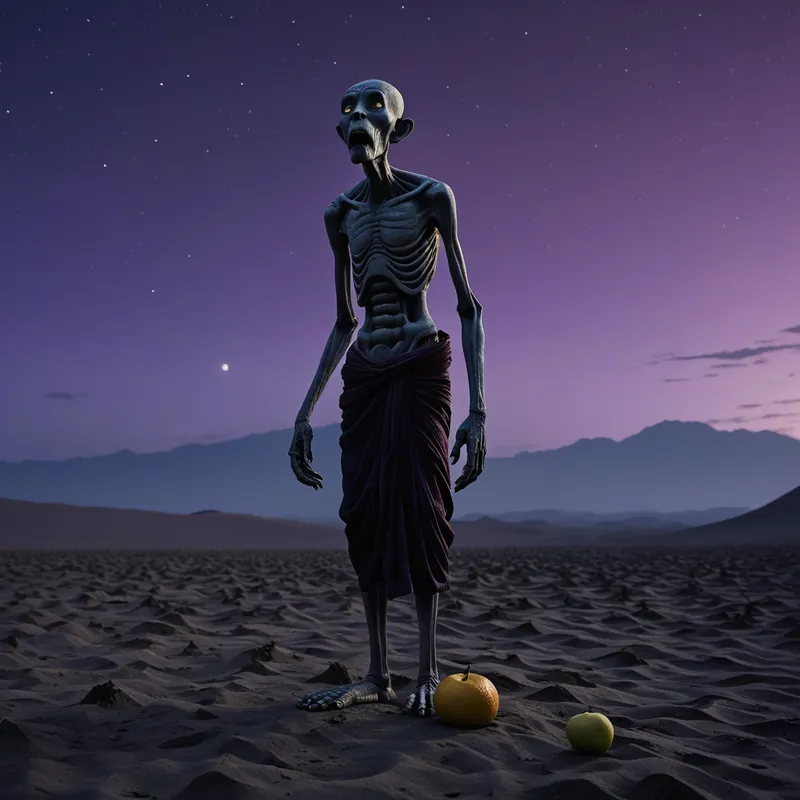
A tormented spirit with a vast belly and needle-throat, eternally starving, embodies the prison of insatiable craving and the possibility of liberation.
The Tale of The Hungry Ghost
Listen, and let [the veil between worlds](/myths/the-veil-between-worlds “Myth from Celtic culture.”/) grow thin.
In the shadowed realms that coil beneath the roots of the Saha World, there exists a plane of profound sorrow. It is a grey land of perpetual twilight, where the air tastes of dust and ashes. Here, the Preta dwells.
Its form is a testament to agony. Its limbs are brittle sticks, its skin stretched taut over a cage of bones. But its belly… its belly is a vast, swollen cavern, a bottomless pit that groans with a hunger that shakes its very frame. Its neck is as thin as a reed, and its mouth is a parched, tiny hole, no larger than the eye of a needle. It can smell the feasts of the gods on [the wind](/myths/the-wind “Myth from Various culture.”/), hear the laughter of mortals at their tables, but for it, sustenance is a cruel joke.
Our tale follows one such being. Once, it walked as a human, but its heart was a furnace of greed, jealousy, and bottomless desire. It hoarded wealth it could never use, coveted love it could never give, and fed on the misery of others. In death, its consciousness did not dissolve but congealed around this core of lack. It awoke in the grey lands.
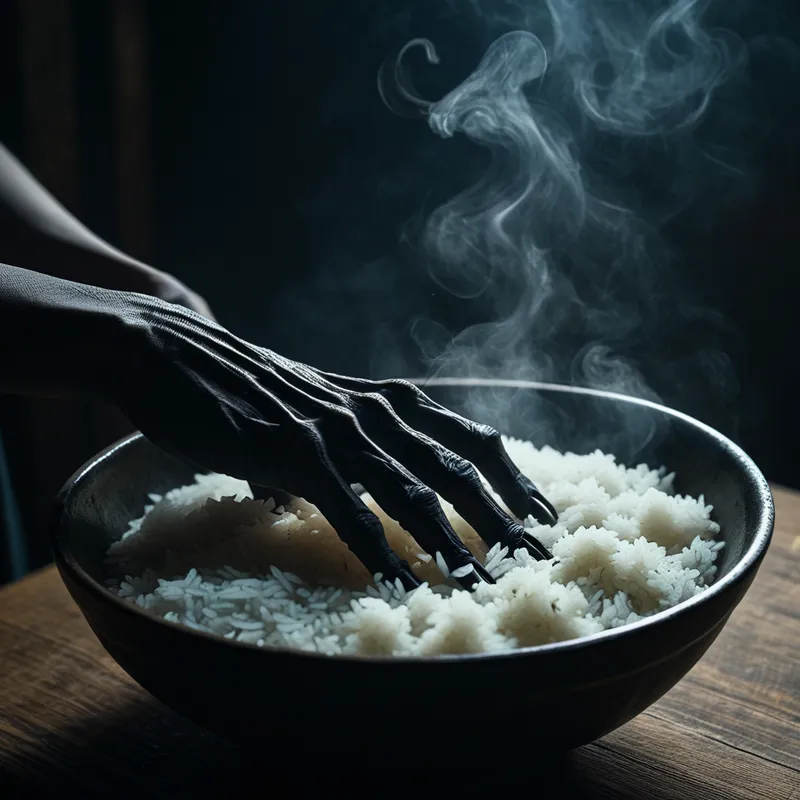
It crawls now, forever. It finds a river, its waters clear and cool, but as it kneels to drink, the [water](/myths/water “Myth from Chinese culture.”/) turns to pus and blood. It stumbles upon a grove of fruit trees, heavy with ripe mangoes, but as it reaches up, the branches recoil into thorny, barren twigs. It sees other Pretas fighting over a morsel of rotten flesh, and its own hunger screams in symphony with theirs. The food, when grasped, bursts into flame or crumbles into dry earth. The torment is not merely physical; it is the perfect, horrifying mirror of its past life: a world of plenty forever out of reach, a desire that consumes but is never consumed.
This is its existence, an eternity of reaching for a satisfaction that recedes with every step. It is a ghost, yes, but its hunger is the most solid, the most real [thing](/myths/thing “Myth from Norse culture.”/) about it. It is a prison built from the inside, with walls of its own making, and the key is a memory it can no longer grasp.
Cultural Origins & Context
The myth of the Preta is not a singular story but a pervasive archetype within the Buddhist cosmological map. It finds its roots in ancient Indian lore, absorbed and refined within the Buddhist teachings on [karma](/myths/karma “Myth from Hindu culture.”/) and rebirth. The Preta is one of the six realms of [Samsara](/myths/samsara “Myth from Buddhist culture.”/)</ab- br>, a possible destination for a consciousness driven by specific, powerful karmic seeds.
These narratives were passed down not merely as frightening folktales but as profound pedagogical tools. Monks would recount them during sermons, and they were vividly depicted in temple art and thangkas. Their societal function was multifaceted: to illustrate the tangible, horrific consequences of unchecked greed and malice, to inspire ethical conduct (sila), and to cultivate compassion ([karuna](/myths/karuna “Myth from Hindu culture.”/)). The annual Ullambana or Ghost Festival, where offerings are made to alleviate the suffering of these beings, directly springs from this mythology, binding the community in an act of shared mercy and reminding all of the interconnectedness of actions and their fruits.
Symbolic Architecture
The Hungry Ghost is perhaps one of the most potent psychological symbols ever conceived. It is not a [monster](/symbols/monster “Symbol: Monsters in dreams often symbolize fears, anxieties, or challenges that feel overwhelming.”/) from the outside, but a portrait of a specific inner state made horrifyingly literal.
The Hungry Ghost is the archetype of insatiability. Its vast belly represents the bottomless void of craving, while its needle-throat symbolizes the utter inability to satisfy, to digest, to integrate experience.
The [realm](/symbols/realm “Symbol: The symbol of ‘Realm’ often signifies the boundaries of one’s consciousness, experiences, or emotional states, suggesting aspects of reality that are either explored or ignored.”/) of the Preta is the [landscape](/symbols/landscape “Symbol: Landscapes in dreams are powerful symbols representing the dreamer’s emotional state, personal journey, and the broader context of life situations.”/) of addiction, compulsive consumption, and spiritual [bankruptcy](/symbols/bankruptcy “Symbol: A state of financial insolvency representing loss, failure, and the collapse of material security or personal foundations.”/). It represents a [consciousness](/symbols/consciousness “Symbol: Consciousness represents the state of awareness and perception, encompassing thoughts, feelings, and experiences.”/) that relates to [the world](/myths/the-world “Myth from Tarot culture.”/) purely through the [lens](/symbols/lens “Symbol: A lens in dreams represents focus, perspective, clarity, or distortion in how one perceives reality, art, or self.”/) of “I want.” Whether it is [material](/symbols/material “Symbol: Material signifies the tangible aspects of life, often representing physical resources, desires, and the physical world’s influence on our existence.”/) [wealth](/symbols/wealth “Symbol: Wealth in dreams often represents abundance, security, or inner resources, but can also symbolize burdens, anxieties, or moral/spiritual values.”/), validation, power, or [sensation](/symbols/sensation “Symbol: Sensation in dreams often represents the emotional and physical feelings experienced in waking life, highlighting one’s intuition or awareness.”/), the object is never the point; the craving itself is the [identity](/symbols/identity “Symbol: Identity represents the sense of self, encompassing personal beliefs, cultural background, and social roles.”/). The external world—the rivers and fruits—is not inherently foul. It is the ghost’s own perceptual apparatus, shaped by its past karma (its past choices and psychological patterns), that transforms nourishment into poison. The myth tells us that hell is a state of [perception](/symbols/perception “Symbol: The process of becoming aware of something through the senses. In dreams, it often represents how one interprets reality or internal states.”/), a way of being in [relationship](/symbols/relationship “Symbol: A representation of connections we have with others in our lives, often reflecting our emotional state.”/) with [reality](/symbols/reality “Symbol: Reality signifies the state of existence and perception, often reflecting one’s understanding of truth and life experiences.”/) that guarantees suffering.
Psychologically, the Preta embodies the part of the [psyche](/myths/psyche “Myth from Greek culture.”/) that feels perpetually deprived, empty, and entitled. It is the [shadow](/symbols/shadow “Symbol: The ‘shadow’ embodies the unconscious, repressed aspects of the self and often represents fears or hidden emotions.”/) of the [orphan](/symbols/orphan “Symbol: Represents spiritual abandonment, primal vulnerability, and the quest for belonging beyond biological ties. Often signifies a soul’s journey toward self-reliance.”/) [archetype](/symbols/archetype “Symbol: A universal, primordial pattern or prototype in the collective unconscious that shapes human experience, behavior, and creative expression.”/), frozen in a state of lack, believing the world owes it a fulfillment it can only give itself.

The Dreamer’s Resonance
When the specter of the Hungry Ghost haunts modern dreams, it signals a profound somatic and psychological process. The dreamer is not encountering an external spirit but meeting their own “hungry” complex.
You may dream of wandering through endless shopping malls where everything is out of stock, of sitting at a banquet but having your plate whisked away as you reach for it, or of trying to drink from a cup with a hole in the bottom. Somatic sensations often accompany these dreams: a gnawing emptiness in the gut, a constriction in the throat, a profound weariness. This is the psyche making tangible a state of emotional or spiritual malnutrition. It points to an area of life—perhaps relationships, career, or self-worth—where desire has become compulsive and fulfillment elusive. The dream is a crisis of integration: a part of [the self](/myths/the-self “Myth from Jungian culture.”/) is starving because it is trying to feed on what can never nourish it, refusing the true sustenance that is available.

Alchemical Translation
The path from Preta to peace is the alchemical core of the myth and the heart of the Buddhist path. The transmutation does not happen by finding bigger fruit or sharper tools to open the needle-throat. It happens through a radical change in the mode of consciousness.
Liberation begins when the ghost stops looking at the river and starts looking at its own thirst. The alchemical fire is the mindful awareness of craving itself.
The first step is Recognition. One must see the “hungry ghost” pattern within—the insatiable scrolling, shopping, gossiping, or seeking. The second is Offering. In the Ullambana ritual, others make offerings for the ghost. Psychologically, this translates to self-compassion. Instead of judging the hunger, one offers it gentle attention, breaking the cycle of shame that fuels more craving.
The final, alchemical stage is Transmutation of the Fuel. The immense psychic energy bound up in craving—the very energy that powers the Preta’s eternity—is not destroyed. It is redirected. Through practices of generosity (dana), the energy of “taking” is transformed into the energy of “giving.” Through mindful contentment, the swollen belly of lack becomes the open hand of receptivity. The needle-throat, the constriction of ego, is loosened by the breath of awareness.
The myth assures us that no state is permanent. The Hungry Ghost realm, like all states of suffering, is sustained by specific causes. By withdrawing the fuel of ignorant craving and replacing it with the clear, bright awareness of the present moment—where, perhaps for the first time, one can taste the simple water of what is—the ghost finds its liberation. Its form dissolves not into nothingness, but back into the flow of potential, ready to take a new, less tormented shape. The individual integrates the orphan’s longing, not by filling [the void](/myths/the-void “Myth from Buddhist culture.”/) from the outside, but by realizing the void itself was a construction, and in its place is a boundless, nourishing space.
Associated Symbols
Explore related symbols from the CaleaDream lexicon: