The Huluppu Tree Myth Meaning & Symbolism
A sacred tree, planted by Inanna, is invaded by dark forces. With Gilgamesh's aid, she reclaims it, forging her throne and bed from its wood.
The Tale of The Huluppu Tree
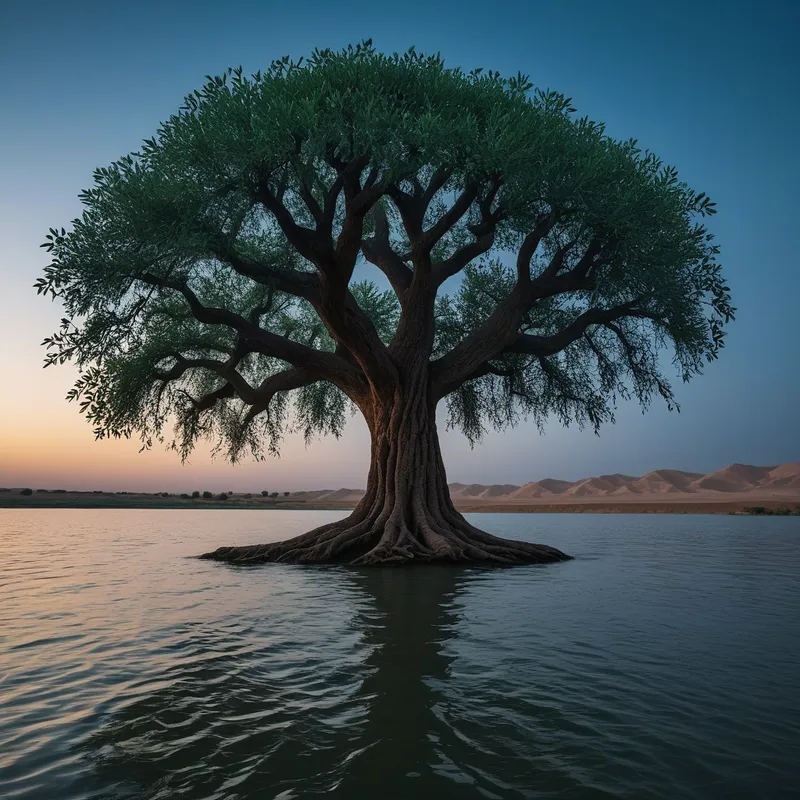
In the first days, when [the world](/myths/the-world “Myth from Tarot culture.”/) was still soft from the hands of the gods, the great river Euphrates ran wild. In its rushing, it tore a young tree from its bank—a Huluppu Tree—and carried it downstream. The waters deposited the sapling on the holy, empty plain. There, the goddess [Inanna](/myths/inanna “Myth from Sumerian culture.”/), Queen of Heaven and Earth, saw its potential. With her own hands, she took the tree and tenderly transplanted it into her sacred garden in the city of Uruk. She watered it with the waters of life and spoke to it of her great vision: “When you are grown, mighty tree, I shall craft from your wood a throne and a bed for my holy sovereignty.”
But a garden is a cosmos in miniature, and where life is planted, chaos soon takes root. As the Huluppu Tree grew tall and strong, it attracted not blessings, but invaders. From the dark, damp earth at its base, a serpent who knew no charm made its home, coiling its thick, cold body around the roots. In the high, untamed branches, the Anzu-bird built its nest, a creature of storm and theft, whose screech could freeze the heart. And in the very trunk of the tree, in a hollow she carved with relentless force, the dark spirit [Lilitu](/myths/lilitu “Myth from Mesopotamian culture.”/) made her dwelling, a being of the wild wind and desolate places.
The tree that was to be Inanna’s symbol of ordered power became a monument to occupation and dread. For years, the goddess wept. Her sacred space was defiled; her vision, held hostage. She, the powerful, was powerless against this trio of primeval forces. In her despair, she turned to her brother, the sun god Utu, but he would not help. She was alone.
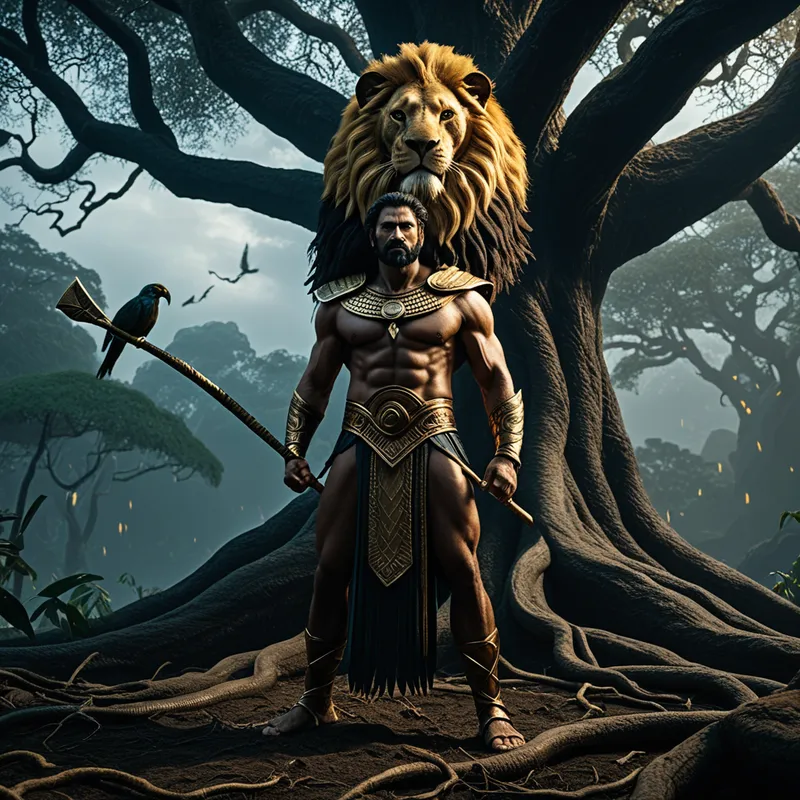
Yet a queen does not surrender her throne. She turned next to the mightiest mortal, the king of Uruk himself: [Gilgamesh](/myths/gilgamesh “Myth from Mesopotamian culture.”/). Hearing his sister’s lament, the hero’s heart was stirred. He took up his great bronze axe, a tool heavier than any other man could lift, and his shield, and went to the sacred garden. He did not hesitate. With a mighty blow, he struck the serpent at the roots. The creature, severed, fled into the depths, leaving a stain of terror on [the earth](/myths/the-earth “Myth from Hindu culture.”/). Seeing this, the Anzu-bird shrieked in fury and fled with its young to the mountains, its shadow passing from the garden like a curse lifted. Lilitu, the spirit in the trunk, tore her house from the tree and vanished into the wild, barren places from whence she came.
The Huluppu Tree stood free. And Gilgamesh, the hero, did not stop. He felled the great tree for Inanna. From its massive trunk, he carved for her a majestic throne and a bed, objects of power and rest. From its roots and crown, he fashioned for himself a pukku and a mikku. The invasion was over. The chaos was given form. The garden was silent, save for the sound of creation.
Cultural Origins & Context
This myth is preserved in the prologue of the Sumerian epic “Gilgamesh, Enkidu, and the Netherworld,” a composition dating back to the late third millennium BCE. It was a story told not merely for entertainment, but to articulate fundamental truths about the world. In the city-states of Sumer, [the temple](/myths/the-temple “Myth from Jewish culture.”/) garden was a microcosm of the cultivated, ordered world (ki-en-gi) constantly threatened by the encroaching, chaotic forces of the untamed wilderness (edinu).
The myth functioned as a foundational narrative for the sacred kingship of Uruk. It established the divine right of Inanna as the city’s patron and the necessary, violent role of the king (Gilgamesh) as her protector and executor. The story explained the origin of the goddess’s cult objects—her throne and bed—which were central to the hieros gamos ritual, a ceremony that legitimized the ruler and guaranteed the fertility of the land. It was a tale of how sacred order is won, not given, through decisive action against the primordial shadows that cling to any new growth.
Symbolic Architecture
At its [heart](/symbols/heart “Symbol: The heart symbolizes love, emotion, and the core of one’s existence, representing deep connections with others and self.”/), the Huluppu [Tree](/symbols/tree “Symbol: In dreams, the tree often symbolizes growth, stability, and the interconnectedness of life.”/) is an [archetype](/symbols/archetype “Symbol: A universal, primordial pattern or prototype in the collective unconscious that shapes human experience, behavior, and creative expression.”/) of the [axis](/symbols/axis “Symbol: A central line or principle around which things revolve, representing stability, orientation, and the fundamental structure of reality or consciousness.”/) mundi, the world pillar. It is the potential center of a psychic or cultural [cosmos](/symbols/cosmos “Symbol: The entire universe as an ordered, harmonious system, often representing the totality of existence, spiritual connection, and the unknown.”/). Inanna’s act of transplanting it represents the conscious act of taking a raw, natural potential (an inspiration, a talent, a [relationship](/symbols/relationship “Symbol: A representation of connections we have with others in our lives, often reflecting our emotional state.”/)) and planting it in the “garden” of one’s cultivated [life](/symbols/life “Symbol: The symbol of ‘Life’ represents a journey of growth, interconnectedness, and existential meaning, encompassing both the joys and challenges that define human experience.”/) with a sacred [intention](/symbols/intention “Symbol: Intention represents the clarity of purpose and direction in one’s life and can symbolize motivation and commitment within a dream context.”/).
The sacred center, once established, becomes a battleground. Its very vitality attracts the unintegrated aspects of the Self.
The three invaders are not random monsters; they are precise symbolic antagonists. The [serpent](/symbols/serpent “Symbol: A powerful symbol of transformation, wisdom, and primal energy, often representing hidden knowledge, healing, or temptation.”/) at the roots represents the chthonic, instinctual [underworld](/symbols/underworld “Symbol: A symbolic journey into the unconscious, representing exploration of hidden aspects of self, transformation, or confronting repressed material.”/) of the unconscious—not evil, but possessive, grounding potential in fear and stagnation. The Anzu-[bird](/symbols/bird “Symbol: Birds symbolize freedom, perspective, and the connection between the earthly and spiritual realms, often representing the soul’s aspirations or personal growth.”/) in the [crown](/symbols/crown “Symbol: A crown symbolizes authority, power, and achievement, often representing an individual’s aspirations, leadership, or societal role.”/) symbolizes the inflated, predatory intellect or spiritual pride that steals the fruits of growth for its own aggrandizement, living in unattainable [heights](/symbols/heights “Symbol: Represents ambition, fear, or spiritual elevation. Often symbolizes life challenges or a desire for perspective.”/). Lilitu in the [trunk](/symbols/trunk “Symbol: The trunk in dreams typically denotes the core structure or foundation of one’s identity, values, or beliefs.”/), the wild [spirit](/symbols/spirit “Symbol: Spirit symbolizes the essence of life, vitality, and the spiritual journey of the individual.”/), embodies autonomous, untamed psychic [energy](/symbols/energy “Symbol: Energy symbolizes vitality, motivation, and the drive that fuels actions and ambitions.”/)—often related to the repressed feminine or [anima](/symbols/anima “Symbol: The feminine archetype within the male unconscious, representing soul, creativity, and connection to the inner world.”/)—that hollows out one’s core vitality, creating a sense of [emptiness](/symbols/emptiness “Symbol: Emptiness signifies a profound sense of void or lack in one’s life, often related to existential fears, loss, or spiritual quest.”/) and restless haunting.
Gilgamesh, the heroic ego-[consciousness](/symbols/consciousness “Symbol: Consciousness represents the state of awareness and perception, encompassing thoughts, feelings, and experiences.”/), is the necessary but brutal force that clears this psychic [space](/symbols/space “Symbol: Dreaming of ‘Space’ often symbolizes the vastness of potential, personal freedom, or feelings of isolation and exploration in one’s life.”/). His [action](/symbols/action “Symbol: Action in dreams represents the drive for agency, motivation, and the ability to take control of situations in waking life.”/) is not gentle therapy; it is a mythic, decisive severing. The transformation is alchemical: the invaded tree of potential is cut down and refashioned into the functional symbols of sovereignty ([throne](/symbols/throne “Symbol: A seat of authority, power, and sovereignty, representing leadership, divine right, or social hierarchy.”/)) and sacred relationship (bed). The [chaos](/symbols/chaos “Symbol: In Arts & Music, chaos represents raw creative potential, uncontrolled expression, and the breakdown of order to forge new artistic forms.”/) is not destroyed but transmuted into culture.
The Dreamer’s Resonance
When this myth stirs in the modern unconscious, it often manifests in dreams of a cherished project, relationship, or inner space being “taken over.” One may dream of a beloved house invaded by strangers, a garden overrun by weeds and snakes, or a personal sanctuary defiled. The somatic feeling is one of violation, helplessness, and choked vitality—a profound sense that something meant to be one’s own has been occupied by alien, persistent forces.
This dream pattern signals that a period of incubation or naive hope (Inanna’s planting and watering) has ended. The [psyche](/myths/psyche “Myth from Greek culture.”/) is announcing that the “tree” has grown enough to attract its shadows, and a crisis of ownership has begun. The dreamer is at [the crossroads](/myths/the-crossroads “Myth from Celtic culture.”/) between perpetual victimhood (weeping like Inanna) and summoning the inner “Gilgamesh”—the assertive, disciplined, and perhaps ruthless aspect of [the Self](/myths/the-self “Myth from Jungian culture.”/) capable of taking up the axe of discernment and setting boundaries. The process is one of reclaiming psychic territory from autonomous complexes (the serpent, the bird, the spirit) that have made themselves at home.
Alchemical Translation
The individuation journey modeled here is not a peaceful unfolding but a necessary conquest. The myth outlines the stages of bringing a sacred vision into manifest reality.
First, Transplantation (Consecration): The individual identifies a deep, life-giving potential and consciously dedicates it to a higher purpose (Inanna’s garden). Second, Invasion (Shadow [Projection](/myths/projection “Myth from Alchemical culture.”/)): As the potential grows, it activates the personal and collective unconscious. Instinct (serpent), inflation (Anzu-bird), and autonomous complex (Lilitu) claim it, attempting to drag the potential back into undifferentiated chaos or divert it to their own ends. This stage feels like failure and despair.
The throne is forged in the moment the axe strikes the root. Sovereignty is born from the courage to dislodge what has taken root within.
Third, The Summoning of the Hero (Ego Activation): The conscious self, tired of weeping, must call upon its own disciplined, courageous function. This is not about brute force alone, but about the focused will (Gilgamesh’s axe) applied with precision. It is the act of saying “no” to the inner parasites. Finally, Sacred Fabrication (Transmutation): The raw material of the experience—the struggle, the fear, the cleared space—is consciously worked. The invaded tree becomes the throne of self-authority and the bed of deep relatedness. The chaos is given holy form. The Self is not the untouched tree, but the artisan who, with help, carves order from the wrestled-with wood of experience. The myth concludes that our deepest power is not found in protecting our potential from invasion, but in courageously reclaiming it and crafting our world from its substance.
Associated Symbols
Explore related symbols from the CaleaDream lexicon: