The House of Atreus Myth Meaning & Symbolism
A cursed royal lineage where a father's sin begets generations of murder, betrayal, and vengeance, demanding a final, terrible justice to break the cycle.
The Tale of The House of Atreus
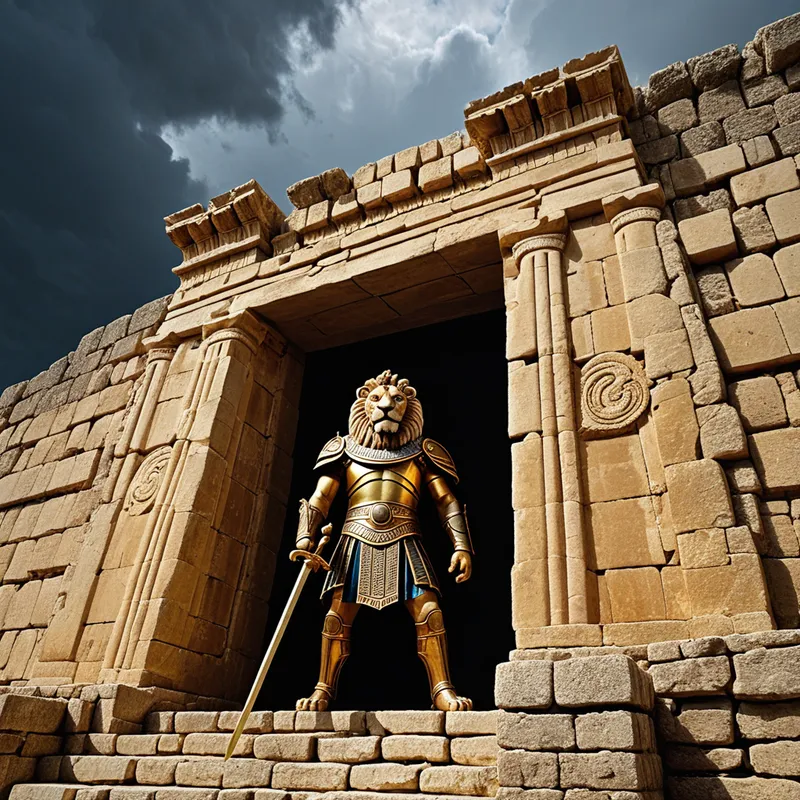
Hear now the tale of a house built not on stone, but on a scream. It begins in the fragrant groves of Atreus, where the sun itself seemed to curdle. He and his brother, Thyestes</abbr, were twin serpents coiled around a single throne. Their feud was old, a poison in the blood. When Thyestes stole not just power but the queen’s favor, Atreus’s smile grew cold. He proclaimed a feast of reconciliation, a sacred breaking of bread. Thyestes came, his hunger for power mingling with the scent of roasted meat. He ate heartily, praising his brother’s hospitality. Only when the platter was bare did Atreus reveal the truth with a whisper that echoed like thunder: “You have dined on the flesh of your own sons.” The sun fled the sky. The earth shook. And from the mouth of Thyestes came a curse that would stain the generations—a vow that the house of Atreus would drink its own blood until the world ran dry.
The curse found its vessel in Agamemnon. Years later, as a thousand ships waited, becalmed at Aulis, the goddess Artemis demanded a terrible price for wind: the life of his most beloved daughter, Iphigenia. On the altar she was laid, a vision in white against the grey sea. The king chose glory over kinship, the fleet over his child. The knife fell. The sails filled. And in the palace at Mycenae, his queen, Clytemnestra, felt her heart turn to iron. For ten long years she nursed her grief, weaving not just tapestries but a net of vengeance.
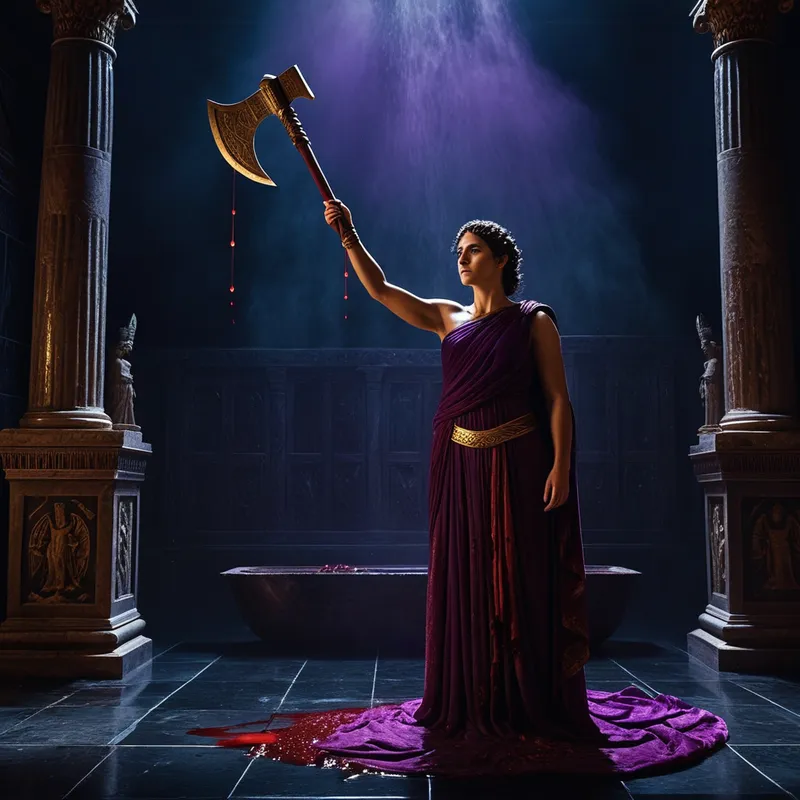
When Agamemnon returned, a conqueror trailing the spoils of Troy, he walked upon tapestries of purple, a honor fit for a god. “Tread on the wealth of the house,” Clytemnestra urged, her voice honey and ash. In his bath, entangled in the very fabric of his pride, the net closed. The axe of his ancestor fell, wielded by his wife’s hand. The bathwater ran red, and the curse sighed in satisfaction.
But the house was not done. From the blood sprang new avengers: Orestes and his sister Electra, children orphaned by their mother’s crime. The Furies of matricide whispered in Orestes’s dreams, yet the command of the god Apollo was clearer: avenge your father. Torn between sacred duties, Orestes became the blade of fate. He returned in disguise and struck down Clytemnestra and her lover, Aegisthus. The moment his mother’s life fled, the true horror descended. The Erinyes, the ancient Furies, visible only to him, rose from the floorboards—gorgon-faced, serpent-haired, dripping with the blood only he could see. They hounded him across the earth, the relentless hounds of his own conscience.
His flight ended at Athens, at the court of the goddess Athena. Here, the first trial by jury was convened. Apollo defended Orestes, arguing for the father’s line; the Furies screamed for the mother’s blood. The votes were tied. With a wisdom that changed the world, Athena cast the deciding vote—for mercy, for reason over blind vengeance. She calmed the ancient Furies, offering them a honored place in the new order as the Eumenides. The cycle was broken. The scream that built the house finally faded, not into silence, but into law.
Cultural Origins & Context
This harrowing saga was not a single story but a sprawling cycle, the foundational trauma of the heroic age for the ancient Greeks. It was the dark soil from which their greatest tragedies grew. Playwrights like Aeschylus (in his Oresteia trilogy), Sophocles, and Euripides shaped the raw myth for the Athenian stage during the 5th century BCE, the height of Greek democracy and civic self-examination.
Performed during religious festivals like the City Dionysia, these plays were far more than entertainment. They were a form of collective therapy and civic education. The audience, participating in a ritual space, witnessed the terrifying consequences of hubris, the unbearable tensions of familial duty, and the clash between old blood-feud justice and new civic law. The myth served as a cultural crucible, asking: How does a society move from the law of the tribe (vengeance) to the law of the city (justice)? The trial of Orestes, staged at the heart of democratic Athens, was a mythic mirror for the city’s own revolutionary transition.
Symbolic Architecture
The House of Atreus is not a palace but a psychic blueprint for the inherited, unconscious complex. It is the archetype of the family curse, the karmic debt passed through generations not by choice, but by unconscious compulsion.
The curse is the unintegrated shadow of an ancestor, a psychic toxin that demands re-enactment until it is consciously witnessed and transformed.
Each character embodies a facet of this trapped energy. Atreus is the Shadow of betrayal and cruel ingenuity. Thyestes is the victim who becomes the accuser, his curse the projection of unbearable trauma outward. Agamemnon is the Ego identified with collective, heroic duty at the catastrophic expense of the personal and humane (sacrificing Iphigenia). Clytemnestra represents the Negative Anima/Great Mother turned vengeful, the instinctual life ruthlessly striking back against a patriarchal order that devours its young.
Orestes is the pivotal figure—the conscious psyche awakening to its dreadful inheritance. His crime is not mere murder; it is the necessary, horrific act of differentiating from the mother complex, of cutting the umbilical cord of enmeshment and vengeance. The Furies that pursue him are not external monsters, but the projected, autonomous guilt of the collective unconscious. They are the raw, primal conscience of the matriarchal order, which sees crime only in terms of blood kinship.
The Dreamer’s Resonance
When this myth stirs in modern dreams, it rarely appears as ancient Greeks. Instead, one dreams of being trapped in a familiar yet oppressive family home where the walls whisper old arguments. One may dream of being forced to make an impossible choice between two loved ones, where any decision feels like a betrayal. The somatic sensation is often of being weighed down, choked, or paralyzed—the physical echo of a burden that is not yours to carry, yet rests upon you.
Dreams of cyclical violence, of repeating a parent’s mistake despite fierce resistance, point directly to the Atreus complex. The dreamer is Orestes, pursued by their own modern Furies: anxiety, chronic guilt, or a pervasive sense of doom that lacks a clear source. These dreams signal that a deep, generational pattern is surfacing, demanding to be confronted not with further action, but with conscious, agonizing witnessing. The psyche is announcing that the time for blind re-enactment is over; the time for trial has come.

Alchemical Translation
The alchemical process modeled here is the nigredo—the blackening, the descent into the utter darkness of the familial shadow—followed by the solutio (dissolution in the trial) and coagulatio (re-forming into a new law).
The transmutation occurs not in avoiding the crime, but in submitting its aftermath to a higher court of consciousness.
For the modern individual, the “vengeance” is the unconscious repetition of parental wounds: adopting their criticisms, inheriting their fears, re-creating their dysfunctional relationships. The “murder of the mother” (or father) is the symbolic, internal act of severing identification with these patterns. It feels like a crime because it breaks a deep, primal loyalty. The ensuing “Furies” are the flood of guilt, shame, and self-recrimination that follows any act of true psychological independence.
The “trial at Athens” is the internal work of holding these conflicting loyalties—to the family past and to the self’s future—in mindful awareness without acting out. Athena’s vote represents the emergence of a transcendent function, a new inner authority (the Self) that can mediate between the old instinctual conscience (the Furies) and the new spiritual imperative (Apollo’s command). To pacify the Furies as Eumenides is to integrate this raw, punishing guilt into a mindful part of the psyche that now protects rather than torments, reminding us of our connections without enslaving us to them.
The curse of the House of Atreus ends not with more blood, but with a verdict. It teaches that the only way to break a cycle of trauma is to stop being a character in the old story and become the author of a new one, establishing an inner acropolis where justice, not vengeance, holds the final gavel.
Associated Symbols
Explore related symbols from the CaleaDream lexicon: