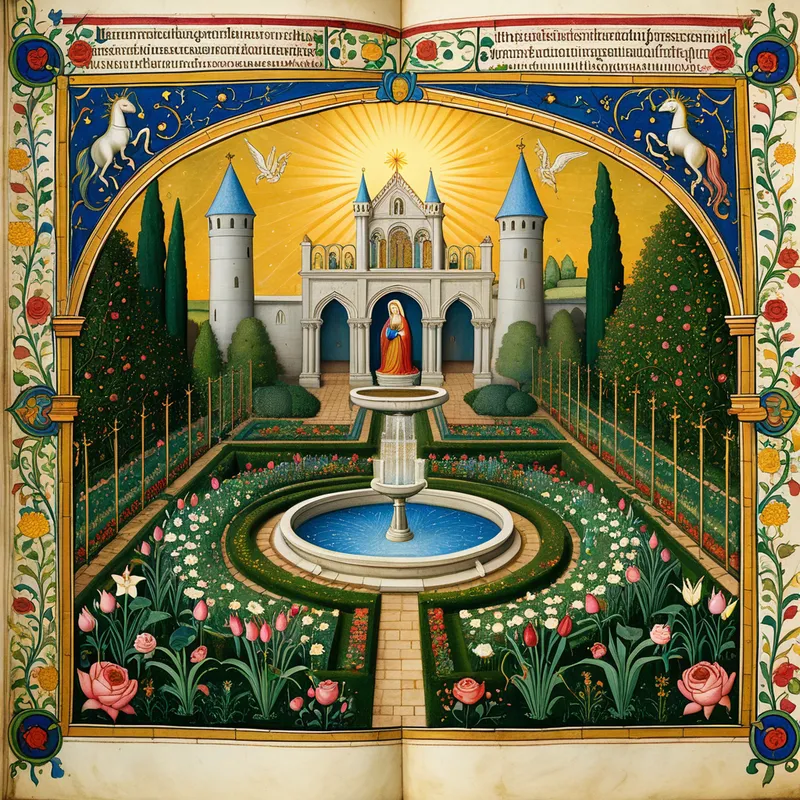
The Hortus Conclusus Myth Meaning & Symbolism
A sacred, inviolable garden, a symbol of the soul's purity and the divine mystery of incarnation, forever guarded and eternally fertile.
The Tale of The Hortus Conclusus
Listen, and let the walls of the world grow thin. Before cathedrals scraped the sky, before the ink of theologians stained the vellum, there was an image whispered in the heart. It was not a tale of dragons or quests, but of a silence so profound it became a place.
Imagine a wall. Not of defense, but of definition. It rises from the good, dark earth, fashioned from stone that knows the weight of time. It is high, so high that the clamor of the marketplace, the dust of the road, the endless chatter of becoming cannot cross its threshold. This wall forms a perfect circle, and within its embrace lies a garden.
This is no ordinary plot. The air within is different—thicker with scent, softer to the touch. Here, the sun does not blaze; it filters, dappling through leaves of deep, knowing green. A fountain sings at the center, its water clear as first thought, welling up from a source unseen. Around it, flowers grow in impossible harmony: the crimson passion of the rose, the virginal clarity of the lily, the humble blue of the violet. Their perfumes do not clash but weave a single, complex hymn. A unicorn, creature of fierce purity, rests its head upon the lap of the garden’s keeper.
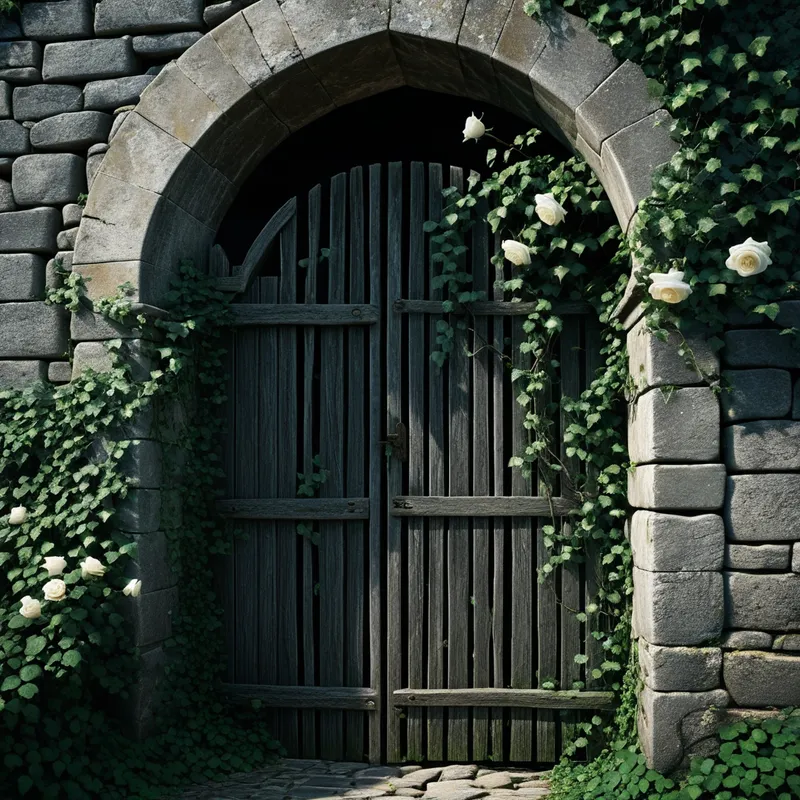
For there is a keeper. She sits, often reading, sometimes with a spindle, her presence the still axis of this turning world. She is the Theotokos, yet here she is simply the Gardener. She does not tend the flowers; the flowers tend to her, unfolding in her presence. The wall guards her, but she is the garden. The gate, heavy and of ancient oak banded with iron, is shut. It is not locked out of fear, but sealed by a sacred necessity. Nothing profane may enter. Nothing sacred may be diluted.
This is the Hortus Conclusus. It is complete. It needs nothing from beyond its wall. It is the world before the first “yes,” and the world after the final “amen.” It is the long, quiet breath held between prophecy and fulfillment. The conflict here is not of clashing swords, but of a sublime tension: the tension between the infinite longing of heaven and the finite, fertile readiness of earth. The resolution is not an explosion, but an incarnation—a single, silent moment when the gate, though shut, becomes transparent to a divine light that needs no entrance, for it arises from within the very soil.
Cultural Origins & Context
The image of the Hortus Conclusus is not a myth with a linear narrative, but a symbolic icon that flowered in the rich soil of medieval Christendom. Its roots tap deeply into the Song of Songs (4:12), where the beloved is praised: “A garden locked is my sister, my bride, a garden locked, a fountain sealed.” Medieval theologians, particularly Bernard of Clairvaux, seized upon this erotic poetry from the Old Testament and performed an allegorical exegesis, transmuting its earthly passion into a mystical blueprint for the soul and the Church.
This symbol was passed down not by bards, but by monks in scriptoria and artisans in workshops. It was painted on altarpieces, carved into choir stalls, and woven into tapestries. Its primary societal function was didactic and devotional. For a largely illiterate populace, it served as a visual sermon: a perfect, comprehensible image of the Virgin Mary’s perpetual virginity (the sealed gate), her immaculate conception (the untilled yet fertile ground), and her role as the vessel of Christ (the fountain of life). It presented an ideal of sacred inviolability and self-contained grace, offering a contemplative focus for prayer and a model of spiritual purity to which the faithful could aspire.
Symbolic Architecture
The Hortus Conclusus is a master symbol of the psyche’s deepest structure. It maps the geography of the Self.
The wall is not a barrier against life, but the principle of distinction. It represents the ego-boundary, necessary for identity. It says, “Here, I am not the other. Here, I have integrity.” It is the vessel that prevents the contents of the soul from spilling out and being lost, and protects the nascent, tender growth within from being trampled by the collective noise.
The most profound creativity requires a sacred enclosure, a temenos where the soul can converse with itself without interruption.
The garden within is the Self in potential, the inner world teeming with latent life. It is the totality of the psyche—its memories, dreams, instincts, and divine spark—existing in a state of pre-conscious harmony. The fountain is the source, the aqua vitae or living water of the unconscious, perpetually renewing the inner landscape. The flowers are the distinct virtues, insights, and beauties that individuation seeks to bring into bloom.
The sealed gate is the ultimate symbol. It represents a paradox central to depth psychology: the point of greatest defense is also the point of potential connection. It is the threshold where the conscious mind (outside) meets the unconscious (inside). It is shut because this meeting cannot be forced by will; it must be permitted by grace, by a lowering of the drawbridge from within. The figure of the Gardener is the archetypal image of the psyche’s own ordering and nurturing principle, the anima in its most integrated form, tending the connection between the personal and the transpersonal.
The Dreamer’s Resonance
When the Hortus Conclusus appears in modern dreams, it rarely comes as a biblical tableau. It manifests as the dreamer’s psyche working on the somatic and psychological process of containment and internal cultivation.
You may dream of a perfectly preserved room in a decaying house, a sealed terrarium thriving on a dusty desk, a fortified library within a chaotic city, or a quiet courtyard you discover in your own backyard that you never knew existed. The somatic feeling is one of profound relief, deep breath, and somatic settling. This dream pattern emerges when the ego is overwhelmed—by external demands, traumatic fragments, or a flood of unconscious material. The psyche is building a wall, not to imprison, but to create a temenos, a protected space where healing and integration can occur.
The conflict in such dreams often revolves around the gate. The dreamer may be trying to break in, representing a conscious desire for quick access to inner riches without the necessary inner work. Or, they may be desperately trying to keep something out, often a symbol of their own unintegrated shadow. The resolution comes when the dreamer simply sits within the garden, or finds they are already inside, tending to a single plant. This signals a shift from seeking salvation externally to engaging in the slow, patient work of inner cultivation.
Alchemical Translation
The myth of the Hortus Conclusus models the alchemical stage of solutio followed by coagulatio—first, a dissolving of rigid ego-boundaries to acknowledge the inner wilderness, then a conscious re-forming of a container strong enough to hold it. The process of individuation it outlines is not one of heroic conquest, but of sacred husbandry.
The first task is to build the wall. In psychological terms, this is the often-neglected work of establishing healthy ego boundaries, discernment, and the ability to say “no.” It is creating a conscious space separate from the personas we wear and the expectations of the collective. Without this wall, the soul’s garden remains a public thoroughfare, its flowers picked and its soil compacted.
Individuation begins not with a journey outward, but with a declaration of interiority. “Here, within me, is a kingdom.”
The second task is to enter the garden and sit. This is the practice of active imagination, meditation, and deep introspection—turning attention inward to observe what is already growing there, without immediately trying to weed or rearrange. It is acknowledging the fountain, the source of one’s own being and creativity, which flows independently of external validation.
The final, perpetual task is to honor the sealed gate. This is the mature understanding that the core of the Self is inviolable. It cannot be given away fully to another person, cause, or ideology. The deepest mysteries of one’s being are not for public consumption. The love that emanates from this garden—the agape of the integrated Self—does so not because the gate is broken down, but because the life within has become so abundant that it overflows the walls, blessing the outer world without losing its essential, sacred separateness. The garden remains enclosed, not out of lack, but out of sublime, fertile completion.
Associated Symbols
Explore related symbols from the CaleaDream lexicon: