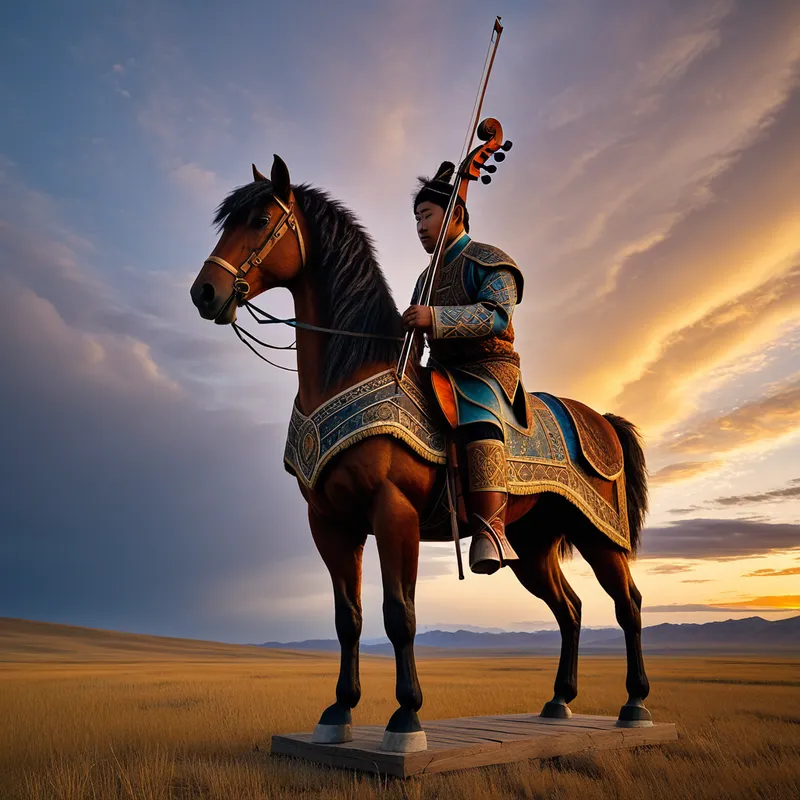
The Horse-Headed Fiddle Myth Meaning & Symbolism
A boy's beloved horse is slain by a jealous lord. From its remains, the horse visits the boy in a dream, instructing him to craft a fiddle from its body so their song may live forever.
The Tale of The Horse-Headed Fiddle
Listen, and let [the wind](/myths/the-wind “Myth from Various culture.”/) carry you to the endless sea of grass, where [the sky](/myths/the-sky “Myth from Persian culture.”/) is a bowl of eternity and [the earth](/myths/the-earth “Myth from Hindu culture.”/) sings beneath the hooves of ten thousand horses. Here lived a boy, his heart as vast as the steppe, whose spirit was twinned with that of a white steed. This was no ordinary horse. Its coat shone like moonlight on snow, its eyes held the deep intelligence of the ancient hills, and its speed was the very breath of the north wind. When the boy played his flute, the horse would dance, and when the horse ran, the boy’s soul flew free upon its back.
But in the shadows of a great lord’s ger, envy took root. The lord, coveting the sublime beauty and speed of the white horse, demanded it for his own. The boy refused, his loyalty a wall of granite. In a fury of wounded pride, the lord devised a cruel theft. He commanded the boy to race his prized horse against his own finest stallions, promising great reward. The boy, trusting and brave, agreed. The white horse flew like an arrow, leaving the lord’s stallions as dust in the distance. Yet this victory was its doom. That night, the lord’s men came. They slew the magnificent creature and left its body upon the open plain, a message written in blood and silence.
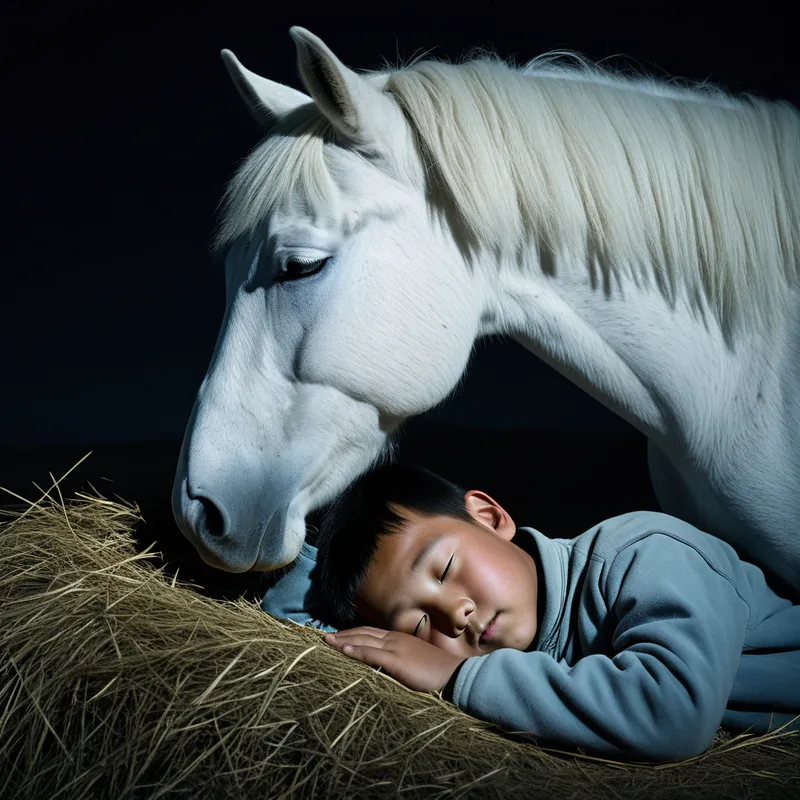
The boy’s world shattered. His grief was a cold river that froze the summer grass. He found his friend, his other half, lifeless under the indifferent stars. He wept until no tears remained, and sleep finally took him, a sleep thick with sorrow.
Then, the dream came.
The white horse stood before him, whole and radiant, its form shimmering like heat haze on [the horizon](/myths/the-horizon “Myth from Various culture.”/). It spoke, not with a human voice, but with a knowing that flowed directly into the boy’s spirit. “Do not weep for the form that is gone,” it seemed to say. “Our song is not finished. From my body, build a new one. Take the skin from my back, the hair from my tail, the bones from my limbs. Fashion a new vessel. Carve my head and neck to be the pegbox and neck. Stretch my skin over a wooden frame for the soundbox. String it with the hairs of my tail. When you draw the bow across those strings, you will not hear an instrument. You will hear my voice. You will hear the wind in the grass, the thunder of hooves, the whisper of the stars. Our union will be eternal.”
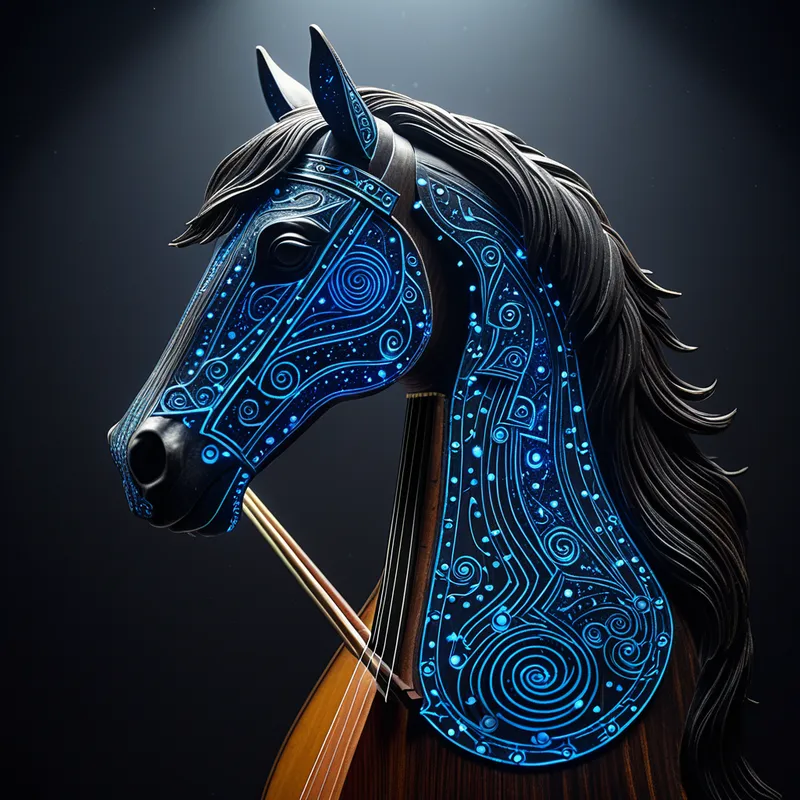
The boy awoke with the dawn, the dream etched upon his heart with the clarity of truth. With reverence and a love that transformed agony into purpose, he did as the spirit instructed. He worked with trembling hands, each piece a sacred relic. Finally, he held it: a curved body, a long neck, and atop it, the carved head of his beloved horse, gazing forever forward. He strung it, lifted the bow, and drew it across the two strings.
The sound that emerged was not of this world. It was the lonely cry of a hawk, the joyful whinny of a foal, the deep sigh of the earth itself. It was the soul of the steppe given voice. He played his grief, and it became a song of memory. He played his love, and it became a hymn of connection that death could not sever. The lord, hearing this unearthly music—a music that held more power and truth than all his wealth—was struck with a shame that chilled his bones. The boy, now a man woven from loss and creation, rode on, his companion’s song forever at his side, a bridge between [the world](/myths/the-world “Myth from Tarot culture.”/) of flesh and the world of spirit.
Cultural Origins & Context
This is the myth of the origin of the morin khuur, the quintessential instrument of Mongolia. It is not merely a story about an instrument’s invention, but a foundational narrative about the Mongolian soul’s relationship with the horse, the landscape, and the unseen world. Passed down orally for centuries by herders and shamans around evening fires, the tale served as a sacred charter, explaining why the morin khuur’s music is capable of expressing the entire spectrum of human and natural emotion—from profound loneliness (ᠬᠠᠨᠳᠠᠭᠤᠨ ᠰᠡᠳᠬᠡᠯ, khandgün sedkhel) to unbridled joy.
The myth functioned as a societal balm, modeling a profound psychological process: how to metabolize catastrophic loss and transform it into enduring cultural beauty. In a nomadic culture where life, death, and survival were intimately tied to the horse, the story provided a spiritual technology for grief. It taught that connection is not broken by death, but transmuted. [The shaman](/myths/the-shaman “Myth from Siberian culture.”/) (ᠪᠥᠥ, böö), often the keeper of such stories, might have seen in the morin khuur a literal tool for journeying—its horse head a vehicle to the spirit world, its strings the pathways between.
Symbolic Architecture
At its core, the myth is a masterclass in symbolic [alchemy](/symbols/alchemy “Symbol: A transformative process of purification and creation, often symbolizing personal or spiritual evolution through difficult stages.”/). The horse is far more than a pet or [vehicle](/symbols/vehicle “Symbol: Vehicles in dreams often symbolize the direction in life and the control one has over their journey, reflecting personal agency and decision-making.”/); it represents the instinctual, free, and noble part of the [human](/symbols/human “Symbol: The symbol of a human represents individuality, complexity of emotions, and social relationships.”/) [psyche](/myths/psyche “Myth from Greek culture.”/)—the untamed [spirit](/symbols/spirit “Symbol: Spirit symbolizes the essence of life, vitality, and the spiritual journey of the individual.”/), the Self in its wild, natural form. The jealous [lord](/symbols/lord “Symbol: The symbol of ‘Lord’ represents authority, mastery, and control, along with associated power dynamics in relationships.”/) symbolizes the oppressive, possessive forces of the conscious ego or societal [authority](/symbols/authority “Symbol: A symbol representing power structures, rules, and control, often reflecting one’s relationship with societal or personal governance.”/) that seeks to own, control, and ultimately kill what it cannot comprehend.
The violent [death](/symbols/death “Symbol: Symbolizes transformation, endings, and new beginnings; often associated with fear of the unknown.”/) of the horse is the central [trauma](/symbols/trauma “Symbol: A deeply distressing or disturbing experience that overwhelms the psyche, often manifesting in dreams as unresolved emotional wounds or psychological injury.”/), the [moment](/symbols/moment “Symbol: The symbol of a ‘moment’ embodies the significance of transient experiences that encapsulate emotional depth or pivotal transformations in life.”/) when the instinctual spirit is sacrificed to the demands of a cruel, superficial order. This is a universal psychological experience: the crushing of creativity by practicality, the silencing of [intuition](/symbols/intuition “Symbol: The immediate, non-rational understanding of truth or insight, often described as a ‘gut feeling’ or inner knowing that bypasses conscious reasoning.”/) by [logic](/symbols/logic “Symbol: The principle of reasoning and rational thought, often representing order, structure, and intellectual clarity in dreams.”/), the [betrayal](/symbols/betrayal “Symbol: A profound violation of trust in artistic or musical contexts, often representing broken creative partnerships or artistic integrity compromised.”/) of one’s true [nature](/symbols/nature “Symbol: Nature symbolizes growth, connectivity, and the primal forces of existence.”/) for social [acceptance](/symbols/acceptance “Symbol: The experience of being welcomed, approved, or integrated into a group or situation, often involving validation of one’s identity or actions.”/).
The most profound creations are often born not from abundance, but from the sacred remains of what we thought was destroyed.
The dream visitation is the critical turn. It represents the intervention of the unconscious, [the Self](/myths/the-self “Myth from Jungian culture.”/) communicating a [path](/symbols/path “Symbol: The ‘path’ symbolizes a journey, choices, and the direction one’s life is taking, often representing individual growth and exploration.”/) of [redemption](/symbols/redemption “Symbol: A theme in arts and music representing transformation from failure or sin to salvation, often through creative expression or cathartic performance.”/). The spirit does not ask for revenge or resurrection of the old form. It instructs a creation from the remains. This is the archetypal [pattern](/symbols/pattern “Symbol: A ‘Pattern’ in dreams often signifies the underlying structure of experiences and thoughts, representing both order and the repetitiveness of life’s situations.”/) of the [opus](/symbols/opus “Symbol: A spiritual or alchemical term for a great work of creation, often representing the culmination of a life’s purpose or a transformative process.”/), [the great work](/myths/the-great-work “Myth from Alchemical culture.”/). The raw materials of trauma—the [skin](/symbols/skin “Symbol: Skin symbolizes the boundary between the self and the world, representing identity, protection, and vulnerability.”/) (boundaries), bones ([structure](/symbols/structure “Symbol: Structure in dreams often symbolizes stability, organization, and the framework of one’s life, reflecting how one perceives their environment and personal life.”/)), and [hair](/symbols/hair “Symbol: Hair often symbolizes identity, power, and self-expression, reflecting how we perceive ourselves and how we wish to be perceived by others.”/) ([connection](/symbols/connection “Symbol: Connection symbolizes relationships, communication, and bonds among individuals.”/))—are to be reassembled into a new, functional [vessel](/symbols/vessel “Symbol: A container or structure that holds, transports, or protects something essential, representing the self, emotions, or life journey.”/) of meaning. The resulting morin khuur is a [symbol](/symbols/symbol “Symbol: A symbol can represent an idea, concept, or belief, serving as a powerful tool for communication and understanding.”/) of the integrated psyche. The carved horse head is the eternal [image](/symbols/image “Symbol: An image represents perception, memories, and the visual narratives we create in our minds.”/) of the lost spirit, now presiding over the [instrument](/symbols/instrument “Symbol: An instrument symbolizes creativity, communication, and the means by which one expresses oneself or influences the world.”/). The two strings are often said to represent the male and female principles, or [heaven](/symbols/heaven “Symbol: A symbolic journey toward ultimate fulfillment, spiritual transcendence, or connection with the divine, often representing life’s highest aspirations.”/) and [earth](/symbols/earth “Symbol: The symbol of Earth often represents grounding, stability, and the physical realm, embodying a connection to nature and the innate support it provides.”/), now in harmonious [relationship](/symbols/relationship “Symbol: A representation of connections we have with others in our lives, often reflecting our emotional state.”/). The [musician](/symbols/musician “Symbol: A musician symbolizes creativity, expression, and the ability to communicate emotions through art.”/), by playing, becomes the conscious ego that has learned to give voice to the spirit, not own it.
The Dreamer’s Resonance
When this myth stirs in the modern dreamer, it signals a profound process of psychic integration following a significant loss or betrayal. It is not merely about missing a person, pet, or opportunity. It is about the death of a way of being, a part of the self that felt free, powerful, and authentic.
Dreams may present: the death or injury of a beloved animal; finding mysterious bones or relics and feeling compelled to assemble them; receiving clear instructions in a dream from a lost loved one or an animal guide; or the act of crafting an object, often an instrument, with intense focus and sorrow. Somatically, the dreamer may awaken with a sense of pressure in the chest (the soundbox being formed) or a tingling in the hands (the act of creation).
The psychological process is one of active mourning. The unconscious is pushing the dreamer beyond passive grief into the creative, reconstructive phase. It asks: “What can be built from the ruins of what you have lost? What new form can carry the essence of that relationship forward?” The dreamer is being invited to become the boy in the story—to heed the call from the depths and engage in the literal or metaphorical craftsmanship that will transform haunting memory into living song.
Alchemical Translation
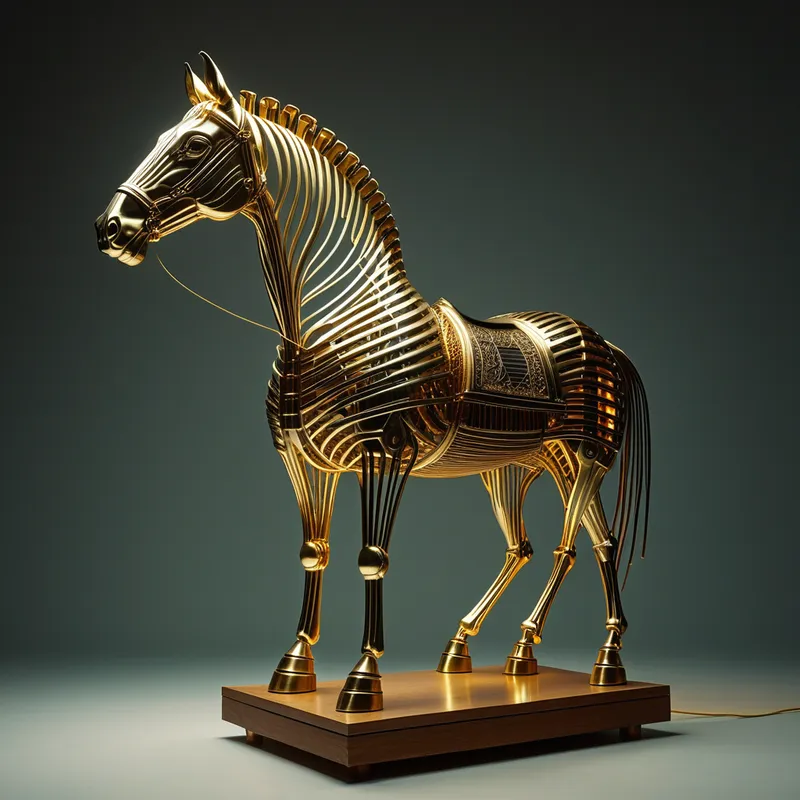
For the individual on the path of individuation, the myth of the Horse-Headed Fiddle is a precise map for psychic transmutation. The process follows the alchemical stages: [nigredo](/myths/nigredo “Myth from Alchemical culture.”/), albedo, [rubedo](/myths/rubedo “Myth from Alchemical culture.”/).
The nigredo, the blackening, is the murder of the horse—the descent into the black despair of loss, the feeling that a vital part of the self has been annihilated by circumstance or malice. This is a necessary dissolution. The albedo, the whitening, is the dream. It is the first light in the darkness, the clarifying message from the Self that reveals the hidden order within the chaos. It is the insight that the spirit of what was lost is not gone, but awaits a new embodiment.
Individuation is the craftsmanship of the soul, using the materials of our wounds to build an instrument capable of playing our unique song back to the universe.
The rubedo, the reddening, is the arduous, loving work of construction. This is the individuation process itself—the conscious, often painful, effort to integrate the lessons, love, and essence of the lost other (or lost self) into the fabric of one’s ongoing life. One does not “get over” the loss; one incorporates it. The finished morin khuur represents the attained goal: a personality that has metabolized its deepest suffering into a source of wisdom and expression. The individual becomes a vessel. The horse-headed part of them—their wild spirit, their deep love—is no longer something they ride unconsciously or that can be taken from them. It is now the carved figurehead of their very being, the guiding image from which the music of their life emanates. They play their own story, and in that playing, they heal not only themselves but, like the mythic boy, become a conduit for something timeless that touches all who hear it.
Associated Symbols
Explore related symbols from the CaleaDream lexicon: