
The Hornet's Nest Myth Meaning & Symbolism
A myth where a curious traveler disturbs a sacred hornet's nest, unleashing a swarm that teaches a lesson in reverence and the cost of trespass.
The Tale of The Hornet’s Nest
Listen. The forest was not always silent. In the time before boundaries were drawn on maps, there was a grove so deep that sunlight fell to the floor in shattered coins. The air there was thick with the scent of damp earth and blooming nightshade. And in the heart of this grove, suspended from the arm of an ancient World Oak, hung the Nest.
It was no ordinary nest. It was a cathedral of clay and spit, a fortress of furious patience. Its surface was a labyrinth of perfect hexagons, a geometry so precise it whispered of a mind greater than human understanding. A low, constant hum emanated from within, the song of ten thousand wings at rest—the hymn of the Swarm-Mind. The creatures themselves were like shards of living amber, their wings sheened with oil-slick rainbows, their stingers tipped in a venom that was said to burn away illusion.
Into this grove came a traveler, Kaelen. He was not a bad man, but he was a restless one, driven by a hunger to know what was hidden. He had heard the elders speak of the grove in hushed tones, calling it the Chamber of Unfinished Patterns. “Do not go there,” they said. “Some orders are not meant for mortal eyes.”
But Kaelen only heard the challenge. He pushed through the final veil of thorn and stood before the Nest. The hum deepened, a warning thrum that vibrated in his teeth. He saw the perfect symmetry, the alien beauty, and a thought, sharp and irresistible, pierced him: What law holds this together? What secret is in the center?
His hand, moving as if of its own will, reached out. A single finger brushed the sun-warmed clay of the outer wall.
The hum ceased.
The silence was more terrifying than any sound. Then, a crack appeared. Not a sound, but a fissure in the air itself. From the perfect hexagons, one, then ten, then a river of living light poured forth. The Swarm-Mind was awake. It did not attack as a mindless beast, but as a single, focused judgment. The hornets did not swarm around him; they swarmed into him. They flowed over his skin, not stinging yet, mapping the contours of his trespass. Their drone was a language now, a single word repeated in a frequency of pure fury: Know. Know. Know.
And then the pain began. It was not the pain of injury, but of revelation. Each sting was the injection of a truth he was not ready to bear—the truth of his own arrogance, the fragility of the boundary he had broken, the immense, humming intelligence of the world he assumed was passive. He did not run, for there was no escape from this knowing. He fell to his knees, a living pillar of agony and awakening, as the swarm etched its lesson directly onto his nervous system.
When the last hornet retreated, the grove was silent once more. Kaelen lay changed. His body was mapped with raised, fiery welts that would never fully fade—a living scripture of his transgression. But his eyes, once merely curious, now held the deep, resonant fear of one who has seen the sacred machinery of the world, and found his own hand on a lever he never should have touched.

Cultural Origins & Context
The myth of The Hornet’s Nest is a warning narrative with remarkably consistent variants across disparate “Various” cultures, from the forest-dwelling tribes of the northern continents to the agrarian societies of the great river basins. It was never a myth of grand creation or heroic conquest, but a fireside story, told by elders to youths on the cusp of venturing beyond the village borders.
Its primary societal function was pedagogical and ecological. It served as a core component of animist ethics, teaching the concept of sacred reciprocity and the dire consequences of its violation. The storyteller, often a hunter or a gatherer deeply attuned to the subtle balances of the local biome, would use the tale to encode practical survival wisdom: there are places of concentrated natural power (beehives, raptor nests, certain groves) that demand a protocol of approach, if they are to be approached at all.
The myth was a narrative container for the law of unintended disturbance. It answered the “why” behind practical taboos. It taught that curiosity, untempered by reverence, is a form of violence, and that the natural world possesses not just a spirit, but a jurisprudence—a system of consequence administered by non-human agents. The hornets are the enforcers of this natural law.
Symbolic Architecture
Psychologically, the myth maps the encounter with a self-contained, autonomous system of the psyche—what Jung might term a complex—that is best left in its own state of dynamic equilibrium. The Hornet’s Nest symbolizes any deeply ingrained pattern, trauma, or latent potential that has organized itself into a functional, if hidden, wholeness.
To prod a complex is to awaken its guardians. The sting is the psyche’s immune response to naive intervention.
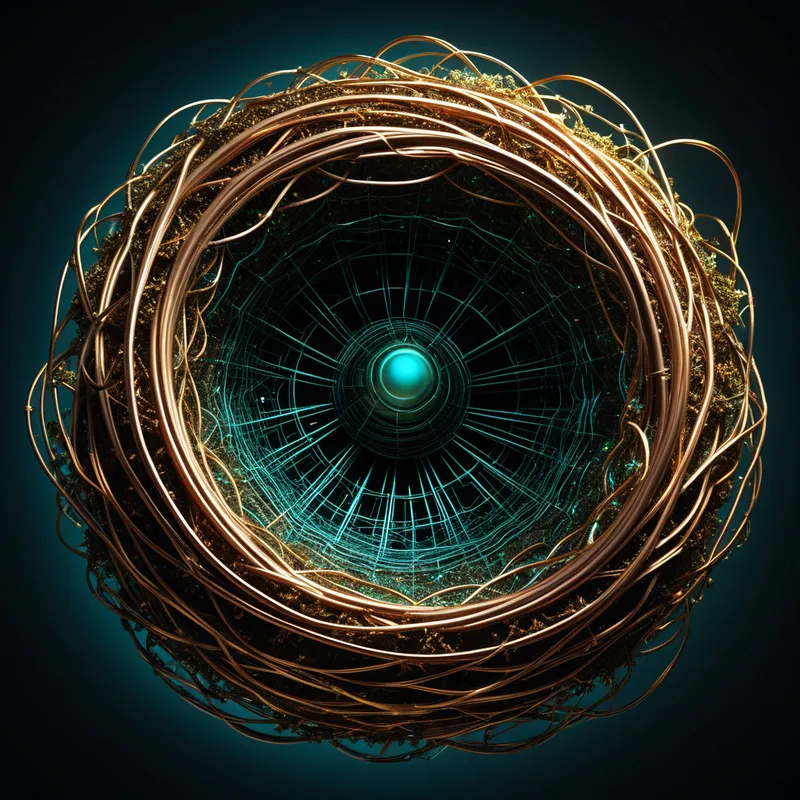
The nest itself represents the Self in its unintegrated, natural state: perfect, intricate, and humming with latent energy. It is not “evil,” but it is sovereign. Kaelen, the wandering ego, represents consciousness that seeks to assimilate, understand, and control the unconscious without the proper respect or preparation. His brush against the nest is the archetypal act of psychological trespass—poking at a childhood wound, arrogantly confronting a deep-seated fear, or trying to forcibly “heal” a part of oneself without invitation.
The Swarm-Mind is the shadow of the complex, its defensive and retaliatory power. The stings are not merely punishment; they are the painful, involuntary insights that flood us when we disturb a buried truth. The welts that remain are the lasting psychological imprints—the changed perspectives, the phobias, or the profound respects—born from such an encounter.
The Dreamer’s Resonance
When this myth pattern activates in the modern dreamscape, it often manifests not with literal hornets, but with symbols of disturbed, autonomous systems. One might dream of accidentally cracking open a wall to find a hidden beehive buzzing with electricity; of tapping on a sealed archive only to have its contents come alive and swarm; or of touching a strange, pulsing orb that then dissolves into a storm of stinging light.
Somatically, the dreamer may awaken with a sense of prickling on the skin, a buzzing in the ears, or a deep, resonant anxiety in the solar plexus. This is the body remembering the myth. Psychologically, this dream signals that the dreamer’s conscious mind is, or is about to, “poke at” something it does not fully comprehend. It is a warning from the deep unconscious that a certain inner order is fragile and defended.
The process underway is one of confrontation with autonomous psychic life. The dream is the first hum of the swarm, a last-ditch effort to warn the ego to back away, or to prepare for the inevitable, painful awakening that comes from forcing a confrontation for which one is not ritually or psychologically ready.

Alchemical Translation
The alchemical journey modeled here is not one of integration, but of the Calcinatio—the burning. In the process of individuation, not all unconscious content is meant to be lovingly assimilated into the conscious personality. Some complexes, some “nests,” must be acknowledged as sovereign territories, their laws respected, their boundaries honored.
The triumph is not in mastering the swarm, but in surviving its teaching and learning the new geography of your own limits.
Kaelen’s “triumph” is his transformation from a curious wanderer into a wounded knower. The alchemical gold he produces is not a merged self, but a hard-won humility. The psychic transmutation occurs in the aftermath: the ego, scorched and humbled, must now re-order its world. It can no longer operate under the illusion that all of the psyche is terra nullius, open for colonization by consciousness.
The modern individual undergoes this alchemy when they learn, often the hard way, that some memories are best left un-prodded, some family patterns are not theirs to “fix,” and some aspects of their own creativity or anger must be approached with ritual care, not blunt force. The myth teaches that individuation requires not just courage, but discernment—the wisdom to know which doors to open slowly, with offering, and which doors to let hum in peace, their sacred, furious intelligence intact. The welts become wisdom; the trespass becomes a treaty. One learns to live in a world that contains hornet’s nests, and in so doing, becomes more whole.
Associated Symbols
Explore related symbols from the CaleaDream lexicon: