The Horn of Bran Myth Meaning & Symbolism
A myth of a king whose severed head provides counsel and protection, symbolizing the eternal bond between a ruler's spirit and the land's well-being.
The Tale of The Horn of Bran
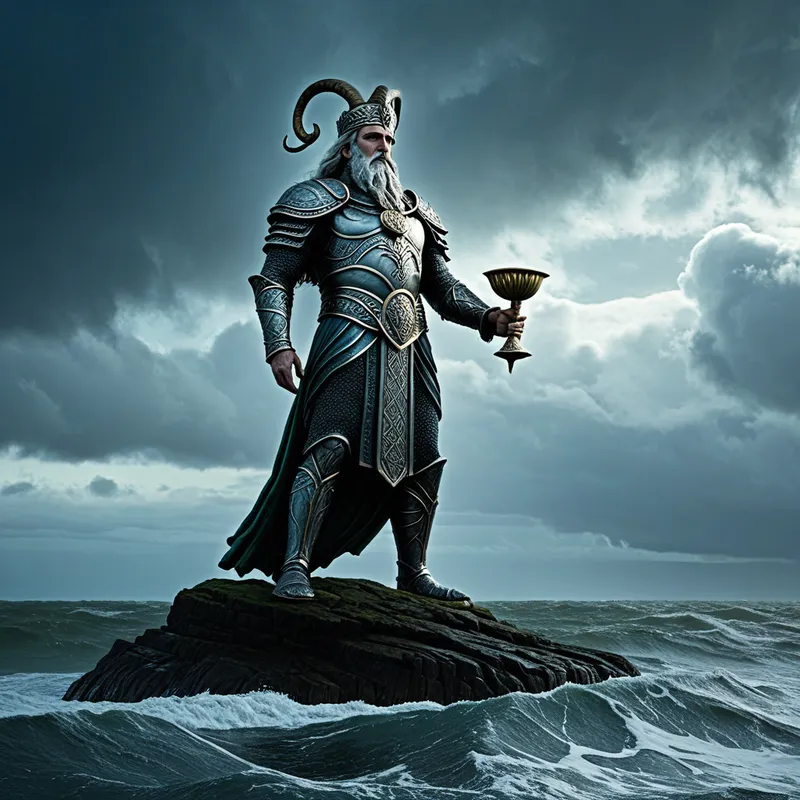
Listen. The wind that howls from the west carries more than salt and spray; it carries a memory of a time when the world was held together by a different kind of law. A law of blood and soil, of word and geas. In that time, there walked a king who was more than a man. His name was Bran the Blessed, and his stature was such that no house built by mortal hands could contain him. He was the island of Britain made flesh, his sovereignty woven into the very rocks and rivers.
The shadow fell from across the sea. His sister, Branwen, married to the King of Ireland, suffered a grave insult, a stain upon the honor of the Island of the Mighty. Grief became a cold fire in Bran’s chest. He gathered a host so vast its ships darkened the sea, and he himself waded through the deep waters, his shoulders a bridge for his armies.
War was a red harvest. In the final, cataclysmic clash, Bran was struck in the foot by a poisoned spear. The venom was a creeping death, and the great king knew his earthly form was ending. But a king’s duty does not end with his breath. He called his seven most loyal men to him. His voice, though weakened, held the rumble of distant thunder. “Cut off my head,” he commanded. “Carry it with you to the White Hill in Llundys. Bury it there, facing the continent, and so long as it remains, no plague shall come from over the sea to this land.”
The men wept, but they obeyed. With a blade blessed by sorrow, they performed the terrible sacrament. The head did not die. It spoke, its eyes seeing more clearly than ever before. It became their guide, their solace, their living Cauldron of Rebirth. For seven years, they journeyed, dwelling in a hall at Gwales, where time stood still and the head provided feasts of laughter and wisdom from a horn that never emptied. For seven years, they forgot all sorrow.
But one man, driven by a compulsion he could not name, opened the door that faced Cornwall. The spell shattered. The memory of their loss, their duty, and the raw wound of the world crashed upon them like a wave. The living head commanded them to complete their journey. They carried it to the White Hill and laid it to rest, facing east, a silent, watchful guardian. And there, it is said, it watches still.
Cultural Origins & Context
This profound narrative is preserved in the Mabinogion, specifically in the branch titled Branwen ferch Llŷr. While recorded in medieval Wales, its roots dig deep into the pre-Christian, pan-Celtic soil. This was not mere entertainment for a fireside; it was a sacred history, a map of sovereignty. Bards and fili would recite such tales, binding the present community to the mythic past.
The function of Bran’s story was multifaceted. It explained the spiritual origin of a talisman of national protection (the buried head). It explored the sacred, often terrifying, responsibilities of kingship, where the ruler is literally the sacrificial vessel for the land’s well-being. Furthermore, it codified a core Celtic eschatology: the belief that the consciousness, the anam or soul, could persist in a detached head, the seat of wisdom and power. This myth served as a bridge between the world of heroic action and the timeless, watchful realm of the ancestral guardian.
Symbolic Architecture
The myth of Bran is a dense tapestry of symbols speaking to the psyche’s deepest structures. The Horn of Plenty, ever-full during the otherworldly feast at Gwales, is not merely a symbol of material abundance. It represents the inexhaustible wisdom and sustenance that flows from the integrated, conscious Self when one is in alignment with the timeless, inner world.
The severed head that speaks is the ego sacrificed to a higher, guiding intelligence. It is personal identity transcended, becoming an oracular center for the community of the psyche.
Bran’s command to bury his head facing east is a powerful geopolitical and psychological ward. It signifies the establishment of a conscious boundary—a psychic immune system. The “plague” from overseas is not just invasion, but any foreign, disintegrating influence that threatens the integrity of the Self. The head becomes a cippus, a permanent marker of a sacred contract between the spirit of the land (the deep, instinctual Self) and its inhabitants (the conscious personality).
The Dreamer’s Resonance
When this myth stirs in the modern dreamer, it signals a profound process of psychic reorganization. To dream of a talking head, especially one that is detached yet alive and wise, often accompanies a life phase where intellectual understanding (the head) is being separated from instinctual, bodily drives (the body of Bran). The dreamer may be undergoing a necessary “decapitation”—a forced shift from an old identity or way of thinking.
Dreams of carrying a sacred, heavy burden on a long journey mirror the seven warriors’ vigil. This is the somatic feeling of holding a new, fragile consciousness—a nascent insight or a painful truth—that requires protection and patience as it is integrated. The sudden, catastrophic memory triggered by opening the forbidden door in a dream speaks to the inevitable moment when blissful avoidance ends, and the full weight of one’s destiny and unfinished work must be faced. The psyche is recalling its oath to wholeness.

Alchemical Translation
The alchemical journey of Bran is a perfect model for the Jungian process of individuation. The initial state is one of inflated, giant-like consciousness (Bran the king), which is inevitably wounded by the poisoned spear of life’s realities—betrayal, failure, mortality. The mortificatio, or killing of the old form, is the severing of the head: the deliberate, painful sacrifice of the ego’s primary position.
The seven-year feast at Gwales is the solutio and coagulatio—a dissolution in the waters of the unconscious where time stops, followed by a reconstitution around a new, central principle.
The talking head is the nascent Self beginning to direct the personality (the seven companions). This period of interior nourishment is crucial, but it is not the end. The final, crucial stage is the separatio and fixatio: leaving the timeless paradise (opening the door) to return the transformed essence to the world. Burying the head on the White Hill is the act of grounding this hard-won, transcendent awareness into one’s personal “kingdom”—one’s life, relationships, and work—where it becomes a permanent, stabilizing, and protective center. The king is dead; long live the guiding, silent wisdom that now watches from the heart of the Self.
Associated Symbols
Explore related symbols from the CaleaDream lexicon: