The Horn of Amalthea Myth Meaning & Symbolism
A divine goat nourishes the infant Zeus; her broken horn becomes the Cornucopia, an eternal symbol of nourishment born from sacrifice.
The Tale of The Horn of Amalthea
Hear now a story from the time before time, when [the world](/myths/the-world “Myth from Tarot culture.”/) was young and raw, and the fate of all things hung by a thread of milk.
In the deep, echoing caves of Crete, darkness was not empty. It was a womb. Here, the air thrummed with the frantic heartbeat of the goddess Rhea. Her tears, salt and desperate, fell upon the stone as she placed her newborn son upon the cold earth. This was Zeus, last hope against the devouring tyranny of his father, [Kronos](/myths/kronos “Myth from Greek culture.”/). To save him, he must be hidden, and he must be fed a food that his father could not smell on [the wind](/myths/the-wind “Myth from Various culture.”/)—a food not of this world.
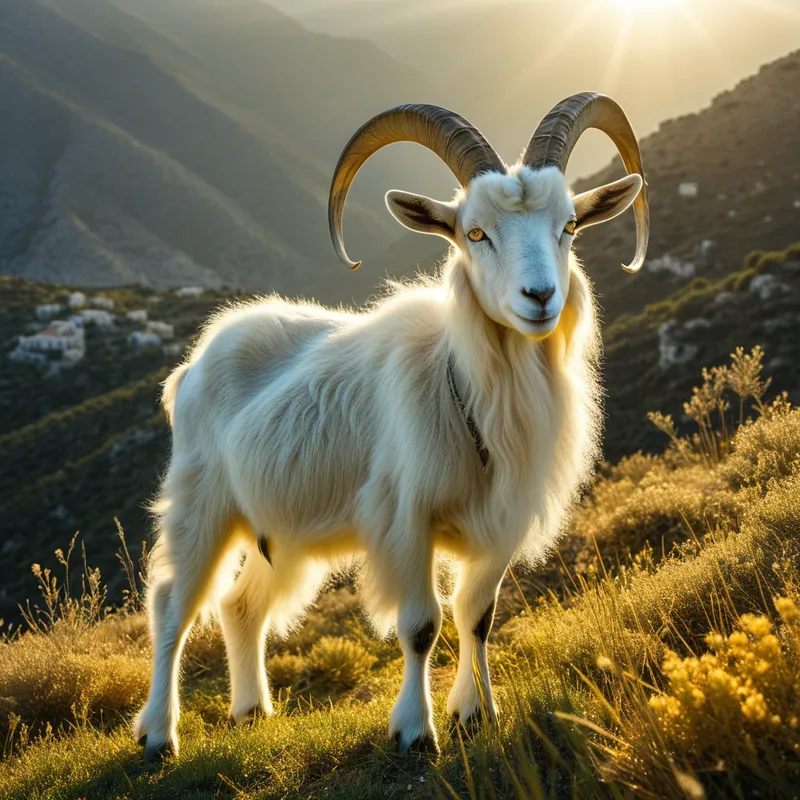
[The earth](/myths/the-earth “Myth from Hindu culture.”/) itself answered. From the shadowed clefts of the Idaean Mountains came a being of gentle majesty: Amalthea. She was no ordinary beast. Her coat was the soft grey of twilight mist, and her eyes held the patience of ancient stone. From her udder flowed not mere goat’s milk, but [ichor](/myths/ichor “Myth from Greek culture.”/)—the very nectar of potential divinity. The infant god suckled, his cries softening into contented sighs. [The cave](/myths/the-cave “Myth from Platonic culture.”/) was filled with the warm, sweet scent of milk and safety.
But a child of destiny is a violent force, even in his joy. As Zeus grew with unnatural speed, tumbling in divine play, his small, powerful hands grasped one of Amalthea’s magnificent, curving horns. In a moment of unbound strength, he pulled. A sound like a cracking mountain echoed in the cavern—not a sound of breaking, but of opening. The horn came away, not as a wound, but as a vessel.
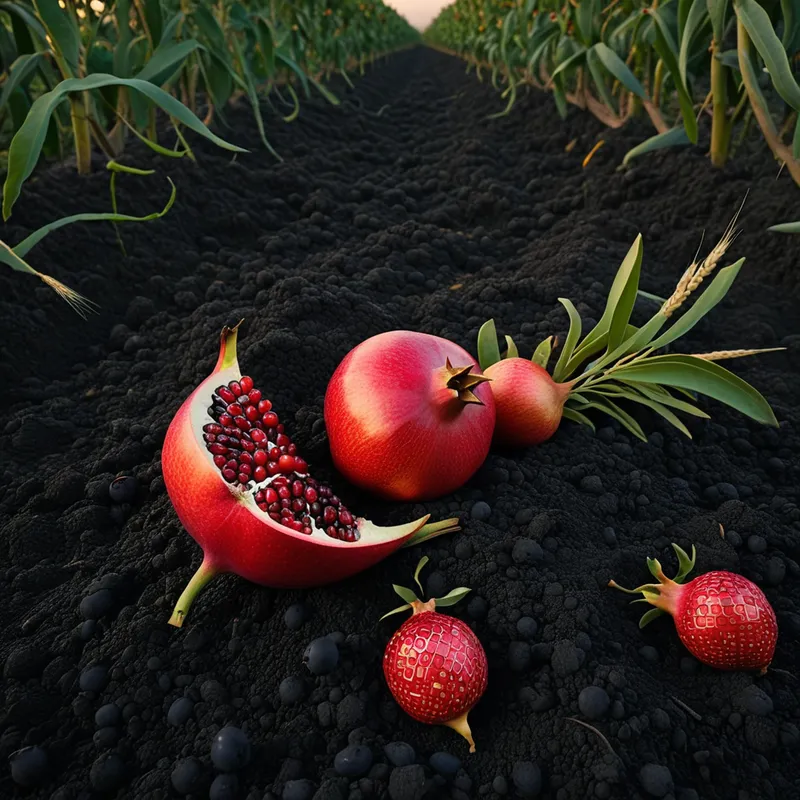
And from that broken place, a miracle poured forth. Not blood, but a river of life itself. Luscious fruits tumbled forth—figs bursting with sweetness, grapes heavy with dew. Grains of gold and barley spilled like sunlight. Flowers bloomed instantly from the stone floor. The horn, cradled in the hands of the now-laughing god, had become an unfailing fountain. It was no longer a part of the goat, but a promise to the world. In gratitude, Zeus would later place Amalthea among the stars, as the constellation Capella, and her horn, the Cornucopia, would pass into the hands of Demeter, of Ploutos, and into the heart of the world’s hope: that from a single act of nurture, broken open, flows the abundance that sustains all.
Cultural Origins & Context
The myth of Amalthea is a foundational layer in the complex stratigraphy of Greek myth, belonging to the “childhood of Zeus” narratives that were crucial for establishing his legitimacy and benevolent nature as a ruler. Unlike the violent, political myths of his adulthood, this story originates in a more intimate, almost domestic sphere. It was a tale told not just to explain sovereignty, but to explain sustenance.
It functioned as an aetiological myth for [the Cornucopia](/myths/the-cornucopia “Myth from Global/Universal culture.”/), an artifact deeply embedded in Greek (and later Roman) iconography as the ultimate symbol of agricultural prosperity, peace, and divine favor. The story was likely propagated through local Cretan cults proud of their claim as the god’s nursery, and then woven into the broader Panhellenic tradition by poets like Hesiod. In a society where famine was a constant specter, the image of an inexhaustible horn was not mere fantasy; it was a profound psychological and religious anchor—a divine guarantee that the world was, at its core, nourishing.
Symbolic Architecture
At its [heart](/symbols/heart “Symbol: The heart symbolizes love, emotion, and the core of one’s existence, representing deep connections with others and self.”/), this is not a myth of battle, but of provision. The symbols here are soft, feminine, and deeply transformative.
Amalthea is the archetypal nourisher, the selfless [caregiver](/symbols/caregiver “Symbol: A spiritual or mythical figure representing nurturing, protection, and unconditional support, often embodying divine or archetypal parental energy.”/) of the [cosmos](/symbols/cosmos “Symbol: The entire universe as an ordered, harmonious system, often representing the totality of existence, spiritual connection, and the unknown.”/). She represents the pre-Olympian, chthonic force of the [earth](/symbols/earth “Symbol: The symbol of Earth often represents grounding, stability, and the physical realm, embodying a connection to nature and the innate support it provides.”/) that willingly gives of its substance to foster the new order. Her breaking is not a violation but a necessary transformation.
The [Horn](/symbols/horn “Symbol: A horn symbolizes primal power, warning signals, and spiritual connection, often representing strength, alertness, or divine communication in dreams.”/) is a potent [symbol](/symbols/symbol “Symbol: A symbol can represent an idea, concept, or belief, serving as a powerful tool for communication and understanding.”/). It is a phallic, projecting symbol of [strength](/symbols/strength “Symbol: ‘Strength’ symbolizes resilience, courage, and the ability to overcome challenges.”/) and [defense](/symbols/defense “Symbol: A protective mechanism or barrier against perceived threats, representing boundaries, security, and resistance to external or internal challenges.”/), yet it is also a hollow [vessel](/symbols/vessel “Symbol: A container or structure that holds, transports, or protects something essential, representing the self, emotions, or life journey.”/), a receptive container. In its breaking, these dualities merge. It is no longer a [weapon](/symbols/weapon “Symbol: A weapon in dreams often symbolizes power, aggression, and the need for protection or defense.”/) but a [womb](/symbols/womb “Symbol: A symbol of origin, potential, and profound transformation, representing the beginning of life’s journey and the unconscious source of creation.”/). It transitions from a tool of the individual (the [goat](/symbols/goat “Symbol: The goat symbolizes independence, resilience, and various traits associated with adaptability across diverse cultures.”/)‘s defense) to a [vessel](/symbols/vessel “Symbol: A container or structure that holds, transports, or protects something essential, representing the self, emotions, or life journey.”/) for the collective (the world’s nourishment).
The deepest abundance is never merely collected; it is always born from a sacred breaking. What we perceive as loss is often the universe opening a vessel within us.
The Milk/Ichor is the fluid of potential. It is the raw, unformed [life](/symbols/life “Symbol: The symbol of ‘Life’ represents a journey of growth, interconnectedness, and existential meaning, encompassing both the joys and challenges that define human experience.”/)-force, the [prima materia](/myths/prima-materia “Myth from Alchemical culture.”/) of divinity. Its transformation into solid, diverse fruits and grains signifies the process of potential becoming actual, of divine [energy](/symbols/energy “Symbol: Energy symbolizes vitality, motivation, and the drive that fuels actions and ambitions.”/) manifesting in tangible, [life](/symbols/life “Symbol: The symbol of ‘Life’ represents a journey of growth, interconnectedness, and existential meaning, encompassing both the joys and challenges that define human experience.”/)-sustaining forms.
Psychologically, the myth maps the process of how nurturing energy—often taken for granted, even exploited—when honored and transformed, becomes the [source](/symbols/source “Symbol: The origin point of something, often representing beginnings, nourishment, or the fundamental cause behind phenomena.”/) of our deepest creative and sustaining powers. The “horn” is that part of our instinctual, providing [nature](/symbols/nature “Symbol: Nature symbolizes growth, connectivity, and the primal forces of existence.”/) that must be “broken off” from its original, defensive function to become a channel for boundless giving.
The Dreamer’s Resonance
To dream of the Horn of Amalthea is to dream at [the threshold](/myths/the-threshold “Myth from Folklore culture.”/) of nurture and sacrifice. The dreamer may encounter a broken vessel that overflows, a wounded animal that provides sustenance, or find themselves drinking from a horn that never empties.
Somatically, this dream pattern often accompanies a feeling of profound depletion—the “caregiver’s burnout”—or conversely, a sudden, unexpected influx of creative energy following a period of loss. The [psyche](/myths/psyche “Myth from Greek culture.”/) is working through the alchemy of the caregiver archetype. The dream asks: What in you has been giving endlessly? And what might need to be “broken,” not to be destroyed, but to be transformed into a more sustainable, abundant vessel?
The modern dreamer wrestling with this myth is often at a point where their natural capacity to nurture (a project, a relationship, a part of themselves) has hit a limit. The dream presents the broken horn as the solution: not to stop giving, but to change the form of the giving. It signals a move from personal, exhausting sacrifice to becoming a channel for a more impersonal, abundant flow.

Alchemical Translation
The individuation process modeled here is the transmutation of the personal caregiver into the universal source. It is the journey from needing to be needed to becoming a vessel of abundance.
The [Nigredo](/myths/nigredo “Myth from Alchemical culture.”/) (Blackening): This is the moment in the cave. It is the darkness of Rhea’s fear, the desperation of hiding, the raw, screaming need of the infant Zeus. For the individual, it is the crisis that forces dependency, the acknowledgment of a hunger that cannot be met by ordinary means.
The Albedo (Whitening): Amalthea arrives. This is the purification by milk, the acceptance of nurture. [The ego](/myths/the-ego “Myth from Jungian culture.”/) (the infant god) must surrender to being cared for, to receiving without guilt. It is the whitening of the soul by the acceptance of grace and primal support.
The [Rubedo](/myths/rubedo “Myth from Alchemical culture.”/) (Redening) & Transmutation: The breaking of the horn. This is the critical, fiery phase. The nurtured one (now strengthened) interacts with the nourisher, and in an act that seems destructive, creates [the philosopher’s stone](/myths/the-philosophers-stone “Myth from Alchemical culture.”/)—the Cornucopia. Psychologically, this is when the individual internalizes the nurturing they received. They do not simply remain a child of the inner mother; they take a piece of that nurturing principle and make it their own creative tool.
Individuation requires that we break the horn of the inner mother, not to wound her, but to liberate her bounty into the world through our own unique vessel.
The horn, now the Cornucopia, represents the integrated Self. It is the part of us that can give endlessly because it is tapped into the infinite, not our finite personal reserves. We are no longer just Amalthea, sacrificially giving of ourselves until we are drained. We become Zeus and Amalthea—the conscious ego holding [the vessel](/myths/the-vessel “Myth from Alchemical culture.”/) of the unconscious’s boundless creativity, directing its flow wisely into the world. The myth concludes not with a battle won, but with a table set. The ultimate [triumph](/myths/triumph “Myth from Roman culture.”/) is sustainable, overflowing abundance, born from grateful sacrifice and destined to feed the world.
Associated Symbols
Explore related symbols from the CaleaDream lexicon: