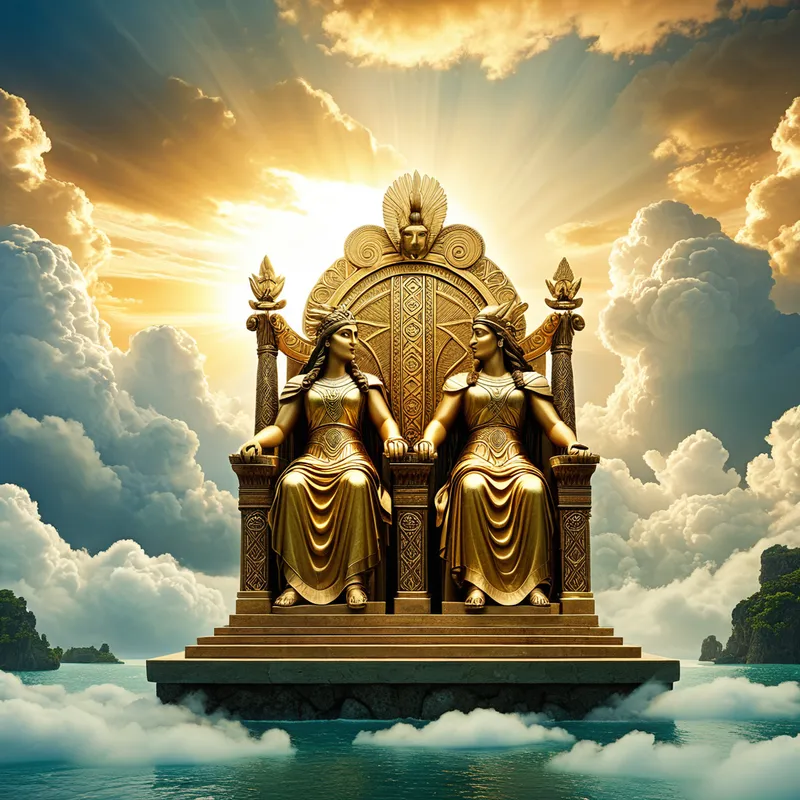
The Honeymoon of Zeus and Hera Myth Meaning & Symbolism
A sacred marriage lasting centuries, where the King and Queen of Olympus retreated to a hidden island, forging a cosmic bond of immense power and tension.
The Tale of The Honeymoon of Zeus and Hera
Listen, and let the veils of time part. Before the world knew the strife of Troy, before heroes walked the earth, the heavens themselves were being forged in a union of unimaginable duration. This is not a tale of fleeting passion, but of the hieros gamos that shook the foundations of creation.
The Thunderer, Zeus, had won his queen through cunning and desire. Yet his victory was hollow without her true sovereignty beside him. He courted Hera not as a conqueror, but as a supplicant, transforming himself into a disheveled, shivering cuckoo to win her pity and her embrace. From that moment of tender deception, a pact was made. But their wedding on Mount Olympus was merely the prologue.
For their union, the earth itself offered a sanctuary. They retreated to the ends of the known world, to a hidden, blessed island—some say Elysium, others a shore kissed by the Oceanus stream. Here, the air was perpetually golden, heavy with the scent of ambrosial flowers that bloomed only for them. The very hours stretched and yawned. A single day contained a season, a month held a year’s worth of twilight.
For three hundred years, the cosmos held its breath. The King and Queen were absent from the councils of the gods. No thunderbolts split the sky; no jealous edicts echoed through the halls of heaven. On their island, time was not a river but a deep, still lake. They walked through groves where trees bore gems instead of fruit, and springs of nectar bubbled from the soil. Their laughter was the wind; their whispered conversations the soft rustle of the leaves. It was a world entire, a universe of two, where the divine polarity of male and female, sky and earth, ruler and consort, was in perfect, dynamic balance. The honeymoon was not a vacation; it was the forging of the cosmic axis itself. And when, after centuries, they finally returned to Olympus, they did not come back as bride and groom, but as the immutable, inseparable dyad at the heart of all power: the Sovereign Pair, forever bound in a marriage that was both the source of celestial order and the wellspring of divine strife.

Cultural Origins & Context
This myth of the protracted honeymoon is primarily preserved in the works of the Hesiod and later mythographers. It functioned as a foundational etiological narrative, explaining the established, if tumultuous, order of the Olympian pantheon. In a culture where marriage was a crucial social and economic institution, the union of Zeus and Hera presented the ultimate divine model—a template of terrifying scale and consequence.
The staggering length—three hundred years—operates on mythic time, signifying a period of cosmic initialization. This was not a story told to illustrate romantic bliss, but to articulate a profound theological and societal concept: legitimate sovereignty requires sacred union. The king (basileus) rules, but his rule is sanctified and given depth through his marriage to the queen (basilissa), who embodies the realm itself, its fertility, its laws, and its social bonds. The honeymoon period, therefore, represents the necessary, hidden process of integrating these two principles into a functioning whole before they can govern the manifest world. It was a myth for rulers, for priests, and for newlyweds, a reminder that true union creates a new, third entity greater than the sum of its parts, but that this creation requires a withdrawal from ordinary time.
Symbolic Architecture
Psychologically, the honeymoon of Zeus and Hera represents the sacred, and often hidden, coniunctio of opposites within the psyche. Zeus symbolizes the conscious principle: active, sky-oriented, structuring, and wielders of the lightning bolt of insight and will. Hera embodies the unconscious principle in its sovereign form: relational, earthy, deeply patterned, and fiercely protective of the bonds and vessels of life (marriage, childbirth).
The island is not a geographic location, but the temenos—the sacred, bounded psychological space—where the ego and the unconscious agree to meet as equals, outside the demands of daily life.
Their three-century retreat signifies an epoch of inner work where these powerful forces are not at war, but in a state of creative, erotic tension. The “honeymoon” is the period of projection, where the other is seen in their ideal, divine form. The conflict that famously defines their later marriage is not a failure of this honeymoon, but its inevitable consequence. The return to Olympus is the integration of this united dyad back into the complexity of the full psyche (the pantheon of other gods and drives), where the perfect balance is constantly tested by reality. The myth tells us that the union of opposites is not a peaceful stasis, but a dynamic, eternal process that generates both world-order and world-storm.
The Dreamer’s Resonance
When this mythic pattern stirs in the modern dreamer, it often manifests not as a literal narrative, but as a profound somatic and atmospheric experience. One might dream of a hidden, impossibly beautiful garden that exists outside of time, or of being in a relationship of immense, silent significance that the waking world knows nothing about. There is a feeling of sacred secrecy, of a process too vital to be exposed.
Somatically, this can correlate with a sense of deep inner alignment—a calm, potent center amidst outer chaos. Psychologically, it signals a major phase of inner marriage: perhaps the conscious mind (Zeus) has finally courted and acknowledged a powerful, complex aspect of the unconscious (Hera)—like one’s capacity for deep commitment, righteous anger in defense of boundaries, or creative fertility. The 300-year timescale in a dream might translate to a feeling that this inner process requires absolute patience and a withdrawal from external expectations. The dream is an affirmation from the psyche: “You are in your sacred temenos. Do not rush. The world outside will wait. This union is your primary creative act.”
Alchemical Translation
The alchemical opus is precisely mirrored in this myth. The first stage, the nigredo or blackening, is Zeus’s chaotic battles and his deceptive courtship—the dissolution of old, solitary forms of power. The retreat to the island is the albedo, the whitening: the purification and joining of the King (Sol) and Queen (Luna) in the sealed vessel of the island. This is the sacred marriage that produces the “philosophical child,” a new level of psychic wholeness.
The honeymoon is the incubation of the lapis, the philosopher’s stone—the creation of a durable, radiant center of personality that can withstand and transmute conflict.
Their return to Olympus is the rubedo, the reddening: the tested, fiery application of this wholeness to the world. The famous strife between Zeus and Hera is not a regression, but the necessary friction that keeps the alchemical wheel turning. For the modern individual, the myth models the process of individuation. It instructs us that to achieve inner sovereignty, we must first create a sacred, protected space to unite our own opposing inner forces (logic and intuition, action and receptivity, ambition and relationship). This union, this long honeymoon, forges the core Self. Only from that fortified, married center can we then engage with the outer world’s complexities, not as fragmented beings, but as integrated rulers of our own inner Olympus, capable of both majestic creation and weathering the storms our unions will inevitably attract.
Associated Symbols
Explore related symbols from the CaleaDream lexicon: