
The Homunculus Myth Meaning & Symbolism
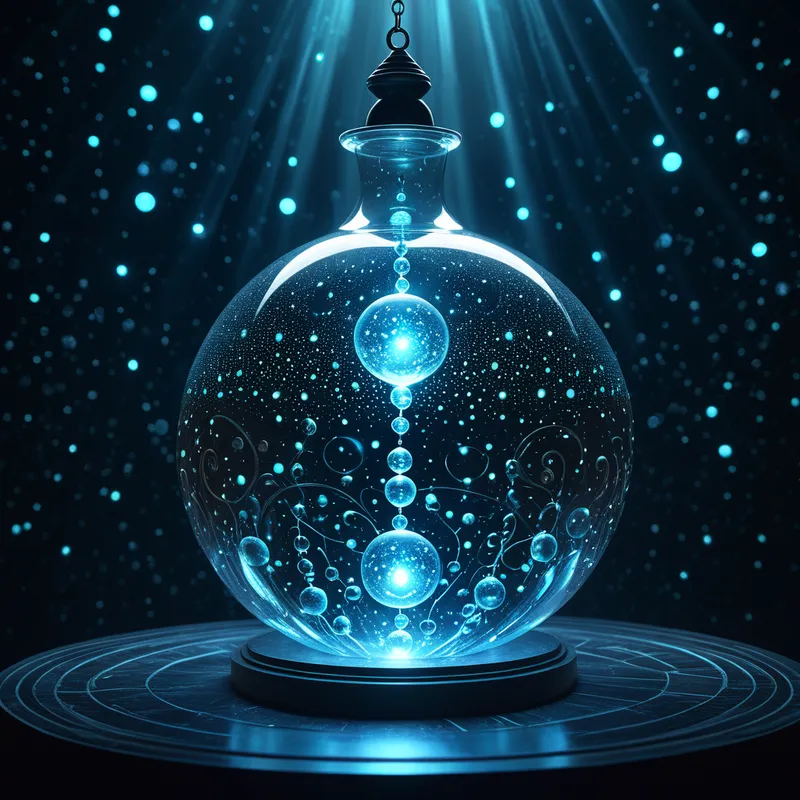
The alchemical quest to create artificial life, a tiny man in a flask, symbolizing the birth of consciousness from the depths of the unconscious.
The Tale of The Homunculus
Listen, and let the smoke of memory coil. In a time when the world was a book written in symbols, and the night sky a map of the soul’s longing, there lived those who sought not gold, but genesis. In a chamber heavy with the scent of mercury and dried herbs, under a vaulted ceiling where shadows danced with the uncertain light of a single candle, the Adept worked. His world was the athanor’s fire, the whisper of parchment, the weight of silence.
His quest was the Magnum Opus, but not for the Philosopher’s Stone alone. A deeper hunger gnawed at him—to witness the spark of life kindled not by nature, but by art. To hold creation in his own hands. He gathered the prima materia—not mere elements, but the essence of things: the red of human blood, the white of purest salt, the secret warmth of horse manure for its generative heat, and the clear, cold spirit of the mountain dew. These he sealed within the Hermetic Vessel, the glass womb of the alembic.
For forty weeks—a mirror of human gestation—the vessel rested in the gentle, constant heat of the athanor. The Adept watched, his vigil a prayer. He saw the contents darken into the Nigredo, a blackness of dissolution. He despaired. Then, a slow lightening, the Albedo, like dawn breaking in glass. Colors swirled—citrine, peacock’s tail—until finally, a stable, radiant gold glowed from within.
And there, in the heart of that golden liquor, it stirred. A form no longer than a thumb, perfectly proportioned, with closed eyes and serene features. The Homunculus. It did not cry, but seemed to sleep, dreaming its glass-bound dreams. The Adept’s triumph was a silence more profound than any shout. He had coaxed life from the lap of the elements. Yet, as he gazed upon his tiny, sleeping child of art, a chill touched his heart. The creation was complete, but it was not alive. It was a perfect semblance, waiting for a breath it could not draw from the fire alone. The myth ends not with a cry, but with a question, hanging in the fragrant, smoky air: What spirit animates the form?

Cultural Origins & Context
The homunculus is not a myth from a single culture, but a persistent dream within the Western alchemical tradition, flourishing from the late medieval period through the Renaissance. It appears most famously in the writings of Paracelsus, who provided a notorious “recipe” in his work De Natura Rerum. This was not folklore for the masses, but esoteric knowledge passed between initiates in coded texts and illuminated manuscripts.
Its societal function was dual. On one level, it was a thought experiment at the bleeding edge of proto-science, probing the boundaries between life and matter, challenging the Church’s monopoly on creation. On a deeper, initiatory level, it served as a powerful allegory for the alchemist’s own spiritual labor. The story was told in whispers in laboratories that were also chapels, a secret narrative for those who understood that the true subject of transformation was never the metal in the flask, but the soul of the person tending the fire.
Symbolic Architecture
The homunculus is the ultimate symbol of the ego, or the conscious personality, fabricated in isolation. It represents a consciousness born not from lived experience, relationship, or suffering, but from intellect, will, and technique alone.
The homunculus is the perfect child of the mind, a marvel of artifice that reveals the poverty of a life untouched by the soul.
The sealed vas hermeticum is the insulated psyche, the laboratory of intense introspection cut off from the world. The forty-week gestation mirrors human birth, but this is a sterile, mental pregnancy. The homunculus’s tiny, perfect, yet dormant form symbolizes a consciousness that is complete in theory but inert in practice—brilliant but unrealized, a potential self that has not yet engaged with the shadow, the body, or the other. It is the persona crafted to perfection, yet devoid of authentic life.
The Dreamer’s Resonance
To dream of a homunculus—a small, human-like figure in a bottle, a doll that seems alive, or a miniature version of oneself—is to encounter the psyche’s commentary on a state of artificial or premature development. Somaticly, one might feel constricted, glass-walled, or curiously numb.
Psychologically, this dream pattern emerges when the dreamer is identified with an intellectual or idealized self-image that has been constructed with great effort but lacks emotional roots and instinctual vitality. It is the dream of the brilliant student who feels like a fraud, the successful professional who feels empty, the artist trapped by their own technique. The homunculus in the dream is often passive, observing, or trapped, reflecting the dreamer’s own sense of being a spectator to their life, rather than a fully embodied participant. The dream signals a critical need to break the glass and risk the messy, unpredictable air of genuine feeling and relationship.

Alchemical Translation
The homunculus myth models the peril and promise of the first half of the individuation journey. The initial creation of a coherent ego-structure (the homunculus) is a necessary and heroic act—we must form a stable sense of “I” from the chaos of the unconscious. This is the Separatio.
However, the myth warns that to stop here is to remain in a state of spiritual stillbirth. The sealed vessel must be opened. The perfect, tiny man must die as an isolated artifact to be reborn as a full human being. This is the terrifying transition from the Albedo to the Rubedo.
The true Magnum Opus begins not with the homunculus’s creation, but with the shattering of its flask. Wholeness demands the death of the perfect idea for the sake of the imperfect, living reality.
For the modern individual, this translates to the courageous act of de-identification. It means allowing one’s carefully constructed identity—the successful one, the smart one, the competent one—to be dissolved by the acids of failure, passion, grief, and love. The goal is not to destroy the homunculus, but to liberate the spirit trapped within it, allowing that nascent consciousness to grow, through relationship and embodied experience, into a true Self. The flask is the womb, but also the tomb. The work of a lifetime is to learn when to break it open.
Associated Symbols
Explore related symbols from the CaleaDream lexicon: