The Home of Enkidu Myth Meaning & Symbolism
A wild man, shaped by gods from clay, lives in perfect unity with beasts until a sacred harlot initiates his heartbreaking journey into human consciousness.
The Tale of The Home of Enkidu
Hear now the tale of the first home, a dwelling not of brick or beam, but of breath and being. Before [the great wall](/myths/the-great-wall “Myth from Chinese culture.”/) of [Gilgamesh](/myths/gilgamesh “Myth from Mesopotamian culture.”/) cast its shadow, there was a silence in the land, a green and humming quiet. This was the home of Enkidu.
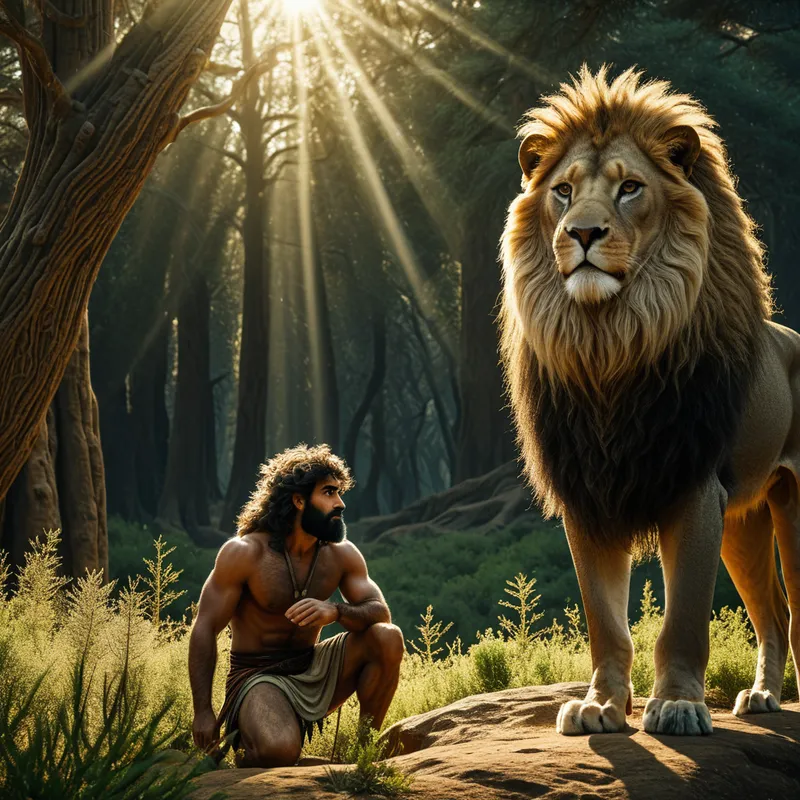
His roof was the vault of [the sky](/myths/the-sky “Myth from Persian culture.”/), spun with [spider](/myths/spider “Myth from Native American culture.”/)-silk stars. His walls were the whispering reeds of the waterhole, and his floor, the warm, damp earth. He was fashioned by Aruru, pinched from the silent clay of [the abyss](/myths/the-abyss “Myth from Kabbalistic culture.”/) and given the spirit of Nergal, the untamed force. He knew no people. His companions were the gazelles, who taught him to run with [the wind](/myths/the-wind “Myth from Various culture.”/). His brothers were the herds of wild asses, with whom he drank at the clear pools. His joy was to crash through the thickets with the lions, his strength matching theirs. He was the guardian of the wild things, tearing apart the trapper’s snares, filling [the hunter](/myths/the-hunter “Myth from African culture.”/)’s pits with earth. His home was a perfect circle of instinct, a paradise of unthinking unity.
But in the ramparted city of Uruk, the clamor of a different kind of home echoed. The king, Gilgamesh, two-thirds god and one-third man, strained against his walls, his energy a torment to his people. The gods heard their lament. Their solution was not a weapon, but a key. They sent Shamhat, whose wisdom was of the flesh and the heart. She waited by the waterhole, a creature of scent and softness utterly alien to the green world.
When Enkidu came to drink with the beasts, he saw her. The animals scattered, sensing a frontier he could not yet name. For six days and seven nights, Shamhat initiated him, not just into the mysteries of woman, but into the terrifying gift of human awareness. When it was done, he returned to his gazelle brothers, but his body was changed, his mind was clouded. They fled from him. His legs, which once flew over the steppe, now were heavy. His understanding, which was once the understanding of the herd, was now a lonely, sharp [thing](/myths/thing “Myth from Norse culture.”/). His home had expelled him. The circle was broken.
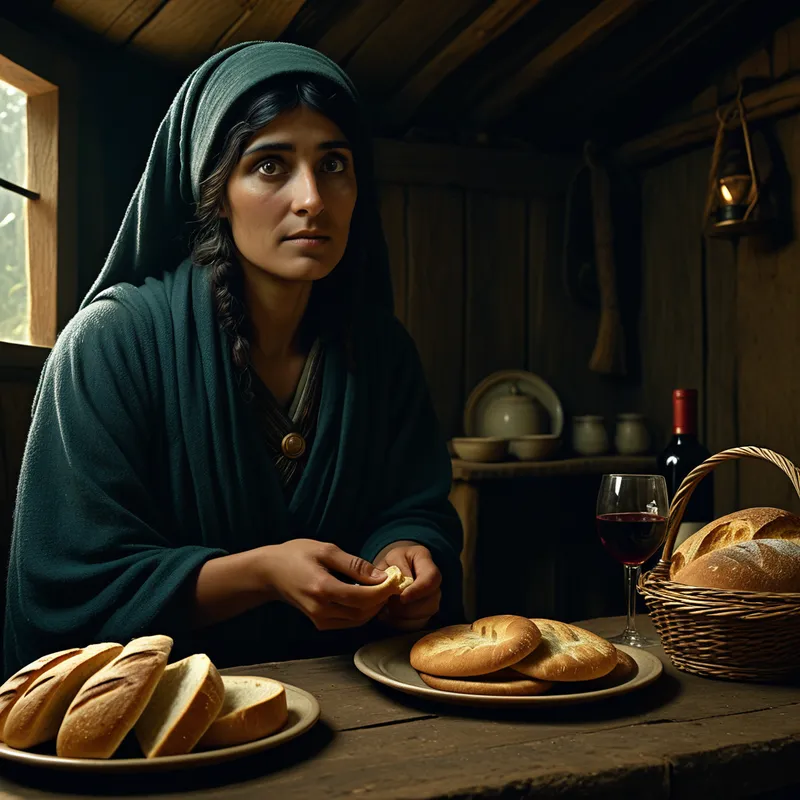
Shamhat spoke then, her voice the first thread connecting him to a new world. She offered him bread, baked from cultivated grain, and strong wine, the fermented fruit of human labor. He ate and drank, and his spirit expanded, grew bright and anxious. She clothed his nakedness with a garment, shearing the wild fur that was his true skin. She led him from the waterhole, from the whispering reeds, toward the noise and smoke on [the horizon](/myths/the-horizon “Myth from Various culture.”/). He learned the ways of shepherds, ate their food, drank their beer. His final act in his old home was to confront the great hunter, not with violence, but with a new, terrible understanding. He had been made for another purpose.
His journey ended at the gates of Uruk, where he blocked the path of the king. They fought, a clash of two primordial forces—the raw, untamed earth and the disciplined, arrogant city. And in the shattering of doors and the heaving of dust, they found not an enemy, but a mirror. In that recognition, the orphan of the steppe found a new, fragile home: the bond of brotherhood. Yet, the echo of the waterhole, the ghost of the gazelle, would forever dwell in the chambers of his heart, a lost paradise mourned in the very moment it was forsaken.
Cultural Origins & Context
This story forms the opening movements of the Epic of Gilgamesh, [the world](/myths/the-world “Myth from Tarot culture.”/)’s oldest surviving great work of literature. Composed in Akkadian on clay tablets, its standardized version is attributed to the scribe Sîn-lēqi-unninni around 1200 BCE. The tale of Enkidu’s creation and taming was not mere entertainment; it was a foundational narrative for a civilization defined by its tense, sacred relationship with the natural world.
Mesopotamia, the land “between the rivers” Tigris and Euphrates, was an engineered landscape. Its cities and granaries were won through relentless labor—clearing marshes, building canals, holding back the chaotic forces of flood and desert. Enkidu’s story dramatizes this fundamental cultural project: the transformation of the wild (edinu, the steppe) into the cultivated and ordered (the city). It was likely recited by skilled narrators in temple and court contexts, serving to validate the civilizing process while simultaneously acknowledging its profound psychic cost. The figure of Shamhat, [the temple](/myths/the-temple “Myth from Jewish culture.”/) harlot, underscores the sacred dimension of this transition; civilization is not just a practical necessity but a divine ordinance, initiated through ritualized sexuality and communion.
Symbolic Architecture
At its core, the myth of Enkidu’s home is an [allegory](/symbols/allegory “Symbol: A narrative device where characters, events, or settings represent abstract ideas or moral qualities, conveying deeper meanings through symbolic storytelling.”/) for the [birth](/symbols/birth “Symbol: Birth symbolizes new beginnings, transformation, and the potential for growth and development.”/) of [consciousness](/symbols/consciousness “Symbol: Consciousness represents the state of awareness and perception, encompassing thoughts, feelings, and experiences.”/). Enkidu begins as pure psychic [nature](/symbols/nature “Symbol: Nature symbolizes growth, connectivity, and the primal forces of existence.”/)—undifferentiated, instinctual, living in a state of unconscious unity with his environment. He is the [human](/symbols/human “Symbol: The symbol of a human represents individuality, complexity of emotions, and social relationships.”/) [psyche](/myths/psyche “Myth from Greek culture.”/) in its primordial, pre-conscious state.
The first home is always the unconscious. To leave it is the original trauma that makes awareness possible.
His home with the animals symbolizes this undifferentiated state. The animals are not external to him; they represent instinctual drives and energies that he is. The tearing up of traps is the psyche’s natural [defense](/symbols/defense “Symbol: A protective mechanism or barrier against perceived threats, representing boundaries, security, and resistance to external or internal challenges.”/) against anything that would capture, define, or isolate a single element from the whole.
Shamhat represents the catalyst of consciousness. She is not merely “civilization,” but the archetypal function of Eros—the connective principle that draws one out of [isolation](/symbols/isolation “Symbol: A state of physical or emotional separation from others, often representing a need for introspection or signaling distress.”/) and into [relationship](/symbols/relationship “Symbol: A representation of connections we have with others in our lives, often reflecting our emotional state.”/), [differentiation](/symbols/differentiation “Symbol: The process of distinguishing or separating parts of the self, emotions, or identity from a whole, often marking a developmental or psychological milestone.”/), and [awareness](/symbols/awareness “Symbol: Conscious perception of self, surroundings, or internal states. Often signifies awakening, insight, or heightened sensitivity.”/). Her six days and seven nights with Enkidu are an alchemical [incubation](/symbols/incubation “Symbol: A period of internal development, rest, or hidden growth before emergence, often associated with healing, creativity, or transformation.”/), dissolving his old form. The [rejection](/symbols/rejection “Symbol: The experience of being refused, excluded, or dismissed by others, often representing fears of inadequacy or social belonging.”/) by the animals is the inevitable and tragic consequence: once consciousness dawns, one can never fully return to the unconscious. The instincts flee from the now-self-aware mind.
The [bread](/symbols/bread “Symbol: Bread symbolizes nourishment, sustenance, and the daily essentials of life, often representing fundamental needs and comfort.”/) and [wine](/symbols/wine “Symbol: Wine often symbolizes celebration, indulgence, and the deepening of personal connections, but it can also represent excess and escape.”/) are potent symbols of [assimilation](/symbols/assimilation “Symbol: The process of integrating new experiences, identities, or knowledge into one’s existing self, often involving adaptation and transformation.”/). He must internalize the products of culture (agriculture, fermentation, technology) to complete his transformation. Putting on the garment is the assumption of a [persona](/symbols/persona “Symbol: The social mask or outward identity one presents to the world, often concealing the true self.”/), a social [skin](/symbols/skin “Symbol: Skin symbolizes the boundary between the self and the world, representing identity, protection, and vulnerability.”/) that covers the raw, natural self. His old home is lost, but a new, more complex [integration](/symbols/integration “Symbol: The process of unifying disparate parts of the self or experience into a cohesive whole, often representing psychological wholeness or resolution of internal conflict.”/) becomes possible—first through [the mirror](/myths/the-mirror “Myth from Various culture.”/) of Gilgamesh (the [Shadow](/symbols/shadow “Symbol: The ‘shadow’ embodies the unconscious, repressed aspects of the self and often represents fears or hidden emotions.”/) made companion), and then through shared heroic endeavor.
The Dreamer’s Resonance
When this myth stirs in the modern dreamer, it often manifests as a profound sense of exile from a natural state. One might dream of being in a wild, beautiful landscape—a forest, a meadow, a shore—feeling a deep, wordless belonging. Then, an intrusion occurs: a path appears, a figure beckons, or the dreamer suddenly realizes they are clothed or carrying a human artifact. The animals in the dream, once friendly, become wary or vanish. The emotional tone is one of poignant loss, a bittersweet awakening.
Somatically, this can feel like a heaviness in the limbs (Enkidu’s slowed run), a tightness around the chest (the first garment), or a dryness in the throat (the thirst for the old, clear [water](/myths/water “Myth from Chinese culture.”/)). Psychologically, this dream pattern signals a rite of passage where an old, instinctual way of being is no longer sustainable. The dreamer is being “tamed” by life—perhaps by a new relationship, a career, a responsibility, or simply the accumulating weight of self-knowledge. It is the psyche working through the necessary mourning for a simpler, more unified state of being that must be relinquished for growth.
Alchemical Translation
The alchemical journey mirrored in Enkidu’s story is the [Nigredo](/myths/nigredo “Myth from Alchemical culture.”/)—the blackening, the initial dissolution of the primal matter. His blissful unity with nature represents the unconscious, unrefined state of the [prima materia](/myths/prima-materia “Myth from Alchemical culture.”/). Shamhat’s act is the application of the primal solvent, often symbolized by the aqua permanens or mercurial water, which dissolves fixed structures.
The civilizing process is an alchemy of the soul. The wild clay of potential is mixed with the tears of loss to fire the vessel of the individual.
The dreamer undergoing this process is not simply becoming “civilized” but is engaging in the first, brutal step of individuation. The loss of the “animal” self—the spontaneous, impulsive, untamed energies—feels like a death. It is. It is the death of unconsciousness. The bread and wine represent the transmutation of those raw instincts into usable psychological energy (libido), which can now fuel conscious action and relationship.
The ultimate goal is not to kill the wild man, but to integrate him. Gilgamesh’s friendship is key here. The civilized ego (Gilgamesh) does not defeat the natural self (Enkidu); it wrestles it to a standstill and then embraces it. In their partnership, Enkidu’s raw strength and connection to the natural world are directed, given purpose. For the modern individual, this translates to acknowledging and making space for one’s own primal, instinctual nature—not letting it rule, nor brutally suppressing it, but bringing it into conscious partnership. The true “home” sought is no longer the unconscious paradise of the waterhole, nor the rigid tyranny of the unfeeling city-wall, but the sacred, interior space where the wild clay and the carved brick can coexist in a tense, creative, and wholly human synthesis.
Associated Symbols
Explore related symbols from the CaleaDream lexicon: