The Holy of Holies Myth Meaning & Symbolism
The innermost sanctuary of the Tabernacle, where the divine presence dwells, accessible only to the High Priest on the Day of Atonement.
The Tale of The Holy of Holies
Listen, and let your breath grow still. For I will tell you of the Heart of the World, the place where the breath of the Maker rests. It was not a place of stone first, but of woven thread and animal skin, a traveling tent called the Mishkan. Within its courtyard, the smell of blood and incense hung thick, a screen for the senses. But beyond that was another veil, and another, each leading deeper into silence.
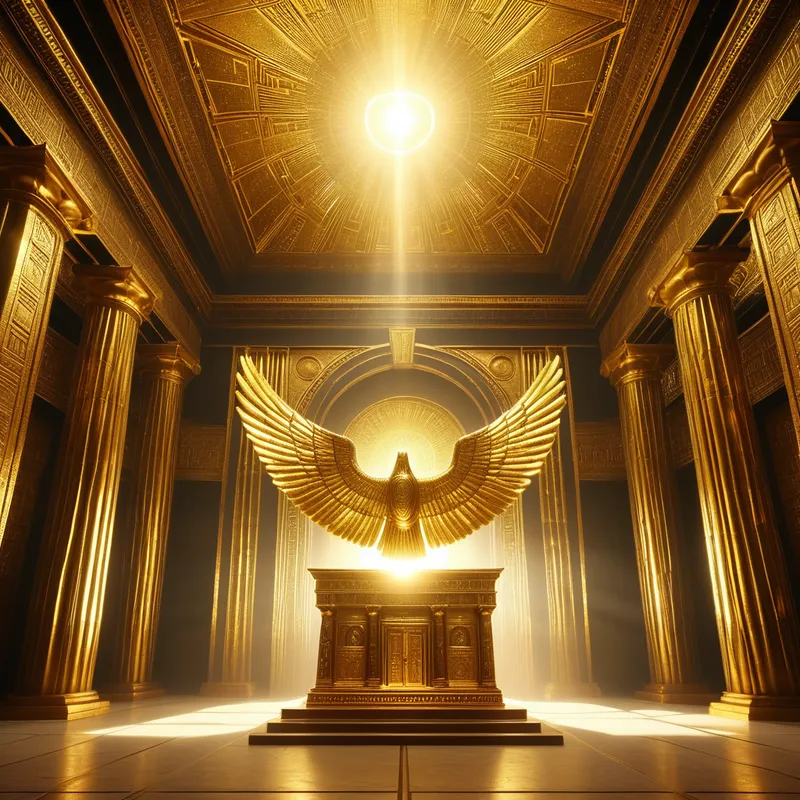
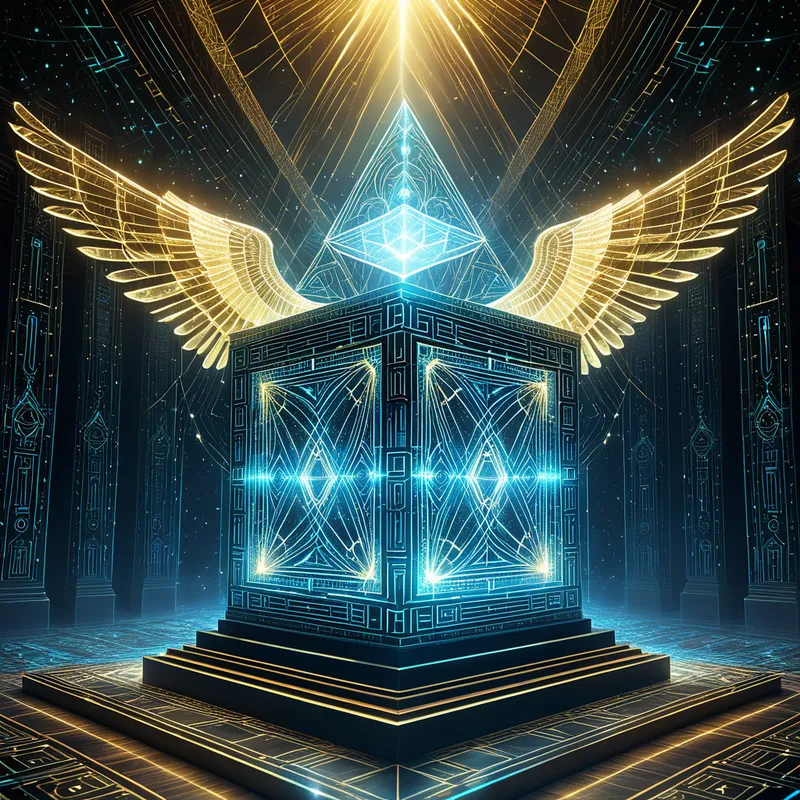
At the center of all things was a perfect cube, a room of terrifying stillness. This was the Dvir, the Holy of Holies. No footstep echoed here, save for one man’s, once a year. The air was not air as we know it, but a thick, honeyed presence, the Shekhinah. And in the gloom, resting upon a slab of pure stone, sat a box of acacia wood sheathed in gold—the Aron HaBrit. Upon its lid, two beings of hammered gold, cherubim, faced one another, their wings arched high, touching tip to tip. And in the space between their wings, in the breath between their silent faces, the Unnameable One sat enthroned.
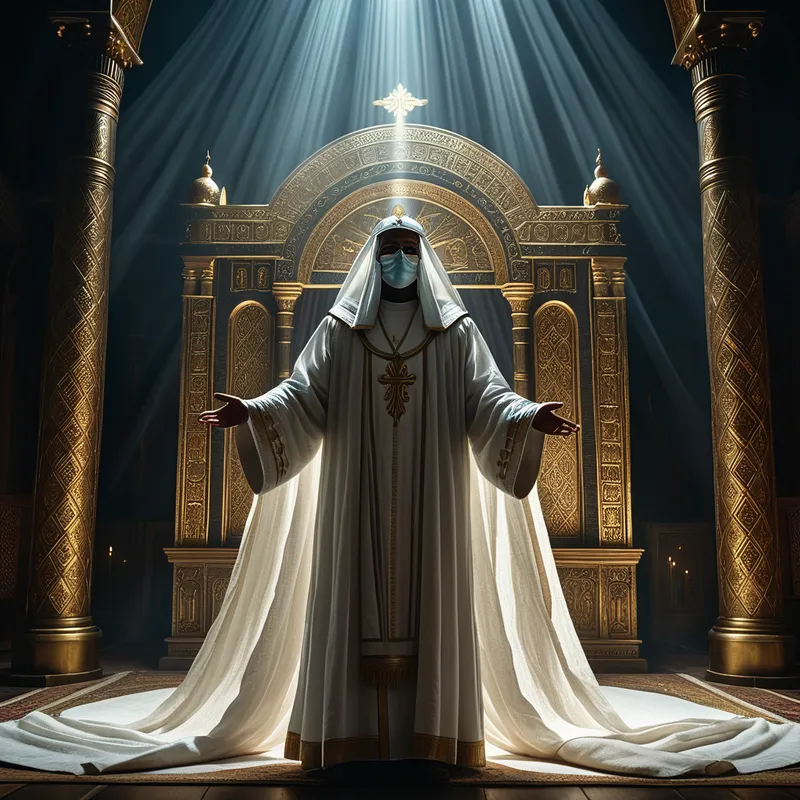
The one who could enter was the Kohen Gadol, the High Priest. On the Day of Yom Kippur, he became a ghost of himself. Stripped of his jeweled robes of glory, he was clothed in simple, spotless white linen—the garments of a mortal, the uniform of the grave. The blood of a bull and a goat was in a basin, the incense smoldered in a censer, and the names of the people were upon his heart.
With trembling hands, he would part the final veil, a tapestry embroidered with blue, purple, and crimson cherubim. He would step across the threshold, and the world outside ceased to be. Smoke from the incense filled the cube, a cloud to shield his eyes from a glory that would blind. He would sprinkle the blood upon the cover of the Ark, upon the space between the cherubim, speaking the sacred, forbidden Name. It was not a prayer of words, but an offering of life for life, a sound swallowed by the absolute quiet. In that moment, he stood between death and life, between the people and their God, a bridge of atonement. Then, he would retreat, backwards, his face toward the Presence, until the veil fell shut once more. And when he emerged, pale and transformed, it was the sign: the people were cleansed. The Heart had been approached, and the world was renewed.
Cultural Origins & Context
This mythic pattern is rooted in the priestly traditions of ancient Israel, meticulously codified in the books of Exodus and Leviticus. It is not a folktale told around a fire, but a precise, ritual technology—a sacred blueprint for managing the terrifying proximity of the divine. The story was preserved and transmitted by the priestly caste, the Kohanim, for whom it was both a supreme privilege and a lethal responsibility.
Its societal function was multifaceted. It established a radical theology of a transcendent God who was nonetheless dwelling (shakhan) among a people. It created a powerful psychological and social center—the literal and symbolic core of the community’s identity. The elaborate restrictions (who, when, how) served to manage sacred terror, transforming chaotic dread into structured awe. The annual ritual of Yom Kippur provided a profound catharsis, a collective “reset” where communal sin and impurity were symbolically transferred and expunged, reinforcing social cohesion and moral order.
Symbolic Architecture
The Holy of Holies is the ultimate symbol of the temenos—the sacred, bounded precinct of the Self. It represents the innermost chamber of the psyche, where the core of one’s being, one’s ultimate values and laws (the Luchot within the Ark), resides in a state of wholeness.
The journey to the center is always a movement from the profane multiplicity of the outer world to the sacred unity of the inner truth.
The layered structure of the Tabernacle—Court, Holy Place, Holy of Holies—maps the path of consciousness inward. The Parochet veil is the final boundary of the ego, the persona behind which the numinous Self resides. The High Priest’s white linen garments symbolize the tabula rasa required for this encounter: all social rank, personal identity, and egoic splendor must be shed to approach the authentic Self. The dangerous glory of the space signifies the peril of confronting the unconscious without preparation; it can annihilate the unprepared ego (as with <abbr title=“Nadab and Abihu, priests who offered “strange fire” and were consumed”>Nadab and Abihu). The ritual of blood is the ancient language of life-force, representing the costly, vital sacrifice of old attitudes and energies required for renewal and reconciliation with one’s own depths.
The Dreamer’s Resonance
When this myth stirs in the modern dreamer, it signals a profound call to inner sanctity and confrontation. To dream of approaching a forbidden, intensely sacred inner room—be it in a childhood home, a corporate office, or a vast library—points to a readiness to encounter what is most central and true in oneself.
The somatic experience is often one of hushed awe, a slowing of the breath, a feeling of both immense dread and irresistible attraction. The dreamer may find themselves preparing meticulously (like the High Priest’s ablutions) or may stand paralyzed before a final door or veil. This is the psyche’s ritual enactment of approaching the Self. The fear is the ego’s legitimate terror of being overwhelmed or fundamentally altered by the contents of the unconscious. The longing is the soul’s pull toward integration. If the dreamer passes the veil, they may encounter a radiant emptiness, a profound silence, a geometric form, or a luminous presence—all symbols of the unified, transcendent center. To emerge from such a dream is often to feel subtly re-calibrated, as if an inner atonement (at-one-ment) has been performed.
Alchemical Translation
The myth models the alchemical opus of individuation—the mysterium coniunctionis—where opposites are held and reconciled at the center. The Holy of Holies is the vas hermeticum, the sealed vessel where transformation occurs.
Individuation is the Yom Kippur of the soul, where one, acting as one’s own High Priest, enters the inner sanctum to make peace between the warring factions of the psyche.
The “outer court” of daily life, with its sacrifices and routines, is the stage of confession and preparation (mortificatio). The shedding of the “colorful garments” represents the stripping away of the persona (nigredo). Carrying the “incense” of focused attention and the “blood” of lived experience, the ego consciously descends into the unconscious. The encounter with the Ark—the container of one’s foundational law and covenant with life—is the confrontation with the Self (illuminatio). Sprinkling the blood is the integration of shadow and life-force, redeeming past errors by bringing them into conscious relation with the core Self. The return, alive and renewed, symbolizes the transformed ego now in service to the Self (rubedo), bringing the wisdom of the center back into the community of one’s outer life. The cycle is annual in myth, but lifelong in practice—a continual rhythm of approach, encounter, and integration that forges an ever-deeper integrity.
Associated Symbols
Explore related symbols from the CaleaDream lexicon: