The Holy Grail Myth Meaning & Symbolism
A sacred vessel of divine grace, lost to a world wounded by its own blindness, sought by flawed knights on a perilous quest for redemption and wholeness.
The Tale of The Holy Grail
Listen. The world is wounded. A king lies dying, his land a barren waste of thorns and sorrow. This is the Fisher King, and his wound will not close. It is a wound of the spirit, a deep, festering grief that bleeds out into the very soil, turning fertile fields to dust and clear springs to mud. His castle, Corbenic, is a phantom, appearing only to those whose hearts are pure enough to bear its sight, yet even there, a shadow hangs.
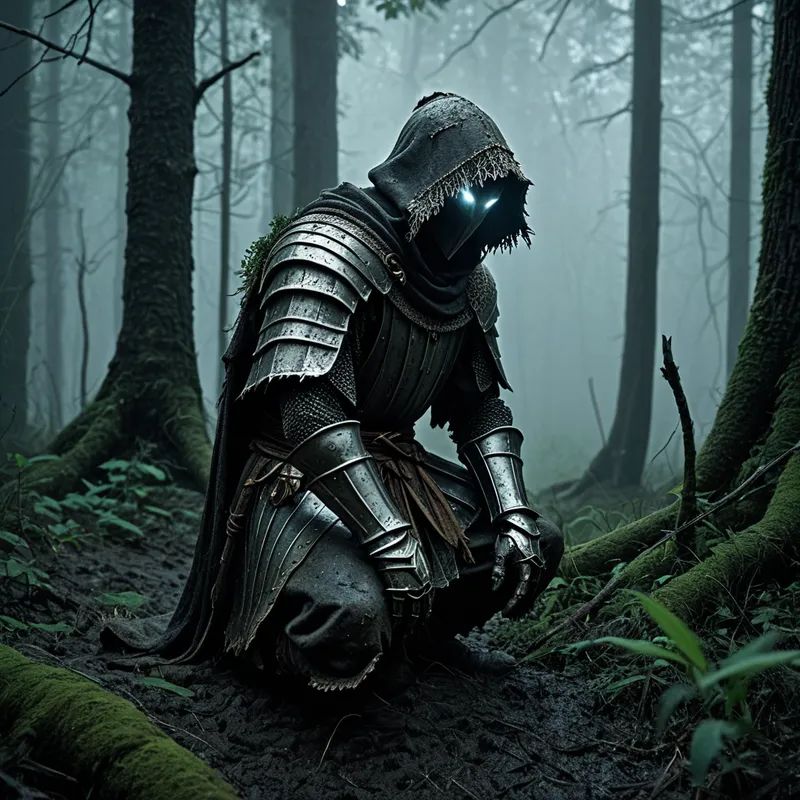
Into this blighted realm ride knights. Not in shining, untarnished glory, but in the dented, travel-worn armor of seekers. The greatest of them is Galahad, born of a sacred lineage, his soul a clear vessel. With him ride Percival, the earnest fool who learns through silence, and Bors, the practical man of simple faith. Their quest is not for gold or glory, but for a thing whispered of in prayers: the Holy Grail.
Their journey is a labyrinth of the soul. They wander through forests where the trees seem to whisper warnings, cross bridges guarded by lions of stone and spirit, and are tested by visions both beautiful and terrifying. They encounter hermits in mossy caves who speak in riddles of the heart, and face temptations in the form of beautiful maidens and illusory feasts. The path is not on any map; it is written in the quality of their courage and the depth of their compassion.
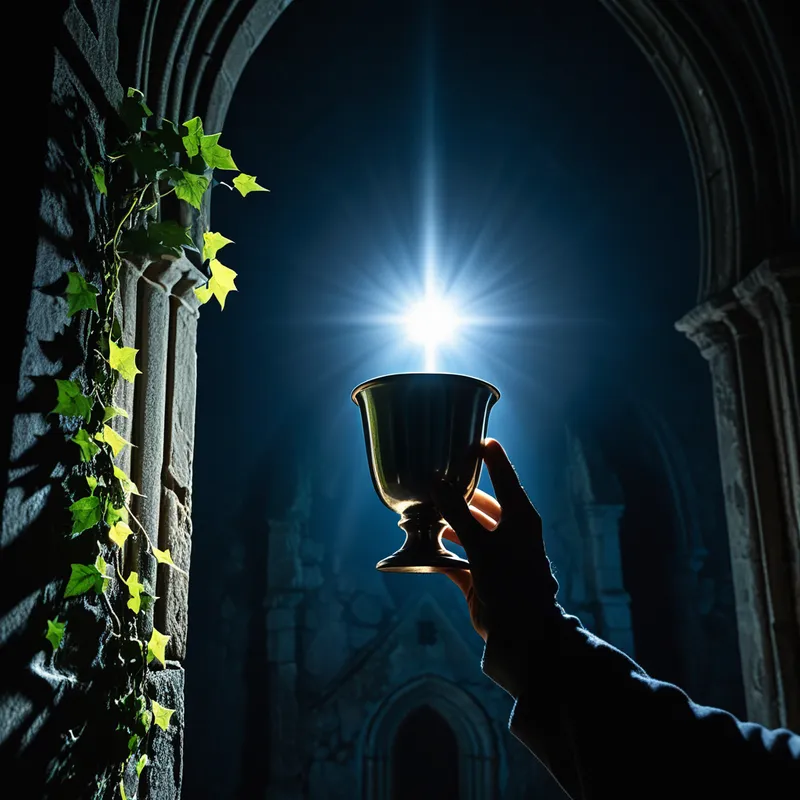
At last, guided by grace more than by sword, the chosen knights find themselves in the great hall of the Fisher King. A solemn, silent procession begins. A maiden carries a spear that drips blood which never ceases. Another bears a silver platter. And then, borne by yet another, comes the Grail itself. It is not adorned with dazzling jewels as in common tales, but is a thing of profound simplicity—a cup, a bowl, perhaps of plain wood or humble silver. Yet it is filled with a light that is not of torch or sun, a radiance that feeds the soul, not the body. It passes, and a feast appears before the wounded king and his guests, a sustenance of pure grace.
But here lies the crux of the tale. The knights are struck dumb by awe. They have found the object of their quest, yet the quest is not complete. One must ask the healing question. It is Percival, who once failed in silence, who now finds his voice. With a heart bursting with empathy for the king’s suffering, he speaks: “Whom does the Grail serve?”
The moment the question hangs in the air, the spell breaks. The king lets out a cry that is both agony and relief. The wound that would not heal closes. Color floods back into his face. And with his healing, a great sigh seems to pass through the very stones of the castle and out across the land. The listeners hear, in their mind’s ear, the sound of water rushing back into dry riverbeds, of green shoots pushing through cracked earth, of life returning. The Wasteland is healed. The Grail, its purpose fulfilled for that moment, vanishes from the sight of men, leaving behind a redeemed king and a lesson etched in mystery.
Cultural Origins & Context
The Grail myth is a palimpsest, a parchment written and rewritten over centuries. Its deepest roots likely lie in pre-Christian Celtic cauldrons of plenty and regeneration, like the Cauldron of Annwn. These were vessels of earthly sovereignty and cyclical rebirth. With the rise of Christianity in Europe, particularly through the lens of monastic scribes and courtly poets like Chrétien de Troyes and later Wolfram von Eschenbach, the symbol was alchemized. The cauldron became the Cup of the Last Supper, the vessel that caught the blood of Christ at the crucifixion, transforming it into the ultimate symbol of divine grace made tangible.
The stories flourished in the 12th and 13th centuries, a time of crusades, spiritual fervor, and the codification of chivalric ideals. The Grail romances were not scripture, but sacred adventure tales for the warrior aristocracy. They were performed in courts, blending martial virtue with a new, introspective piety. The quest for the Grail became the ultimate chivalric adventure, internalizing the crusader’s journey from external conquest to an inner, spiritual conquest of the self. It served as a societal mirror, questioning what true nobility and purity meant in an often brutal and compromised world.
Symbolic Architecture
The Holy Grail is the supreme symbol of the unattainable yet urgently needed goal of the soul. It is not a thing to be possessed, but a state of being to be approached.
The Grail does not represent the answer, but the capacity to receive the question that leads to wholeness.
The Wounded King and his Wasteland are a profound psychological truth: the ruler (the conscious ego) is injured, and his inner kingdom (the psyche) lies fallow. The wound, often in the thigh (the seat of generative power), symbolizes a spiritual impotence, a disconnect from the life-giving depths of the unconscious. The Quest is the ego’s necessary, arduous journey into those depths, guided by the Self (the total, organizing center of the psyche). The knights represent different aspects of the seeking consciousness: Galahad is the transcendent, spiritual function; Percival is the feeling function, learning through relatedness; Bors is the sensation function, grounded in practical reality.
The central, transformative moment is the Healing Question: “Whom does the Grail serve?” This shifts the paradigm from seeking to possess a sacred object (“Where is the Grail?”) to understanding one’s relationship to the sacred (“What is my proper role before the divine?”). It is a question of service, humility, and correct orientation. The healing occurs not when the Grail is found, but when the seeker realizes they are not its master, but its potential vessel.

The Dreamer’s Resonance
When the Grail pattern stirs in the modern unconscious, it often manifests not as a golden cup, but as a profound sense of lack or a calling toward an undefined “something more.” In dreams, one might be searching endlessly through a familiar yet alien city (the modern wasteland) for a lost key, a vital document, or a specific person who holds a secret. The dreamer feels a pressing urgency but is thwarted by confusing signs, blocked paths, or their own forgetfulness.
Somatically, this can feel like a hollow ache in the chest, a chronic fatigue that sleep does not cure—a spiritual anemia. Psychologically, it is the process of the ego confronting its own insufficiency. The dreamer is the Fisher King, and the quest is the psyche’s innate drive toward healing. The appearance of a wise but cryptic figure (the hermit), or a tantalizing glimpse of a radiant but unreachable object, signals that the deep Self is activating the individuation process. The frustration in the dream mirrors the resistance of the conscious personality to ask the vulnerable, transformative question.

Alchemical Translation
The Grail myth is a precise map of psychic alchemy, the opus of individuation. The base metal of the fragmented personality (the Wasteland) must be dissolved in the nigredo of the quest’s trials and despair. The knights’ encounters with shadows and temptations are the necessary confrontation with the personal and collective unconscious.
The alchemical vessel is not the Grail you seek, but the self that is remade in its seeking.
The Grail itself represents the lapis philosophorum, the philosopher’s stone—the achieved state of psychic wholeness or the Self. It is both the goal and the catalytic agent. The pivotal alchemical stage is the coniunctio, the sacred marriage. This is symbolized by the union of the spear (masculine, penetrating consciousness) and the Grail (feminine, receptive vessel), which generates the healing light. For the individual, this is the integration of opposites within the psyche—logic and intuition, spirit and matter, conscious and unconscious.
The final transmutation is modeled in the healing. The king’s reintegration with his land signifies the ego’s restored, vital connection to the Self. The individual is no longer a barren wasteland of disconnected parts but a fertile, flowing kingdom where consciousness is nourished by the deep, renewing waters of the unconscious. The Grail “vanishes” because it is no longer an external object of desire; it has become the internalized, functioning center of a life lived in meaning. The quest ends not in possession, but in becoming a vessel through which grace can flow into the world.
Associated Symbols
Explore related symbols from the CaleaDream lexicon:
- Cup
- Safe
- Dishes
- Dish
- Holy
- Crystal
- Expensive
- Hidden
- Bloody
- Spoon
- Loved
- Tea Set
- Time Travel Device
- Designer Handbag
- Sweetheart Neckline
- Cooking Meals
- Filling Cup
- Relic of the Ancients
- Mystical Crystal
- Burgundy Wine
- Garnet Chalice
- Bloodstone Talisman
- Beryl Crystal
- Aquamarine Heart
- Chalcedony Orb
- Bloodstone Sphere
- Gardenia Secret
- Treasure Chest
- Vase of Promises
- Talking Crystal
- Potion Bottle
- Field Goal Post
- Capture the Flag
- Mystery Box
- Treasury Chest
- Forgotten Chapter
- Tattered Book
- Ceramic Platter
- Secret Compartment
- Translucent Bar Cart
- Secret Drawer
- Polished Silver Spoon
- Sleek Wine Bottle Opener
- Tupperware
- Wine Glass
- Porcelain Plate
- Gravy Boat
- Corkscrew
- Glass Tumbler
- Treasure Box
- Lute of Light
- Ornate Reliquary
- Buried Treasure
- Crowned Heart
- Unearthed Treasure
- Chalice of Knowledge
- Herbal Elixirs
- Roasting Spit
- Cooking Pot of Clay
- Ceremonial Vessel
- Earthen Vessel
- Herbal Potion
- Acoustic Lens
- Fermat’s Last
- Riemann Hypothesis
- Cipher
- Achievement
- Enigma
- Philosopherstone
- Crystallizing