The Hollow Hills Myth Meaning & Symbolism
A tale of the Sidhe, the fairy folk dwelling within ancient mounds, guarding the threshold between the mortal world and the timeless, perilous Otherworld.
The Tale of The Hollow Hills
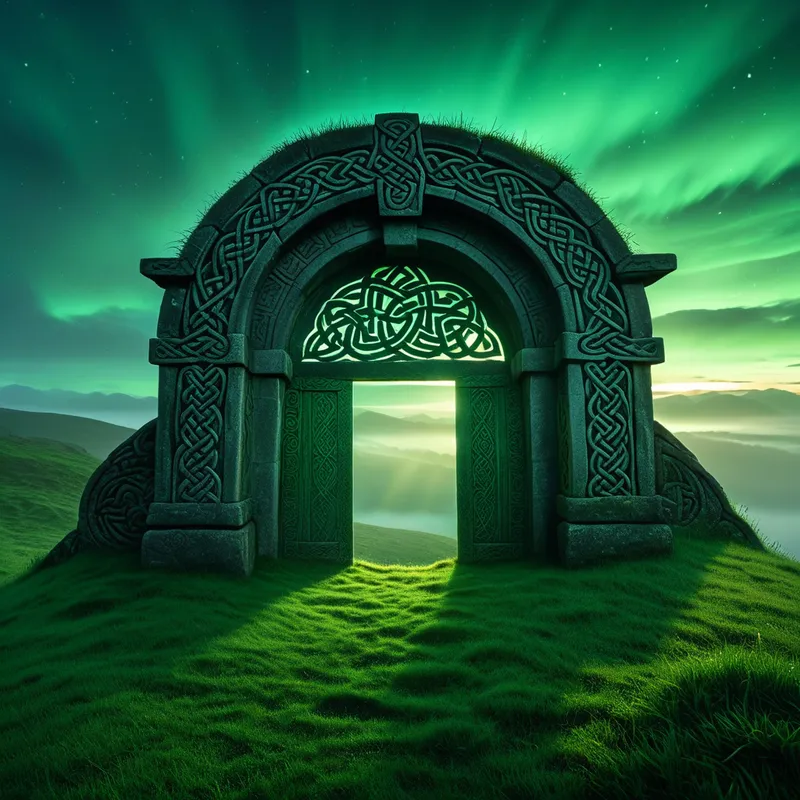
Listen. The land you walk upon is not solid. It breathes. Beneath the green cloak of grass, under the roots of the ancient oak, behind [the veil](/myths/the-veil “Myth from Various culture.”/) of the morning mist, the hills are hollow.
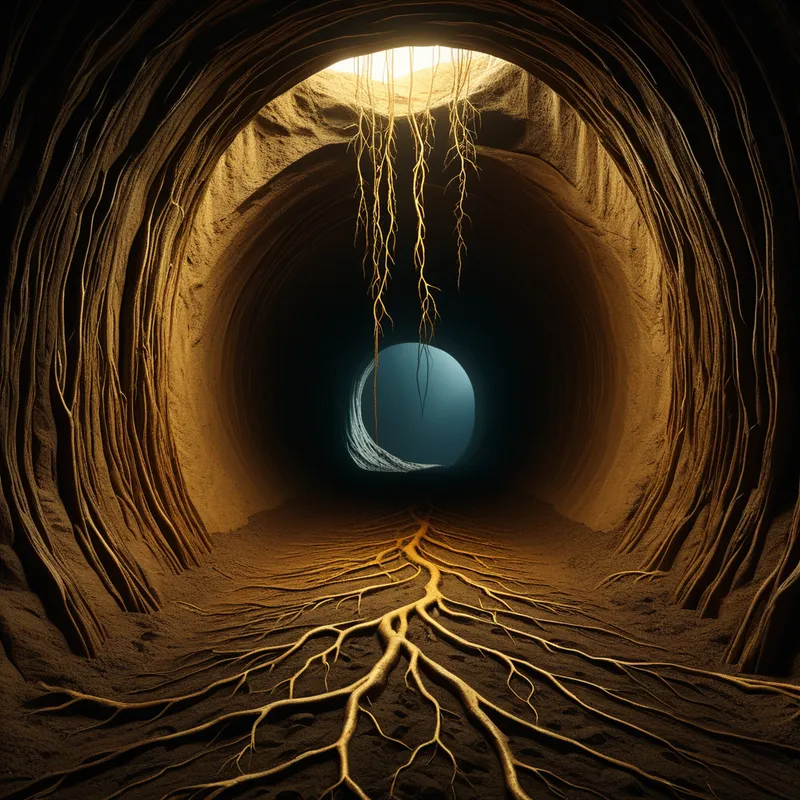
They are the dwelling places of the [Sidhe](/myths/sidhe “Myth from Celtic culture.”/), the Shining Ones. They are not small, winged creatures of children’s tales. They are tall, terrible, and beautiful, a race older than memory, who retreated into the secret places when [the world](/myths/the-world “Myth from Tarot culture.”/) of iron and prayer arrived. Their halls are not of stone and mortar, but of living earth and root, lit by a light that has no source—a perpetual, golden twilight. Time there flows like honey, slow and sweet. A night spent in their company can be a hundred years in the world above.
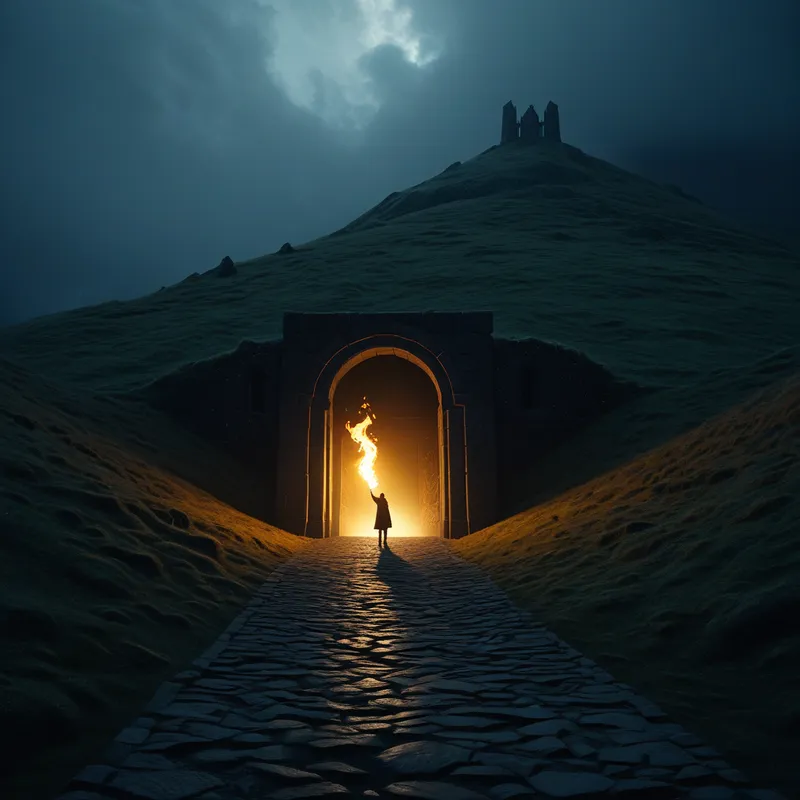
The story is never of a single hero, but of many who stumbled upon [the threshold](/myths/the-threshold “Myth from Folklore culture.”/). A hunter, following a white stag of impossible grace, finds it vanishing into a hillside where no opening was before. A musician, playing a lament by a lonely cairn at dusk, hears a harmony rise from [the earth](/myths/the-earth “Myth from Hindu culture.”/) itself, an invitation. A lost traveler, caught in a sudden, silvery fog, sees lights flicker in a mound and hears the faint, intoxicating sound of laughter and harp strings.
To cross that threshold is to enter a contract with eternity. The air is thick with the scent of apple blossom and damp soil. The Fairy King or Queen holds court, their beauty so severe it aches to behold. They offer hospitality: food of surpassing flavor, drink that ignites the soul, music that rewrites memory. But here lies the peril. To partake of their food or drink is to be bound to their realm. The taste of that otherworldly feast seals the fate. The mortal who eats it can never truly return. If they do stumble back into the sunlight, they find faces they loved are dust, their homes are ruins, and the world has become a strange, hard place. They are a ghost in their own life, forever tasting the [pomegranate seeds](/myths/pomegranate-seeds “Myth from Greek culture.”/) of the hollow hill on their tongue, forever hearing the echo of that unearthly music in [the wind](/myths/the-wind “Myth from Various culture.”/).
Cultural Origins & Context
The myth of the [Hollow Hills](/myths/hollow-hills “Myth from Celtic culture.”/) is not a single, codified story but a pervasive folk belief woven into the landscape of Ireland, Scotland, Wales, and Brittany. These narratives were the province of the seanchaí, the traditional storyteller, passed down orally by hearthfires for centuries before being collected by folklorists like W.B. Yeats and Lady Gregory. The tales served multiple functions: they explained ancient, pre-Celtic Neolithic burial mounds and [stone circles](/myths/stone-circles “Myth from Celtic culture.”/) that dotted the countryside, attributing them to the “good people” or “the gentry” to avoid offense. They enforced social codes, warning against wandering alone at twilight (the “in-between” times of [Samhain](/myths/samhain “Myth from Celtic culture.”/) and Beltane) and stressing the sacred importance of hospitality, even to unseen guests.
Most profoundly, they mapped a psychological and spiritual geography. The world was not binary—life and death, here and there—but tripartite: the mortal realm, [the sea](/myths/the-sea “Myth from Greek culture.”/), and the [Otherworld](/myths/otherworld “Myth from Celtic culture.”/). The Hollow Hills were the most accessible doors to this [Otherworld](/myths/otherworld “Myth from Celtic culture.”/), a parallel dimension of eternal youth, abundance, and artistic perfection, but one with its own ruthless laws. It was a culture deeply animistic, believing the land itself was conscious, and [the Sidhe](/myths/the-sidhe “Myth from Celtic culture.”/) were its most potent expression—the genius loci given form.
Symbolic Architecture
The Hollow [Hill](/symbols/hill “Symbol: A hill represents challenges, progress, or obstacles in life’s journey, often symbolizing effort and perspective.”/) is the ultimate [symbol](/symbols/symbol “Symbol: A symbol can represent an idea, concept, or belief, serving as a powerful tool for communication and understanding.”/) of the liminal [space](/symbols/space “Symbol: Dreaming of ‘Space’ often symbolizes the vastness of potential, personal freedom, or feelings of isolation and exploration in one’s life.”/), the threshold. It represents the [barrier](/symbols/barrier “Symbol: A barrier symbolizes obstacles, limitations, and boundaries that prevent progression in various aspects of life.”/) between the conscious ego and the vast, autonomous [psyche](/myths/psyche “Myth from Greek culture.”/)—the unconscious.
The hill is the skull of the world, and within it dreams the sleeping god of our own depths.
The Sidhe themselves symbolize the archetypal contents of the unconscious: our latent talents, our ancestral memories, our creative daimons, but also our capricious moods, our repressed desires, and our psychic complexes. They are beautiful because the [soul](/symbols/soul “Symbol: The soul represents the essence of a person, encompassing their spirit, identity, and connection to the universe.”/)‘s potential is beautiful; they are dangerous because to be engulfed by the unconscious is to lose one’s [identity](/symbols/identity “Symbol: Identity represents the sense of self, encompassing personal beliefs, cultural background, and social roles.”/). Their [timeless realm](/symbols/timeless-realm “Symbol: This symbol signifies a state of existence beyond the constraints of time, where moments can stretch infinitely, marked by either clarity or confusion.”/) signifies the nunc stans—the eternal now—of the psyche, where all possibilities exist simultaneously, unfettered by chronological time.
The forbidden feast is the central symbol of irreversible transformation. It is the point of no return in any profound psychological process.
To eat the food of the gods is to assimilate their substance; one can no longer pretend to be merely mortal.
It represents the total commitment to a new level of [awareness](/symbols/awareness “Symbol: Conscious perception of self, surroundings, or internal states. Often signifies awakening, insight, or heightened sensitivity.”/), a new way of being. The tragedy of returning “too late” speaks to the alienation that follows a deep inner awakening; the old world, the old self, can never fit again.
The Dreamer’s Resonance
When the motif of the Hollow Hill arises in modern dreams, it signals a powerful encounter with the threshold of the deep Self. The dreamer may find a hidden door in their basement, a cave in a familiar park, or an elevator descending into earthy depths.
This is not a call to casual exploration, but a summons to a sacred negotiation. The somatic feeling is often one of both awe and dread—a tightening in the chest, a literal “gut feeling.” Psychologically, the dreamer is being confronted by an autonomous complex or a nascent archetype seeking recognition. The beautiful yet severe figures of the Sidhe in the dream may represent a brilliant but neglected talent (a creative Sidhe) or a powerful, unsettling emotion or drive (a warrior Sidhe). The dream is an invitation to acknowledge this inner “other,” to hear its music, but also a warning not to lose oneself in it entirely—to remember [the way](/myths/the-way “Myth from Taoist culture.”/) back to the sunlit world of conscious life.
Alchemical Translation
The journey to and from the Hollow Hill is a perfect map for the alchemical process of individuation. [The first stage](/myths/the-first-stage “Myth from Alchemical culture.”/), [nigredo](/myths/nigredo “Myth from Alchemical culture.”/) (the blackening), is the call—the feeling of being lost, following [the white stag](/myths/the-white-stag “Myth from Celtic culture.”/) of fascination into the unknown. Crossing the threshold is the [separatio](/myths/separatio “Myth from Alchemical culture.”/), leaving the known world behind.
The mortal must die to their old life so the enchanted one can be born.
The time spent in the hill is the albedo (the whitening) and citrinitas (the yellowing)—a period of illumination, purification, and instruction by the inner figures (the Sidhe). Here, one “eats the food”—assimilates the insight, accepts the gift, or integrates the complex. This is the transformative feast.
The return, if possible, is the final and most difficult stage: [rubedo](/myths/rubedo “Myth from Alchemical culture.”/) (the reddening). It is not a return to the old state, but the embodiment of the gold—the aurum philosophicum—in the world of reality. The dreamer who has “returned too late” symbolizes the failed integration, where the insight remains a haunting, dissociated secret. The successful alchemist is the one who bears the echo of [the Otherworld](/myths/the-otherworld “Myth from Celtic culture.”/)‘s music but plants their feet firmly on the changed earth, bringing the treasure of the hollow hill—the creative spark, the hard-won wisdom, the healed fragment of soul—back into the community of daylight. They have learned to live in both worlds, mortal yet touched by the eternal, carrying the hollow within them as a [vessel of transformation](/myths/vessel-of-transformation “Myth from Alchemical culture.”/).
Associated Symbols
Explore related symbols from the CaleaDream lexicon: