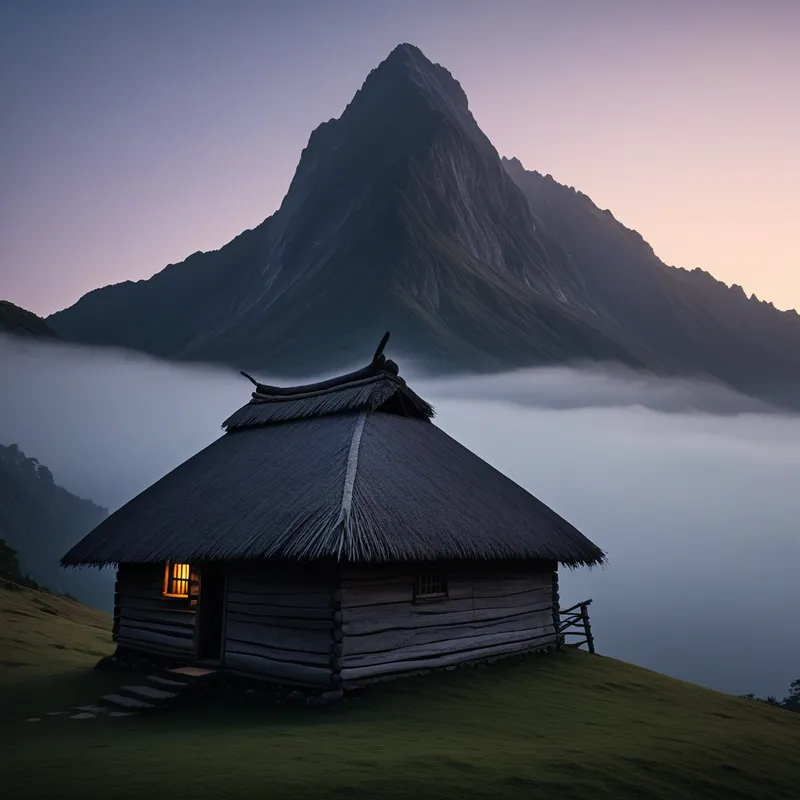
The Hermit's Hut in Taoist and Myth Meaning & Symbolism
A wanderer seeks the legendary Hermit's Hut, a place of ultimate simplicity that exists only when the seeker's own mind becomes utterly still and clear.
The Tale of The Hermit’s Hut
Listen. Beyond the last known path, where the maps dissolve into blank parchment and the chatter of [the world](/myths/the-world “Myth from Tarot culture.”/) fades to a memory of rain, there lies the realm of the quest. It is not a place for the faint of heart or the burdened of spirit. Here, the air is thin, sharp with the scent of pine and ancient stone. The stars hang low, cold and indifferent.
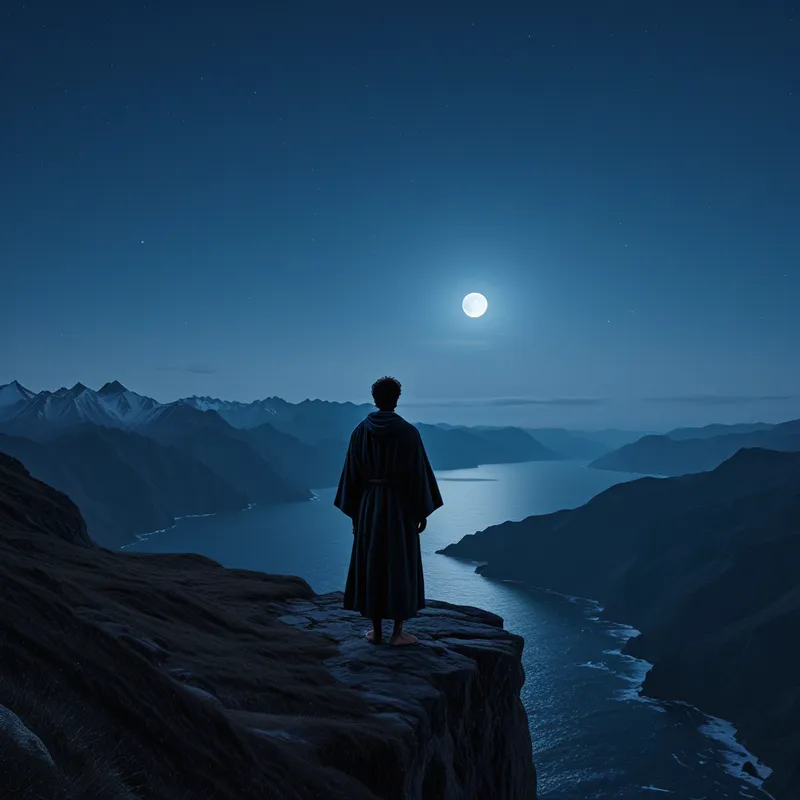
Into this silence walks the Seeker. They have left behind titles, possessions, the tangled threads of obligation. Their feet are bare and calloused on the rock, their robe threadbare against the mountain’s breath. They carry only a question, a hollow ache in the chest that the world’s noise could never fill. They seek [the Hermit’s Hut](/myths/the-hermits-hut “Myth from Taoist culture.”/).
Whispers in valley taverns spoke of it: a shelter of ultimate simplicity, perched where heaven meets earth. Some said it was built by a sage who had untied the knot of self. Others claimed it was not built at all, but had grown from the mountain’s dream. It was said that within its walls, time unspooled, the mind became still as a forest pool, and one could hear the whisper of the Tao itself.
The journey is the stripping away. Each steep pass demands a sacrifice—a cherished belief, a hidden fear, a story of who they thought they were. Hunger becomes a companion; solitude, a mirror. They encounter phantom guides: a laughing woodcutter who points [the way](/myths/the-way “Myth from Taoist culture.”/) with an empty hand, a stream that speaks in riddles of flow and resistance. Despair, a cold wind, whispers that the Hut is a fairy tale for fools.
Then, one evening, when the Seeker’s strength is ash and their quest feels like the greatest folly, they crest a ridge. Before them, the world falls away into abyssal beauty. And there, on an outcrop no larger than a meditation cushion, it stands.
It is less than they imagined. A frame of grey timber, a roof of worn thatch, a door of unplaned wood. No grandeur, no mystical light—just profound, unshakable ordinariness. As they step forward, trembling, they realize the door has no latch. It opens not to a push, but to a sigh—the final release of the seeking mind.
Inside, there is no hermit. Only a bare floor, a single window framing the infinite sky, and a stillness so complete it has a presence, a weight. The Seeker sits. In the quiet, the boundary between hut and mountain, between self and sky, begins to dissolve. The ache is gone, not answered, but understood as the very space in which all things arise. They have not found the Hut. The Hut, in its humble, perfect emptiness, has found them.
Cultural Origins & Context
The myth of [the Hermit](/myths/the-hermit “Myth from Tarot culture.”/)‘s Hut is a pan-cultural archetype, a story whispered by mountains and yearned for by the human soul in every age. Its most refined philosophical articulation is found within Taoism, particularly in the teachings of [Zhuangzi](/myths/zhuangzi “Myth from Chinese culture.”/) and the poetry of wilderness recluses. However, its roots are universal. It appears in the forest huts of Hindu sadhus, [the desert](/myths/the-desert “Myth from Biblical culture.”/) caves of Christian anchorites, the isolated mountain retreats of Buddhist monks, and the visionary cabins of Romantic poets.
This was never a myth for the masses, but for the individual at [the crossroads](/myths/the-crossroads “Myth from Celtic culture.”/) of society and spirit. It was passed down not in grand epics, but in oral anecdotes, poems, and painted scrolls—often created by those who had tasted such solitude themselves. Its societal function was paradoxical: it served as a critical counter-narrative to the values of accumulation, ambition, and social complexity. It validated the path of radical inward turning, suggesting that the ultimate wisdom and stability for a culture might be found not in its bustling centers, but in its most silent, empty margins.
Symbolic Architecture
The Hut is not primarily a physical dwelling, but a psychic [structure](/symbols/structure “Symbol: Structure in dreams often symbolizes stability, organization, and the framework of one’s life, reflecting how one perceives their environment and personal life.”/). It represents the achieved state of a [consciousness](/symbols/consciousness “Symbol: Consciousness represents the state of awareness and perception, encompassing thoughts, feelings, and experiences.”/) that has returned to its original, unadorned [nature](/symbols/nature “Symbol: Nature symbolizes growth, connectivity, and the primal forces of existence.”/). The arduous [journey](/symbols/journey “Symbol: A journey in dreams typically signifies adventure, growth, or a significant life transition.”/) symbolizes the necessary via negativa—the [path](/symbols/path “Symbol: The ‘path’ symbolizes a journey, choices, and the direction one’s life is taking, often representing individual growth and exploration.”/) of letting go, unlearning, and simplification required before one can inhabit such a state.
The Hut is the soul’s own architecture, built not with hands but with relinquishment.
The [mountain](/symbols/mountain “Symbol: Mountains often symbolize challenges, aspirations, and the journey toward self-discovery and enlightenment.”/) represents the arduous [ascent](/symbols/ascent “Symbol: Symbolizes upward movement, progress, spiritual elevation, or striving toward higher goals, often representing personal growth or transcendence.”/) of consciousness, moving from the collective plains of [convention](/symbols/convention “Symbol: A convention often signifies collective understanding, agreements, or shared knowledge, embodying the pursuit of goals and unity among individuals.”/) to the rare, thin air of individual [insight](/symbols/insight “Symbol: A sudden, deep understanding of a complex situation or truth, often arriving unexpectedly and illuminating hidden connections.”/). The absent hermit is the most potent [symbol](/symbols/symbol “Symbol: A symbol can represent an idea, concept, or belief, serving as a powerful tool for communication and understanding.”/) of all: it signifies that the ultimate [authority](/symbols/authority “Symbol: A symbol representing power structures, rules, and control, often reflecting one’s relationship with societal or personal governance.”/)—the sage, the [guru](/symbols/guru “Symbol: A Guru represents a teacher or guide, often embodying wisdom, knowledge, and spiritual insight.”/), the God within—is not an external figure to be found, but an inner [presence](/symbols/presence “Symbol: Presence in dreams often signifies awareness or acknowledgment of something significant in one’s life.”/) revealed only in the [emptiness](/symbols/emptiness “Symbol: Emptiness signifies a profound sense of void or lack in one’s life, often related to existential fears, loss, or spiritual quest.”/) of seeking. The Hut’s lack of a latch means it cannot be taken by force of will; it opens only to surrender. Its single [room](/symbols/room “Symbol: A room in a dream often symbolizes the self, representing personal space, mental state, or aspects of one’s identity.”/) is the unified, non-dual mind, where [observer](/symbols/observer “Symbol: An observer represents contemplation, self-awareness, and the act of witnessing one’s experiences.”/) and observed are one.
The Dreamer’s Resonance
To dream of seeking the Hermit’s Hut is to experience a profound somatic call to simplification. The dreamer is often in a life phase of overwhelming complexity—cluttered schedules, tangled relationships, or a noisy internal landscape of anxiety and ambition. The dream mountain may feel insurmountable, reflecting a deep exhaustion with [the ego](/myths/the-ego “Myth from Jungian culture.”/)‘s projects.
The somatic process is one of purging. The dream body feels the weight of symbolic baggage it must discard. Finding the Hut, or even catching a glimpse of it, signals a readiness to stop the relentless outward search and turn inward. If the dreamer enters the Hut and finds it occupied by a threatening figure or cluttered with worldly junk, it reveals a fear of what true emptiness might contain—the unintegrated shadows that only appear when the noise stops. The dream is an invitation to court that silence.

Alchemical Translation
The myth models the alchemical stage of [solutio](/myths/solutio “Myth from Alchemical culture.”/) and coagulatio—dissolution and re-coagulation. The seeker’s old identity, built on social roles and acquired knowledge, is dissolved by the journey’s hardships (the solutio). The climax at the Hut is not an addition, but a crystallization of what remains when all else is washed away—the coagulatio into a simpler, denser, more authentic form of being.
For the modern individual, this translates to the courageous work of individuation through subtraction. It is the process of asking: What can I strip away? Which obligations are truly mine, and which are inherited ghosts? What remains of “me” when my job title, my routines, and my stories are silent?
The alchemy occurs in the realization that the sought-after sanctuary was never a location, but the quality of attention one brings to any location.
The [triumph](/myths/triumph “Myth from Roman culture.”/) is not becoming a hermit on a mountain, but achieving the hermit’s hut of the mind—an inner sanctuary of clarity and impartial observation that one can inhabit amidst the marketplace. It is the creation of a psychic space so simple and honest that it allows the true self, in alignment with the Tao or the deep unconscious, to finally speak and be heard. The myth teaches that we must undertake the perilous journey to the edge of our known world not to find something new, but to remember something ancient and essential that was there all along, waiting in the quiet.
Associated Symbols
Explore related symbols from the CaleaDream lexicon: