The Hereford Mappa Mundi Myth Meaning & Symbolism
A medieval map of the world is not a chart of lands, but a sacred story of the soul's pilgrimage through a cosmos teeming with monsters and marvels.
The Tale of The Hereford Mappa Mundi
Listen. [The world](/myths/the-world “Myth from Tarot culture.”/) is not as you walk it. It is a story, told on stretched skin.
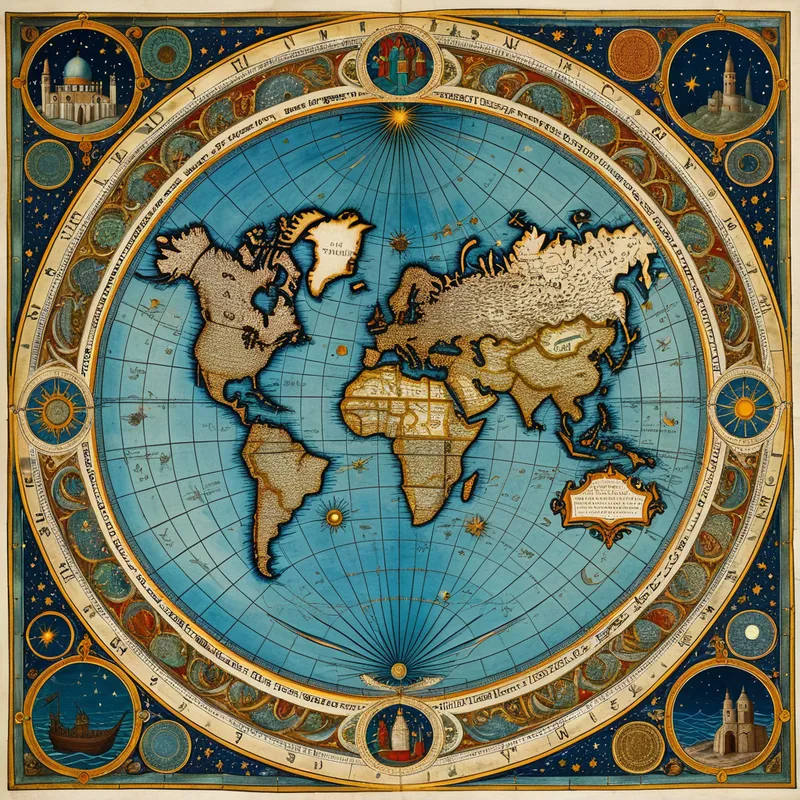
In the beginning, there is the circle. A perfect, bounded O, the rim of all that is and all that can be known. Within it, chaos churns—a great, green sea, the Tehom, salted with fear and wonder. And from this sea, the lands rise like the backs of sleeping leviathans.
See here, at the very top, in the east where the sun is born: the [Garden of Eden](/myths/garden-of-eden “Myth from Biblical culture.”/), walled and lush, guarded by a flaming sword. A river of life flows from it, parting into four heads that become the great arteries of the world. This is the memory of origin, the wound of exile.
Now let your eye travel west, following the sun’s path. Here are the three known continents, shaped like great petals: Asia cradling the dawn, Europa with her castles and kings, Africa burning under a fierce sun. Their coastlines are precise where knowledge is firm, but they fray into speculation—into terra incognita where the parchment whispers.
And in these blank spaces, the monsters bloom. The Sciapod sleeps under his own foot. The Cynocephali bark at the edges of reason. The [Griffin](/myths/griffin “Myth from Persian culture.”/) guards gold no miner can reach. They are not mistakes; they are the inhabitants of the unexplored self, the fauna of fear and fascination.
But at the very center, where all lines converge, where the rivers of story meet, there is a city. [Jerusalem](/myths/jerusalem “Myth from Biblical culture.”/). It is rendered not as a place of stone, but as a perfect, concentric circle—a navel. Its walls are gold. At its heart lies not a palace, but an empty tomb, a circle within a circle. This is [the axis mundi](/myths/the-axis-mundi “Myth from Chinese culture.”/), the still point around which the entire roaring, monstrous, beautiful world turns.
The conflict is the journey itself. A pilgrim—you, perhaps—stands at the edge, in your own familiar shire, a tiny dot among thousands. The path to the center is not straight. It winds through regions of beasts, across rivers that are also the four humours, past mountains that are the bones of giants. The rising action is the act of looking, of tracing the route with a finger that trembles. To move toward the center is to pass by every marvel and terror the mind has ever conceived.
The resolution is not arrival, for no one truly reaches [the empty tomb](/myths/the-empty-tomb “Myth from Christian culture.”/) on parchment. The resolution is orientation. To see your own tiny, named home on the same skin as Eden and the Blemmyae, to understand that you exist in a web of meaning that has a center. The map does not say “you are here.” It whispers, “you are in relation to the sacred.” The story ends with the viewer found, located, no longer adrift in a meaningless sea, but placed within a cosmos that, for all its terrors, is ultimately ordered and full of purpose.
Cultural Origins & Context
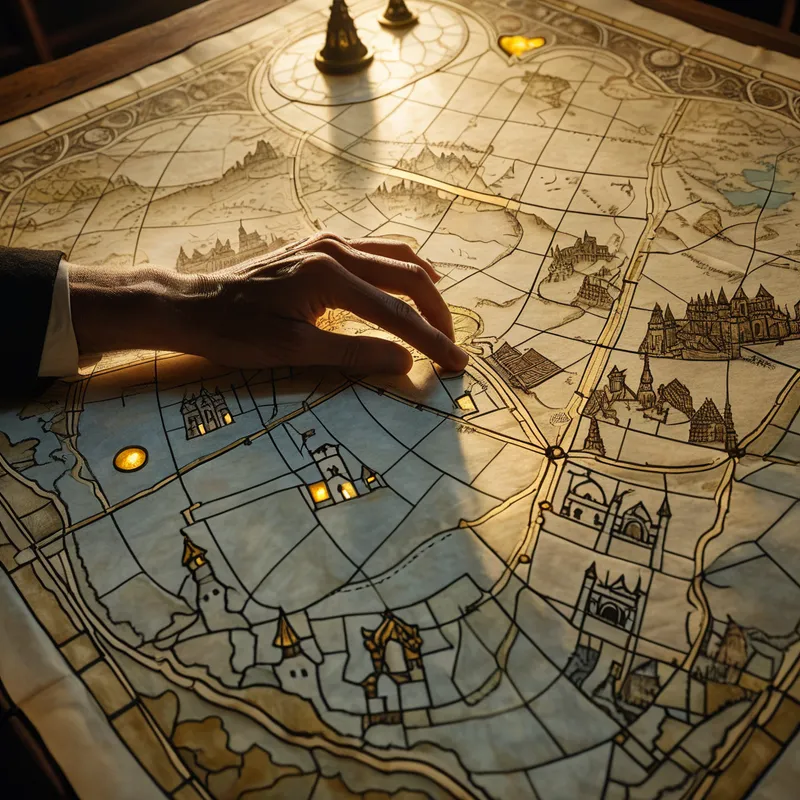
The Hereford Mappa Mundi is not a singular myth from one culture, but a grand synthesis—a syncretic scripture of the medieval European mind. Created around 1300 in England, it is a physical artifact born from the “Various” culture of Christendom, which itself was a palimpsest over Roman geography, Biblical lore, Classical bestiaries, and travelers’ tales.
It was likely made by and for a community of canons at Hereford Cathedral, serving a profound societal function. This was not a tool for navigation, but for salvation. It was a didactic instrument, a sermon in vellum and ink. In an age where few could read words, all could read this image. It was the world-picture that held society together, explaining not where things were, but what they meant. It placed human history—from Creation to Last Judgment, depicted around the map’s border—within a spatial framework. The map was passed down not through oral recitation, but through solemn display and contemplative viewing, a focal point for understanding humanity’s divine drama played out upon the stage of [the Earth](/myths/the-earth “Myth from Hindu culture.”/).
Symbolic Architecture
Psychologically, the Mappa Mundi is a monumental externalization of the [psyche](/myths/psyche “Myth from Greek culture.”/)’s own [structure](/symbols/structure “Symbol: Structure in dreams often symbolizes stability, organization, and the framework of one’s life, reflecting how one perceives their environment and personal life.”/). It is a [mandala](/symbols/mandala “Symbol: A sacred geometric circle representing wholeness, the cosmos, and the journey toward spiritual integration.”/) of the pre-modern [soul](/symbols/soul “Symbol: The soul represents the essence of a person, encompassing their spirit, identity, and connection to the universe.”/).
The encompassing circle represents the Self, the ultimate [boundary](/symbols/boundary “Symbol: A conceptual or physical limit defining separation, protection, or identity between entities, spaces, or states of being.”/) of individual and collective existence. The three continents symbolize the known territories of the conscious ego—the familiar, the ordered, the domesticated. But the true symbolic power lies in the periphery and the center.
The monsters at the edges are the contents of the personal and collective unconscious—the repressed, the feared, the exoticized aspects of ourselves that we project into the unknown. The Griffin is not in Africa; it is in the shadow.
Jerusalem at the center is the [archetypal image](/symbols/archetypal-image “Symbol: A universal, primordial symbol from the collective unconscious that transcends individual experience and carries profound spiritual or mythic meaning.”/) of the individuation goal. It is not a geographical [location](/symbols/location “Symbol: The symbol of ‘Location’ signifies a sense of place, context, and the environment in which experiences unfold.”/), but the symbolic core of meaning, the integrated [personality](/symbols/personality “Symbol: Personality in dreams often symbolizes the traits and characteristics of the dreamer, reflecting how they perceive themselves and how they believe they are perceived by others.”/). The empty tomb at its [heart](/symbols/heart “Symbol: The heart symbolizes love, emotion, and the core of one’s existence, representing deep connections with others and self.”/) is crucial—it represents a [paradox](/symbols/paradox “Symbol: A contradictory yet true concept that challenges logic and perception, often representing unresolved tensions or profound truths.”/). The center is not a place of [fullness](/symbols/fullness “Symbol: A state of complete satisfaction, abundance, or completion, often representing emotional, spiritual, or physical fulfillment.”/), but of sacred [absence](/symbols/absence “Symbol: The state of something missing, void, or not present. Often signifies loss, potential, or existential questioning.”/), a void that gives meaning to the whole. It is the point where the divine intersects the [human](/symbols/human “Symbol: The symbol of a human represents individuality, complexity of emotions, and social relationships.”/), where [the ego](/myths/the-ego “Myth from Jungian culture.”/)’s [journey](/symbols/journey “Symbol: A journey in dreams typically signifies adventure, growth, or a significant life transition.”/) aims for a reconciliation with something transcendent and ultimately unknowable in its fullness.
The Dreamer’s Resonance
When this myth stirs in modern dreams, it rarely appears as a literal map. Instead, one dreams of being in a vast, labyrinthine library where the books are landscapes. Or of standing on a shore, looking at a chart that shows familiar hometown streets leading directly into dragon-infested mountains. The somatic feeling is often one of profound disorientation followed by a deep, calming orientation.
To dream this is to undergo a process of psychic re-mapping. The ego, having expanded into a modern world that often feels centerless and flat—a network, not a hierarchy—is crying out for a cosmology. The dream is the psyche’s attempt to re-establish a meaningful topography. The rising anxiety as one confronts the “monsters” (now dream figures of uncanny coworkers, forgotten childhood fears, or societal chaos) is the friction of encountering [the shadow](/myths/the-shadow “Myth from Jungian culture.”/). The profound relief upon “seeing the center”—perhaps a glowing object, a known face, or simply a feeling of “Yes, here”—is the momentary alignment of the conscious mind with [the Self](/myths/the-self “Myth from Jungian culture.”/)’s innate ordering principle. The dream is a corrective: you are not lost in data; you are on a pilgrimage in a soul that has a structure.
Alchemical Translation
The alchemical process mirrored here is the [nigredo](/myths/nigredo “Myth from Alchemical culture.”/) giving way to the albedo, through [the crucible](/myths/the-crucible “Myth from Alchemical culture.”/) of the journey. The modern individual’s “individuation” is not a linear progress, but a circumambulation of the Self.
One begins in the massa confusa—the confused mass of the modern world and the unexamined life. This is the great, uncharted ocean of the map.
The first transmutation is the act of defining a boundary (the circle). This is the commitment to self-knowledge, which creates a sacred vessel within which the work can occur. Next comes the terrifying yet necessary exploration of the periphery—the intentional engagement with one’s shadow, the monsters of addiction, trauma, arrogance, or weakness. This is [the pilgrim](/myths/the-pilgrim “Myth from Christian culture.”/)’s path through the lands of the Blemmyae.
The final, ongoing transmutation is the re-centering. It is not about becoming perfect or divine (occupying Jerusalem), but about constantly re-orienting one’s life and choices toward that symbolic center of meaning and integrity. The empty tomb is key: the goal is not a filled ego, but an ego transparent to, and organized around, a transcendent value. The map teaches that wholeness is not the absence of monsters, but the creation of a world-picture vast and honest enough to include them, all ordered around a central, sacred truth. The individual becomes the cartographer of their own soul, drawing coastlines through the seas of chaos, always navigating by the fixed, inner star of Jerusalem.
Associated Symbols
Explore related symbols from the CaleaDream lexicon: