The Hen of the World in Slavic Myth Meaning & Symbolism
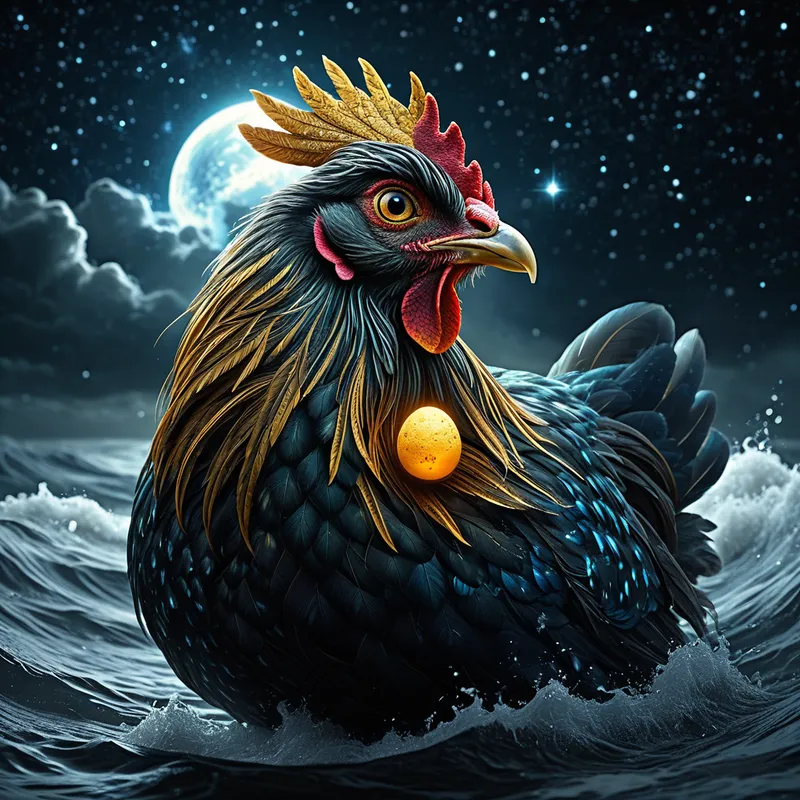
A cosmic hen broods on primordial waters, laying the golden egg from which the world is hatched, symbolizing creation from chaos and the nurturing of existence.
The Tale of The Hen of the World in Slavic
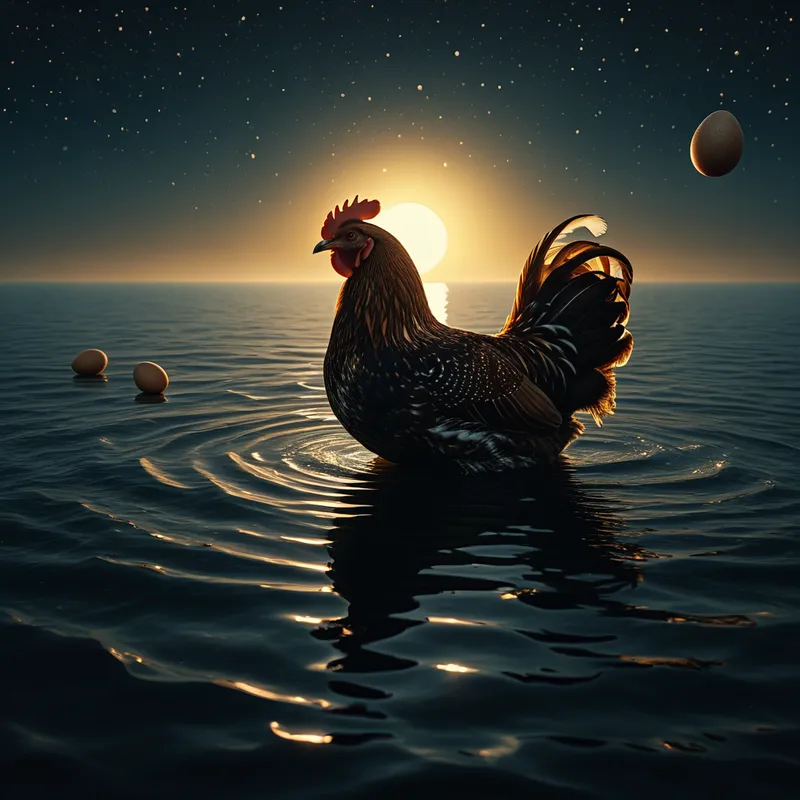
Before the sun knew its path, before the stars had names, there was only the endless, dark water. It was not a sea, for there were no shores to contain it; it was not a river, for it had no course. It was the Chaos-Water, deep and cold and silent, stretching into forever.
And upon this water, in the great stillness before the first thought, there came a presence. Not with a crash or a cry, but with the soft, inevitable settling of weight upon a yielding surface. It was the Hen of the World. Her form was vast, her feathers the color of a gathering storm at twilight, and in her eyes swam the slow, patient light of unborn suns. She found a place—though all places were the same—and she settled. She brooded.
The chill of the abyss seeped upward, but beneath her, the water grew still. The random churning ceased. A circle of perfect calm spread out from where her breast met the darkness. For an age that cannot be measured, she sat in perfect, attentive silence. Her warmth was the first warmth. Her will was the first order.
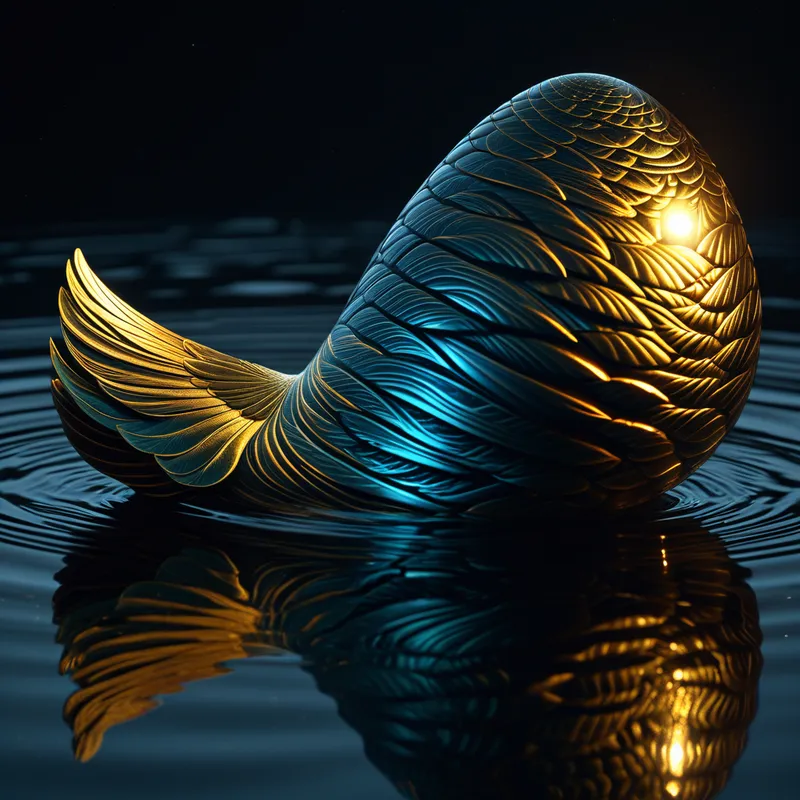
Then, from the very center of that calm, from the meeting of her vital heat and the receptive dark, a pressure began to build. It was not a struggle, but a fulfillment. And there, upon the waters, she laid an egg. Not a simple thing, but a Golden Egg. It glowed with a soft, internal fire, casting the first true light—a warm, yolk-yellow radiance that pushed back the featureless dark. The egg rested on the water, cradled by the hen’s own body, a perfect, self-contained universe of potential.
The hen shifted, her vast wings curving with infinite care to encircle her creation. She poured her essence into it, not as a force, but as a constant, nurturing attention. Within the golden shell, the possibilities stirred. Land dreamed of being solid. Sky yearned to be vast. Life whispered in its sleep.
And when the time was full—a time known only to her—the shell, no longer a boundary but a womb, began to give way. From the egg hatched not a chick, but the World itself. The firmament rose as the shell’s upper half; the earthly realm settled as the lower. The waters were organized into seas and rivers. The light within became the sun, and fragments of the glowing shell scattered to become the stars. The Hen of the World watched it all unfold, her task of primary creation complete. She did not vanish, but receded into the fabric of what was now a cosmos, her nurturing presence becoming the very principle of growth and sustenance that would forever underpin the living world.
Cultural Origins & Context
This profound creation narrative belongs to the rich, oral tapestry of Slavic folklore, particularly within Eastern Slavic traditions. It was not a myth confined to temple priests but a story told by grandmothers at the hearth, by village storytellers during the long winter nights, and embedded in the ritual songs and embroidery patterns of the people. Its transmission was intimate, woven into the domestic and agricultural cycles it ultimately explained.
The myth functioned as a foundational cosmology, answering the primal human questions of origin without recourse to violent theomachy or patriarchal sky-fathers. Instead, it presented a deeply organic, feminine, and nurturing model of genesis. The societal function was one of grounding and reassurance. It positioned humanity within a cosmos born not from conflict, but from patient brooding; not from a commanding word, but from a generative act. This mirrored the central, sustaining role of women in the household and the cyclical, nurturing processes of nature they were intimately tied to—the planting of seeds, the raising of children, the tending of the hearth. The world, in this view, was fundamentally cared for into existence.
Symbolic Architecture
The symbolic power of this myth lies in its elegant, non-linear architecture. It bypasses the heroic struggle and presents creation as an act of profound, embodied incubation.
The Primordial Waters represent the unconscious, the undifferentiated state of pure potential and psychic chaos before the ego—the “I”—crystallizes. The Hen of the World is the archetypal principle of the nurturing Great Mother, but with a specific, focused function: she is the container. She does not battle the chaos; she settles upon it, providing the first boundary, the first “vessel” that makes organization possible. Her warmth is the first spark of conscious attention applied to the inner void.
The first act of creation is not to speak, but to listen; not to command, but to brood. It is the deep, somatic attention that calls form forth from the formless.
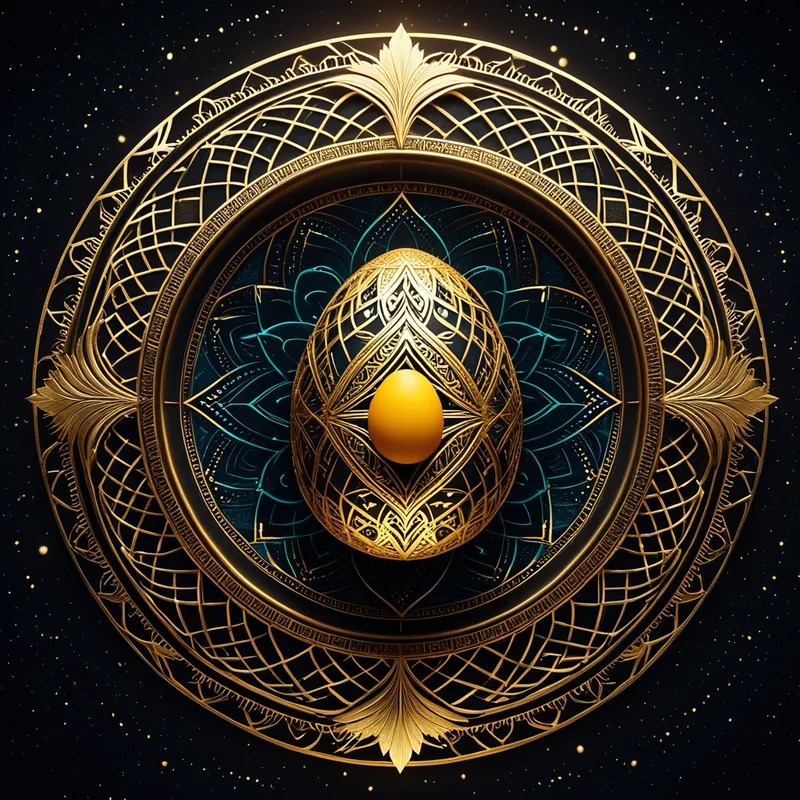
The Golden Egg is the ultimate symbol of latent totality—the Self in its pre-manifest state. It contains all opposites (heaven and earth, light and dark) in harmonious unity. The hatching is not an explosion, but an unfolding, a natural maturation of this inner wholeness into the structured reality of the psyche (the world). The myth teaches that our conscious world—our identity, our values, our life—emerges from a period of necessary incubation, protected and warmed by our own deepest, often unconscious, nurturing capacities.
The Dreamer’s Resonance
When this myth stirs in the modern unconscious, it often manifests in dreams of profound incubation and quiet genesis. One might dream of finding a strangely large or luminous egg in a dark place—a basement, a cave, a closet. The dreamer feels a protective, almost maternal urge toward it, a knowing that they must not force it open, but must keep it safe and warm.
Somatically, this can correlate with feelings of deep, centered calm amidst life chaos, or a sense of “sitting with” a problem or creative idea without actively trying to solve it. Psychologically, it signals a process of inner gestation. The ego is not in charge; it is in service to a slower, deeper process of integration happening in the dark waters of the psyche. The dream is an assurance: you are in a phase of brooding. The chaos you feel is the primordial water. Your task is not to fight it, but to be the hen—to provide a steady, warm, containing presence for the new wholeness forming within you. Anxiety arises when we mistake this sacred incubation for stagnation.
Alchemical Translation
In the alchemical journey of individuation—the process of becoming psychologically whole—the myth of the Hen of the World models the crucial, often overlooked stage of the nigredo, not as a torturous descent, but as a purposeful incubation. Our culture glorifies the heroic fight and the blinding flash of insight (the hatching), but undervalues the dark, moist, quiet work that must precede it.
The modern individual is often adrift on their own “primordial waters” of anxiety, depression, or creative block. The alchemical instruction here is to cease thrashing. The first step toward psychic transmutation is to settle. To consciously become the vessel. This means creating containers in one’s life—through ritual, therapy, journaling, or simple, disciplined quietude—that can hold the chaos without being overwhelmed by it.
The gold is not forged in fire alone, but in the long, patient heat of the alchemist’s vessel. So too is the Self not born in struggle, but in the sustained, nurturing warmth of conscious attention.
From this settled, brooding stance, the “golden egg” of a new synthesis can form. This might be a reconciling of a lifelong inner conflict, the gestation of a true vocation, or the slow crystallization of a more authentic personality. The myth assures us that this process has its own innate timing, governed by a wisdom deeper than the ego’s impatience. Our task is to trust the brooding, to protect the process, and to know that the world which will eventually hatch from this inner egg will be more solid, more radiant, and more truly our own than any we could have willed into being through force alone. We move from being victims of chaos to being the nurturing creators of our own cosmos.
Associated Symbols
Explore related symbols from the CaleaDream lexicon: