The Healing Stones of Ishtar Myth Meaning & Symbolism
The goddess Ishtar descends into the underworld to retrieve the Healing Stones, facing her shadow to restore life and wholeness to the world above.
The Tale of The Healing Stones of Ishtar
Hear now the tale whispered by the date palms along the Euphrates, carried on the dust-laden wind from the ziggurats of Babylon. The world above was in the grip of a silent malaise. The laughter of children had grown thin, the vigor of warriors had waned, and the songs of lovers had lost their fire. A sickness of the spirit had seeped into the marrow of creation, a dullness that no herb or incantation could cure. It was a forgetting of the raw, pulsing heart of life itself.
In her celestial chamber, Ishtar, Lady of Heaven, she who stirs passion and commands the storm, felt this withering in her own divine essence. She consulted the tablets of fate and the whispers of the stars. The answer was a cold knot in her being. The cure, the Healing Stones, lay not in the sun’s realm or the deep vaults of the sky, but in the silent, dread kingdom from which no light returns: the Kur, the realm of her dark sister, Ereshkigal.
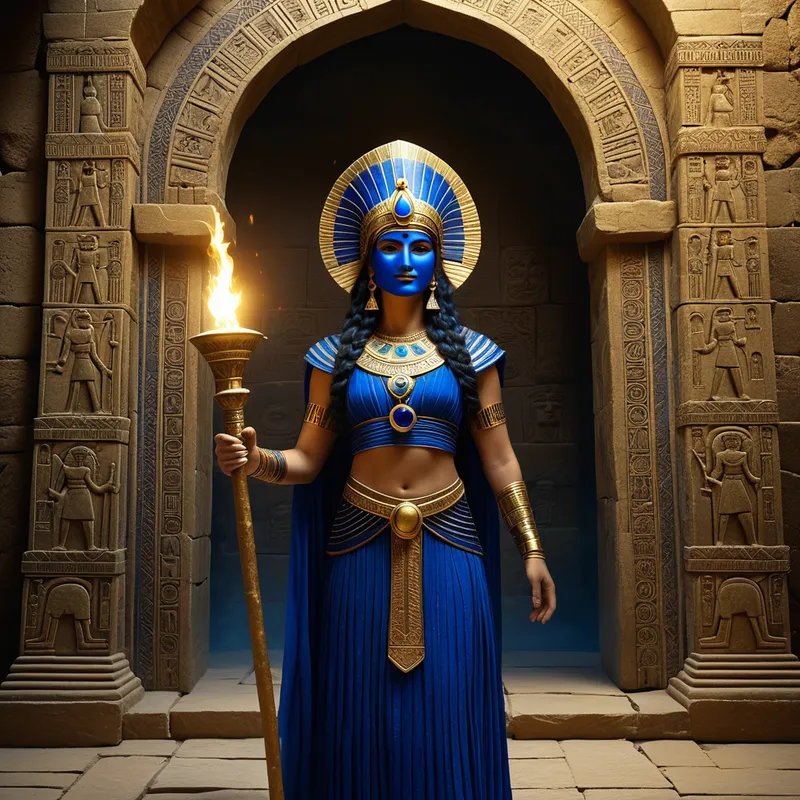
With a resolve that shook the foundations of her palace, Ishtar prepared. She adorned herself with the emblems of her power: the crown of the steppes, lapis lazuli necklaces, sparkling rings, and a robe woven from the light of dawn. These were not mere ornaments; they were the very sigils of her identity. At the distant edge of the world, she found the entrance—a gaping maw in the barren earth, exhaling a breath of tomb-chill. Before the gate of black basalt stood Namtar, the silent herald of death.
“Open the gate, gatekeeper,” Ishtar commanded, her voice echoing with a authority that felt hollow in that place. “Enter, Lady of Heaven,” Namtar intoned, “but know the law of Ereshkigal. You must pass through the seven gates of the Kur. And at each, you must pay the toll.”
The first gate groaned open. “Your crown,” said the guardian. Ishtar, her jaw set, removed the crown of the steppes. The light around her dimmed. At the second gate, she surrendered her lapis necklaces; at the third, her sparkling rings; at the fourth, the breastplate of her station; at the fifth, her girdle of birthstones; at the sixth, the bracelets from her wrists and ankles. With each relinquishment, a layer of her celestial self was stripped away. The vibrant goddess grew pale, her step heavy.
At the seventh and final gate, she stood shivering, clad only in the memory of her glory. “Your robe,” the guardian demanded. Ishtar, now utterly vulnerable, removed the robe woven from dawn’s light. Naked and powerless, she was ushered into the throne room of Ereshkigal.
It was not a hall, but an expanse of living rock and stagnant air. Upon a throne of fused bones sat Ereshkigal, Ishtar’s own shadow given form. Grief, rage, jealousy, and the absolute solitude of sovereignty radiated from her. Without a word, Ereshkigal fixed her gaze upon her sister. The gallu spirits of the pit swarmed Ishtar, and the goddess of life was struck down, her body hung upon a hook like a side of meat, her essence draining into the dust.
Above, all life ceased. Mating, growth, song—all fell into a stupor. The gods themselves grew fearful. Only through cunning intervention was a lifeless trickle of water and the spirit of a eunuch sent to revive Ishtar. Sprinkled with the water of life, she stirred.
But Ereshkigal’s judgment was not complete. “You have seen the face of your other half,” the Queen of the Kur hissed. “You have paid the price. But to leave, you must provide a substitute for yourself, and you must take only what you came for, nothing more.”
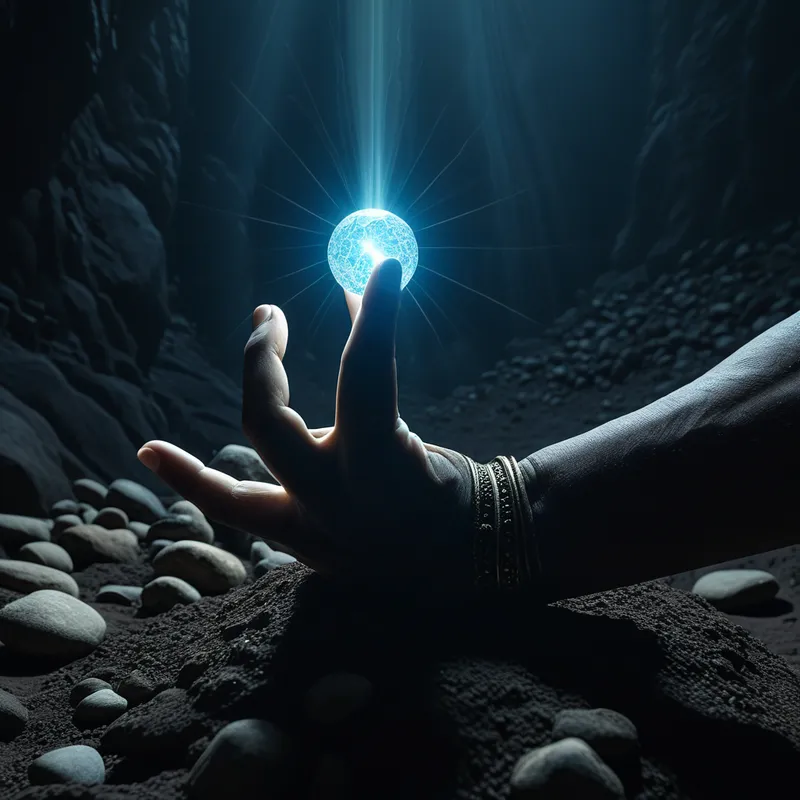
A shadow of her former self, Ishtar moved through the caverns. There, in a chamber where the roots of the world-tree drank from the waters of Apsu, she saw them. The Healing Stones. They were not dazzling gems, but rough, dark nodules that pulsed with a slow, inner light, like a heartbeat seen through skin. She took three. No more.
Ascending back through the seven gates, each of her adornments was returned to her. But they felt different now. The crown was heavier, the lapis colder, the robe a mere garment. She emerged into the blinding sun, clutching the Stones. Where she walked, color returned to the fields, warmth to the hearth, and passion to the heart. The world was healed not by a triumphant goddess, but by one who had been broken and remade in the dark clay of her own depths.
Cultural Origins & Context
This narrative is a scholar’s reconstruction, drawing from the profound corpus of Mesopotamian literature, most notably the epic Gilgamesh and the standalone myth Inanna’s Descent (Ishtar being the Akkadian/Babylonian name for the earlier Sumerian Inanna). It was not a children’s fable but a sacred text, recited by priestly scribes (dub-sar) during rituals tied to the agricultural cycle, the king’s legitimacy, and rites of passage. The story functioned as a metaphysical map. In a culture that saw the universe as a precarious balance between cosmic order (me) and chaos, Ishtar’s journey explained the necessary death of winter and the rebirth of spring, not as a simple rotation, but as a costly divine sacrifice. It modeled the terrifying but essential journey of the sovereign—both king and goddess—into the realm of failure, loss, and the unknown, to retrieve the power needed to rule and renew the community.
Symbolic Architecture
The myth’s power lies in its stark architecture of symbolic opposites, which are not enemies but necessary complements.
The Descent: This is not a fall but a deliberate, courageous movement toward the source of one’s own negation. The upper world represents the conscious ego, identity, and social persona (Ishtar in her full regalia). The Kur is the unconscious, the repository of all that is repressed, feared, and unlived—the personal and collective shadow.
The Seven Gates & The Stripping: The systematic removal of Ishtar’s attributes is the most psychologically precise element.
To meet the Self, one must first be stripped of the persona. Every title, every achievement, every defense must be surrendered at the gate of the deep.
Each gate represents a layer of egoic identification—status, beauty, power, sexuality, protection. To stand naked before Ereshkigal is to stand before the totality of one’s being, including the wounded, vengeful, and isolated parts we disown. Ereshkigal is Ishtar’s unintegrated power: the fury in love, the destructive aspect of creativity, the absolute autonomy that refuses connection.
The Healing Stones: They are found not in light, but in the deepest dark, fed by the primordial waters. They symbolize the core, indestructible value that can only be accessed after the persona’s deconstruction. They are not “positive” treasures, but the raw, unpolished essence of life-force itself—the psychic resource born from confronting and integrating the shadow.
The Dreamer’s Resonance
When this myth stirs in the modern psyche, it manifests in dreams of profound transition. You may dream of:
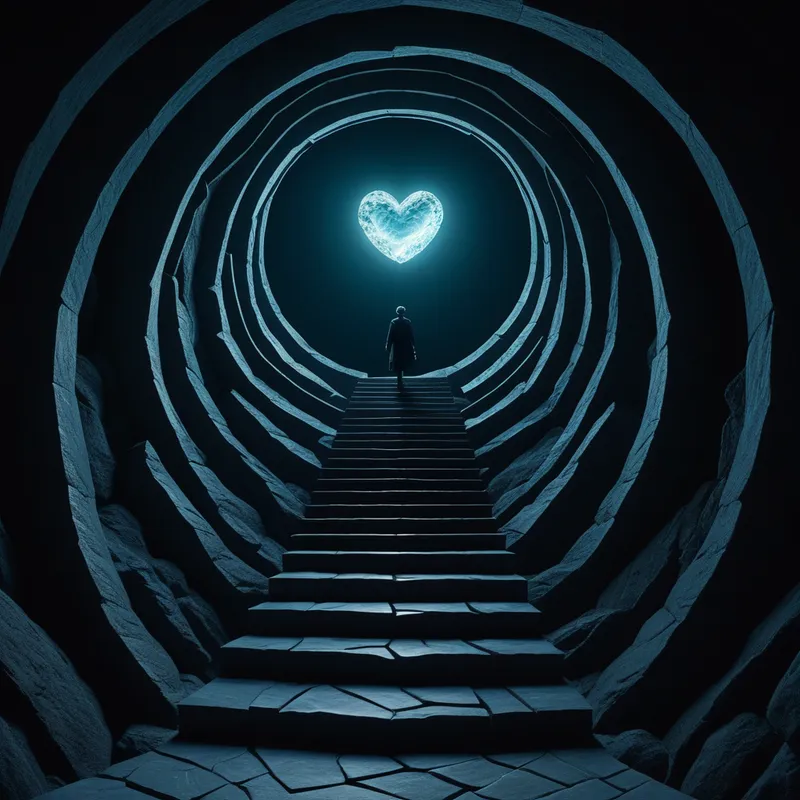
- Descending: Endless staircases, elevators going down, caves, basements, or subway tunnels leading into the earth.
- Being Stripped: Losing clothes, jewelry, a uniform, or a job title in public; your teeth falling out; feeling exposed and vulnerable.
- Meeting a Dark Double: Confronting a hostile, powerful, or grieving figure who feels eerily familiar—your own Ereshkigal.
- Finding a Core Object: Discovering a rough stone, a dense root, a simple clay pot, or a still-beating heart in a dark place.
Somatically, this process often coincides with feelings of depression, ennui, or a “dark night of the soul.” It is the psyche’s necessary withdrawal of energy from the outer world to undertake the inner excavation. The dream is not a warning, but a map. It confirms you are in the Kur, undergoing the stripping. The malaise is the “sickness above” that demands the descent.
Alchemical Translation
The myth of the Healing Stones is a perfect allegory for the Jungian process of individuation—becoming whole by integrating the unconscious.
The Nigredo (The Blackening): Ishtar’s descent and death on the hook is the nigredo, the dissolution of the old, inflated identity. In life, this is experienced as failure, loss, depression, or a crisis of meaning where everything you thought you were proves inadequate.
The Separatio (The Stripping): The seven gates enact the separatio, the careful differentiation of what is truly you from what you merely wear (the persona). This is the painful but liberating work of therapy or deep introspection: “Is this my crown, or one I was given?”
The Coniunctio (The Sacred Marriage): The confrontation between Ishtar and Ereshkigal is not a battle, but a fateful recognition. It is the coniunctio oppositorum (union of opposites) at its most dramatic.
Wholeness is not achieved by the light vanquishing the dark, but by the goddess recognizing the queen as her own most vital and terrifying truth.
The Albedo & Rubedo (The Whitening & Reddening): The retrieval of the Stones and the ascent is the albedo (purification) and rubedo (fulfillment). The revived Ishtar is not her old self; she is tempered, wiser, and paradoxically more powerful because she carries the dark wisdom of the underworld within her. The Healing Stones she brings back are the transformed psychic energy—now grounded, resilient, and authentic—that she can use to genuinely nourish her world (her relationships, creativity, and life’s work).
For the modern individual, the myth instructs: when life loses its color and vigor, the cure is not a frantic search for new adornments (new jobs, new partners, new accolades). The cure demands a courageous descent into what has been neglected, feared, or rejected within oneself. The true healing power is always found in the very place we least wish to look.
Associated Symbols
Explore related symbols from the CaleaDream lexicon: