The Hawthorn Blossom Myth Meaning & Symbolism
A tale of a mortal who plucks a sacred hawthorn blossom, invoking the wrath of the Aos Sí and setting in motion a journey of sacrifice and transformation.
The Tale of The Hawthorn Blossom
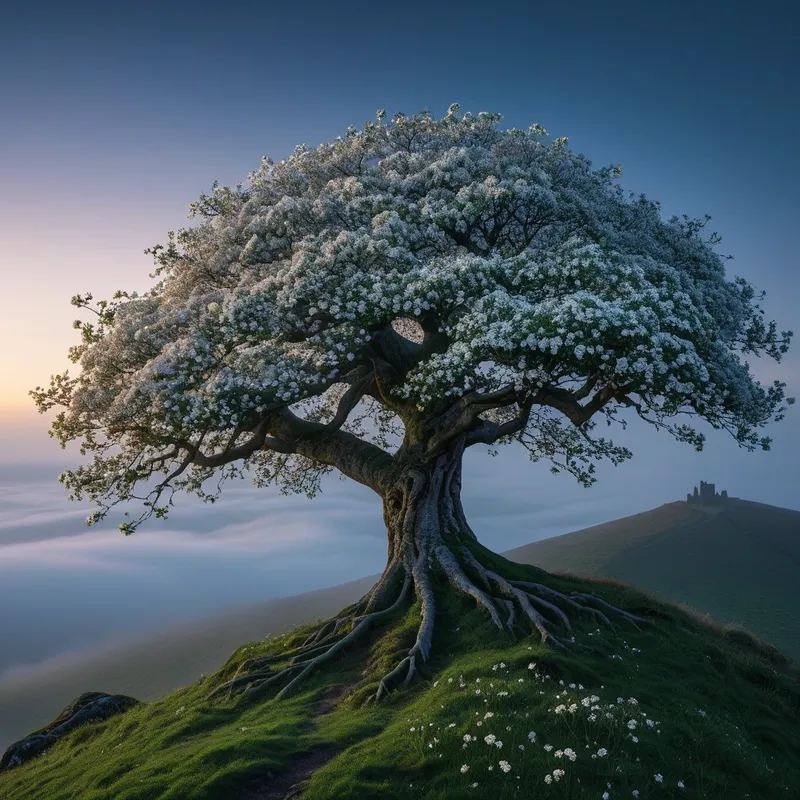
Listen, and let the fire’s shadow tell it. In a time when [the veil](/myths/the-veil “Myth from Various culture.”/) was thin as a moth’s wing, there lived a youth named Aedan. He was of [the earth](/myths/the-earth “Myth from Hindu culture.”/), his hands knowing the soil and the seasons, but his heart was restless, caught between the solid world of his people and the whispering song that came from the lone [hawthorn](/myths/hawthorn “Myth from Celtic culture.”/) on the [sidhe](/myths/sidhe “Myth from Celtic culture.”/) mound.
This was no ordinary tree. It was the White Queen of the Mound, guardian of [the threshold](/myths/the-threshold “Myth from Folklore culture.”/), whose roots drank from the wells of the Annwn. For eleven moons and eleven days, it wore only its armor of thorns. But on the night when the Beltane fires were but embers and [the moon](/myths/the-moon “Myth from Tarot culture.”/) hung like a silver sickle, it would bloom. A single, perfect cluster of white flowers would appear, holding the condensed light of the summer stars and the breath of the Aos Sí. To touch it was forbidden. To take it was to declare a war of longing against the very order of the worlds.
Aedan’s love, Aisling, lay fevered and fading. The healers had no cure. In his desperation, a whisper came on [the wind](/myths/the-wind “Myth from Various culture.”/): Only the light held within the Thorn-Queen’s heart can mend a mortal wound. On that fateful night, driven by a love that blinded him to law, he climbed the sacred mound. The air hummed with unseen presence. The single blossom glowed with a soft, cold fire. He could feel the gaze of the guardians, the shifting forms in the periphery of sight. With a trembling hand, he closed his fingers around the stem. A shock, cold and electric, raced up his arm. The blossom came away silently.
[The world](/myths/the-world “Myth from Tarot culture.”/) stilled. Then, a sound like a thousand bees, rising into a keen of profound loss. The mound itself seemed to shudder. From the tree and the earth around it, the Aos Sí manifested—not as tiny sprites, but as tall, luminous, and terrible figures of ancient power. Their king, his eyes like chips of winter sky, stood before Aedan. No words were spoken, yet the judgment rang in Aedan’s soul: You have stolen the promise of summer. You have broken the boundary. For life taken, life is owed.
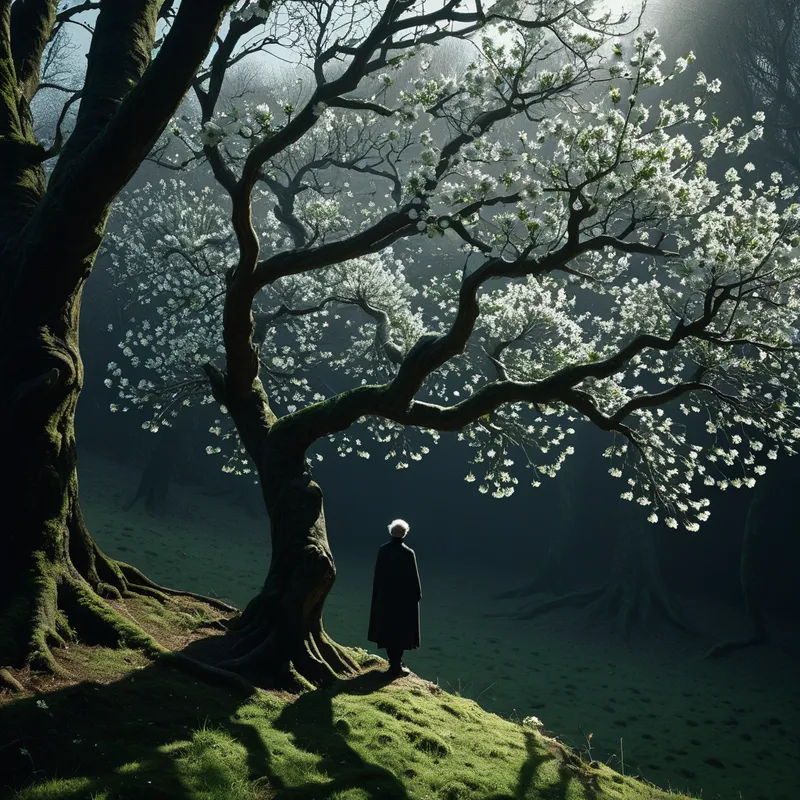
Aisling awoke, whole and healed, the blossom’s scent upon her pillow. But Aedan was gone. In his place, rooted where he stood on the mound, was a young hawthorn sapling, its branches bare. The myth says that for the span of a human life, Aedan stood as the new guardian of the threshold, his consciousness woven into the tree, feeling the turn of every season, the passage of every soul to and from [the Otherworld](/myths/the-otherworld “Myth from Celtic culture.”/). Only when Aisling, at the end of her long life, came to lay her hand upon his bark did the sapling finally bloom, releasing his spirit not into death, but into a different kind of existence within the tapestry of the land itself.
Cultural Origins & Context
This story belongs not to a single text, but to the oral tapestry of the Gaelic world, particularly Ireland and Scotland. It is a seanchas, a narrative belonging to the folk tradition, told by firesides and at crossroads. The hawthorn, or sceach gheal, was deeply sacred in Celtic practice. Lone thorns, especially on hills or near wells, were considered direct portals to the Aos Sí and were never to be cut or disturbed.
The myth functioned as more than a cautionary tale. It was a societal compass, encoding profound laws of ecology and cosmology. It taught respect for the liminal spaces—the boundaries between village and wild, human and other-than-human. It reinforced the concept of geasa (taboos or sacred prohibitions) and the dire consequences of breaking them, not out of petty vengeance, but to restore a cosmic balance. The storyteller, often a respected elder or a seanchaí, was not merely entertaining; they were reinforcing the psychic geography of the people, mapping the sacred onto the landscape.
Symbolic Architecture
At its [heart](/symbols/heart “Symbol: The heart symbolizes love, emotion, and the core of one’s existence, representing deep connections with others and self.”/), the myth is an exploration of the ultimate [boundary](/symbols/boundary “Symbol: A conceptual or physical limit defining separation, protection, or identity between entities, spaces, or states of being.”/) and the cost of crossing it. The hawthorn [blossom](/symbols/blossom “Symbol: A symbol of new beginnings, growth, and the unfolding of potential, often marking a transition or the start of a journey.”/) is not just a flower; it is a hierophany—a manifestation of the sacred in the [material](/symbols/material “Symbol: Material signifies the tangible aspects of life, often representing physical resources, desires, and the physical world’s influence on our existence.”/) world. It represents pure potential, the unmanifest promise of [life](/symbols/life “Symbol: The symbol of ‘Life’ represents a journey of growth, interconnectedness, and existential meaning, encompassing both the joys and challenges that define human experience.”/) and sovereignty.
The blossom is the soul’s desire made visible, but plucking it prematurely is the inflation of the ego, believing it can possess the sacred rather than participate in it.
Aedan represents the [human](/symbols/human “Symbol: The symbol of a human represents individuality, complexity of emotions, and social relationships.”/) [psyche](/myths/psyche “Myth from Greek culture.”/) in its heroic, yet tragically flawed, [aspect](/symbols/aspect “Symbol: A distinct feature, quality, or perspective of something, often representing a partial view of a larger whole.”/). His love is genuine, but his [action](/symbols/action “Symbol: Action in dreams represents the drive for agency, motivation, and the ability to take control of situations in waking life.”/) is one of hubris—the mortal overreach. He attempts to solve a mortal [problem](/symbols/problem “Symbol: Dreams featuring a ‘problem’ often symbolize internal conflicts or challenging situations that require resolution and self-reflection.”/) (sickness, decay) with an immortal [solution](/symbols/solution “Symbol: A solution symbolizes resolution, clarity, and the overcoming of obstacles, often representing a sense of accomplishment.”/), violating the natural order. His transformation into the [tree](/symbols/tree “Symbol: In dreams, the tree often symbolizes growth, stability, and the interconnectedness of life.”/) is not merely a [punishment](/symbols/punishment “Symbol: A dream symbol representing consequences for actions, often tied to guilt, societal rules, or internal moral conflicts.”/); it is a symbolic [resolution](/symbols/resolution “Symbol: In arts and music, resolution refers to the movement from dissonance to consonance, creating a sense of completion, release, or finality in a composition.”/). He becomes the boundary he violated. His individuation is arrested, his personal [identity](/symbols/identity “Symbol: Identity represents the sense of self, encompassing personal beliefs, cultural background, and social roles.”/) sacrificed to become part of the collective, archetypal [pattern](/symbols/pattern “Symbol: A ‘Pattern’ in dreams often signifies the underlying structure of experiences and thoughts, representing both order and the repetitiveness of life’s situations.”/)—the [Guardian](/symbols/guardian “Symbol: A protector figure representing safety, authority, and guidance, often embodying parental, societal, or spiritual oversight.”/) of the Threshold.
The Dreamer’s Resonance
When this myth pattern stirs in the modern dreamer, it often surfaces during a life crisis involving a profound dilemma between heartfelt desire and a deep, often unconscious, taboo or law. Dreaming of a forbidden, glowing blossom or fruit represents a potent psychic content—a talent, a relationship, a spiritual insight—that feels tantalizingly within reach but is surrounded by an aura of danger or prohibition.
The somatic experience can be one of simultaneous attraction and dread, a tightening in the chest or a chill. This is the psyche’s warning system activating. To dream of plucking the blossom and facing the ensuing wrath signifies [the ego](/myths/the-ego “Myth from Jungian culture.”/)’s conscious decision to pursue this content, fully aware it will disrupt the existing psychic order. The resulting transformation in the dream—becoming tree-like, rooted, silenced—mirrors the initial stage of integrating this powerful content: a necessary period of stasis, where the personal will is subsumed by a larger process. The dreamer is not being punished; they are being re-structured.
Alchemical Translation
The myth models the alchemical process of mortificatio and subsequent [solutio](/myths/solutio “Myth from Alchemical culture.”/)—the dissolution of the old form to allow for a new birth. Aedan’s conscious, heroic ego (the would-be savior) must die for a deeper, more rooted consciousness to emerge.
The triumph is not in saving the beloved with stolen grace, but in becoming the vessel through which grace is eternally mediated.
For the modern individual, the “hawthorn blossom” is any numinous goal we believe will complete us—the perfect job, the idealized partner, the ultimate spiritual attainment. The myth warns that seizing it directly, for our own ends, leads to a kind of psychic petrification. We become trapped in the role, the identity, the “tree.” The alchemical work is to undergo the transformation willingly: to take the desire (Aedan’s love) and, instead of projecting it onto an external forbidden object, allow it to lead us to the sacred boundary within. We must become the threshold itself.
The final blooming at Aisling’s touch signifies that the integration is complete only in relationship, in the full cycle of a life lived. The released spirit is no longer the personal Aedan, but an aspect of [the Self](/myths/the-self “Myth from Jungian culture.”/)—the psychic function that can now navigate between conscious and unconscious, personal and transpersonal, without violation. The blossom is no longer something to be stolen, but a quality that flowers from the fully rooted and sanctioned existence. The myth thus guides us from the inflation of the hero to the humble, enduring wisdom of the guardian.
Associated Symbols
Explore related symbols from the CaleaDream lexicon: